

Burgundy is one of the rare regions in France where both trains and cars make sense, depending on how far you stray from the main vine-covered valleys. High-speed links deliver you from Paris into Dijon or Montbard in about an hour to ninety minutes, yet some of the region’s most soulful experiences sit on small country roads around Morvan’s lakes, Romanesque churches and hidden domaines. This guide looks beyond simplistic advice to rent a car, and instead compares in detail when trains work beautifully, when a car becomes genuinely useful, and how to combine both without mixing wine tasting and driving.
Understanding Burgundy’s Rail Backbone
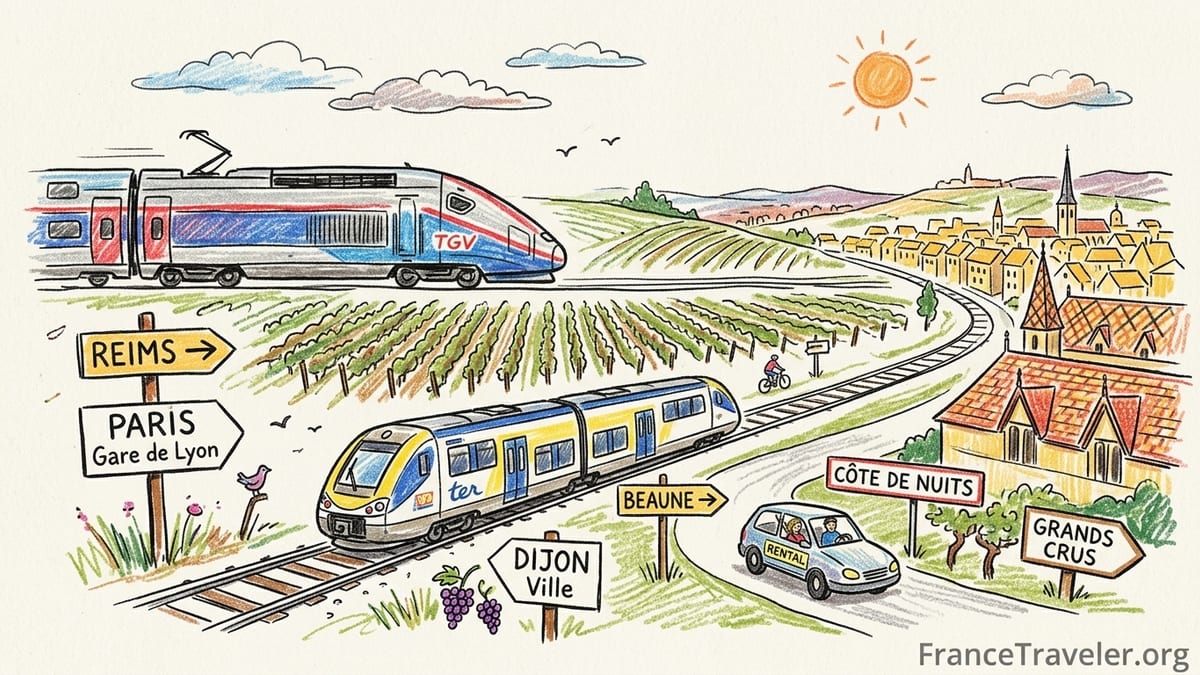
If your image of Burgundy is limited to Dijon mustard and Beaune’s tiled roofs, you might be surprised by how well connected these towns are by rail. Fast TGV services from Paris Gare de Lyon to Dijon Ville usually take about 1 hour 30 minutes on the quickest runs, with several departures daily when engineering works are not affecting schedules. Regional and high-speed trains from Paris to Montbard, the small gateway town for northern Burgundy, can take as little as about 1 hour on the fastest services, making it entirely realistic to leave Paris after breakfast and be walking between vineyards before lunch.
Dijon is one of eastern France’s major railway hubs, with frequent regional trains running south to Beaune and Chalon-sur-Saône, west via Montbard toward Paris Bercy, and east toward Dole and Franche-Comté. For a visitor, this means you can comfortably base in Dijon and day-trip by train to several wine-related towns without touching a car. Beaune, for example, is around 20 to 25 minutes away by TER regional train, with multiple departures spread across the day. You step off at Beaune’s modest station and walk roughly ten minutes to the medieval center and the Hospices de Beaune.
These services are integrated into the national booking platforms, so tickets can be bought in advance or on the day. Advance-purchase fares on Paris to Dijon or Paris to Montbard often start at relatively low promotional levels compared with last-minute business fares, which makes rail quite competitive against the total cost of a rental car, tolls and fuel for a short wine break. For travelers nervous about driving in France, choosing the train also means avoiding the busy beltways around Paris and the autoroute network junctions near Beaune.
Just as importantly, the main rail corridor between Dijon and Beaune runs directly through the Côte de Nuits and Côte de Beaune vineyards. When you gaze from the train window, you are already following the famous north–south line of the Route des Grands Crus, passing names such as Nuits-Saint-Georges, Meursault and Chagny. Several wine villages on this corridor retain small stations, which opens real possibilities for a rail-based tasting trip combined with local transport.
Designing a Rail-Based Dijon and Beaune Wine Trip
A rail-first itinerary in Burgundy is entirely feasible if you focus on Dijon, Beaune and a few larger wine towns, and if you are willing to book tastings that include transfers or guiding. Many domaines near Beaune and along the Côte de Beaune partner with local tour companies that collect visitors from central meeting points. In practice, that could mean taking the morning TER from Dijon to Beaune, walking to the town center, then joining a half-day minivan tour that visits a handful of estates in Pommard, Meursault or Puligny-Montrachet before returning you to Beaune station for an evening train.
Dijon itself warrants at least a full day without any need for a car. The historic center around the Palais des Ducs and the covered Les Halles market can be explored entirely on foot. For tastings, the city hosts several wine bars and boutiques that offer flights of Burgundy by the glass, and there are guided walking tours that include introductions to local appellations. Since Dijon is compact and walkable, staying in a central hotel or apartment puts restaurants, markets and Divia public transport within a short stroll.
In Beaune, the compact walled center is also ideal for travelers arriving by train. Hospices de Beaune, the old town ramparts and most wine cellars are within walking distance. Many visitors schedule cellar visits at large négociant houses that maintain impressive underground networks and are accustomed to guests arriving without cars. Booking afternoon tastings at these houses, combined with a morning market visit and an evening TER back to Dijon or an overnight stay in Beaune, removes any pressure to drive after drinking.
For those who want to reach a bit further into the vines without renting a car, two realistic options are cycling and e-bikes. Several rental shops in Beaune and Dijon offer standard bikes and electric-assist models suited to the gently rolling terrain between villages like Volnay, Pommard and Savigny-lès-Beaune. Local tourism offices promote signed cycling routes that often parallel small vineyard roads, keeping you mostly off busy traffic. This can work well if you limit the number of tastings and focus on one or two villages, then ride back to a base in Beaune before dusk.
When a Car Becomes a Game Changer
Once you leave the main Dijon–Beaune axis and the larger railway-served towns, a car quickly shifts from optional to very helpful. The classic Route des Grands Crus stretches for about sixty kilometers between Dijon and Santenay, passing through roughly three dozen villages such as Gevrey-Chambertin, Vosne-Romanée, Aloxe-Corton, Puligny-Montrachet and Chassagne-Montrachet. While the main villages on this corridor are not far from the D974 road and some have small train stations, many of the most atmospheric hamlets and hillside vineyards sit a few kilometers from the tracks.
With a car, you can link three or four villages in a single day at your own rhythm, stop for photos at viewpoints above Pernand-Vergelesses, detour up to lesser-known places behind the Côte de Beaune hills, and carry cases of wine in the trunk. Without a car, stitching together such multi-village days becomes difficult, especially if you want to visit smaller family domaines that do not provide transfers or work with tour companies. Rural bus services exist but are infrequent, often oriented to local commuters rather than visitors.
Beyond the vineyards, a car is particularly useful for exploring Parc naturel régional du Morvan. The Morvan’s lakes, including Lac des Settons and Lac de Pannecière, and scattered hiking trailheads sit on small, twisting roads with limited public transport. Villages like Ouroux-en-Morvan or Saint-Brisson can take hours to reach via a mix of regional trains and infrequent buses, whereas from Beaune or Autun you can drive there in roughly one to one and a half hours. For travelers who want to combine wine with swimming, canoeing or forest walks, renting a car for several days opens up an entirely different side of Burgundy.
Another area where a car pays off is around Vézelay and northern Burgundy. The hilltop basilica at Vézelay is accessible by train to nearby Sermizelles or Avallon and then by taxi, but relying on that combination limits your flexibility for stops in villages such as Noyers-sur-Serein, Montréal or along the Yonne and Cure rivers. With your own vehicle, you can design a slow day linking Vézelay’s basilica, a riverside picnic and a wine tasting in the nearby Vézelay AOC vineyards before driving back to a rural guesthouse.
Safety and the Reality of Wine Tasting and Driving
Any honest comparison of train versus car in Burgundy has to confront a basic fact: drinking and driving do not mix. France’s legal blood alcohol limit for most drivers is currently 0.5 grams per litre, lower for novice drivers, and roadside checks are not uncommon on busy weekends or during festivals. Burgundy tastings can involve multiple pours over the course of a day, especially if you are visiting several domaines. Even if you spit consistently, cumulative alcohol can still build up, and fatigue on unfamiliar rural roads adds extra risk.
This is where a car, while convenient for logistics, can easily become a liability if you feel obliged to drive between appointments. Guided wine tours that include transport solve this problem by providing a professional driver. Many companies based in Beaune and Dijon offer small-group or private tours in minivans, often visiting three or four estates spread along the Côte de Nuits or Côte de Beaune. Prices for a quality full-day small-group tour tend to run into the low to mid hundreds of euros per person, depending on inclusions, which is not cheap but compares more favorably when you factor in the cost of a rental car, fuel and the value of being able to taste freely.
Another practical solution is to designate a non-drinking driver within your group. This can work on shorter days with just one or two appointments, particularly if the driver limits themselves strictly to spitting. However, it requires discipline and may not feel like much of a vacation for the person behind the wheel. For couples or small groups deeply interested in Burgundy’s wines, using taxis or prebooked drivers for transfer-heavy days is often more relaxed, even if it increases costs.
Cycling and e-bikes sit somewhere between these models. On one hand, you are not driving a motor vehicle, and the routes between villages along small vineyard roads are relatively short. On the other, you still need to stay in control of your bike and respect local rules. A good approach is to treat cycling days as scenery-first outings with one tasting at most, ideally at the end of the ride once you have stored the bikes back at your accommodation. Multi-day stays based in wine villages like Puligny-Montrachet or Santenay allow you to walk to evening tastings without any motorized or cycling transport at all.
Parking, One-Way Rentals and Practical Driving Logistics
If you choose to rent a car for at least part of your Burgundy trip, it helps to understand parking and rental logistics before you arrive. Dijon and Beaune both manage large stocks of public parking, with a mix of on-street paid spaces and multi-storey or underground car parks near the historic centers. In Dijon, the city and metropolitan authority highlight several DiviaPark garages within walking distance of the old town, and on-street parking in many central areas is regulated into color-coded zones with payment required during daytime hours but often free on Sundays and public holidays.
Beaune has a similar mix of paid covered car parks and surface parking as well as more than a thousand free spaces in outer zones. The town divides central streets into red, orange and green paid zones, with typical hourly rates in the central red areas starting at a few euros and rising with duration, capped by maximum stays measured in hours rather than days. Beyond these cores are free car parks such as those near the Tanneries or Madeleine, which are within a manageable walk of the town walls. For overnight guests, many hotels inside or just outside the ramparts either have small private car parks or arrangements with nearby garages.
One-way car hire is common in France, so you can, for instance, pick up a compact car at Dijon or Beaune after arriving by train from Paris, then drop it in Lyon, Geneva’s French-side terminal or even back in Paris. Rental companies usually add a one-way fee, which can vary from modest amounts for intra-country returns to more substantial sums for cross-border drops. Drivers from outside the European Union should check whether their home licence needs to be accompanied by an International Driving Permit and should be prepared for standard deposit and insurance procedures at pickup.
Fuel and distances are another part of the equation. The drive from Dijon to Beaune along the A31 motorway is around 45 kilometers and can take about 30 minutes, while following the slower D974 through wine villages can stretch the journey to more than an hour, depending on how often you stop. From Beaune to Santenay at the southern end of the Route des Grands Crus is roughly 25 kilometers. To reach the main Morvan lakes from Beaune or Autun you may drive 60 to 90 minutes across small roads. Petrol prices in France fluctuate, but filling a compact car for a week of regional touring typically runs into the double or low triple digits in euros, depending on mileage.
The Limits of Taxis and Rural Public Transport
Travelers sometimes imagine that they can thread Burgundy’s villages using a combination of trains and taxis in place of a rental car. This can work in limited circumstances, but it has clear constraints. Taxis in small villages around the Côte de Beaune or Morvan are often single-vehicle operations. They prefer prebooked transfers to and from local stations, and evening pick-ups after dinner can be difficult to secure at short notice. During busy harvest or festival periods, cars may be fully committed to local clients. If you plan on relying on taxis, it is essential to ask your accommodation for trusted numbers well in advance and to book key transfers before you arrive.
Regional buses fill some gaps but rarely offer the frequency or late operating hours that visitors from larger cities might expect. In many rural communes, services are oriented toward school days and morning and late afternoon commuting, with limited or no operation on Sundays and public holidays. That can complicate wine tasting, which often happens on Saturdays and sometimes Sundays, and it may leave you stranded after an evening restaurant meal in a nearby town.
This is where basing yourself in a wine village for several nights can be a smart compromise. If you sleep in places like Vosne-Romanée, Meursault or Santenay, you can often walk to several nearby domaines and restaurants, limiting the need for any transport during tasting days. For days when you do want to go further afield, arranging a private driver through your hotel or guesthouse becomes easier, because they know local providers and typical rates.
In the Morvan and around Vézelay, the gaps in public transport are even more pronounced. Here, if you are not comfortable renting a car, the most realistic option is to anchor yourself in one of the better-served small towns that have rail or reliable taxi connections and then work with local guides for excursions. That approach can still deliver excellent hiking, canoeing and village visits, but it requires more planning than simply hopping in a hire car.
Sample Trip Scenarios: Matching Transport to Itinerary
To translate these choices into real travel decisions, it helps to look at concrete trip scenarios. Imagine a city and wine weekend for a couple arriving from Paris on a Friday. You could take an afternoon TGV to Dijon, check into a central hotel and spend the evening wandering the old town and dining near the market. On Saturday, you ride the morning TER to Beaune, join a prebooked half-day guided tour visiting two or three domaines on the Côte de Beaune, then explore Beaune on foot before a casual dinner and late train back to Dijon. Sunday might be devoted to Dijon’s museums and food shops before catching an evening train back to Paris. In this scenario, a car adds little and might even complicate matters given parking and alcohol.
A seven-day Burgundy loop looks quite different. You might arrive by train in Dijon, spend a night or two exploring the city without a car, then pick up a rental vehicle in town. Over the next several days you could drive the length of the Route des Grands Crus in stages, staying for two nights in Beaune, one night in a wine village such as Santenay, and two or three nights in or near the Morvan for lakes and hiking. Along the way you would park at village car parks, avoid tastings on days with long drives, and cluster your cellar visits on days when you can walk or use local drivers between vineyards.
A cycling-based wine trip favors the train-to-bike combination. For example, you might take the train to Beaune for four nights, book e-bikes from a local shop and choose one direction of the Route des Grands Crus for each day: north toward Corton and the Côte de Nuits one day, south toward Meursault and Puligny-Montrachet another. By keeping your accommodation fixed in Beaune, you eliminate the need to move luggage and can structure tastings late in the day close to town. If you want one car day, you could rent a vehicle just for 24 hours to reach an area not easily covered by bike, such as the Hautes-Côtes or a Morvan lake.
For families, particularly those traveling with children, flexibility and luggage capacity often push the calculation toward renting a car for at least part of the trip. A family might still arrive by train in Dijon to avoid city driving, then pick up a car to base themselves in a gîte outside Beaune. From there they can visit kid-friendly stops such as castle ruins, short vineyard walks, canal towpaths, lakes with beaches and animal parks. On days when adults want to taste, they can arrange a babysitter through their accommodation or alternate who drives, keeping wine-focused days and driving days separate.
Finally, consider a Morvan-focused trip. Here, the logical pattern is to take the train to a gateway town like Autun or Avallon, rent a car locally if available, and then spend several days exploring lakes, forests and small villages. Because distances are longer and public transport thin, having your own vehicle is almost essential if you want to reach specific trailheads, viewpoints or lake beaches at times that suit the weather and your energy levels. Wine can still enter the picture via day trips to Chablis, Vézelay or the Côte Chalonnaise, but such days should be planned with the same caution about tasting and driving.
The Takeaway
Choosing between train and car in Burgundy is less about a single correct answer and more about aligning transport with your style of travel. The rail network works very well for a Dijon and Beaune city break, especially if you are happy to let guides and taxis handle the transfers to and from vineyards. In that context, remaining car-free simplifies your life, keeps budgets predictable and removes the tension of balancing tastings with driving duties.
Once you want to link multiple small wine villages in a single day, reach Morvan’s lakes and forests, or weave in rural abbeys and canal-side towns, a car becomes far more useful. It gives you the freedom to explore lesser-known appellations, arrive early at hiking trailheads and adapt your schedule to changing weather. Yet it also brings responsibilities: planning tastings around days when you do not drive, understanding parking rules in historic centers, and booking rural accommodation with realistic access.
For many travelers, the most balanced approach is a hybrid one. Take the train from Paris or Lyon into Dijon or another major Burgundy hub, enjoy at least a day or two exploring on foot, then rent a car only for the rural stretch of your trip. Return the car before your final night back in a city if possible. This pattern minimizes stress on French motorways, controls rental and fuel costs, and lets you design a trip that combines world-class wine villages, quiet lakes and medieval hill towns without ever needing to drive on the days you most want to taste.
Used thoughtfully, both trains and cars can help you experience Burgundy at its best. The key is to be honest about your priorities and your limits, then build an itinerary where the mode of transport supports, rather than constrains, the way you want to travel.
FAQ
Q1. Is it realistic to visit Burgundy’s wine country without renting a car?
Yes, if you focus on Dijon, Beaune and a few larger towns on the main rail line, and use guided tours, taxis or bikes to reach nearby vineyards.
Q2. How long is the train journey from Paris to Dijon or Montbard?
On the fastest direct trains, Paris to Dijon is often around 1 hour 30 minutes, while Paris to Montbard can be just over 1 hour on certain services.
Q3. Which parts of Burgundy really require a car?
Areas that are hard to visit by train include the smaller Route des Grands Crus villages, Morvan lakes, many Vézelay area sights, canal country and scattered rural domaines.
Q4. Is it safe to combine wine tasting with driving in Burgundy?
It is safer to avoid drinking if you must drive. Legal limits are strict, and using guided tours, taxis, designated drivers or walking between tastings is strongly recommended.
Q5. How difficult is parking in Dijon and Beaune?
Both cities have a mix of paid on-street spaces and multi-storey car parks in or near the centers, plus some free car parks a bit further out, so parking is manageable with planning.
Q6. Can I do a one-way car rental, for example Dijon to Lyon or Geneva?
Yes, most major rental firms allow one-way hires within France and to some nearby countries, usually with an added fee that depends on distance and drop-off location.
Q7. Are taxis easy to find in small Burgundy villages at night?
Not usually. In small wine villages taxis are limited and often must be prebooked, especially for evening returns after dinner or tastings.
Q8. Is cycling between wine villages a good alternative to driving?
Cycling and e-bikes work well on short routes between nearby villages, especially from bases like Beaune, but it is wise to limit tastings and avoid riding after heavy drinking.
Q9. What is a good strategy for a short Burgundy weekend from Paris?
A common plan is to take the train to Dijon, base there or in Beaune, use a guided wine tour for vineyard visits, and avoid renting a car for just a couple of days.
Q10. What is the best overall transport strategy for a longer Burgundy trip?
For a week or more, many travelers arrive by train, then rent a car only for the rural portion to reach smaller wine villages, Morvan lakes and canal towns before returning it in a larger city.