


On paper, Burgundy’s Route des Grands Crus is a dreamy 60‑kilometre ribbon of vineyard road between Dijon and Beaune, running through 37 villages and the UNESCO‑listed Climats landscape. In reality, my day driving it felt far more workaday and human: tractors straddling the white line, vans blocking cellar doors, tasting rooms with “sur rendez‑vous uniquement” taped to the glass, and quiet stone villages whose million‑euro vineyard names were stamped on tiny enamel signs at the corner of each lane. What follows is exactly how I drove it, what I tasted, what I paid, and what I learned about making this famous route work in real life without either overspending or driving after too much wine.
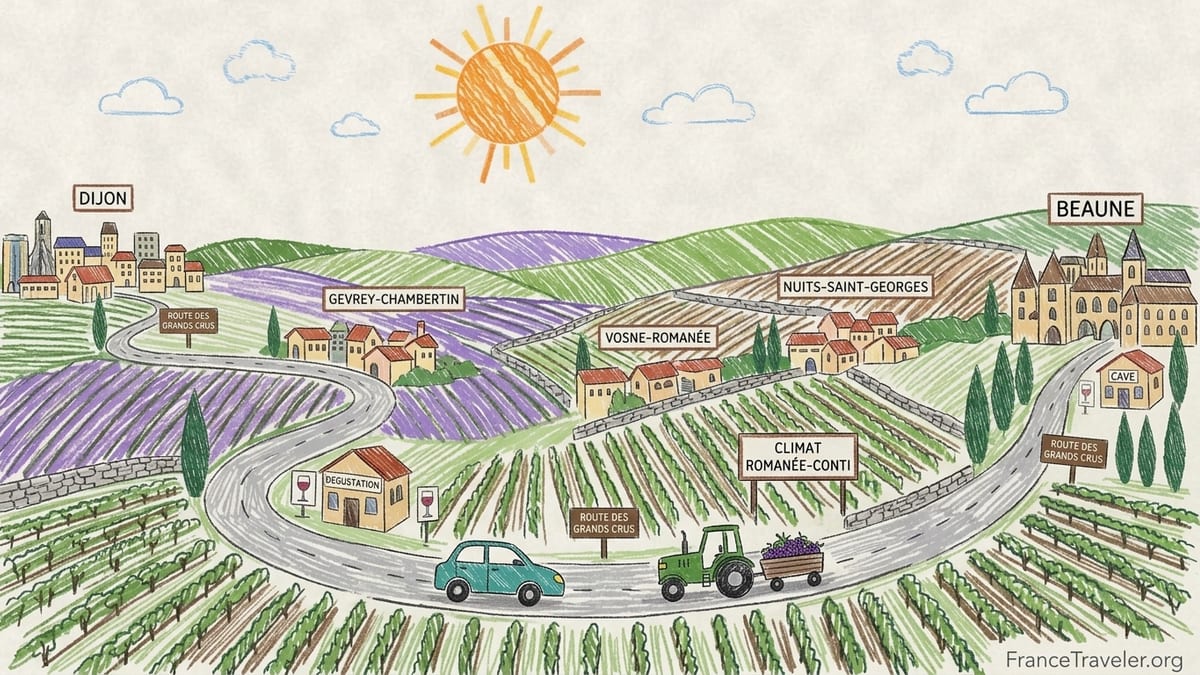
The Exact Route I Drove Between Dijon and Beaune
I started just south of central Dijon, where the official Route des Grands Crus peels away from the city streets and heads toward Chenôve, the first historic wine village on the route. The road here is still semi‑urban, with supermarkets and apartment blocks giving way only gradually to low stone walls and the first neat rectangles of vines. My plan for the day was to drive as far as Beaune and back, focusing on a realistic slice of the 60‑kilometre route between Dijon and Santenay, which crosses 37 wine villages through the heart of the Côte de Nuits and Côte de Beaune according to local tourism authorities.
From Dijon I followed signs toward Marsannay‑la‑Côte, often promoted as the “gateway” to the route. I passed Chenôve, with its historic wine presses from the dukes of Burgundy era tucked into the old village, then rolled into Marsannay itself. Instead of detouring into every cellar door, I stayed on the D122 road that snakes through the vines, continuing south through Fixin, Brochon and into Gevrey‑Chambertin. The landscape tightened here: long, narrow parcels of vines climbing gentle slopes, each parcel a separate “climat” or named plot that forms the basis of Burgundy’s UNESCO‑listed vineyard mosaic.
After Gevrey‑Chambertin I stayed on the small departmental road that hugs the base of the slope, threading next through Morey‑Saint‑Denis and Chambolle‑Musigny. I skirted the grand stone walls of Clos de Vougeot near Vougeot, then continued to Vosne‑Romanée and Nuits‑Saint‑Georges. After a short motorway hop to save time, I rejoined the wine road north of Beaune, dipped into Savigny‑lès‑Beaune, then continued through Beaune itself and out toward Pommard and Meursault on the Côte de Beaune side, before looping back to Beaune for the night. It was not the complete 60 kilometres to Santenay and the Maranges, but it covered both the Côte de Nuits and the northern Côte de Beaune at a pace that allowed proper tastings without rushing or unsafe driving.
What the Route Actually Looks and Feels Like
If your mental image of the Route des Grands Crus is a broad scenic highway through solitary vineyards, adjust it now. Much of the way, especially between Marsannay and Nuits‑Saint‑Georges, is on narrow two‑lane roads with almost no shoulder. During my October visit, harvest was finishing and tractors hauling trailers of grapes or equipment moved slowly between plots. I frequently tucked in behind them at 25 to 30 kilometres per hour, waiting for a safe chance to overtake between tightly spaced junctions. In several villages, especially Morey‑Saint‑Denis and Chambolle‑Musigny, parked vans turned the road into a single lane. It felt more like driving through working farmyards than a polished tourist parkway.
The villages themselves were smaller and more modest than I expected for such prestigious names. In Gevrey‑Chambertin I parked opposite a pharmacy and bakery on an ordinary looking main street, with just a discreet sign pointing up a side road toward the grand cru slopes. Vosne‑Romanée was even quieter: small stone houses, a simple church, almost no commercial signage. Yet just beyond the last houses, you can pull over in a small lay‑by and look across to Romanée‑Conti, a plain‑looking walled vineyard that produces some of the most expensive wine on earth. This contrast between unassuming village life and global luxury pricing was one of the most striking things I learned to expect along the route.
The UNESCO “Climats” designation sounds abstract until you are actually driving alongside them. A climat in Burgundy is not about weather, but a precisely defined parcel of vines with its own name, soil, slope and often long history. In practice, this meant that every few hundred metres I passed another small brown sign pointing to a climat: “Les Amoureuses,” “Clos de la Roche,” “Les Suchots.” On foot or by bike you could almost trace each climat boundary by its low wall or change in stone color underfoot. Behind the wheel, I had to resist the temptation to read every sign and instead pull into a couple of official viewpoints where panels explain how these parcels all stack together into village, premier cru and grand cru wines.
Appointments, Walk‑Ins and What Tastings Cost Me
I had three structured tastings booked for the day, and that was the right number: one mid‑morning, one mid‑afternoon along the route, and a final early evening tasting in Beaune. The first was at a family domaine in Gevrey‑Chambertin, arranged several weeks ahead by email. They offered a simple tasting of five wines for 25 euros per person, which aligned with general guidance that private Burgundy tastings often run from about 20 to 50 euros per person depending on the level of wines poured and whether it is a group or private session. I confirmed the price and that spitting was completely acceptable, something worth clarifying in advance if you plan to taste but still drive.
At this Gevrey visit I tasted a regional Bourgogne Rouge, a village Gevrey‑Chambertin, two premier crus and one grand cru, all from recent vintages. The pour sizes were modest, roughly 20 to 30 millilitres each. I spat most samples and swallowed perhaps the equivalent of a single glass across the whole flight. There was no pressure to buy, though the family made it clear that the tasting fee did not count toward purchases, which has become more common in Burgundy as demand has risen and available stock has tightened. When I did choose a bottle of village Gevrey‑Chambertin at just under 60 euros, it was because I loved it, not because I felt obliged.
My second tasting, in Nuits‑Saint‑Georges, was with a mid‑sized domaine that accepts small groups by appointment in English. Here the fee was 30 euros for six wines, again broadly in line with regional price surveys for 2025 and 2026 that show many Côte d’Or domaines charging somewhere between 25 and 40 euros for structured tastings involving village and premier cru wines. The visit lasted just over 90 minutes, including a short walk through the cellar and time to ask questions about recent vintages and the impact of successive warm years on picking dates and alcohol levels. I spat all wines at this stop because I knew I would be driving a busier stretch of road afterward.
For comparison, I booked my final tasting of the day not at a domaine but at a wine merchant in central Beaune. Houses like these and long‑established négociant‑producers offer seated flights where you can sample several appellations in one go and, crucially, leave without buying if you prefer. In Beaune that evening I paid 39 euros for a guided flight of seven wines, split between whites from Meursault and Puligny‑Montrachet and reds from Beaune and Savigny‑lès‑Beaune. This balanced out my more focused, village‑based tastings earlier in the day and let me compare styles without needing to criss‑cross the vineyards again by car.
A Day of Tastings: How Many Is Sensible if You Are Driving
The hardest part of planning the Route des Grands Crus was not choosing villages, but deciding how many tastings I could responsibly fit in while still driving myself. On my main day along the route I booked three sessions. In hindsight, that was the upper limit I would recommend for anyone who intends to drive at all, even if you spit diligently at each stop. Each appointment involved not only wine, but focused conversation, standing or walking, and emotional energy. By the time I reached Beaune in the late afternoon I felt pleasantly saturated by information, but mentally tired. I was glad I had resisted adding a fourth stop in Meursault that I had briefly considered.
To keep things safe, my partner and I agreed that only one of us would drive the rental car that day, and that person would spit every pour. The non‑driver could taste more freely, but we still measured our intake cautiously. At the Gevrey domaine I tasted five wines and spat four completely, swallowing only small sips of the village wine and one premier cru. At the Nuits‑Saint‑Georges visit, with six wines, I spat them all, noting flavours and aromas but not treating it as a social drinking occasion. Only in Beaune, where we parked the car for the night and walked to the tasting room from our hotel, did I feel comfortable swallowing more generously, which still amounted to roughly two glasses over 90 minutes.
If you want to taste more widely in a single day, Burgundy has several ways to reduce or eliminate the need to drive. You can base yourself in Beaune or Dijon and join a minivan tour that covers both Côte de Nuits and Côte de Beaune, with a professional guide driving and tastings pre‑booked. Official tourism partners publish full‑day wine tours from around 150 euros per person, including transport and several wines at each stop. Another option, especially in good weather, is to take the train to Beaune or Nuits‑Saint‑Georges and rent an electric bike, following signposted vineyard paths at a leisurely pace. In that case I would still keep tastings to three in a day, but you will feel much less pressure around timing and traffic.
Warm Welcomes vs Formal Temples: How Domaines Really Felt
Burgundy can be intimidating on paper, full of revered family names and grand cru labels. On the ground, the tone of visits varied widely. The warmest welcome I had was in Gevrey‑Chambertin, where the grower met us in muddy boots straight from the vines. We began with a short walk to the edge of a village‑level parcel, looking upslope to where the premier cru and grand cru plots start. Inside the small tasting room, cluttered with barrel samples and paperwork, we tasted at a simple wooden counter while he explained how a “village” wine is made from multiple climats around one village, while “premier cru” must come from specific named climats recognised for higher quality potential. The explanation was straightforward, free of jargon, and grounded in the wines we were actually tasting.
In Nuits‑Saint‑Georges the experience was more polished but still friendly. The domaine’s export manager led our tasting in English, with printed maps of their holdings and clear information about prices and availability. We sampled a regional Bourgogne Chardonnay, a village Nuits‑Saint‑Georges, a premier cru from older vines and a grand cru from a neighbouring village where they lease vines. Here the tone was more formal, and discussion sometimes drifted into technical details such as percentage of new oak or length of cold maceration. It was educational, but also a reminder that some Burgundy visits cater primarily to trade buyers and collectors.
The least engaging stop, surprisingly, was the evening merchant tasting in Beaune. Although the wines were very good and the guide knowledgeable, the room felt like a conveyor belt. Groups started every half hour, and much of the script was memorised. When one guest asked about specific small producers, the host gently steered the conversation back to their own labels. It was still useful as a structured introduction to appellations of Côte de Beaune, but it lacked the personal connection and sense of place that I had felt earlier in the day on the slope itself. If your time is short, one well‑chosen domaine visit in a village can be more rewarding than a lengthy multi‑flight tasting in town.
Wine Words I Finally Understood
Burgundy is famous for its vocabulary, and driving the Route des Grands Crus helped me finally connect several key terms with real landscapes and bottles rather than abstract definitions. The most important was “climat,” which, as noted earlier, refers to a specific named parcel of vines, not the weather. Each climat can have its own soil conditions, exposure and reputation, and its name often appears on labels of premier cru and grand cru wines. For example, in Chambolle‑Musigny you might see “Chambolle‑Musigny Premier Cru Les Amoureuses,” where Chambolle‑Musigny is the village and Les Amoureuses is the climat.
I also learned to distinguish clearly between the four main quality levels of Burgundy appellations. At the base is “Bourgogne” or “Bourgogne Rouge/Blanc,” which can blend grapes from multiple areas within the wider Burgundy region. One step up is the “village” level, where the label carries the village name such as Gevrey‑Chambertin or Meursault. Above that is “premier cru,” which adds both the village and a climat name and indicates a site historically recognised for high quality. At the top sit the “grand cru” appellations like Chambertin or Montrachet, where the vineyard name alone usually appears on the label and the village name may be omitted because the site itself is so famous.
Another term that came to life during cellar conversations was “terroir.” Growers used it not as mystical shorthand, but as a practical bundle of factors: soil type, slope, drainage, sun exposure, and even local human traditions that influence pruning and picking. On a hillside outside Nuits‑Saint‑Georges, one winemaker crouched to show how the soil shifted from deeper clay at the bottom to thinner limestone and stones higher up, explaining that vines on thinner, rockier soils tended to produce smaller, more concentrated grapes. Tasting a village wine from the lower slope next to a premier cru from higher up made the idea of terroir feel concrete rather than theoretical.
Buying Bottles and Getting Them Home
Prices along the Route des Grands Crus in 2025 and 2026 reflected Burgundy’s global demand. At small domaines, regional Bourgogne wines often started around 20 to 30 euros per bottle, with village wines in well‑known communes like Gevrey‑Chambertin or Meursault frequently 45 to 70 euros or more, depending on vintage. Premier cru bottlings from sought‑after climats could easily climb into the 90 to 150 euro range. Grand cru wines, when offered at all, were sometimes sold only to existing customers and, when available, could run several hundred euros per bottle. Merchants in Beaune quoted similar figures, sometimes slightly higher for ready‑to‑drink older vintages.
Over the course of my day, I bought four bottles: one village Gevrey‑Chambertin, one Nuits‑Saint‑Georges premier cru and two Côte de Beaune whites from Beaune and Meursault. The total came to just under 260 euros. Rather than risk checking them as loose luggage on my flight home, I asked each seller about shipping. Both the domaine and the merchant worked with specialist wine shippers able to send mixed cases to most European Union countries and, with more paperwork and higher cost, to North America and parts of Asia. A mixed six‑bottle shipment to a nearby EU address was quoted at roughly 60 to 80 euros including packaging and insurance, which felt reasonable compared with potential airport breakage or excess baggage fees.
For travellers who prefer to carry bottles with them, Beaune’s wine shops sell dedicated polystyrene or heavy‑foam wine boxes that fit into standard airline luggage size limits and offer much better protection than improvised wrapping in clothes. I spoke with several visitors who had successfully checked such boxes on flights via Paris and Lyon without breakage, though airlines treat them as regular baggage and do not guarantee temperature stability. If you choose this route, buying mostly younger, sturdier wines and avoiding shipping in peak summer heat is wiser.
The Takeaway
Driving the Route des Grands Crus was less like floating through a postcard and more like slipping into the daily rhythm of one of the world’s most intensively farmed wine landscapes. I learned that the route’s magic lies not in choreographed vistas, but in the way modest villages, narrow roads and hard work in the vines coexist with globally celebrated labels. I also learned that, for a normal visitor, the practical details matter as much as the romance: booking tastings well ahead, respecting that many domaines are working farms rather than walk‑in attractions, and taking alcohol and transport decisions as seriously as locals do.
If I were to structure the day again, I would still start near Dijon, but I would limit myself to two domaine visits along the Côte de Nuits, perhaps in Gevrey‑Chambertin and Nuits‑Saint‑Georges, then finish with a single comparative tasting at a merchant or wine school in Beaune after parking the car for the night. That would make a total of three tastings in one day, which is the maximum I now feel comfortable recommending if you are driving at any stage. With a private guide or if you are cycling and staying locally, you might stretch to four, but only with careful pacing and plenty of food and water.
Next time, I would also build in more unscheduled time to walk vineyard paths between villages like Morey‑Saint‑Denis and Chambolle‑Musigny, where the nuances of climats and terroir feel most tangible on foot. The Route des Grands Crus rewards patience and curiosity far more than box‑ticking. With realistic expectations, a clear plan for tastings and transport, and a willingness to embrace both tractors and grand crus, it can be one of the most quietly memorable wine drives in Europe.
FAQ
Q1. Do I really need appointments for tastings on the Route des Grands Crus?
Yes, in most cases you do. Many family domaines work primarily in the vines and cellar and open for visitors only at set times by prior arrangement. Larger houses and wine merchants in Beaune and Dijon are more likely to accept walk‑ins, but even there, reserving a time by phone or email helps avoid disappointment on busy weekends and during harvest.
Q2. How many tastings can I safely plan in one day if I am driving?
If you intend to drive at all, three tastings in a day is a sensible upper limit, and that assumes you spit most of what you taste and eat properly between visits. With a private driver or cycling base and no need to touch the car, you might add a fourth tasting, but the day will be very full and you may remember less of what you learned.
Q3. What does a typical tasting cost along the Route des Grands Crus?
For small group or private tastings at domaines, expect to pay around 20 to 40 euros per person for flights of five to seven wines, often including at least one village or premier cru level bottle. In high‑profile villages or at more famous producers, fees can be higher, especially if grand cru wines are poured. Merchant and négociant tastings in Beaune are often priced similarly, with more emphasis on comparative appellation flights.
Q4. Is it better to drive, cycle or hire a guide?
Each option has trade‑offs. Driving gives flexibility but limits how much you can safely drink and adds stress on narrow, busy roads. Cycling allows you to move slowly through the vines and stop often, but you still need to manage alcohol intake carefully. Hiring a guide or joining a small‑group tour is more expensive but removes the driving burden and often includes pre‑arranged tastings that would be harder to secure independently.
Q5. When is the best time of year to drive the Route des Grands Crus?
Late spring and early autumn are particularly rewarding. In May and June the vines are green and active, while in September and early October you may glimpse harvest in progress, though this also means more tractors and busier cellars. Mid‑summer can be hot and crowded. Winter visits offer a quieter atmosphere, but vineyard walks are less appealing and some domaines reduce visitor hours.
Q6. Can beginners who know little about wine still enjoy this route?
Absolutely. Many domaines and merchants tailor explanations for non‑experts, focusing on clear distinctions between regional, village, premier cru and grand cru wines and using simple language to describe flavours and terroir. Booking at least one educational tasting in Beaune or Dijon can give you a solid foundation before you explore the smaller villages.
Q7. How far in advance should I book tastings?
Booking four to six weeks ahead is wise for peak seasons such as late spring, harvest time and long weekends. For off‑season weekday visits, a week or two may suffice, though the most sought‑after domaines often schedule appointments months in advance or restrict visits to existing clients and trade professionals. Last‑minute walk‑ins are possible mainly at merchants and larger houses in Beaune.
Q8. What should I budget for buying wine along the route?
As a rough guide, regional Bourgogne wines often start around 20 to 30 euros, village wines in well‑known communes from about 45 to 70 euros, and premier cru bottles from 80 euros upward at many addresses. Grand cru wines, when available, can run into several hundred euros. Setting a daily bottle budget before you start tasting can help you make clearer decisions when faced with tempting line‑ups.
Q9. How can I get my wine purchases home safely?
You can ship directly from domaines and merchants using specialist wine carriers, which is convenient but adds cost, or you can pack bottles yourself in dedicated foam or polystyrene wine boxes designed for airline travel. Checked luggage remains subject to usual weight limits and is not temperature controlled, so avoid shipping in extreme heat and protect bottles carefully if you choose to carry them.
Q10. Is it possible to enjoy the Route des Grands Crus without tasting much alcohol?
Yes. Spitting is normal and respected at Burgundy tastings, and hosts are accustomed to guests who want to focus on learning rather than drinking. You can also build your trip around vineyard walks, village visits, local food and occasional small pours, turning the route into a cultural and landscape journey rather than a continuous drinking tour.