


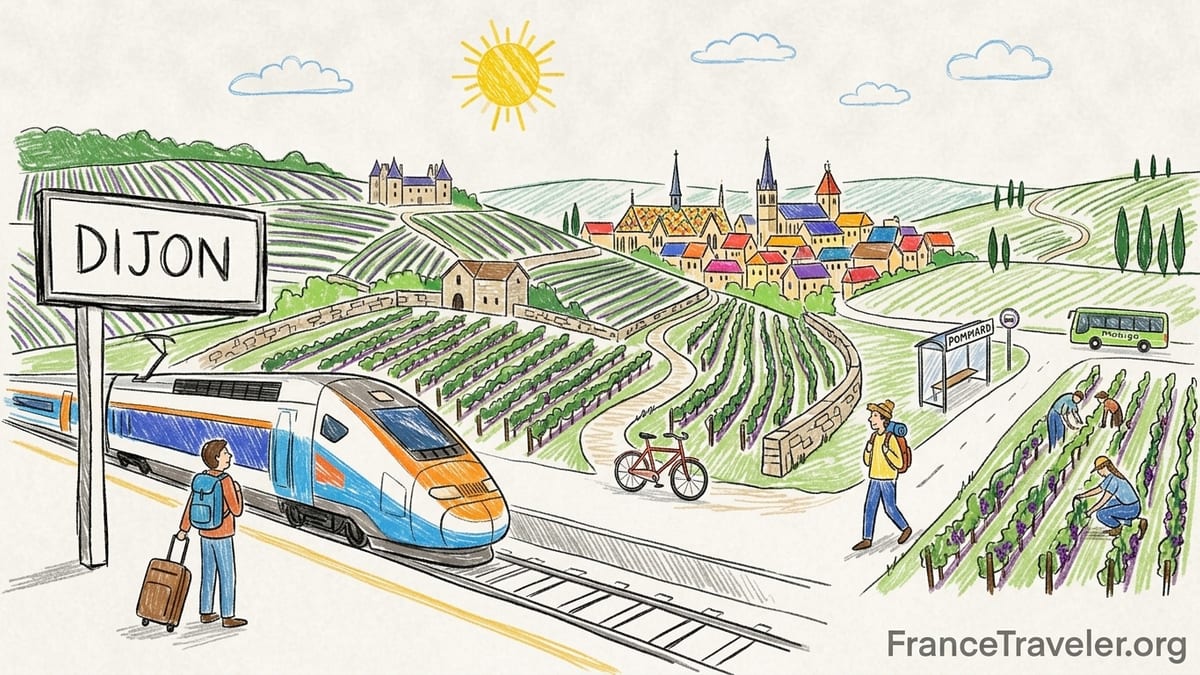
On paper, my car free trip to Burgundy looked perfectly sensible. High speed trains from Paris into Dijon, an easy hop to Beaune, then a few carefree days wandering vineyards, tasting wines and using local buses and bikes to reach the famous villages I had seen on labels for years. Burgundy Tourism brochures talked confidently about TGV access into Dijon and Montbard and suggested itineraries by train, bike and bus. It sounded like the rare French wine trip I could do without renting a car. In reality, I discovered a big difference between visiting Burgundy without a car and visiting Burgundy’s wine villages without a car, and that gap shaped almost every day of the journey.
Why Car Free Burgundy Looked So Appealing
I started planning with the rail map, not the road map. Dijon appeared as a major node, with TGVs from Paris Gare de Lyon in about 1 hour 35 minutes when booked in advance, and connections from Lyon in roughly 1 hour 30 minutes. Regional TER services run frequently between Dijon and Beaune along the main line to Lyon, with direct trains that can take around 20 minutes for the 40 kilometre journey according to recent timetables. That combination of fast access and regular regional trains convinced me that I did not need a car at all.
The official Burgundy and Côte d’Or tourism sites reinforced that impression. They highlight the idea of “Bourgogne sans voiture,” showcasing examples where you arrive by TGV in Dijon or Montbard, then continue with Mobigo regional buses, walking routes and cycling. One itinerary describes catching a TGV from Paris to Montbard in just over an hour, then using a Mobigo bus into the Morvan hills. The message is clear: trains plus a bit of soft mobility can unlock a lot of the region if you plan carefully.
On top of that, I liked the idea of not driving after tasting wine. Burgundy’s greatest villages lie along the Route des Grands Crus between Dijon and Santenay, passing through names like Gevrey Chambertin, Nuits Saint Georges, Pommard and Meursault. Tourism materials explain that you can explore this corridor on foot, by bike, by car or on guided wine tours. It seemed reasonable to assume that with so many visitors coming for wine, public transport and organised tastings would fill the gaps normally covered by a hire car.
What I did not appreciate at the planning stage was how sharply the transport picture changes as soon as you step off the main rail spine. Dijon without a car is one thing. Beaune without a car is also manageable. The small wine villages between them without a car are another proposition entirely, especially outside peak times and without pre booked transfers. That distinction, which sounds subtle on a map, became painfully clear the first day I tried to go from a city station to an actual vineyard with my suitcase.
Trains That Worked, And The Connections That Did Not
My first leg went exactly as promised. I left Paris on a morning TGV and stepped off in Dijon roughly an hour and a half later. The station is right in town, with trams and city buses outside and a straightforward ten to fifteen minute walk into the historic centre. I felt vindicated in skipping a car. The air smelled faintly of roasting mustard seeds, the traffic was light compared with Paris, and I could roll my suitcase over to my hotel without worrying about parking or one way streets.
The Dijon to Beaune leg also behaved itself. On the day I travelled there were multiple TER departures spread through the day, with some trains taking around twenty minutes station to station. Buying a ticket at the SNCF Connect machines was simple enough, and the fare was modest compared with intercity prices. The train was a basic regional service, but the countryside sliding past the window was every bit as bucolic as I had hoped. From Beaune station it was another manageable walk into the walled town, perhaps ten minutes with a wheeled bag.
The trouble started when I treated the regional train network as if it were a metro for vineyards. Once you leave Dijon and Beaune, frequencies drop, services are grouped around commuter patterns and some connections are replaced entirely by substitute coaches. A Sunday afternoon connection I planned to use from Beaune to Chagny turned out to be an infrequent service with a gap of several hours in the middle of the day. A missed late morning train quickly turned into an arrival nearly three hours later than expected. Unlike a city network, there was no quick alternative route.
On another day, I tried to fit a morning visit in Beaune with an afternoon look at a village further along the line, banking on a tight change from a TER to a Mobigo regional bus. A ten minute delay on the incoming train erased my planned buffer, and the bus left right on time from a stop about 300 metres from the station. Watching its tail lights disappear while I hurried down the pavement with my day pack was the first hint that Burgundy without a car would demand more slack than I had built into my schedule.
Walking Distances, Luggage And The Reality Of Wine Villages
The distances involved would not bother a seasoned hiker travelling light, but they feel very different when you are dragging a suitcase after several connections. One of the most eye opening moments came when I followed the official guidance that many Mobigo bus stops are in “canton centres” rather than right in wine villages. On the map, the stop looked close to Pommard. On the ground, that translated into a forty minute walk along narrow roads with no pavement, punctuated by trucks rushing past at rural speeds.
Tourism information for Côte d’Or notes explicitly that buses often stop in administrative centres, leaving a fifteen to forty five minute approach walk to reach cellars, domaines and chateaux. That is a fair trade off for residents who use the buses for work or school, but as a visitor with a rolling suitcase and a lunch reservation, it becomes a non trivial part of the day. In one direction the walk cut through peaceful vineyards, in the other it meant backtracking along the same road just to reach the bus in time.
Luggage changed the equation again. Moving between Dijon and Beaune with bags was simple because the stations sit close to the centres and pavements are smooth. Shifting that same luggage into smaller places was a different story. I ended up leaving my main bag in Beaune for two nights and doing out and back day trips, which limited how far I was willing to roam. If you want to sleep in villages like Meursault or Gevrey Chambertin without a car, you either carry your luggage on those long walks or you start paying for transfers.
There were lovely moments walking between villages. The path from Beaune towards Pommard, for example, rewards you with classic views of low stone walls, neatly aligned vines and church spires in the distance. But when your route planning depends on a bus that only runs a handful of times per day, those relaxing strolls quickly gain a clock watching edge. The margin for error is measured in kilometres of extra walking or an expensive taxi ride back to base.
Winery Access, Sparse Taxis And Evening Restaurant Logistics
If the daytime logistics were tricky, the combination of tastings, limited taxis and evening meals was where the cracks really showed. Many of the best known domaines in villages such as Puligny Montrachet, Chassagne Montrachet or Vosne Romanée either require advance appointments or offer limited walk in hours. Reaching them without a car usually means stitching together a TER train, a regional bus, and a stretch on foot, all timed around fixed tasting slots.
I found that even when I successfully reached a village for a late morning tasting, getting back was less straightforward. Midday bus gaps are common, and afternoon services tend to tilt towards school and work commuting patterns rather than tourist movement. On one occasion I finished a cellar visit in a small village, walked back to the canton centre bus stop and discovered the next bus to Beaune would not arrive for almost two hours. There was no café open near the stop, and the only practical option was to walk another half hour to a larger village with a bit more activity.
Taxis were the logical fallback in theory but patchy in practice. In Beaune itself there are several taxi companies, yet many expect phone bookings and some drivers focus on pre arranged wine tours rather than short ad hoc hops between villages. When I asked my hotel to call a taxi for an evening restaurant in a nearby village, they succeeded, but the round trip fare ended up rivalling the price of the set menu. On another night, I tried to call taxis myself for a return to Beaune after dinner and found none available at short notice. In the end the restaurant owner kindly drove me back into town after closing.
Even within the main towns, evenings require a bit of planning without a car. In Dijon the tram and urban bus network runs into the night, so moving between neighbourhoods is simple as long as you watch the schedules. In Beaune public transport is far more limited in the evening, and while the centre is compact enough to walk across in fifteen minutes, any restaurant that sits just beyond town or in an outlying village becomes a small expedition. The prospect of walking several kilometres along unlit country roads after a wine paired dinner concentrates the mind very quickly.
Destinations That Looked Close, But Were Hard Without A Car
The map of Burgundy invites underestimation. Distances between famous names are short in kilometres, yet complicated by the lack of direct public transport. I assumed that places like Meursault and Puligny Montrachet would feel like extensions of Beaune, not least because they sit only about seven to ten kilometres away. In reality, the absence of a simple, frequent shuttle or rail spur meant that visiting both villages in one day from Beaune without a car required a patchwork of walking, a taxi and firm time limits at each stop.
Further north, villages in the Côte de Nuits presented a similar challenge. Gevrey Chambertin, for instance, lies less than fifteen kilometres south of Dijon. The main rail line between Dijon and Beaune passes nearby, but the station serving Gevrey Chambertin is modest, with limited services. Reaching smaller villages tucked into the hills above, like Chambolle Musigny or Vosne Romanée, involves changes at Nuits Saint Georges or regional buses that may not align neatly with visiting hours.
Outside the wine belt, places like the Morvan Regional Nature Park revealed another dimension of the “close but not easy” problem. Information from local tourism offices describes reaching the park by taking a TGV or TER to Montbard or Autun, then using Mobigo lines such as LR 120 or LR 123. These routes work, but departures are infrequent and some stretches rely on transport on demand services that must be reserved in advance. For a hiker planning a multi day trek, that is manageable. For a casual visitor hoping to add a last minute detour into the hills, it is a significant barrier.
Again and again, my carefully drawn lines on the map collided with the reality of rural public transport designed primarily around residents rather than visiting wine lovers. None of this means Burgundy is inaccessible without a car, but it does mean that itineraries which look effortless on a schematic map demand extra time, flexibility and sometimes a willingness to abandon a plan mid route when a connection fails to materialise.
What Worked Well: Dijon, Beaune And The Main Rail Spine
It is important to underline that some parts of my plan worked very well. Dijon without a car is rewarding and relatively simple. The historic centre sits just uphill from the station, with most sights compressed into a walkable core. City buses and trams radiate from the station area and major squares, and a self service bike system allows you to pick up a bicycle in one part of town and drop it in another. For museum visits, food markets and casual wine bars, not having a car in Dijon felt like a net positive.
Beaune, although much smaller, also benefits from its position on the main TER line. The walk from the station to the town walls is short, and several affordable hotels and guesthouses sit within ten to twelve minutes on foot. Once inside the ring of boulevards that trace the former ramparts, everything is close: the Hospices de Beaune, tasting rooms, restaurants and small supermarkets. For two days I did not miss a car at all, sampling wines by the glass in bars around Place Carnot and wandering back to my room on quiet streets.
The bigger rail picture across Burgundy is not broken either. Regional timetables from the current season show a dense web of services connecting Dijon with Besançon, Dole, Chalon sur Saône, Mâcon and Auxerre, among others. Some trains allow free bike transport with reservation, which pairs neatly with the idea of cycling along the Route des Grands Crus while using trains to cover longer jumps. TGVs still offer fast links from Paris and other major French cities into Dijon and occasionally Montbard, which underpins any car free arrival plan.
Where Burgundy excels is the combination of big picture access by train and pleasant, compact cities where driving would be more hassle than help. The shortcomings appear at the micro level in wine villages and rural corners. Recognising that split is the key to designing a trip that plays to the strengths of the rail network without pretending it can fully replace the flexibility of a car once you leave the main line.
Guided Tours, E Bikes, Transfers And Other Workarounds
To patch the gaps, I experimented with and researched a range of alternatives to driving myself. Guided wine tours were the most straightforward, if not always cheap. Several operators based in Beaune and Dijon offer half day and full day small group tours along the Route des Grands Crus, typically using minibuses that collect guests from central meeting points. Prices for a full day with several tastings often sit in the range of a modest hotel night, but what you buy is convenience: someone else worries about appointments, parking and safe driving after tastings.
E bike rentals provided another partial solution. In Beaune I found shops offering electric bikes for day rentals, with suggested itineraries through Pommard, Volnay, Meursault and back, using minor roads and vineyard tracks. Pairing an e bike with the TER train network opens up the possibility of staying in Beaune or Dijon and doing long loops without a car. The caveat is weather, fitness and luggage: battling a headwind on an e bike after several tastings is a different challenge than rolling a suitcase from station to hotel.
Hotel transfers turned out to be one of the most underrated tools. Some higher end guesthouses and small hotels in villages like Puligny Montrachet or Meursault quietly offer pick up and drop off from Beaune station for guests who stay several nights. In practice, that means you can arrive by train, hand off your luggage to a pre arranged driver and settle into village life without touching a steering wheel. During my trip I used one such service for a transfer into a village stay, and it removed the most stressful segment of the journey.
Finally, regular taxis and on demand transport services deserve a mention, with caveats. Regional schemes such as Mobigo offer transport on demand in some areas if you reserve at least a day ahead. Traditional taxis in Beaune and Dijon can bridge short gaps when buses do not line up, but availability is limited during peak harvest times and after dinner. I found that when I treated taxis as strategic tools, booked in advance through my accommodation or tour provider, they enhanced the car free experience. When I relied on them at the last minute, frustration followed.
The Exact Moment I Wished I Had Rented A Car (And When I Was Glad I Had Not)
The point where I truly wished for a rental car came at the end of a long, hot afternoon south of Beaune. I had visited a domaine in Meursault, lingered over generous pours and then walked out to the roadside with the idea of catching a regional bus towards Puligny Montrachet. A small scheduling misread on my part meant the bus I expected ran only on school days. The next one was more than ninety minutes away, and the taxi numbers I tried went unanswered in the mid afternoon lull.
Standing by the roadside, watching tractors trundle past and calculating whether I could walk the six or so kilometres before my early evening dinner reservation, I experienced a sharp stab of regret. With a compact car parked in Meursault, the whole day would have been easy: a short drive between villages, the freedom to adjust plans on the fly, and no anxiety about missing the one bus of the hour. That was the moment the romance of a fully car free Burgundy collided with the reality of rural timetables.
Yet there were also times when I was distinctly glad not to have a car. In Dijon, wandering the streets after a tasting flight at a wine bar, I appreciated the ability to order an extra half glass without thinking about breathalyzers or late night parking. In Beaune, I enjoyed returning to my hotel on foot after a long dinner, weaving quietly through narrow lanes that would have been awkward to navigate by car. On a crowded Saturday market morning in Dijon, watching drivers circle in search of spaces near the covered market, I felt a flicker of smugness as I walked past with only a canvas shopping bag.
In short, the absence of a car enhanced my experience in the cities and large towns but constrained it in the countryside. The real lesson was not that one mode is universally better, but that Burgundy is best approached as two overlapping geographies: an urban rail corridor suited to car free travel, and a patchwork of villages where a car or car like service multiplies your options dramatically.
The Takeaway: A Revised Hybrid Plan For Burgundy
Looking back, I would not abandon the idea of travelling to Burgundy without a car, but I would abandon the all or nothing mindset. The smarter strategy is a hybrid approach: lean on the strength of France’s rail system to reach Dijon or Beaune, then introduce a car or car based services for specific days devoted to wine villages and rural side trips. That balance preserves the pleasures of arriving and departing by train while acknowledging the limits of public transport once you step into the vines.
My ideal do over itinerary starts with a TGV into Dijon and two nights there without a car, exploring on foot, tram and bus. From Dijon I would take a TER to Beaune, again without a car, and spend at least one full day enjoying the town itself: Hospices de Beaune, the Saturday market if timing allows, and tastings in cellars reachable on foot. Only after settling in would I arrange a short term solution for the wine villages, either a two day rental car from Beaune, a sequence of guided tours, or a mix of hotel transfers and e bikes.
For example, I might book a two day rental car timed to coincide with village stays, using it to shuttle between Pommard, Volnay, Meursault and Puligny Montrachet, then return it in Beaune before the final nights. Alternatively, I could keep my base in Beaune and schedule one full day small group tour through the Côte de Beaune and a second day on an e bike loop, using a pre booked taxi for a single tricky segment. In all these variants, the key idea is that “Burgundy without a car” describes the spine of the trip, while “Burgundy wine villages without a car” becomes a targeted challenge solved with specific services.
Most importantly, I would pad my schedule. Connections that look neat on paper need extra breathing room in practice. I would avoid tight same platform transfers between TER trains and buses, allow for long lunch breaks in canton centres where bus stops actually sit, and make restaurant bookings in villages only on nights when I have a confirmed taxi or private transfer lined up. With that mindset, the frustrations I experienced could have been minimised, and the rewards of slow travel through one of France’s great wine regions could have taken centre stage.
FAQ
Q1. Is it realistic to visit Burgundy entirely without a car?
It is realistic to visit Dijon, Beaune and several larger towns without a car using TGV and TER trains, but reaching many small wine villages and rural sites becomes difficult or time consuming if you rely only on public transport.
Q2. What is the difference between “Burgundy without a car” and “Burgundy wine villages without a car”?
“Burgundy without a car” usually means staying in larger towns like Dijon or Beaune and using trains and local buses, while “Burgundy wine villages without a car” involves accessing small communes such as Meursault or Gevrey Chambertin where buses are infrequent and often stop far from the vineyards.
Q3. How easy is the train journey from Paris to Dijon and Beaune?
High speed TGV trains connect Paris Gare de Lyon to Dijon in around one and a half hours, and regional TER trains link Dijon and Beaune in roughly twenty minutes, making this part of the journey straightforward and comfortable.
Q4. Are there buses directly into the main wine villages?
There are regional Mobigo buses serving the general area, but many stops are in canton or administrative centres rather than inside specific wine villages, which often requires an additional fifteen to forty five minutes of walking to reach cellars and domaines.
Q5. Can I rely on taxis to get between villages in Burgundy?
You can use taxis for some transfers, especially if you book through your hotel, but availability can be limited at busy times and in the evening, and short hops between villages can be surprisingly expensive if used frequently.
Q6. Are guided wine tours a good alternative to renting a car?
Guided wine tours are one of the most practical alternatives, as they include transport, tasting appointments and a driver, though the cost can be similar to a night or two in a mid range hotel, so they work best for focused tasting days.
Q7. Is cycling or using an e bike a realistic way to see the vineyards?
Yes, many visitors rent standard or electric bikes in Beaune or Dijon and follow signed routes through the vineyards, but you should be comfortable sharing minor roads with traffic, factor in weather and avoid overly ambitious distances after tastings.
Q8. How should I plan evening meals if I do not have a car?
If you are staying in Dijon or central Beaune, choose restaurants within walking distance; for meals in villages, book in advance and coordinate a taxi or hotel transfer so you are not dependent on infrequent evening buses or long walks on dark roads.
Q9. When is it worth renting a car for part of a Burgundy trip?
Renting a car becomes worthwhile if you plan to stay in small villages, visit several domaines in one day spread across the Côte de Beaune or Côte de Nuits, or make side trips into areas like the Morvan where public transport is limited.
Q10. What is the best overall strategy for combining trains and cars in Burgundy?
A balanced approach is to use TGV and TER trains to reach Dijon or Beaune for city based days without a car, then add a short rental, guided tour or organised transfers for one or two days focused on wine villages, before returning to train travel for onward journeys.