


Burgundy is often reduced to a straight line on a map: Dijon to Beaune, then village after village along the Route des Grands Crus. It is a seductive idea, especially if you love Pinot Noir and Chardonnay. But treat Burgundy like a checklist of ten tastings in ten villages and you risk missing the region’s real breadth: market cities, quiet canals, Romanesque churches, hilltop castles, forested lakes and long vineyard bike rides where the tasting is the side dish, not the main course. This framework shows how to plan 3, 5, 7 or 10 days in Burgundy using geography and travel time instead of attraction counts, and how to keep wine at a human scale.
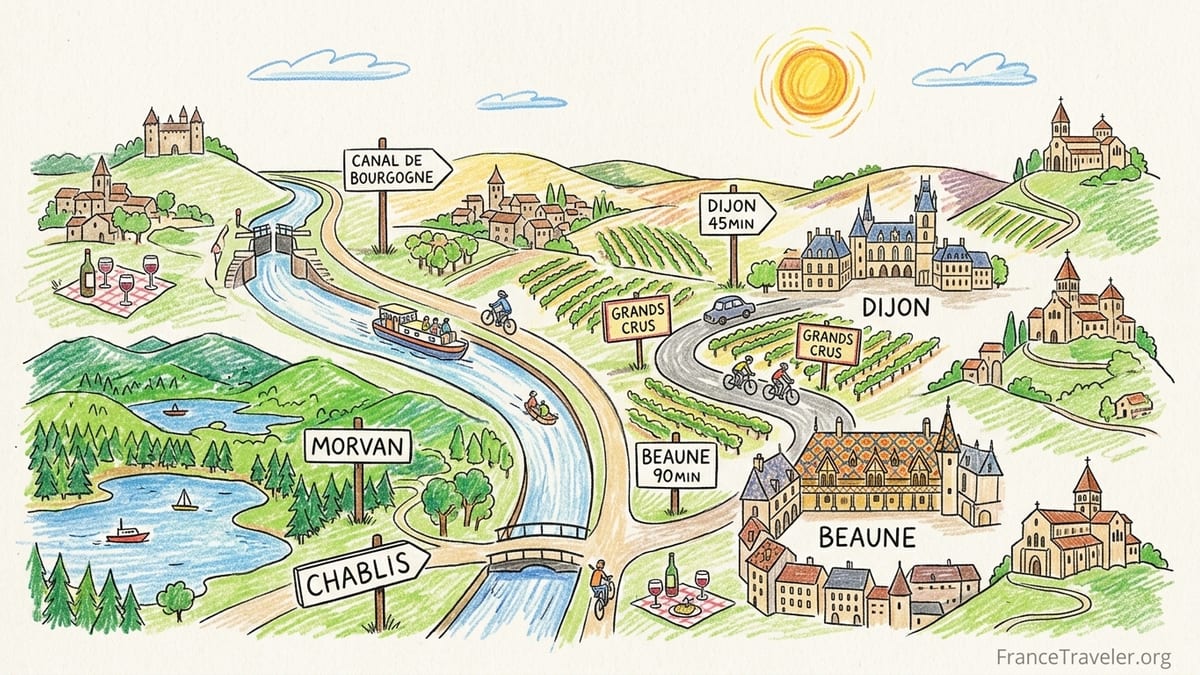
Forget the Corridor: Understanding Burgundy’s Shape and Distances
The mental picture many travelers arrive with is a single wine corridor from Dijon to Beaune, perhaps as far as Santenay. That strip, roughly 60 kilometres from north to south, is famous as the Route des Grands Crus, crossing about three dozen wine villages in the Côte de Nuits and Côte de Beaune. Driving Dijon to Beaune on the main D974 road is only about 45 minutes without stops, which tempts people to “do it all” in one or two frantic days. In reality, Burgundy sprawls far beyond those slopes, from Chablis and the Yonne valley in the north to canal country and the fringes of the Morvan hills in the west.
Once you zoom out, you see a set of distinct zones that do not line up neatly for a linear hotel hop. Dijon is a compact regional capital with museums, food halls and a tram network. Beaune is a small wine town hemmed in by vineyards. To the northwest you have Chablis and the Canal de Bourgogne, with towpath cycling and stone villages stretching toward Auxerre and Tonnerre. To the southwest lies the Parc naturel régional du Morvan, a lake and forest landscape threaded with small roads and hiking trails. Each area is at least 45 to 90 minutes from the others by car, which means every hotel move eats into your day.
Regional tourism bodies increasingly present Burgundy as a patchwork of experiences rather than one corridor, showcasing Dijon and Beaune but also Chablis, the Burgundy and Nivernais canals, Romanesque churches, castles set above rivers such as the Armançon and tranquil Morvan lakes. Cycling routes like the Voie des Vignes, which links Dijon with Beaune through about 90 kilometres of vineyards and villages, and the canal-side greenways of the Canal de Bourgogne and Canal du Nivernais, underline how water, woods and villages complete the picture, not just wineries and barrel rooms.
For planning, that means you should think in terms of bases and loops, not a straight line race. A base in Dijon, Beaune or a canal town such as Montbard or Pouilly-en-Auxois can support easy day trips within a 45 to 60 minute radius. Beyond that, expect a slower pace, deliberate transfers and fewer activities on moving days. Once you accept that Burgundy is bigger and slower than the wine corridor suggests, your itinerary becomes more relaxed, and individual experiences have room to breathe.
How Much Is Too Much Wine: Tasting Fatigue, Lunches and Free Afternoons
Even if you are in Burgundy for wine, your body and palate have limits. Two booked tastings per day is usually the sweet spot, three if you are in good shape, spitting consistently and not driving. Many estates still expect you to arrive at a set time, ask questions and taste through 5 to 8 wines. A single appointment can stretch to 90 minutes, and if you chat with the vigneron or walk the vines, you can easily spend two hours. Stack three of those plus a long lunch and you will find your sightseeing day gone before you see a single church, market hall or canal lock.
Most serious travelers find that tasting fatigue sets in after around 12 to 15 wines in a day, especially with structured reds from the Côte de Nuits or barrel samples. Flavors merge and small stylistic differences that seemed crucial in the morning become hard to perceive. You might still enjoy the social aspect, but your ability to make thoughtful buying decisions drops sharply. On a five or seven day trip, that cumulative fatigue adds up if every single day is wine heavy.
Lunch length is the other invisible planner of your day. In wine towns like Beaune or Nuits-Saint-Georges, a good bistro lunch with two courses and coffee will usually take 90 minutes, longer if you sit on a shaded terrace and share a bottle. A proper gastronomic menu in a Michelin-starred dining room can easily run to two and a half hours. That is wonderful if you have planned for it as your main daytime activity. It is frustrating if you were imagining squeezing in a historic hospital, a museum and a canal walk in the same afternoon.
The antidote is purposeful under-planning. On a 3 or 5 day itinerary, aim for at least one unstructured afternoon with no bookings. That may mean a picnic by a canal lock near Pouilly-en-Auxois, a lazy stroll around the lake at Panthier or a slow loop through lesser-known Hautes Côtes villages like Saint-Romain or Auxey-Duresses where you can stop spontaneously at a small producer’s cellar if the sign says open. Your schedule then has room for a lunch that drifts late, an extra coffee in a village square or a sudden decision to rent bikes and follow the nearest stretch of greenway.
Planning 3 Days: Pick One Core and Commit to It
In three days, you do not have time to “do” Dijon, Beaune and northern Burgundy in any meaningful way. Trying to sleep in more than one place will turn the trip into a suitcase shuffle. A realistic 3 day framework is to choose one of three cores: a Dijon city and nearby vineyards focus, a Beaune and surrounding wine country stay, or a northern Burgundy base that blends Chablis or Auxerre with canal and countryside.
Choose Dijon if you enjoy food markets, architecture and a light sprinkling of wine. The city is about 1 hour 40 minutes by high speed train from Paris, and you can walk from the station into the medieval center under ten minutes. A full day can revolve around the covered market designed with input from Gustave Eiffel, the Palais des Ducs and the Cité internationale de la gastronomie et du vin at the edge of town. On your other days, you can join a half day minivan tour down the Route des Grands Crus or take the tram toward the Canal de Bourgogne and walk sections of the towpath where boats pass through old locks. With only three days, you might skip hiring a car and rely on trains and guided tours.
Choose Beaune if your priority is wine country without having to commute. Beaune is about 45 minutes by regional train from Dijon and around 3 hours from Paris by a combination of TGV and local train. The Hospices de Beaune with its patterned roof and historic hospital buildings can absorb half a day between the main museum and tasting in the cellars. The rest of your time can go to two winery visits per day within a 15 to 20 minute drive, and a slow walk or bike ride on the Voie des Vignes between villages such as Pommard, Volnay and Meursault. With just three days, keep your base in Beaune, avoid hotel changes and treat a single loop along the vineyards as your big outing.
Choose northern Burgundy if you want more canals and heritage than wine labels. A base in Auxerre, Chablis or a village on the Canal de Bourgogne gives you a different flavor: slate roofs over the Yonne River, timbered facades, towpaths used by leisure boats and cyclists, and smaller, less touristed tasting rooms. You might spend a day driving or cycling along the canal between towns such as Tonnerre and Montbard, stopping for lock-side lunches and views of hilltop chateaux, then another day split between a Chablis cellar and a walk in the limestone hills above the vines. With three days, constrain your radius to 30 to 45 minutes from your bed and resist the temptation to dip down to Dijon or Beaune on the same trip.
Planning 5 Days: One Base Plus One Contrast
With five days, the instinct is often to string together three or four different hotels. In Burgundy that simply translates into too many packing sessions and not enough time in any one place. A smarter use of five days is to choose one urban or wine base for three or four nights and then add one contrasting region for one or two nights. That way, you experience both the wine heartland and another face of Burgundy without constant transfers.
One practical pattern is three nights in Beaune, then two nights in canal country. On the Beaune side, you can devote one full day to the town itself, including the Hospices de Beaune, the Saturday or Wednesday market in season and a long lunch inside the ramparts. Another day can be vineyard focused, with two tastings and a drive or cycle along the Voie des Vignes south through Meursault and Santenay. On your third day, add a half day in the lesser visited Hautes Côtes behind the main slopes, driving up to villages like Saint-Romain with their cliffs and cooler vineyards. Then transfer west to a small hotel or guesthouse near Pouilly-en-Auxois or Montbard, where the Canal de Bourgogne cuts through green hills and you can rent bikes or walk along the towpath.
A reverse version works well if you prefer starting with a city. Spend three nights in Dijon, exploring the ducal palaces, churches and covered market, and taking one guided day trip through the Côte de Nuits villages. With an extra day you might follow the Voie des Vignes by rental bike for a comfortable 35 kilometre stretch, perhaps Dijon to Nuits-Saint-Georges, before returning by regional train. Then transfer for two nights to a village guesthouse in the Morvan fringe near Saulieu or Autun, where you can trade tasting rooms for forest walks, small lakeside beaches and Romanesque churches glowing at dusk.
Train and road timings underpin these choices. Dijon to Beaune by regional train is usually around 20 to 25 minutes of travel, but once you include walking to and from stations and waiting time, a day trip round trip easily occupies an hour and a half. Dijon to Auxerre by regional rail or car is often just under two hours each way. Five days look long on paper, but you realistically only have three or four true full days once you subtract journeys in and out of the region. Anchoring half of those days in one place and using the rest for a single contrasting base is both more restful and more memorable.
Planning 7 Days: Adding Morvan Forests or Canal Country to Wine
Seven days in Burgundy finally make a layered trip realistic. You can give wine country its due without ignoring the region’s forests, lakes and canals. A common pattern is four nights near the vineyards and three nights in either the Morvan Regional Natural Park or along a major canal. The key is to choose a cluster of bases that limit any single transfer to under two hours by car or train.
For a wine plus Morvan week, you might split three or four nights in Beaune or a surrounding village with two or three nights in the hills around Lac des Settons or near the small town of Avallon on the edge of the park. After a few days visiting estates around Beaune, walking through the vines near Puligny-Montrachet and exploring the Hospices, you drive about 90 minutes west toward lakes, granite outcrops and dark forests. Days there can be deliberately low-tech: a loop walk around a lake, canoe rental, or a drive to Romanesque churches in villages like Vézelay, which sits on a hill above the Yonne plain and is reached in about an hour from many Morvan bases.
For a wine plus canal week, pair Beaune or Dijon with the Canal de Bourgogne. The canal towpath has been upgraded in many sections to form a greenway suitable for leisurely cycling, forming part of the Tour de Bourgogne à vélo network. You could spend your first three or four nights tasting in the Côte d’Or, then move to a waterside hotel or guesthouse near Pouilly-en-Auxois or Montbard for another three. From there, you can rent bikes locally or simply walk long, flat stretches between locks and small villages, perhaps pausing at the canal interpretation center near Pouilly or taking a short boat cruise where available. Wine appears again in passing when you see vineyards on distant hillsides, but the daily rhythm is shaped by the water and the tempo of pleasure boats.
Seven days also give you room to properly integrate unstructured time. You might declare one full day “no bookings” in each base, and instead follow your nose: join a last minute cooking class in Dijon if one has space, sit through a long Sunday lunch in a roadside inn in the Auxois hills, or follow a sign for a short hiking loop in the Morvan that leads to a viewpoint above a reservoir. Rather than seeing these as wasted opportunities for another tasting, treat them as essential to avoiding burnout. After a week, most visitors remember the unexpected picnic by a canal lock or the view over pine forests as clearly as a grand cru lineup.
Planning 10 Days: A North–South or Wine + Canals + Morvan Arc
With ten days, you can finally imagine a broader arc through Burgundy, but it still pays to resist the temptation to add a new bed every night. A sensible 10 day framework is to string together three bases that each reveal a different element of the region, with three or four nights in each. One option is a north to south progression from Chablis or Auxerre down the Canal de Bourgogne to Dijon, then on to Beaune and the Côte de Beaune and Côte Chalonnaise.
In this pattern, you could spend three nights in northern Burgundy, with days split between Chablis cellars and a drive or bike ride along the Yonne or early stretches of the Canal de Bourgogne. Then move for three or four nights to a base near the middle section of the canal, perhaps Montbard or a countryside inn near Pouilly-en-Auxois. Here you focus on canal-side cycling or walking and nearby heritage sites such as hilltop castles and fortified villages, using one day to dip into Dijon by train if you wish. Finally, end with three or four nights in Beaune or another vineyard village, consolidating your wine visits, exploring the Route des Grands Crus at a relaxed pace and perhaps extending south toward the quieter Côte Chalonnaise.
An alternative arc is wine plus canals plus Morvan. Start with four nights in Dijon or Beaune for city life and vines, then three nights directly on a canal, and finish with three nights in the Morvan. If you begin in Dijon, you have quick access to both the Côte de Nuits vineyards and the head of the Burgundy Canal. You might cycle a segment of the Voie des Vignes one day, then travel west by car or train to a canal-side base where locks, towpaths and waterside villages define your days. From there, a relatively short drive leads into the Morvan hills, where your last days are about walks, lakes, and quiet country roads with little traffic.
Ten days can also accommodate a car-free strategy. High speed and regional trains link Paris to Dijon in under two hours, and Dijon to Beaune in less than half an hour. Bus and train connections reach Auxerre and Chablis from Paris in a few hours. Canal-side cycling holidays along the Canal de Bourgogne and Canal du Nivernais often include bike rentals and luggage transfers, letting you ride point to point without a car. With ten days, you can reasonably combine two nights car-free in Dijon, a multi-day supported cycling section along a canal or vineyard route, and several nights in a small town where you explore entirely on foot.
Practical Frameworks: First Visit, Wine Focus, Food, Car-Free, Active and Nature
By now it should be clear that Burgundy rewards planning around themes and bases rather than lists of villages. To translate that into action, it helps to frame your trip by type. A first-time visit might balance recognisable names with breathing room. A wine-heavy trip will concentrate tastings but still cap daily appointments to avoid fatigue. Food-centered, car-free, active and nature-focused trips overlay different structures on the same geography.
For a first-time Burgundy itinerary, think in terms of five to seven days with two bases. Three or four nights in Beaune give you a classic introduction through the Hospices, the surrounding villages and a couple of cellar visits, while two or three nights in Dijon or on the Canal de Bourgogne add urban life or slow canal scenery. Keep winery visits to two a day, with at least one day fully free of tastings. Treat a single long lunch at a gastronomic table as a highlight rather than trying to string several such meals back to back.
For a wine-heavy trip of similar length, stay in or very near Beaune or a central village like Meursault or Nuits-Saint-Georges for the entire time. That minimizes driving and allows you to schedule multiple visits in a tight radius, often less than 15 minutes apart by car or bike. On your most intense days, limit yourself to three pre-booked tastings. Alternate heavier red days in the Côte de Nuits with lighter white-focused days in the Côte de Beaune to rest your palate. Allocate one unstructured afternoon midweek where you visit only one walk-in cellar, stroll the vines, or taste at a cooperative in a lower pressure setting.
For a food-oriented Burgundy trip, your geography might tilt more strongly to Dijon and Beaune. You could base three to four nights in Dijon to take advantage of its covered market, speciality shops and bistro scene, then two or three nights in Beaune for wine bar dinners and perhaps one special occasion meal in the countryside. Markets dictate your schedule as much as wineries: plan to be in Dijon on a market morning, then take a cooking class or join a culinary walking tour. In Beaune, reserve lunches well ahead at popular bistros, especially on Saturdays when day trippers swell the crowds.
A car-free model leans on trains, buses and bicycles. You might spend three nights in Dijon, using local tours for vineyard access, then ride sections of the Voie des Vignes by rental bike between stations such as Dijon, Nuits-Saint-Georges and Beaune. From Beaune, regional trains and occasional buses can link you to Chalon-sur-Saône or back to Dijon. For canals, look at supported cycling trips along the Canal de Bourgogne or Canal du Nivernais that include accommodation and luggage transfers. Distances are usually framed around 30 to 50 kilometres of flat riding per day, with time for a picnic and a short village stroll.
Active or cycling focused trips map naturally onto Burgundy’s veloroutes. One model is to base initially in Beaune or Dijon to warm up on the Voie des Vignes, which winds roughly 90 kilometres through vineyards between Dijon and Chalon-sur-Saône. Then you can join the Burgundy Canal by Bike for multi-day stretches on towpaths where car traffic is limited and gradients are gentle. Another option for strong cyclists is to base near the Morvan and tackle hillier circuits that climb and descend through forests and lakes. You could split time between a canal-side base with relaxed rides and a Morvan guesthouse that opens directly onto more challenging routes.
For a nature and heritage trip with only light wine tasting, let the Morvan, the canals and Romanesque sites set the frame. A week could involve three nights around Vézelay or Avallon, three nights near the Canal de Bourgogne, and perhaps a final night in Dijon before heading onward. Days revolve around short hikes through beech and pine woods, swims in lakes in summer, visits to abbeys and hilltop basilicas, and village dinners, with wine appearing mainly at table. You will still pass vineyards when you drop down toward the Saône or Yonne, but they become one landscape element among many rather than the spine of your journey.
The Takeaway
Planning Burgundy by geography and time rather than by the length of your tasting list changes the entire feel of the trip. Instead of rushing from Dijon to Beaune to a dozen wine villages, you choose two or three well placed bases, accept realistic travel times and let some days remain deliberately open. Winery visits then become highlights anchored in real conversations, not boxes to tick between hurried drives. Long lunches, canal walks, forest swims and unplanned stops in villages that do not make it into guidebook top tens fill in the gaps and often become the memories that last.
Whether you have three days or ten, the most satisfying itineraries are the ones that resist the illusion that you can “cover” Burgundy. The region is too deep, too varied and too human to be reduced to a corridor of labels. Start with one corner, layer in a contrast such as a canal or the Morvan, and leave room to come back. That way, Burgundy remains what it has always been at its best: a place to return to, not a checklist to complete.
FAQ
Q1. How many winery visits per day are realistic in Burgundy?
Two visits per day is comfortable for most travelers, three if you are disciplined about time and spitting and keep driving distances short.
Q2. Do I need a car to explore Burgundy properly?
A car gives the most flexibility in wine country and rural areas, but you can combine trains, guided tours and cycling routes to travel without one.
Q3. Is it worth staying in both Dijon and Beaune on a short trip?
On a three day trip it is better to choose one base to avoid hotel changes; with five days or more, splitting time between them can work well.
Q4. How far is it from Dijon to Beaune, and can I do it as a day trip?
The distance is roughly 45 minutes by car or about 20 to 30 minutes by regional train, so visiting one from the other as a day trip is straightforward.
Q5. When does tasting fatigue usually set in on a wine-focused day?
Many visitors find that after sampling around a dozen wines in a day, their palate tires and it becomes harder to distinguish fine differences.
Q6. How long should I allow for lunch in Burgundy?
Plan at least 90 minutes for a sit down bistro meal and up to two and a half hours if you are booking a multi course gastronomic restaurant.
Q7. Can I combine wine country and the Morvan in a single week?
Yes, a seven day trip can comfortably include a few nights near Beaune or Dijon and a few nights near the Morvan lakes or hill towns.
Q8. Are Burgundy’s canal towpaths suitable for casual cycling?
Many sections of the Burgundy and Nivernais canals have been improved as greenways, offering mostly flat, traffic free cycling for all levels.
Q9. Is Burgundy a good destination for a car-free holiday?
It can be, especially if you base yourself in cities like Dijon or Beaune and use trains, local buses, guided tours and organised cycling trips.
Q10. How many hotel bases should I plan for a 10 day trip?
Three bases are usually enough for ten days, which limits packing time and keeps transfers under two hours while still showing different parts of Burgundy.