


Southern France is not one single coastline but a patchwork of very different seasides. From polished Riviera resorts to wind‑brushed Atlantic surf towns and wild, empty dunes, each stretch of coast suits a different kind of traveler. Understanding how the Côte d’Azur, the Var and Marseille–Calanques area, the Occitanie Mediterranean, and the southwest Atlantic compare in real life can save you both money and disappointment when you finally spread your towel on the sand.
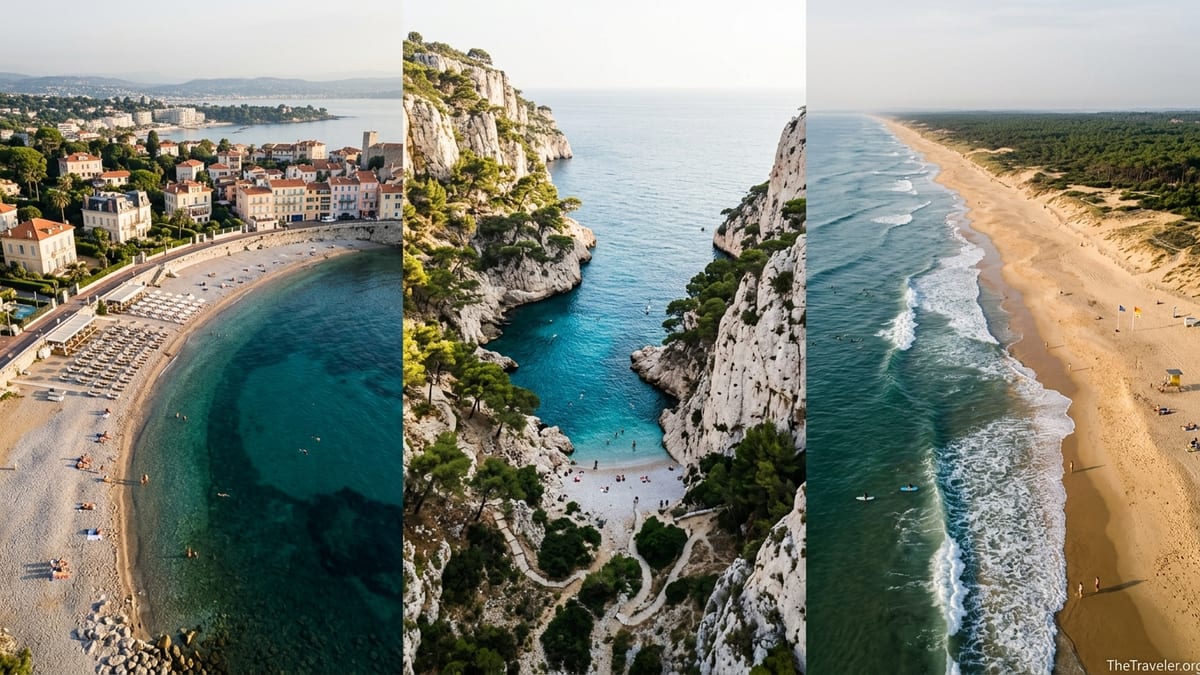
Côte d’Azur: Glamour Resorts and Sheltered Swimming
The Côte d’Azur, running roughly from Menton to Cannes, is where many first‑timers picture "the south of France": corniche roads, Belle Époque villas, and private beach clubs with waiters in pressed white shirts. Beaches here are often narrower and more urban, with a mix of pebbles and sand, but they excel for serviced days out and easy logistics. In Nice, for example, you can base yourself in a mid‑range seafront hotel one block off the Promenade des Anglais, expect summer room rates from around 220 to 350 euros per night, and have staffed public and private strands within a five‑minute walk for confident swimmers and teens.
This coast works especially well for couples and travelers who value atmosphere and dining over raw beach wilderness. Places like Villefranche‑sur‑Mer and Beaulieu‑sur‑Mer have small, sheltered coves where the water stays calm even on breezy days, handy if you prefer floating and snorkeling to waves. In Théoule‑sur‑Mer, Pointe de l’Aiguille offers a more natural feeling with cliffs and pine trees above clear water, yet you are still minutes from hotels and bus connections. Family travelers should be aware that many central beaches are pebbly and shelves can be quite steep, so younger children may be more comfortable in spots with gentler entries such as Antibes’ sandy town beaches.
For resort stays with a classic Riviera look, Cannes, Antibes and Juan‑les‑Pins are the main hubs. A four‑star hotel with its own beach concession in high season can easily run 350 to 600 euros per night, and hiring a lounger at a private beach might add 25 to 50 euros per person per day, depending on location and extras. In return, you get lifeguards, changing cabins, hot showers and restaurant service directly to your sunbed, which many visitors find worth the premium for one or two indulgent days. Nightlife is close at hand, and train links make it easy to combine several resort bases in a single week without renting a car.
If you want a quieter Côte d’Azur feel without losing the Riviera polish, look at smaller communities between major names. Mandelieu‑la‑Napoule, for example, has a castle‑backed beach and modestly priced three‑star hotels on or near the seafront, with double rooms in shoulder season (May, late September) often between 120 and 180 euros. You still get the same bright Mediterranean light and easy train access, but with family‑run restaurants replacing velvet‑rope beach clubs.
Var & Saint‑Tropez: Classic Riviera Beach Resorts and Family Sands
Move west into the Var and the Riviera opens out. Between Saint‑Raphaël and Toulon you find more sandy bays, pine‑backed coves and traditional seaside towns that feel immediately more relaxed than central Nice. The headline destination is Saint‑Tropez, especially Pampelonne Beach, a long sandy arc lined with beach clubs that range from boho shacks with beanbags to high‑design decks favoured by yacht owners. Renting two loungers and an umbrella at a mid‑range club in high summer often starts around 80 to 120 euros for the day, rising in the front rows and at the most fashionable venues.
Just along the same peninsula, you can slip away from the glitz. Ramatuelle’s Plage de l’Escalet, with its mix of sand, smooth rocks and clear water, attracts more snorkels than stilettos and is popular with couples and families who do not need full service all day. You will still find seasonal snack bars and kayak rentals, but it feels more like a holiday village cove than an outdoor catwalk. Inland, campgrounds and rental villas lower the overall budget compared with staying in Saint‑Tropez town, where boutique hotels easily exceed 400 euros per night in July and August.
Farther west, resorts such as Bandol, Sanary‑sur‑Mer and La Ciotat illustrate why many French families choose the Var for beach holidays. Bandol’s central Plage de Rènecros sits in a sheltered bay with soft sand and gently sloping water that suits smaller children, plus lifeguards in peak season. A simple seafront apartment here in August might run 150 to 220 euros per night, significantly less than an equivalent set‑up near Cannes. Sanary‑sur‑Mer couples a traditional harbor and evening markets with several supervised sandy beaches that are walkable from most town‑center hotels.
Travelers seeking quieter escapes without giving up swimming quality should consider the less famous coves between these towns. Many are signed from the coastal road with a simple "plage" marker and require a short walk through pines to reach. Outside school‑holiday peaks in late July and August, you can often find space even at midday, and water temperatures in late June and early September remain inviting for long swims.
Marseille & the Calanques: Dramatic Coves and Wild Swimming
The coastline around Marseille and Cassis is very different in character from the sandy Riviera. Here, the Calanques National Park cuts the shore into narrow, fjord‑like inlets with limestone cliffs, turquoise water and pebble or shingle beaches. Famous names include the calanques of Sormiou, Morgiou, En‑Vau and Port‑Pin, which attract hikers, swimmers and kayakers rather than sunbed crowds. Reaching them usually means either a steep walk of 30 to 60 minutes from signed trailheads, a seasonal shuttle plus shorter walk, or a boat or kayak tour from Marseille, Cassis or La Ciotat, which might cost from around 35 to 70 euros per person for a half‑day trip depending on the operator and season.
This area is ideal for travelers who value scenery and clear water more than amenities. At Port‑Pin, for example, you spread your towel on stones under pine shade and slip into water that feels like a natural swimming pool, but there are no beach bars and only limited toilets near the trail junctions. Cassis’ own town beaches such as Bestouan and Grande Mer offer a compromise: you can stay in a small hotel in the village, expect summer rates of roughly 180 to 280 euros for mid‑range rooms, and walk to both serviced beaches and hiking trailheads. In Marseille, urban strands like Prado Sud or Corbières provide lifeguards, playgrounds and snack stands, better suited to families who want an easier beach day between city sightseeing.
Because the Calanques are inside a protected national park, access is regulated in summer and on high fire‑risk days. Roads to some calanques close to regular traffic, and on certain days in July and August foot access can require an advance reservation, which is free but strictly controlled. Travelers who arrive with a rental car on a hot morning and expect to park beside a wild cove often find gates closed and should be prepared to reroute to urban beaches along Marseille’s Corniche or to the gentler Côte Bleue coast between Marseille and Martigues. Planning a day here usually means checking local park information the evening before and carrying sufficient water, sturdy footwear and a dry bag for valuables if you plan to swim off rocks rather than a sand strip.
For couples and solo travelers who enjoy low‑key, local atmospheres, villages on the Côte Bleue such as Niolon and Carry‑le‑Rouet give you rocky coves and small harbors within a short train ride of central Marseille. Accommodation options include simple waterfront hotels, guesthouses and holiday apartments, often starting below 150 euros per night outside August. You can swim from stone platforms early in the morning, take a midday train into Marseille’s Old Port for lunch, and be back on a quiet terrace by sunset, a very different rhythm to the Côte d’Azur resort scene.
Occitanie’s Mediterranean: Big‑Sky Sands and Laid‑Back Family Resorts
West of the Rhône, the Occitanie region offers an almost continuous line of long, flat sandy beaches from the Petite Camargue to the Spanish border. Here, names like Le Grau‑du‑Roi, La Grande‑Motte, Palavas‑les‑Flots, Cap d’Agde, Narbonne‑Plage, Gruissan and Argelès‑sur‑Mer are popular with French, Belgian and German families looking for space and simpler prices than the Riviera. The tone is less about luxury hotels and more about holiday apartments, campsites with pools and mid‑range three‑star hotels, where in high season doubles often start between 120 and 180 euros, and outside July and August can fall below 100 euros.
These beaches particularly suit travelers who prioritize shallow water and open sand for children. Espiguette, near Le Grau‑du‑Roi, is a good example: a huge protected beach backed by dunes where you may walk 10 or 15 minutes from the parking area to reach the sea, then find yourself with plenty of space even on busy weekends. Facilities are limited to seasonal snack bars, lifeguard posts and toilets, so many families bring their own umbrella, cooler and beach toys and settle in for the day. Closer to towns, family‑oriented resorts such as Argelès‑sur‑Mer and Canet‑en‑Roussillon have supervised central beaches, cycle paths and evening promenades with ice‑cream stands and casual restaurants.
For quieter escapes, Occitanie also hides pockets of character. Gruissan, with its Plage des Chalets lined by wooden stilt houses, offers a cinematic but relaxed setting at more approachable prices than Saint‑Tropez. Most accommodation consists of holiday rentals and small hotels; expect summer weekly apartment rates that undercut the Riviera by a wide margin, particularly if you book a back‑second‑row property a short walk from the sand rather than one directly on the seafront. Nearby, windier spots such as Leucate attract kitesurfers and windsurfers, while smaller creeks around the Côte Vermeille towards Collioure feel almost Catalan, with rocky coves and colorful villages.
Occitanie’s Mediterranean is less ideal if you dream specifically of upscale beach clubs or dramatic coves. Beach bars tend to be seasonal wood structures with plastic chairs instead of designer decks, and the horizon is often a straight line of sand and sea. That said, this simplicity can be an advantage if your priority is a week of straightforward swimming and sandcastle‑building without worrying about formal dress codes or high restaurant prices. Supermarkets and beach gear shops in these resorts target long‑stay self‑caterers, so it is easy to pick up parasols, boogie boards and inflatables at reasonable prices once you arrive rather than packing them from home.
Southwest Atlantic: Surf Capitals, Wide Beaches and Wild Dunes
Turn the corner at the Spanish border and the coast changes again. From Biarritz and the Basque Country up through Hossegor, Seignosse, Capbreton and the Landes, the Atlantic delivers long, straight beaches, rolling dunes and powerful beachbreak waves. This is mainland Europe’s surf capital, home to events that have attracted the world’s best surfers and a dense network of surf schools and board‑rental shops. In Hossegor, for instance, the beaches of La Gravière and La Nord are famous for hollow, heavy waves that intermediate and advanced surfers travel specifically to ride in autumn, while nearby La Sud and Capbreton’s more sheltered spots are better for lessons and cautious beginners.
Non‑surfers also find plenty to enjoy here. The sands around Seignosse’s Le Penon or Les Estagnots stretch for kilometers, backed by pine forest and campground after campground. A basic but comfortable mobile‑home rental for a family of four in July might cost from around 900 to 1,300 euros per week, often including shared access to pools and kids’ activities. Biarritz, by contrast, feels more like a compact coastal city with Belle Époque architecture, a central market and several distinct beaches, including Côte des Basques, which is popular with longboarders and has a sociable, mixed‑ability surfing scene. Here, you can combine half‑day beginner surf lessons that run from roughly 40 to 60 euros per person with afternoons exploring Basque culture and food.
The Atlantic coast suits active travelers, surf‑curious couples and families with teenagers more than those who need bathtub‑calm water. Even in midsummer, Atlantic waves and currents can be strong, so lifeguarded areas marked by colored flags are the place to swim. Parents who want small children to paddle safely often choose more sheltered locations like Saint‑Jean‑de‑Luz or Hendaye, where natural bays and headlands tame the swell and create a sort of giant sea pool at low to mid‑tide. Accommodation ranges from surf hostels with dorm beds from around 35 to 50 euros per night in shoulder season to smart seafront hotels in Biarritz that sit in the 220 to 350 euro range in summer, not unlike mid‑range Riviera rates.
If your dream trip revolves primarily around surfing, the shoulder seasons of late May to June and September to early October often provide a balance of workable swells, milder crowds and lower prices compared with the July–August peak. In September, for example, you might wake to early‑morning glassy waves at Hossegor, share a line‑up with a mix of locals and visiting surfers, then eat a reasonably priced set lunch at a café around the central square. Rental cars are useful here, as many of the best sandbanks and peaks lie in stretches of coast forested and separated from towns by dunes; public transport is limited and walking between spots can be time‑consuming under summer sun.
Choosing the Right Coast for Your Style of Beach Holiday
When you compare these coasts side by side, each clearly matches a certain style of trip. Travelers seeking resort polish, chic people‑watching and services directly on the sand will likely gravitate to the Côte d’Azur and the Var’s better‑known resorts, where private beaches and designer hotels are part of the experience. Those who want spectacular scenery, cliff‑backed coves and clear water without luxury trimmings will find the Marseille and Calanques area compelling, especially if they are comfortable walking to reach their swimming spots and planning around park rules.
Families with young children or anyone who simply wants space, gently shelving sand and a relaxed budget often prefer the Occitanie Mediterranean coast. Here, wide beaches such as Espiguette, Narbonne‑Plage and Argelès‑sur‑Mer balance easy access with room to play, and resort infrastructures are built around holiday apartments, campsites and mid‑range hotels rather than five‑star complexes. Surf‑oriented travelers and active couples, meanwhile, will most likely be happiest along the southwest Atlantic, basing themselves in places like Biarritz, Hossegor, Seignosse or farther north in the Gironde, where you can fill a week with surf sessions, bike rides through forests and sunsets over the dunes.
Timing can influence your choice as much as geography. In July and August, all these coasts are busy, but pressure is felt differently: private beaches of the Côte d’Azur pack loungers side by side, Calanques hiking paths become crowded and car parks fill early, while Occitanie’s huge sandy bays absorb crowds more easily and still offer quieter corners if you are willing to walk. The Atlantic sees its warmest water in late summer but also its biggest surf later in the season, which can challenge beginners. Spring and autumn are excellent moments for couples and flexible travelers, when hotel rates ease throughout the south and temperatures often remain comfortable for swimming, especially on the Mediterranean side.
Budget is the final filter. Broadly speaking, Riviera resorts and central Biarritz command the highest prices for seafront stays, while Occitanie’s Mediterranean and smaller Atlantic surf villages present the best value, particularly if you self‑cater. Wild coves in the Calanques cost less in nightly rates but more in effort and advance planning. By sketching out how you want to spend a typical vacation day, whether it is receiving aperitifs to your lounger or hiking to a hidden inlet with a picnic, you can quickly see which part of southern France aligns with your expectations.
FAQ
Q1. Which part of southern France is best for a classic Riviera resort stay?
For traditional Riviera glamour with promenade strolls, beach clubs and upscale hotels, focus on the Côte d’Azur between Nice and Cannes or on Saint‑Tropez and nearby Var resorts.
Q2. Where should I go if I want good surfing in southern France?
The southwest Atlantic coast around Biarritz, Hossegor, Seignosse and Capbreton offers the most consistent surf, surf schools and board rentals for all levels.
Q3. Which beaches are most suitable for families with young children?
Look to the wide, gently shelving sands of Occitanie, such as Espiguette, Argelès‑sur‑Mer and Narbonne‑Plage, or sheltered bays like Bandol and Saint‑Jean‑de‑Luz.
Q4. Are the Calanques near Marseille good for a relaxed beach day with facilities?
The Calanques are better for scenic swims and hiking than for serviced beach days; for facilities, use Marseille’s city beaches or Cassis’ town strands instead.
Q5. Where can couples find quieter, romantic beach spots without complete isolation?
Consider smaller Riviera towns such as Théoule‑sur‑Mer or Mandelieu, village settings on the Côte Bleue near Marseille, or characterful resorts like Collioure and Gruissan.
Q6. Which area offers the best value for money on a peak‑season beach holiday?
Generally, the Occitanie Mediterranean coast and many southwest Atlantic surf villages provide more affordable accommodation and dining than the Côte d’Azur or central Biarritz.
Q7. Is it easy to swim on the Atlantic coast, or is it only for surfers?
Swimming is possible and enjoyable on the Atlantic, but waves and currents can be strong, so you should stay within lifeguarded zones and follow local flag warnings.
Q8. Do I need a car to enjoy these beach regions?
You can manage without a car on the Côte d’Azur and in Biarritz thanks to trains and buses, but a car is very helpful for reaching Calanques trailheads and more remote Atlantic or Occitanie beaches.
Q9. When is the best time to visit for warm water and fewer crowds?
Late June and September usually balance pleasant sea temperatures with lighter crowds across most of southern France, though the Atlantic tends to be cooler earlier in the season.
Q10. Which coast should I choose if I want mostly quiet reading and swimming days?
If you prefer calm routines over nightlife, look at smaller Var and Côte Bleue towns, wide Occitanie beaches with space to spread out, or sheltered Atlantic bays like Hendaye.