


The French Riviera is often imagined as one endless golden beach, but the reality on the ground is far more interesting. Within an hour’s drive, you move from wide sandy bays to deep-pebble coves, from barefoot-friendly family strands to glamorous private clubs with champagne on ice. Understanding how Pampelonne, Cannes, Antibes, Villefranche, Nice and the eastern Riviera differ is the key to choosing the right base for your trip, especially if you are traveling with children or do not want to spend every day paying for sunbeds.
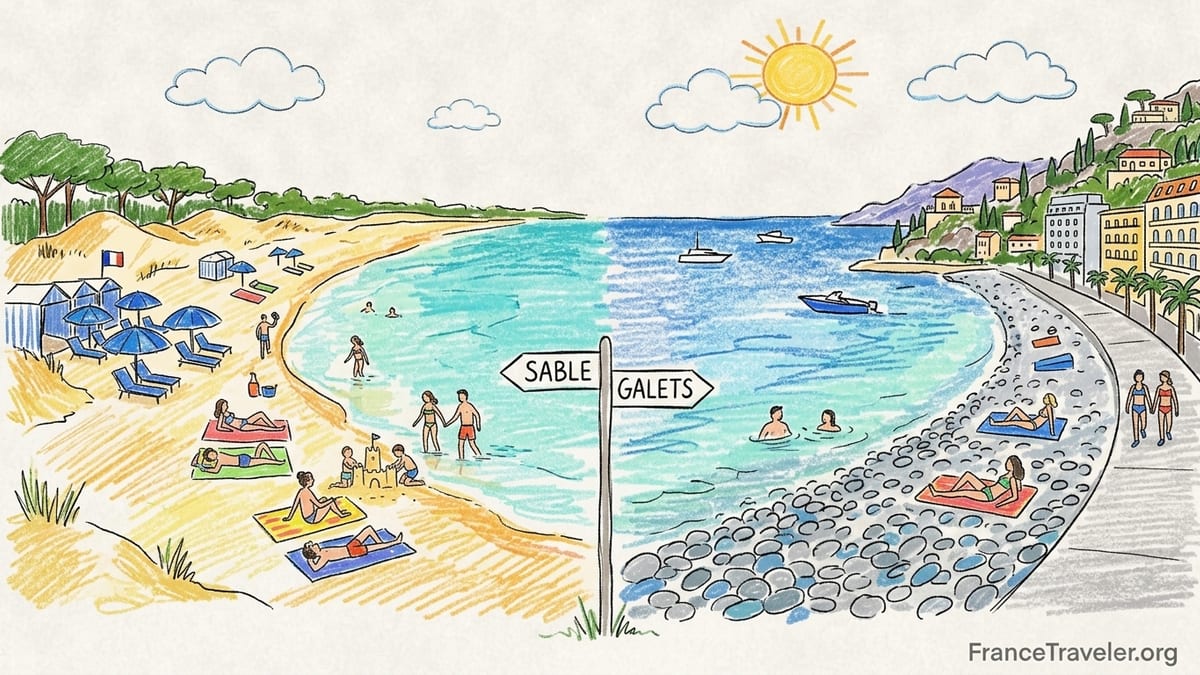
Sand vs Pebbles: How the Riviera’s Beaches Really Differ
The biggest surprise for many first-time visitors is that the eastern half of the French Riviera is mostly pebbles, not sand. Nice’s entire seafront along the Promenade des Anglais is covered with rounded grey galets, split between public sections and private beach concessions. The same is broadly true in Villefranche-sur-Mer and on much of Cap-Ferrat, where the beaches are narrow and stony, backed by steep hillsides and villas. This makes the water beautifully clear for swimming, but it is far less forgiving for toddlers and anyone who likes to stroll at the waterline.
By contrast, the classic sandy “Riviera” look is concentrated around Pampelonne, Cannes and the wider Antibes and Juan-les-Pins area. Pampelonne, a 4.5 kilometre arc of pale sand near Saint-Tropez, is one of the longest true sand beaches on the coast. Cannes promotes its Croisette and Midi beaches specifically as fine sand, and the town map clearly marks this stretch in contrast to the pebble shores farther east. Antibes and Juan-les-Pins also have soft, buff-coloured sand with gently shelving entry to the sea, which is why many French families base themselves here instead of in Nice when they are traveling with young children.
In practical terms, sand means you can get away without water shoes, build sandcastles, and let younger kids run in and out of the shallows. Pebbles reward those who come for swimming and scenery rather than play. A typical day in Nice or Villefranche involves bringing or renting beach shoes, spreading a thick mat on the stones and walking straight into deep, clear water that stays cool even on peak August afternoons.
These differences also shape pricing. Sandy areas with space, such as Plage du Midi in Cannes or some stretches of Antibes, have larger public areas where you can lay a towel for free. In denser, pebble-based resorts with limited flat shoreline, private concessions are closer together and sunbed prices are often higher, particularly on Nice’s most central private beaches and in the smarter bays of Cap-Ferrat.
Pampelonne near Saint-Tropez: Wide Sand and High Glamour
Pampelonne Beach, technically in the commune of Ramatuelle rather than Saint-Tropez itself, is the Riviera’s archetypal long sandy strand. Around 4.5 kilometres of sand curve along a shallow bay, backed by low dunes and vineyards rather than tower blocks. Here you find both open public sectors and a long run of private beach clubs, from laid-back wooden-deck spots with simple sunbeds to high-gloss venues that host champagne-fuelled parties in July and August.
Access and parking are crucial details. Pampelonne is not easily reached by train, so most visitors arrive by car, scooter or shuttle from Saint-Tropez or nearby campsites. Several signed access points off the beach road lead to parking areas behind the dunes. In low season you may pay only a modest fee for the day, but in July and August budget for a noticeable charge and arrive before late morning to avoid circling for a space. Public sections of the beach sit between the clubs, so even if you are not paying for a lounger you can still enjoy the same fine sand and swimming, though without showers or waiter service.
Private clubs are where Pampelonne’s character really shows. Historic names such as Club 55 share the sand with newer concepts that lean into beach design and music. A pair of sunbeds and an umbrella in high season often runs from the equivalent of a casual lunch to the cost of a mid-range hotel room night, depending on the club and how close you are to the waterline. Families who still want Pampelonne but not the party scene can look for the quieter, more family-oriented clubs toward the Ramatuelle end of the bay, which often have kids’ menus, calmer music and a more relaxed dress code.
Accommodation around Pampelonne ranges from luxury properties hidden in the pines to mid-range hotels and a network of well-equipped campings a short drive inland. This dispersal means you will almost certainly be driving to the beach each day. For a week-long stay, it can make sense to mix Pampelonne days with excursions to smaller local coves and villages, since constant access fees and club prices add up quickly for a family of four.
Cannes & Juan-les-Pins: Soft Sand, Glamour and Easy Access
Cannes is often the most straightforward introduction to Riviera beach life for visitors who want sand without a car. The city’s coastline divides into two main sandy areas: the Croisette beaches in front of the main hotels, and the long Plage du Midi stretching west from the Old Port. The official city map and tourism material highlight these as “plages de sable fin,” and they really are soft underfoot, especially compared with Nice. The town manages a mix of public and private areas. Along the Croisette, public strips such as Plage Macé and the municipal Zamenhof beach punctuate the run of private clubs, while Plage du Midi offers larger public stretches interspersed with simpler private operations.
For families, Plage du Midi is a standout choice. It is a broad, gently sloping beach with views back to the old town and islands offshore. The sand here allows for bucket-and-spade play, and the shallows remain shallow for a fair distance, which reassures parents. The city’s information notes that the Midi beaches are heavily public, with only some private concessions, which in practice means a good amount of free towel space even in summer. On the Croisette, public municipal beaches like Plage Macé and Zamenhof offer supervised swimming in high season and basic facilities at lower prices than the five-star hotel clubs beside them.
Cannes also shines for access without a car. The rail station is a short walk from both the Croisette and Plage du Midi, so a family staying in Nice, Antibes or even farther along the line can hop on a regional train and be on the sand within minutes of arrival. Local buses connect the western suburbs and La Bocca area with the city centre and beaches, and there is some on-street and underground parking along the waterfront. In peak months, underground garages near the Palais des Festivals and the side streets just behind the Croisette can fill by late morning, so aim for earlier starts or plan to travel by train.
Just up the coast, Juan-les-Pins extends the sandy experience. This resort area west of Antibes town has a long crescent of sand facing the Bay of Juan, lined with pine trees and Belle Epoque villas inland. Many French families choose Juan-les-Pins because the beach is sandy, the water is usually calmer than on exposed stretches, and everything is compact. Private beach clubs are common along the main strip, offering sunbed and parasol packages. Prices are broadly comparable to mid-range Cannes clubs, though you may find better deals if you avoid the absolute high season weeks.
Antibes: Sandy Town Beaches and Sheltered Coves
Antibes straddles the divide between resort and old town, and its beaches reflect that variety. Around the headland, you will find both compact town beaches with soft sand and more rugged coves and rocky ledges for snorkeling. The family-friendly focus is strongest around the main sandy strands close to the historic centre and train station, which many French guidebooks recommend specifically for visitors who want sand without the busier feel of Cannes.
Plage de la Gravette, tucked just outside the old town walls, is a classic example. It is a curved pocket of sand with enclosed, gently shelving water and lifeguard supervision in high season, ideal for children who are not strong swimmers. A short walk away, Plage du Ponteil and Plage de la Salis offer wider sandy areas with views of the old town ramparts and the Alps beyond. These beaches are popular with locals, especially on weekends, but retain a community feel that contrasts with the more overtly glamorous Croisette scene.
One of Antibes’ advantages is the way beach options cluster around public transport. The main SNCF station sits only a few minutes’ walk from the town beaches, making it easy to stay elsewhere on the Riviera and day-trip in. Several car parks serve the waterfront, but spaces fill quickly on sunny days; arriving early or relying on trains can save frustration. Public beaches dominate here, with only a handful of private clubs, so you can often enjoy a full day with nothing more than the cost of a café lunch and an ice cream from a stand behind the promenade.
On the Cap d’Antibes itself, the character changes. Small coves and rocky inlets with patches of sand or gravel offer clearer water and good snorkeling. These spots appeal more to couples and confident swimmers than to families with prams, as access paths can be steep and facilities minimal. If you are staying in Antibes with children, a practical approach is to spend most days on the main town beaches and reserve a half-day for a coastal path walk or a dip off the rocks when everyone is comfortable in deeper water.
Villefranche-sur-Mer & Cap-Ferrat: Deep Bays and Pretty Pebbles
East of Nice, the coastline tightens into deep, fjord-like bays framed by steep hillsides. Villefranche-sur-Mer embodies this geography. Its main strand, Plage des Marinières, is a long, narrow shingle and pebble beach curling along the inner edge of the bay, directly beneath the coastal railway line. Trains from Nice and Monaco stop here, and from the station it is a short walk down to the water. The beach’s orientation means long sun exposure through the day and usually calm water, sheltered from open-sea swells.
Plage des Marinières is mostly public, with a few small concession areas renting sunbeds or kayaks. The pebbles are finer than on some parts of Nice, but most visitors still appreciate water shoes for easier entry and exit. There is limited roadside parking along the seafront, which fills very early in summer, so train access is a major plus. Families use Villefranche as a quieter alternative to Nice, but it is best suited to children who do not mind stones underfoot and are confident in relatively deep water close to the shore.
Across the bay, the Cap-Ferrat peninsula offers some of the Riviera’s most photogenic small beaches, again mostly pebbled or a mix of sand and shingle. Plage de Passable on the western side faces Villefranche, with a shaded backdrop of trees and a private club section offering sunbeds, restaurant service and paddleboard rentals beside a free public zone. On the eastern side, Paloma Beach has similar arrangements in a setting of dramatic cliffs and turquoise water. Both beaches are smaller than Pampelonne or Cannes, so sunbed availability is limited and prices typically higher, reflecting the exclusive nature of the peninsula.
Reaching these Cap-Ferrat beaches usually involves a combination of train to Beaulieu-sur-Mer or Villefranche, followed by local buses or a walk, or driving in and searching for one of the limited parking areas near the coastal path access points. The reward is a sense of retreat: no high-rise backdrop, just villas in the pines and clear water. These spots are excellent for couples or older families focused on swimming and snorkeling rather than sand play, and they pair well with an overnight stay in Nice or Villefranche, using public transport to avoid the peninsula’s tight parking in high season.
Nice: Pebble Beaches, Urban Energy and Train Convenience
Nice is the Riviera’s largest city and the hub for most travelers, and its beaches reflect that urban energy. From the airport almost to the old town, around seven kilometres of shoreline are edged by the Promenade des Anglais, with a continuous stretch of grey pebbles below. City information confirms that all of these beaches are pebble-based. Public sections alternate with around a dozen private beaches where you can rent loungers and umbrellas. This mix gives visitors a choice between low-cost days on a towel and more comfortable but pricier club experiences.
The pebbles shape how you use the beach. The slope into the sea is relatively steep compared with sandy resorts like Cannes or Antibes, so the water deepens quickly. This is ideal for adults and confident swimmers who want refreshing dips, but it demands closer supervision of younger children. Many locals and frequent visitors bring rubber-soled water shoes and thick beach mats. On a practical level, Nice’s private beaches earn their keep here, since their wooden walkways, ladders and cushioned mattresses make the stones less punishing and the entry to the sea easier.
There is another trade-off: access is exceptionally easy. Unlike Pampelonne or parts of Cap-Ferrat, Nice’s beaches are directly across from hotels, apartments and tram stops. The airport tram and local buses run along or near the seafront, and visitors using the city as a base can be on the beach within minutes of stepping outside their accommodation. Many Nice hotels sit within one or two blocks of the promenade, so a family can return to their room quickly for naps or breaks, something that is harder to manage in more dispersed resorts.
Nice’s seafront is also heavily regulated and serviced. In high season, specific sections of the beach are patrolled by lifeguards, with posted flags indicating conditions. There are public showers spaced along the promenade, and several dedicated “handiplage” areas where access and equipment are adapted for visitors with reduced mobility. Dogs are generally prohibited, except on two designated dog beaches toward the western end of the bay. These details matter for planning, particularly if you are visiting outside peak months and want to be sure which sections will have supervision and facilities on your travel dates.
Public vs Private, Sunbeds, Parking and Where to Stay
Across all of these destinations, the same basic pattern repeats: a mix of free public areas and private beach concessions renting sunbeds, umbrellas and often running a full restaurant or bar. In Cannes, the city notes that Plage du Midi has many public sections with only some private clubs, while the Croisette is more heavily privatized. In Nice, public stretches alternate with private concessions roughly every hundred metres or so along the most central section of the Promenade des Anglais. On Pampelonne, public gaps between famous clubs allow you to enjoy the sand without paying for a lounger, though parking and food will still cost you.
Sunbed prices vary widely. On central Nice beaches or the smarter clubs of Cannes and Cap-Ferrat, a pair of loungers and an umbrella in high summer can easily become one of your largest daily expenses, rivalling a moderate restaurant bill. On more relaxed stretches such as parts of Plage du Midi or some Juan-les-Pins clubs outside peak weeks, prices are noticeably lower, and half-day or late-afternoon rates can offer better value. If you are content with towels on the sand, you can reduce costs significantly, especially in Antibes where public beaches dominate and simple facilities like showers are provided by the town.
Parking is the other big practical difference between resorts. Nice and Cannes offer underground car parks just behind the seafront, but these fill quickly on sunny weekends and during major events such as the Cannes Film Festival or big concerts. Plage du Midi and the western beaches of Cannes have more roadside spaces, though competition is stiff in July and August. Villefranche and Cap-Ferrat have very limited seafront parking, which is why so many visitors arrive by TER regional train and then walk or take local buses. Pampelonne has multiple car parks behind the dunes accessed from the beach road; these are convenient but often come with higher daily charges because there is no alternative public transport.
Choosing where to stay depends on your priorities. For sandy family beaches with an easy, car-free routine, central Cannes, Juan-les-Pins or Antibes offer the best balance: close to the sand, full services, gentle water and straightforward train access up and down the coast. For clear water, pebbles and dramatic scenery, base yourself in Nice, Villefranche or Beaulieu and day-trip to sandier bays when you want variety. For a splurge built around chic beach clubs and evenings in Saint-Tropez, consider a hotel or villa near Pampelonne and factor in car hire or private transfers to move around.
The Takeaway
What looks like one simple blue line on the map is, in reality, a series of very different beach worlds. West of Nice, around Cannes and Antibes, the French Riviera delivers the soft sand many visitors instinctively picture, with family-friendly slopes into the sea and a good amount of public space where you can simply lay a towel. East of Nice, pebble shores dominate, rewarding swimmers and snorkelers with clear water and deep bays, at the cost of barefoot comfort and sandcastle terrain.
If you are traveling with small children or strongly prefer sand underfoot, basing yourself in or near Cannes, Juan-les-Pins or Antibes will make daily life easier. You can always day-trip by train to Nice or Villefranche for a change of scene. If you are a couple or group of adults who value swimming, sea views and restaurant choice over sand quality, Nice, Villefranche and the Cap-Ferrat coves deliver memorable experiences with efficient transport and a lively dining scene.
For those drawn to Riviera glamour, Pampelonne offers the archetypal Saint-Tropez setting, with long sand, polished beach clubs and price tags to match. It works best if you are comfortable driving and prepared for higher daily budgets. In all cases, a little planning around sand versus pebbles, public versus private, and the realities of parking and train access will ensure your French Riviera beach holiday matches the dream you have in mind, rather than the one in the postcards.
FAQ
Q1. Which French Riviera resort is best for families who want sandy beaches?
For straightforward, sandy family beaches with gentle water and lots of public space, Cannes, Juan-les-Pins and Antibes are the strongest choices. Plage du Midi in Cannes and beaches like Plage de la Gravette or Plage de la Salis in Antibes offer soft sand, supervised swimming in season and easy access to cafés and toilets, all within a short walk of train stations and town centres.
Q2. Are Nice’s beaches suitable for young children?
Nice’s beaches are mostly deep pebbles with a steeper slope into the sea, so they are better for confident swimmers than toddlers. Families still use them, but most bring water shoes and thick mats, and keep younger children close to the shore under supervision. If sand and shallow entry are priorities, many parents choose to stay in Cannes or Antibes and visit Nice as a day trip instead.
Q3. Can I find free public beaches in Cannes, or is everything private?
Cannes has a mix of public and private beaches. Along the Croisette, public stretches such as Plage Macé and the municipal Zamenhof beach sit between private clubs, while Plage du Midi to the west is largely public with only some private concessions. You can spend full days on free sand in Cannes if you are happy to bring your own towels and shade.
Q4. Is Pampelonne Beach only for expensive beach clubs?
No. Pampelonne has a long run of high-end clubs, but there are also substantial public sections between them where you can lay a towel for free and swim in the same water. The costs come mainly from parking, food and drink, and sunbed rentals if you choose a club. Budget-conscious visitors often mix one or two “club days” with simpler public beach days.
Q5. How easy is it to reach these beaches by train instead of renting a car?
Train access is excellent for Cannes, Antibes, Juan-les-Pins, Nice and Villefranche-sur-Mer, where stations sit within a short walk of the main beaches. Many travelers base themselves along this rail line to avoid parking issues and summer traffic. Pampelonne and most Cap-Ferrat coves, by contrast, are not directly on the train line, so you will need local buses, taxis or a car to reach them comfortably.
Q6. Do I need to book sunbeds in advance in summer?
In July and August, advance reservations are wise at the most popular private beaches in Cannes, Nice, Pampelonne and on Cap-Ferrat, especially for front-row loungers or weekends. Many clubs accept same-day walk-ins for back rows, but you may find only limited availability by late morning. On public beaches you cannot reserve space, so arriving earlier in the day helps secure a comfortable spot.
Q7. Where are the clearest waters for swimming and snorkeling?
Pebble and rocky areas tend to offer the clearest water. Villefranche-sur-Mer’s Plage des Marinières, the coves on Cap-Ferrat, the rocky edges of Cap d’Antibes and parts of Nice’s seafront all reward swimmers with good visibility. Sandy bays like Cannes and Antibes are great for playing and paddling but can be a little cloudier near the shore, especially on busy days when the sand is stirred up.
Q8. Is it worth staying in Nice if I prefer sandy beaches?
Yes, if you value Nice’s city atmosphere and transport connections, you can still enjoy sandy days by using the regional trains. From Nice Ville station, you can reach Antibes, Juan-les-Pins or Cannes in under an hour and walk to their sandy beaches. Many visitors split their time this way: urban evenings and pebble swims in Nice, plus one or two sand-focused day trips west.
Q9. Are there accessible beaches for visitors with reduced mobility?
Several Riviera resorts provide adapted beach access in season, often known locally as “handiplage.” Nice and Cannes both designate specific sections of their seafront where ramps, adapted toilets and assistance into the water are available during supervised hours. These facilities are usually concentrated on the most central beaches, so it is worth checking which sections are operating on your travel dates.
Q10. When is the best time to visit Riviera beaches to avoid crowds?
The most crowded weeks are typically from mid-July to late August, especially around national holidays and major events in Cannes and Nice. For warm water but fewer crowds and more affordable sunbed prices, aim for late May to late June or early September to early October. During these shoulder periods, you are more likely to find same-day availability at beach clubs and easier parking, while still enjoying plenty of sunshine.