


The modern French Riviera itinerary is shorter and smarter than the old-fashioned two-week epic. Most travelers now give the Côte d’Azur five to seven days, use one main base such as Nice or Antibes, and then layer in well-planned day trips by train, bus or car to Monaco, Èze, Villefranche-sur-Mer, Cannes, Menton and beyond. This guide follows that real-world pattern and shows you exactly how to build an efficient, great-value coastal trip in 2026.
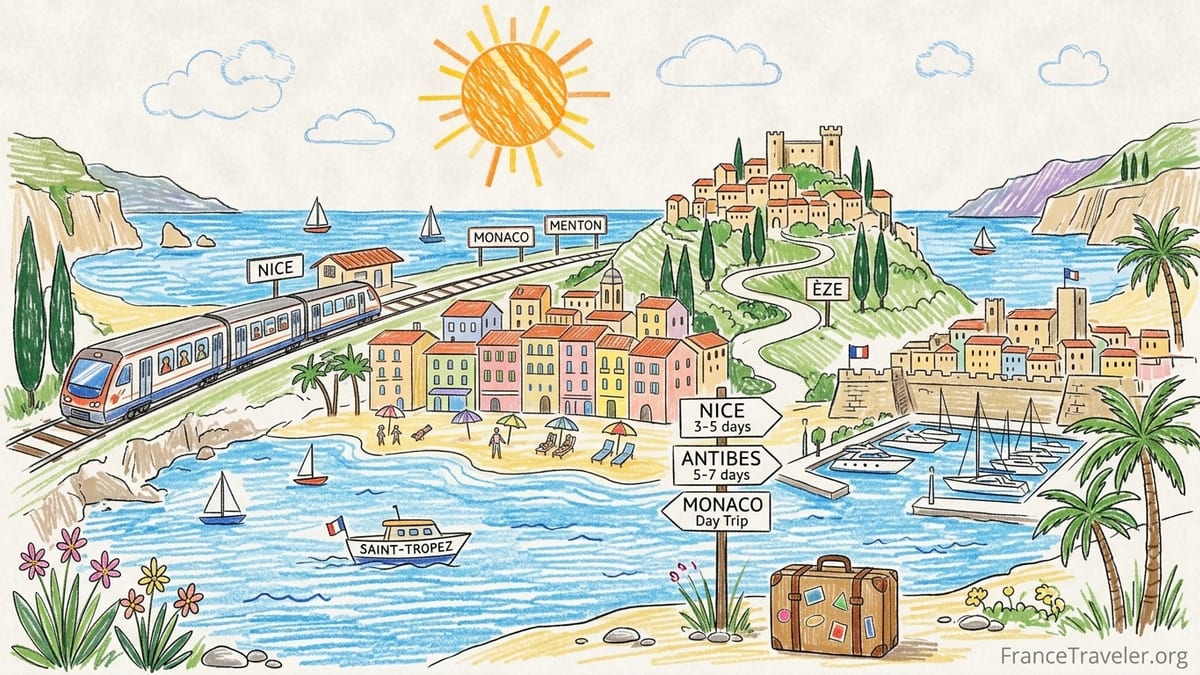
How Long to Spend on the French Riviera in 2026
Search results and recent tour brochures increasingly center on five-day and one-week French Riviera itineraries rather than long, slow grand tours. Many current 5-day plans combine Nice with Monaco, Èze, Antibes, Cannes and at least one slower beach day, balancing sightseeing with downtime instead of trying to cram in every hill town on the map. In practice, five full days is enough for a first visit, and seven gives you room for Menton or an organized Saint-Tropez excursion.
If you have five days, expect one full Nice day and three or four day trips using the coastal train. A sample pattern that mirrors current itineraries looks like: Nice, Monaco plus Èze, Antibes plus Cannes, Menton plus Villefranche, and a flexible final half day for shopping or the Promenade des Anglais. With seven days, you can repeat that structure and then add an inland art village such as Saint-Paul-de-Vence or a boat-based Saint-Tropez day that avoids the worst traffic.
Season will shape how you use those days. In July and August, crowds and heat push you toward early-morning sightseeing in places like Èze, an extended lunch in the shade, and beach time after 4 p.m. In May, June, September and early October you can comfortably walk Antibes’ ramparts or Cannes’ La Croisette all afternoon, then take a sunset swim before dinner. Winter trips focus more on markets, museums and coastal walks, with shorter daylight but fewer cruise groups.
Budget also matters. Current mid-range hotel rates in high season often sit between 180 and 300 euros per night in Nice and Antibes for central, air-conditioned doubles, with Cannes and Monaco generally higher. Because costs rise quickly as you add nights, a tightly planned five- or six-day trip can make more financial sense than drifting into a second week without a clear plan.
Choosing a Base: Nice, Antibes or Villefranche
Most recent guides and trip reports lean toward one main base instead of changing hotels every night. Nice is consistently recommended as the most practical hub, thanks to its international airport, two main train stations and dense tram network that links the airport to the center in about 25–30 minutes. From Nice-Ville station, regional TER trains typically reach Monaco in about 25 minutes, Antibes in roughly 20–25 minutes and Cannes in 35–40 minutes, which makes day trips simple.
Antibes appears in 2025 and 2026 itineraries as a strong alternative base, especially for travelers who prioritize sandy beaches and a smaller-town feel. Its medieval old town, Picasso Museum and marina sit within a compact area, and the TER network connects Antibes quickly to Cannes in one direction and Nice in the other. Many visitors who have already explored Nice once choose Antibes for a second trip, using it as a launchpad for Cannes, nearby Juan-les-Pins and inland perfume towns like Grasse on organized excursions.
Villefranche-sur-Mer, by contrast, is more often used as a scenic escape than as a main base. The pastel harbor and sheltered bay are just one train stop from Nice and under 10 minutes by TER, but accommodation options are more limited and often priced at a premium for sea views. As a result, a common pattern is to sleep in Nice, spend a lazy afternoon on Villefranche’s plage with a rental sunbed and simple beach lunch, then ride the train back in the evening.
Changing bases makes sense only a few times. If you have seven days or more and want a quieter second half, splitting between Nice and Antibes can work, for instance three or four nights in Nice to explore the eastern side of the coast, followed by two or three nights in Antibes to focus on Cannes, islands and inland villages. For a five-day trip, however, most travelers will lose time rather than gain variety by hotel-hopping.
Getting Around: Train, Bus or Car
Recent car-free itineraries underline how well the Riviera works by public transport, especially for the coastal string of Nice, Villefranche, Èze-sur-Mer, Monaco, Menton, Antibes and Cannes. The TER regional trains run frequently in daytime, and a typical 2026 one-way fare between Nice and Monaco or Nice and Antibes is roughly 4–7 euros in second class, purchased from station machines or via SNCF’s official app. Trains are usually faster and more reliable than traffic-choked coastal roads at peak times.
Buses fill in the gaps, especially for hilltop villages. To reach Èze Village without a car, you can take the TER from Nice to Èze-sur-Mer station, then connect to a local bus that winds up to the old stone village in around 15 minutes. Alternatively, direct buses from central Nice climb the Moyenne Corniche, but they can be slower in summer. Expect to pay just a few euros per ride. This combination of train plus bus is also how many day trips reach Saint-Paul-de-Vence, Vence or local perfume factories.
Renting a car is less about getting between major towns and more about reaching the less connected pockets of coastline. The road between Cannes and Saint-Tropez, for instance, includes long stretches without train access, and buses can be infrequent. Visitors who want to explore smaller coves, vineyard routes or the Esterel cliffs in detail often choose a short two- or three-day car rental in the middle of their trip, picking up in Cannes or Nice and dropping back before returning to purely urban days.
Parking costs and narrow streets are the trade-offs. Daily parking fees in Nice or Cannes garages commonly fall in the 20–35 euro range in 2026, and hotel parking can be limited. For that reason, many travelers blend modes: trains for Nice, Monaco, Menton, Antibes and Cannes, buses for hill villages such as Èze and Saint-Paul-de-Vence, and either a dedicated tour or a temporary car for more complex outings like Saint-Tropez or the inland Var countryside.
Core 5-Day Itinerary From Nice
A realistic five-day itinerary that closely reflects what current guides and trip planners recommend starts and ends in Nice, without changing hotels. On Day 1, check into a central Nice hotel near the Old Town or the Carré d’Or, drop your bags, and walk the Promenade des Anglais for a first sea view. Spend time in the Cours Saleya market, climb Castle Hill for a panorama and finish with a sunset swim at one of the public or private beach sections, where a sunbed plus umbrella typically runs between 25 and 40 euros per day in high season.
Day 2 covers Monaco and Èze in a single loop, now standard in many 5-day plans. Take an early train from Nice to Èze-sur-Mer, connect to the hillside bus and explore Èze Village before the crowds arrive, paying the small entrance fee to the Exotic Garden for cliffside views. By late morning, ride the bus back down, then continue by train along the coast to Monaco. Spend the afternoon between the Prince’s Palace quarter and Monte Carlo’s casino district, perhaps visiting the Oceanographic Museum, which is often highlighted as a family-friendly stop. Return by TER to Nice in the early evening.
Day 3 focuses on Antibes and Cannes. Take a morning train to Antibes, walk the old town ramparts, visit the Picasso Museum housed in the Château Grimaldi, and enjoy a street-side lunch in the market area. In the afternoon, ride the short train hop to Cannes for a stroll along La Croisette, people-watching near the Palais des Festivals and a swim off one of Cannes’ sandy beaches. As with Nice, private beach clubs here rent loungers and parasols, while public stretches remain free if you bring your own towel.
On Day 4, head east again for Menton and Villefranche-sur-Mer. Trains from Nice to Menton usually take about 40 minutes; once there, wander the pastel old town, sample local lemon-flavored treats and visit the seafront gardens if time allows. Return in the afternoon and break your journey at Villefranche. The small bay makes an atmospheric swimming and early dinner stop before you hop back on the train to Nice after dark. Day 5 then becomes a flexible buffer: revisit your favorite spot, fit in a museum such as the Matisse Museum in Cimiez or the Chagall Museum, or simply schedule one last unstructured beach day in Nice before departure.
Extending to 7 Days: Menton, Art Villages and Slower Beach Time
With a full week, you can slow the pace and deepen the trip rather than piling on more towns. One common approach is to keep the five-day structure then add two extra days for either inland villages or a deliberate break in a quieter base. If you stay in Nice the entire time, use Day 6 for an inland loop to Saint-Paul-de-Vence and Vence, both of which feature in 7-day group tour brochures. Typical visits involve cobbled lanes, art galleries and the Maeght Foundation, a modern art museum with gardens. Organized half-day or full-day tours from Nice usually include transport, at least one guided walk and sometimes a stop at a perfume factory in nearby Grasse.
The seventh day can become a beach-focused finale. Options include returning to Villefranche-sur-Mer to rent loungers for the full day, exploring just west of Antibes in Juan-les-Pins for softer sand and more resort-style cafes, or discovering one of the smaller coves on Cap d’Antibes via a marked coastal path. In late spring or early autumn, sea temperatures are often still comfortable for swimming, and restaurant terraces are generally less crowded than in peak summer.
Travelers who want variety in their surroundings might instead split their stay. For example, spend four nights in Nice to cover the eastern circuit of Monaco, Èze, Menton and Villefranche, then move to Antibes for two or three nights for easier access to Cannes, Juan-les-Pins and the Îles de Lérins via short boat rides. Because check-in and check-out days tend to eat into sightseeing time, this strategy works best for stays of at least seven nights, ensuring several full days in each base.
Another way to use the extra time is to dedicate an entire day to one town that interests you most. First-time visitors sometimes regret not lingering in Menton or Antibes because a half-day visit felt rushed. With a week, you can schedule one “intentional” day with no train back until evening, allowing for museum visits, long lunches and afternoon beach time without clock-watching.
When and How to Include Saint-Tropez
Saint-Tropez sits at the southwest edge of most French Riviera itineraries and requires deliberate planning. It does not lie on the same TER line that connects Nice, Antibes and Cannes, and the coastal road between Cannes and Saint-Tropez can be heavily congested in July and August, with driving times stretching well beyond two hours each way. For that reason, five-day itineraries based in Nice rarely include it, and when they do, it is usually as one long organized excursion rather than a spontaneous side trip.
The most practical ways to include Saint-Tropez on a short itinerary are either by boat or as part of a guided tour. Seasonal boat services typically run from Cannes or Saint-Raphaël to Saint-Tropez in around one hour and forty-five minutes to two hours, bypassing the worst road traffic and delivering you straight to the harbor. Prices vary by operator and season, but travelers should expect to pay several dozen euros per person for a same-day return ticket. This route is especially appealing during the peak summer season when traffic jams are most severe.
Guided full-day coach tours from Nice and Cannes are another option and remain popular in current itineraries sold through agencies and cruise lines. These usually combine Saint-Tropez with one or two other coastal stops or inland villages, and include round-trip transport, limited free time around the harbor and sometimes a boat cruise in the bay. The trade-off is less flexibility; you travel on the group’s schedule and may have limited beach time compared with an independent visit.
For those determined to explore Saint-Tropez by car, the most efficient approach on a short trip is to rent a vehicle in Cannes or Nice for one or two days, leave early in the morning to beat peak traffic and park in one of the signed lots outside the historic center, walking in from there. This tactic fits better in a seven-day itinerary where you can block off an entire day for the drive and allow for delays, rather than compressing the visit into an already tight five-day schedule.
Beach Time, Tours and What to Prebook
Balancing sightseeing with beach time is where well-structured itineraries stand out. Many 5-day and 7-day plans now build in at least two afternoons on the water, usually in Nice, Cannes, Antibes or Villefranche-sur-Mer. In Nice, the shoreline is mostly pebbled, so visitors often rent padded sunbeds from private beach operators along the Promenade des Anglais, who typically charge a fixed fee for a half-day or full day plus optional food and drink service. In Cannes and Juan-les-Pins, the sand is softer and better for families with children, with a mix of free public stretches and private clubs.
Certain experiences are worth reserving ahead, especially in high season. Small-group day tours from Nice that combine Èze and Monaco, or that include Saint-Paul-de-Vence and a perfume factory in Grasse, often run with minibuses of 8 passengers and can fill up weeks in advance for July and August dates. Prebooking a slot ensures you do not waste time trying to piece together buses on the morning of your trip and can be particularly helpful if you are nervous about driving mountain roads yourself.
Museum tickets are another case where advance planning can smooth your days. While most Riviera museums still sell same-day tickets at the door, certain special exhibitions or large events in Monaco and Cannes can generate queues. Checking current opening hours and, if available, reserving timed-entry tickets helps you avoid losing an hour of your limited coastal time waiting in line. This is especially relevant if you only have a single afternoon in Monaco or Menton.
Beach clubs in Nice, Cannes and Antibes often accept reservations for front-row loungers or cabanas, particularly on weekends and during festivals such as the Cannes Film Festival in May or major yacht shows. If your trip coincides with those events, consider calling or using a booking form a few days in advance to secure a spot. Outside of peak periods, you can usually walk up earlier in the day and still find space.
Sample 7-Day French Riviera Plan Using Two Bases
Travelers who prefer to experience more than one overnight atmosphere without overcomplicating logistics can follow a simple 7-day split between Nice and Antibes. Days 1 to 4 are based in Nice. After your arrival day and Nice orientation, dedicate Day 2 to Monaco and Èze as before, Day 3 to Menton with a stop in Villefranche-sur-Mer on the way back, and Day 4 to inland Saint-Paul-de-Vence and Vence on a small-group tour, freeing you from bus connections and parking searches.
On Day 5, check out of your Nice accommodation after breakfast and take a mid-morning TER to Antibes, which often takes under 30 minutes. Drop your luggage at your hotel, walk the old town and visit the Picasso Museum, then spend late afternoon on a nearby beach or exploring the Cap d’Antibes coastal path. Evening meals in Antibes generally feel more small-town and low-key compared with Nice or Cannes, with plenty of bistros in the old streets around the market area.
Day 6 becomes your Cannes and island day. Board a short train from Antibes to Cannes, stroll La Croisette in the morning, then consider a boat trip to the Îles de Lérins, a small archipelago just offshore. Ferries usually run several times per day in season, and visitors use them for shaded walks, simple seaside lunches and swims in clearer water away from the main bay. Return to Antibes by early evening for a relaxed dinner.
Use Day 7 as a final free day based on how you are feeling. You might choose Juan-les-Pins for one last sandy beach session, revisit a favorite museum, or simply wander Antibes’ ramparts and marina with no fixed schedule, before catching an afternoon or evening train back toward Nice for your onward transport. This two-base structure delivers distinct urban and small-town experiences while keeping hotel changes to a minimum.
The Takeaway
A well-built French Riviera itinerary in 2026 is compact, coastal and realistic. Rather than racing from town to town with heavy luggage, you choose one or at most two bases such as Nice and Antibes, then rely on frequent TER trains and local buses to unlock Monaco, Èze, Menton, Villefranche-sur-Mer, Cannes and surrounding villages. Five full days are enough for a memorable first trip, and seven days let you either slow the tempo or add more ambitious outings.
Thoughtful planning around transport and timing makes all the difference. Pair nearby destinations like Monaco and Èze or Menton and Villefranche on the same day, schedule inland villages on cooler days or guided tours, and keep Saint-Tropez as a deliberate choice that usually requires a boat or coach, not a casual detour. Layer in at least two unhurried beach afternoons and one or two evenings spent simply strolling and people-watching, and you will match the rhythm that keeps travelers coming back to the Côte d’Azur year after year.
FAQ
Q1. Is five days really enough for the French Riviera?
Five full days is enough for a first visit if you use a smart base like Nice and pair destinations, such as Monaco with Èze and Antibes with Cannes, instead of trying to do one town per day.
Q2. Should I stay in Nice, Antibes or Villefranche-sur-Mer?
Nice is the most practical all-round base with the best transport links, Antibes suits those wanting a smaller town and sandy beaches, and Villefranche works best as a tranquil afternoon or dinner stop rather than a primary base.
Q3. Do I need a car on the French Riviera?
No, you do not need a car for the main coastal towns. Trains and buses easily cover Nice, Monaco, Èze-sur-Mer, Menton, Antibes and Cannes. Consider a car only for harder-to-reach areas like the coast toward Saint-Tropez or remote inland villages.
Q4. How much should I budget per day for transport?
If you rely on TER trains and local buses, a realistic 2026 budget is roughly 10 to 20 euros per person per day for regional travel, depending on how many journeys you make and whether you add any boat trips or occasional taxis.
Q5. When is the best time to visit the French Riviera?
The most comfortable months are May, June, September and early October, when sea temperatures are pleasant but crowds and prices are usually lower than in July and August. Winter offers mild weather and quieter streets but less beach time.
Q6. Is it realistic to visit Monaco and Èze in one day?
Yes, combining Monaco and Èze is a common and realistic day trip from Nice. Take the bus or train plus bus to Èze early, explore in the morning, then continue by train to Monaco for an afternoon of sightseeing before returning to your base.
Q7. How far in advance should I book hotels on the Riviera?
For peak summer dates and major events such as the Cannes Film Festival or Monaco Grand Prix, book several months ahead. For shoulder seasons, booking four to eight weeks in advance usually secures a good choice of centrally located hotels.
Q8. Are the beaches free or do I have to pay?
There are both free public beaches and paid private sections. Public areas are free if you bring your own towel, while private beach clubs charge for loungers and umbrellas and often provide changing rooms, showers and food service.
Q9. Is Saint-Tropez worth visiting on a short trip?
Saint-Tropez can be rewarding but is logistically more complex. On a five-day itinerary it is rarely essential, whereas on a seven-day trip it can be a worthwhile dedicated day by boat or organized tour if you enjoy glamorous harbors and beach clubs.
Q10. Can I do the French Riviera on a moderate budget?
Yes, by traveling outside peak weeks, staying in mid-range hotels or apartments in places like Nice or Antibes, using trains and buses, eating some meals away from waterfront promenades and focusing on free beaches and walks, you can keep costs reasonable.