


The French Riviera is compact enough that you can sleep in one town and day-trip along the coast, yet each base feels like a different kind of holiday. The choice between Nice, Cannes, Antibes, Juan-les-Pins, Saint-Tropez, Villefranche-sur-Mer, Cap-Ferrat and Menton will shape everything from your budget and beach days to how late you stay out at night. This guide compares the main bases side by side so you can choose the best place to stay for your style of trip.
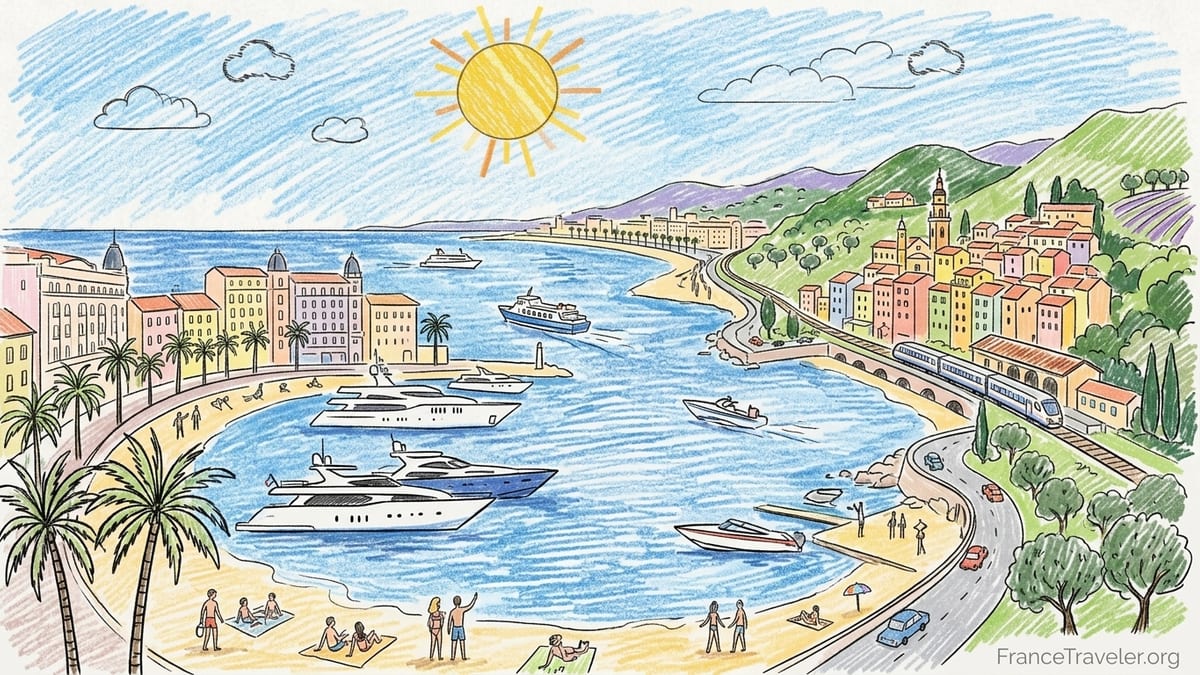
How to Think About Bases on the French Riviera
The stretch of coast from Menton to Saint-Tropez is tied together by a reliable coastal train line between Ventimiglia in Italy and Cannes, plus buses and ferries, so you do not need a car for most itineraries. Nice usually works as the default first-timer base because Nice Côte d’Azur Airport sits right on its edge and the main rail line runs through the city center. From Nice, direct trains typically reach Cannes in about 35–40 minutes, Antibes in around 25 minutes and Menton in 40–50 minutes, which makes back-and-forth day trips easy.
Hotel prices vary by town and season, but as a rough pattern, mid-range double rooms in Nice and Antibes often start around the lower three-figure euro mark in spring and autumn, climb sharply in July and August, and trend higher in Cannes, Saint-Tropez and Cap-Ferrat, especially during major events. Menton and Villefranche-sur-Mer can be marginally cheaper than Cannes or Saint-Tropez for similar quality, while still giving access to the same coastline and trains.
When choosing a base, think first about your priorities. If you want maximum restaurant choice, nightlife and easy transport, Nice and Cannes function best as hubs. If you care more about sand and family-friendly beaches, Antibes and Juan-les-Pins are strong contenders. Luxury and late-night clubbing point you towards Saint-Tropez. If a quieter, upscale village feel appeals, Villefranche-sur-Mer and Cap-Ferrat shine. For a calmer, pastel-toned town near the Italian border, Menton is the obvious pick.
Many travelers now split their stay: for example three nights in Nice to cover Monaco, Èze and Antibes by train, then two or three nights in a quieter resort such as Villefranche or Menton. Others use one base only, such as Antibes or Nice, and accept slightly longer train rides on some days in exchange for not changing hotels.
Nice: Best All-Round Base and Transport Hub
Nice is the coast’s big city and the most practical starting point for many trips. Nice Côte d’Azur Airport sits on the waterfront west of town, with a tram linking both terminals to the city center in around 25–30 minutes. Regional TER trains from Nice-Ville station fan out along the coast: west to Antibes and Cannes, east to Monaco and Menton. That central position means you can reach most major Riviera sights in under an hour, which is why many repeat visitors still choose Nice as their base.
As an urban beach destination, Nice offers a long string of public and private beaches along the Promenade des Anglais. The surfaces are mostly smooth pebbles rather than sand, so many people rent a lounger and mattress at private beach clubs for more comfort, especially in high season. Prices at these clubs typically run from moderate to high for the coast, with surcharges in July and August. In return you get changing cabins, showers, waiter service and on-site restaurants so you can spend a full day by the sea without moving far.
Hotel prices in Nice span everything from hostels and simple two-star pensions up to landmark luxury properties overlooking the promenade. In spring and autumn you can often find central, well-rated three-star hotels in or near the Old Town at a relatively moderate nightly rate, while seafront rooms in upscale hotels can easily cost several times that during summer and during big events. Neighborhoods such as the Carre d’Or, the Old Town and the area near Nice-Ville station balance walkability to the beach, restaurants and trains.
Nightlife in Nice is varied rather than ultra-exclusive. In and around the Old Town you will find busy wine bars, craft cocktail spots, casual pubs and late-opening clubs, especially on weekends. For food, the choice is wide: traditional Niçoise bistros serving socca and stuffed vegetables, contemporary Mediterranean places around the Port, and informal cafes lining the Cours Saleya market. From Nice, straightforward day trips include Monaco for the Casino and harbor, hill villages such as Èze, Antibes for sandy beaches and old-town ambience, Cannes for its Croisette and islands, and Menton for a calmer, more Italian-feeling day by the sea.
Cannes: Polished Resort City for Style and Nightlife
Cannes suits travelers who want a polished resort-city experience with upscale shopping, a strong hotel scene and a seafront built around sandy beaches. The Croisette, the main seafront boulevard, is lined with luxury hotels, designer boutiques and beach clubs that feel more like loungy resorts than simple sunbed rentals. Public sandy stretches such as Plage du Midi and parts of the Croisette give you a free alternative to the paid clubs, which is useful if you plan to spend many hours by the water.
Accommodation in Cannes skews more resort-oriented than in Nice. There are still mid-range and budget options, but a large share of the front-row seafront is occupied by four and five-star properties that charge accordingly, especially during the Cannes Film Festival in May and other trade fairs that fill the city. Outside those peak periods, you can often find reasonable rates on apartments or smaller hotels a few blocks back from the Croisette while still being able to walk to the beach in under ten minutes.
For nightlife, Cannes runs a little more overtly glamorous than Nice, with cocktail bars and clubs around the Croisette and the Port often drawing an international crowd in summer. Restaurants run from simple pizzerias on side streets to white-tablecloth terraces with sea views, plus traditional brasseries in the old quarter of Le Suquet up on the hill. While Cannes does have its own small airfield, most visitors still fly into Nice and take a direct train or airport bus for about 45–60 minutes to reach the city.
Cannes works as a base if you imagine a trip that alternates between beach days on the Croisette and occasional half-day excursions. The ferry to the nearby Lérins Islands makes for a relaxed outing, while trains connect you quickly to Antibes and Juan-les-Pins for variety, and onward to Nice if you want a bigger city feel for an afternoon or evening. The downside as a base is that reaching eastern destinations like Menton or Italy takes longer than from Nice or Menton itself, so Cannes fits best if your focus is on beaches and resort atmosphere more than covering the entire coast.
Antibes and Juan-les-Pins: Sandy Beaches and Family Appeal
Antibes blends an atmospheric old town, a working marina and easy beach access, which makes it a popular base for families and for travelers who prioritize a slower pace than Nice without giving up train connections. The old town’s narrow streets are packed with cafes, markets and small restaurants, and the Picasso Museum inside the Château Grimaldi adds a cultural stop between swims. Sandy beaches curve around both sides of the old town, ranging from small coves to longer arcs with shallow water suited to children.
Just over the headland, Juan-les-Pins feels more resorty, with a denser strip of beach clubs, bars and ice cream stands backing a long sandy bay. In summer, it can feel livelier and younger in the evenings than central Antibes, with music from beachfront venues carrying into the night. Families often sleep in Antibes itself for the old-town atmosphere and quieter nights, then walk or take a short bus ride to Juan-les-Pins for all-day beach sessions with softer sand than you will find in Nice.
In terms of price, Antibes and Juan-les-Pins typically fall between Nice and Cannes. You can find family-run hotels and apartments within a reasonable walk of both the station and the beach that cost noticeably less than comparable seafront options in Cannes, but rates increase sharply in July and August. Booking several months ahead is wise if you want a pool, parking and easy beach access at a mid-range price point. Because Antibes sits roughly between Nice and Cannes on the rail line, day trips in both directions are straightforward.
For many travelers, the main trade-off when basing in Antibes is accepting slightly fewer restaurant and nightlife options than in Nice or Cannes in exchange for that sandy, more relaxed seaside feel. For families and couples who imagine early morning beach strolls, market visits and quiet evenings with a glass of wine in the old town, it often hits a sweet spot. It is less ideal if you plan to be out very late every night or want to cover the eastern Riviera heavily, where Menton and Monaco start to feel like long day trips by comparison.
Saint-Tropez: High-End Luxury and Late Nights
Saint-Tropez sits on the western side of the French Riviera and is not on the main coastal train line, which already makes it a different type of base. Most visitors reach it by driving around the gulf, by seasonal ferry from towns like Sainte-Maxime, or by private boat. In high summer, road access can be heavily congested, especially on weekends, so basing here generally suits travelers who want to stay put and enjoy the local scene rather than day-trip up and down the coast each day.
The town itself is compact, with a harbor lined by yachts, pastel townhouses and cafe terraces. The famous Pampelonne Beach lies several kilometers out of town, backed by a sequence of private beach clubs that range from understated-chic to full party mode. Daybed and restaurant prices here are some of the highest on the Riviera, particularly in July and August, which fits Saint-Tropez’s image as a luxury, see-and-be-seen destination. Public stretches of sand exist between the clubs, but most of the infrastructure is geared towards paying guests of the establishments.
Accommodation in Saint-Tropez skews strongly towards the high end. Five-star hotels, design-driven boutique properties and villa rentals dominate, often with pools, lush gardens and dedicated concierge services. Even simple rooms in season can cost significantly more than in Nice, Menton or Antibes for equivalent standards. For dining and nightlife, the town offers a dense concentration of high-end restaurants, cocktail bars and nightclubs that regularly host international DJs in summer. Reservations and planning ahead become important in the peak months if you want specific venues.
Because of its location and transport reality, Saint-Tropez works best as a base for short, high-budget trips that revolve around beach clubs, yachting, dining and nightlife, rather than as a practical hub for covering the entire Riviera by public transport. If you are on a longer itinerary and want a taste of Saint-Tropez without committing to its prices for a full week, one common strategy is to base in Cannes, Antibes or Nice and add an overnight or two in Saint-Tropez in the middle of the trip.
Villefranche-sur-Mer and Cap-Ferrat: Quiet, Upscale and Scenic
Just east of Nice, the small bay of Villefranche-sur-Mer and the pine-covered peninsula of Cap-Ferrat offer a quieter, more upscale alternative without sacrificing train connections. Villefranche-sur-Mer sits on a deep natural harbor, with a compact old town cascading down to a long curve of sand-and-pebble beach. Many hotels and guesthouses face the bay, so even mid-range places can offer sea views that would cost far more in a larger city. The train station sits right behind the beach, with regular services to Nice in about ten minutes and to Monaco and Menton further along the line.
Cap-Ferrat, meanwhile, is one of the Riviera’s classic luxury enclaves, formed by a peninsula of villas, gardens and coastal paths. The Grand-Hôtel du Cap-Ferrat, operated by a major luxury brand, anchors the high end of the hotel scene here, with extensive grounds, pools and direct sea access. Other properties, including long-established four and five-star hotels, cluster around the small port of Saint-Jean-Cap-Ferrat and along the coastline, often with private or semi-private beach access and a calm, leafy setting that feels far from city noise even though Nice and Monaco remain close.
Staying in Villefranche or Cap-Ferrat suits travelers who value sea views, quiet evenings and easy access to walking trails such as the coastal path around the peninsula. In Villefranche, a typical day might involve coffee on a harborfront terrace, a swim from the main beach, a short train hop into Nice for museums and dinner, then a later return to fall asleep with windows open to the bay. In Cap-Ferrat, days often revolve around hotel pools, spa time and leisurely walks to smaller coves like Passable Beach, which sits opposite the old town of Villefranche across the water.
Prices reflect the setting. While you can sometimes find modest guesthouses and apartments in Villefranche-sur-Mer at a mid-range level, Cap-Ferrat is largely in the premium to luxury bracket. Restaurant choice is narrower than in Nice or Cannes, but quality is typically high, leaning towards seafood and Mediterranean dishes served on terraces overlooking the sea. For day trips, the location is excellent: Nice, Monaco, Èze and Menton all lie within straightforward train or bus rides, and boat excursions and kayak rentals in the bay add another way to explore the coastline.
Menton: Calm Eastern Base Near Italy
Menton sits near the Italian border at the eastern end of the French Riviera, and it makes a particularly good base for travelers who prioritize a calm atmosphere, pastel architecture and gardens over late-night bars. The microclimate here is relatively mild, which supports lush gardens and the town’s famous citrus festival in late winter. The seafront promenade backs a series of beaches that are a mix of coarse sand and pebbles, with some shallow sections that suit children and less-confident swimmers.
Hotel prices in Menton can be slightly lower than in Cannes or Saint-Tropez for equivalent quality, especially outside peak summer. The stock ranges from simple two-star hotels and apartments near the station to Belle Époque facades along the seafront. Many travelers choose sea-view rooms with balconies facing the bay, since road noise is usually lower here than along Nice’s main seafront. In the evenings, the old town offers a choice of restaurants from straightforward bistros to more sophisticated spots, with an emphasis on seafood and Mediterranean cooking that often nods towards nearby Liguria.
From a transport perspective, Menton works well if most of your day trips are east-focused. Direct trains run frequently to Monaco in around 25 minutes and to Nice in 40–50 minutes, with some services continuing into Italy, for example to Ventimiglia for markets. The trade-off is that going all the way to Cannes or Antibes becomes a longer ride than from Nice or Antibes themselves. For many people who choose Menton, that is acceptable because they are less interested in nightly dining and nightlife in the western towns and more interested in walking the coastal paths, exploring gardens and absorbing a quieter ambience.
For families and couples seeking calm, Menton’s promenades, old town lanes and relatively uncrowded beaches outside August are part of the appeal. It does not have the same density of beach clubs or late-night venues as Cannes, nor the big-city buzz of Nice. Instead you get evenings spent on terraces overlooking the water, gelato stops and the option to hop into Monaco for a more intense dose of glamour and casinos before retreating to a gentler base.
Choosing the Right Base for Your Trip Style
Thinking about the French Riviera in terms of your priorities helps clarify the best base. For a first or second trip, especially without a car, Nice usually makes the most practical starting point. You land at the local airport, ride the tram into the city, and immediately have the coastal train and buses at your disposal. From there you can sample Cannes, Antibes, Monaco, Villefranche and Menton on day trips and get a feel for which place you might like to base in next time.
If you already know you prefer sandier beaches and a more compact, relaxed town, Antibes and Juan-les-Pins are strong central options, especially for families. If you imagine evenings in designer boutiques and upscale bars followed by walks along a broad sandy bay, Cannes fits that brief. For a quieter but still upscale stay, especially on a repeat trip, Villefranche-sur-Mer and Cap-Ferrat give you sea views, elegant hotels and ready access to Nice and Monaco without necessarily being in the thick of a big city.
Travelers drawn to high-end hotels, private beach clubs and yachting often carve out a dedicated segment in Saint-Tropez, accepting higher prices and more limited public transport access in exchange for its particular scene. Meanwhile, if a pastel old town, gardens and calmer evenings sound more attractive than nightclub queues, Menton makes an appealing eastern base. It especially rewards stays of three nights or more, when you can interleave slow local days with trips to Monaco, Beaulieu-sur-Mer, Cap-Ferrat or even across the border into Italy.
One sensible strategy, if your trip is a week or longer, is to pair two contrasting bases, such as four nights in Nice followed by three nights in Menton, or a split between Antibes and Villefranche-sur-Mer. That way you experience both an active hub and a quieter retreat without changing regions entirely. Whatever you choose, booking accommodation early for July and August stays is advisable, as the most desirable seafront rooms and family apartments in these towns often sell out months in advance.
FAQ
Q1. Is Nice or Cannes better as a base for a first French Riviera trip?
For most first-time visitors, Nice works better as a base because it combines the main airport, the coastal rail hub and a wide choice of accommodation and restaurants, while Cannes suits those who specifically want a polished resort feel, sandy city beaches and a slightly more glamorous nightlife scene.
Q2. Where should families with children stay on the French Riviera?
Families often do well in Antibes and Juan-les-Pins thanks to their sandy, shallow beaches, compact old town, relaxed evening atmosphere and central position on the train line, though Nice can also work if you are comfortable with pebble beaches and want more city-style attractions.
Q3. Is Menton too far for day trips to the rest of the Riviera?
Menton is excellent for visiting Monaco, Beaulieu-sur-Mer, Villefranche-sur-Mer and even Italy, but day trips all the way to Cannes or the western towns are longer and more tiring by train, so it works best if you are happy to focus on the eastern side of the coast.
Q4. Do I need a car to enjoy Saint-Tropez?
You can reach Saint-Tropez by seasonal ferries and regional buses, but many visitors either drive or arrange transfers because public transport is less seamless than along the main coastal train line, and once in town most people walk or use local shuttles to reach beaches like Pampelonne.
Q5. Is Villefranche-sur-Mer cheaper than staying in Nice?
Simple rooms and apartments in Villefranche-sur-Mer can sometimes be slightly cheaper than equivalent sea-view accommodation in central Nice, but the town is small and demand is high, while Nice offers a broader range of price points if you are willing to stay a few streets back from the promenade.
Q6. Which town has the best nightlife on the French Riviera?
For varied nightlife with many bars and clubs within walking distance, Nice and Cannes are the strongest bases, while Saint-Tropez offers the most exclusive and high-priced late-night venues; Antibes, Villefranche and Menton are quieter in comparison.
Q7. Are beaches on the French Riviera mostly sandy or pebbly?
The answer depends on the town: Nice and much of Villefranche-sur-Mer have smooth pebble beaches, while Cannes, Antibes, Juan-les-Pins and the main stretches around Saint-Tropez offer sandy beaches, and Menton has a mix of coarse sand and small pebbles.
Q8. How far in advance should I book hotels on the French Riviera?
For July and August, it is wise to book popular seafront hotels and family apartments several months in advance, while in late spring, early summer and autumn you can sometimes find good options closer to your dates, especially if you are flexible on exact location within each town.
Q9. Is it realistic to stay in one base and day-trip everywhere?
Staying in one base such as Nice or Antibes and day-tripping along the coast is realistic for many itineraries, but expect some longer days on trains if you are crossing from one end of the Riviera to the other, and consider splitting your stay between two bases if your trip is a week or more.
Q10. Which base is best for a quieter, upscale romantic trip?
For a quieter romantic stay with an upscale feel, Villefranche-sur-Mer, Cap-Ferrat and Menton are all strong options, with sea views, scenic promenades and easy access to nearby towns for dinners and day trips without the constant buzz of a larger city.