


Few travel dilemmas are as tempting as choosing between the glittering French Riviera and the sun-baked villages of inland Provence. Both sit in the same corner of southern France, share a similar climate and cuisine, and can even be combined in one itinerary. Yet they offer very different trips in practice. One is based around beaches, coastal trains and glamorous promenades; the other around hilltop villages, lavender fields, markets and slow road trips. This guide breaks down the differences so you can decide which South of France experience fits you best.
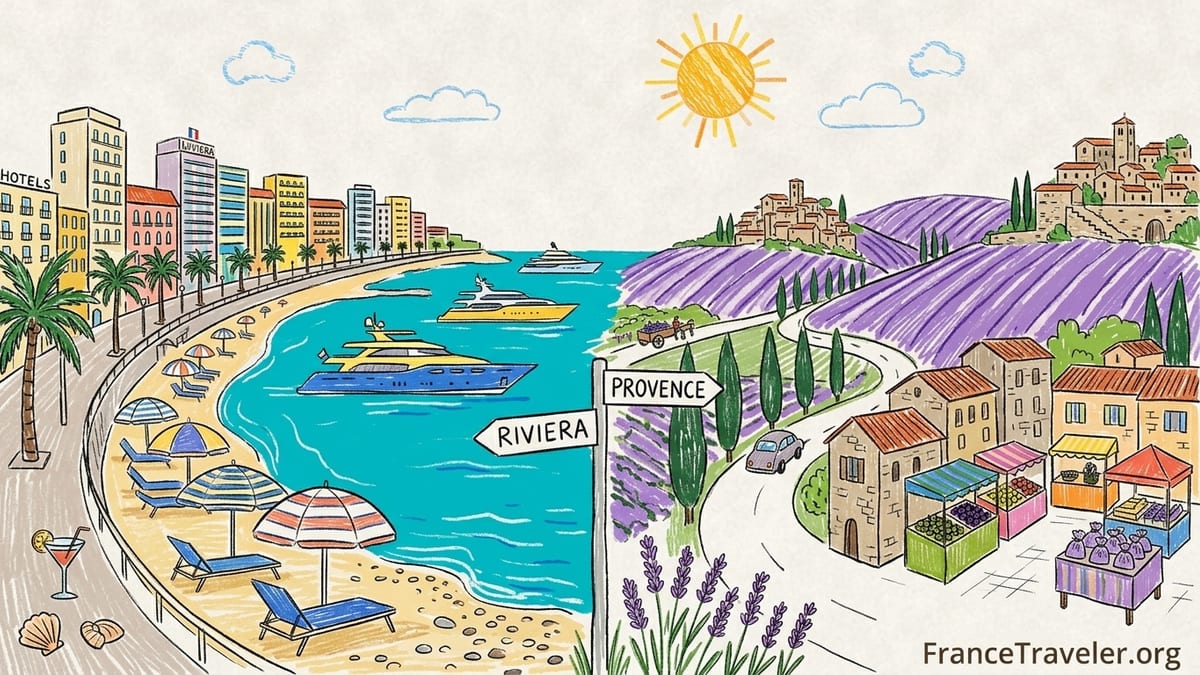
Overall vibe: Coast glamour vs village life
The French Riviera, or Côte d’Azur, runs roughly from Cannes and Antibes through Nice to Monaco and Menton. It feels built around the sea: promenades lined with palm trees, pebbly and sandy beaches, yacht-filled marinas, beach clubs and cocktail bars. In Nice you might spend the evening strolling the Promenade des Anglais, while in Cannes the seafront boulevard is backed by designer boutiques and palace hotels. Even smaller spots like Villefranche-sur-Mer or Beaulieu-sur-Mer mix fishing-village roots with an unmistakably upscale, international crowd.
Inland Provence, by contrast, is a trip of stone villages and countryside. Think the Luberon hills around Gordes, Roussillon and Ménerbes, the markets of Saint-Rémy-de-Provence, or the café-lined squares of Aix-en-Provence. The rhythm is slower and more local: wandering farmers’ markets, driving between vineyards, and lingering over rosé in a shaded square. You are more likely to wake to church bells and roosters than to the buzz of scooters and beach traffic.
If you picture yourself people-watching in linen on a seafront terrace, the Riviera will feel like a movie come to life. If your dream is getting lost in narrow lanes between shuttered stone houses, with the scent of thyme and lavender in the air, then inland Provence is closer to what you want.
Both regions have pockets of glamor and authenticity, but the balance is different. The Riviera is glossy, social and extroverted; Provence is rustic, introspective and made for slow days.
Beaches, sea and coastal scenery
The most obvious advantage of the French Riviera is the Mediterranean itself. Nice offers long stretches of public and private beaches right in the city, reached simply by crossing the road from the Old Town. The shoreline is mostly smooth pebbles, so many people rent a lounger at a beach club for the day, where around 30 to 60 euros typically buys a sunbed, towel, umbrella and waiter service in high season. Further along the coast, Antibes and Juan-les-Pins have more sand, while Cannes has wide, shallow sandy beaches ideal for families.
Iconic spots like Saint-Tropez mix narrow village lanes with a beach scene set a few kilometers away at Pampelonne, where a string of famous clubs line the sand. Reaching Saint-Tropez often involves a boat from Saint-Raphaël or Sainte-Maxime in summer to dodge heavy traffic, but the payoff is a postcard mix of pastel facades, luxury yachts and clear, swimmable water. Even travelers who are not “beach people” often enjoy walking the coastal paths, such as the trail around Cap d’Antibes or Saint-Jean-Cap-Ferrat, for sea views without crowds.
Provence, strictly speaking, does not offer classic beach days unless you base around places like Cassis or the western Var coast, which feel more like a softer, less built-up cousin of the Riviera. What Provence does offer are river swims and natural water holes. In the Luberon you might cool off in the Sorgue River near L’Isle-sur-la-Sorgue, or paddle kayaks under the arches of the Pont du Gard. It is refreshing and memorable, but it is not the same as rolling out of bed onto a Mediterranean beach.
For travelers who want daily swims, promenades at sunset and easy access to the sea, the French Riviera clearly wins. If you mainly want countryside and do not mind only occasional dips in rivers or hotel pools, Provence will still feel complete.
Villages, lavender and countryside
Where Provence shines brightest is in its villages and landscapes. The Luberon massif, less than an hour’s drive from Avignon or Aix-en-Provence, is dotted with perched villages like Gordes, Roussillon, Bonnieux and Lacoste. Driving between them, you pass vineyards, cherry orchards and pockets of lavender. In July, roads near Sault or the Valensole Plateau are lined with purple fields and roadside stands selling soaps, oils and honey. Travelers who rent a car in Marseille or Avignon often dedicate a full day to looping through several villages and stopping whenever they see a view or market that catches their eye.
Markets are central to the Provence experience. In Saint-Rémy-de-Provence, a weekly market fills the streets with olives, cheeses, linen clothing and lavender sachets. L’Isle-sur-la-Sorgue is known for its Sunday antiques and brocantes, where visitors pick up old enamel signs or vintage linen. These markets are busy and popular with tourists, but you still see locals doing their weekly shop, which gives them a lived-in feel that many people find missing along the most polished sections of the Riviera.
The Riviera does have some charming inland villages. Èze, clinging to a clifftop between Nice and Monaco, offers narrow stone alleys and a spectacular view from its hilltop gardens. Saint-Paul-de-Vence and Biot, set back from the coast, mix art galleries with old ramparts. Yet they are generally visited as day trips from the coast and can feel more curated and art-gallery focused. Provence’s villages, by contrast, are the main event. Staying overnight in somewhere like Goult or Lourmarin means evenings when the day-trippers leave and the village returns to local pace.
If wandering from your rental house to a small bakery, driving quiet backroads to find a viewpoint over the Luberon, or timing your entire trip around lavender blooming from late June to mid-July sounds appealing, then Provence is the better fit. The Riviera’s countryside is steeper, more built up and always pulls you back toward the sea.
Transport, car dependence and ease of getting around
One of the biggest practical differences between the regions is transport. The French Riviera is one of the easiest places in France to explore without a car. A coastal train line connects towns such as Cannes, Antibes, Nice and Menton, with frequent regional services. For example, on a typical day there are dozens of trains between Nice and Cannes, with journey times around 30 minutes and departures roughly every 15 to 30 minutes at busy times. Local bus networks around Nice, Cannes and Antibes fill in the gaps to nearby beaches and hill towns, and trams run through Nice itself. From Nice, buses and trains also reach Monaco, Villefranche-sur-Mer and many hiking trailheads in the hills.
Inland Provence offers far fewer public-transport options. You can reach hubs like Avignon, Aix-en-Provence or Arles easily by train from Paris or Lyon, but once you want to visit the best villages, vineyards or lavender fields, you quickly run up against infrequent buses and long, hot walks from stops outside town. Regional buses may only run a handful of times per day, and some villages have no meaningful service in the evening. This is why so many Provence guides strongly recommend renting a car if you want to explore the Luberon or areas around Mont Ventoux or the Alpilles.
Driving in Provence is generally straightforward if you are comfortable with narrow village streets and occasional hairpin bends. Distances are not huge, but you will often spend 30 to 45 minutes driving between clusters of villages, especially if you are chasing lavender viewpoints. That is part of the charm for many travelers, who treat the drive as a scenic experience in itself, stopping for roadside fruit stands or field photos. In the Riviera, by contrast, driving can be stressful in high season because of heavy traffic and expensive parking, especially in Nice, Cannes and Saint-Tropez. Many visitors who rent a car there end up leaving it parked most of the time and using trains instead.
In simple terms, the Riviera is much better suited to a car-free trip, especially if you base in Nice or Antibes. Provence is much better suited to a road trip, ideally with several nights in the countryside. If you strongly prefer not to drive, you will get more out of the Riviera or will need to focus in Provence on just one well-connected town and a few guided day tours.
Hotels, rentals, nightlife and daily rhythm
Accommodation choices also shape the style of your trip. On the French Riviera, you can choose everything from large seafront hotels in Nice and Cannes to boutique guesthouses in Antibes or Villefranche-sur-Mer. In high summer, midrange hotels in central Nice often start around the low 200s in euros per night and climb significantly for sea views, while luxury properties along the Croisette in Cannes or near Saint-Tropez can cost several hundred euros per night. There are also many apartment rentals, which suit longer stays and help keep restaurant costs down.
Inland Provence tends to offer more small hotels, chambres d’hôtes and countryside rentals. Around the Luberon, it is common to rent a stone farmhouse with a pool for a week, especially for families or groups, and use it as a base for day trips to nearby villages. In and around towns like Aix-en-Provence or Saint-Rémy, you find a mix of small boutique hotels and guesthouses. Prices vary widely by season, but in many inland areas you can expect to pay somewhat less than in the most sought-after Riviera addresses, especially if you stay a few kilometers outside the biggest name villages.
Nightlife is another area where the Riviera clearly stands apart. Nice offers wine bars, cocktail lounges, beach clubs and late-night music, especially on weekends. Cannes and Saint-Tropez add high-end clubs and a more glamorous dressy scene. Even smaller places like Juan-les-Pins are known for summer jazz festivals and lively evenings along the waterfront. This does not mean you need to go out late; many travelers simply enjoy an after-dinner stroll with gelato along the promenade amid the buzz.
Provence evenings are quieter. In a village like Bonnieux, you might have two or three dinner options plus a wine bar, and by midnight the streets are nearly silent. Aix-en-Provence and Avignon have lively student and theater scenes, but you will not find lines outside clubs or rows of beach bars. For many visitors this is exactly the appeal: sunset over the vineyards, a slow dinner on a terrace, then stars and cicadas. If you want social nights and people-watching, choose the Riviera. If you want early mornings at the bakery rather than late nights at the bar, choose Provence.
Costs, crowds and seasonality
Both regions are popular and can be expensive, but the Riviera, especially in famous spots, generally costs more day to day. Eating along the seafront in Nice or Cannes often means paying a premium for the view, with simple main courses in high season often priced higher than in inland towns. Renting sunbeds at beach clubs, paying for parking near popular stretches of coast, and ordering cocktails in famous bars all add up quickly. Many travelers manage costs by staying a few blocks back from the seafront, using supermarkets for picnic breakfasts and choosing set lunch menus rather than à la carte dinners.
In Provence, you can still spend plenty if you choose luxury hotels or dine at the most celebrated restaurants, but average day-to-day expenses tend to be a bit lower once you are away from major tourist magnets. Village cafés serving plat du jour lunches, local markets where you assemble your own picnic, and free countryside attractions like viewpoints and hiking trails help stretch budgets. Fuel and car rental add to the cost, but split between two or more travelers, a small rental often works out comparable to multiple rail tickets and transfers on the Riviera.
Crowds differ too. The Riviera is busy from late spring through early autumn, with peak congestion usually in July and August. Beaches can feel packed by mid-morning, and trains are busy on weekends and holidays. Major events like the Cannes Film Festival and Monaco Grand Prix send hotel prices and occupancy soaring. Provence’s peak also runs from June to September, with especially high visitor numbers around lavender bloom in late June and July. Certain vantage points near famous fields can feel surprisingly crowded at sunset, and parking near top villages can be tight in the middle of the day.
Shoulder seasons feel different in each region. Late April, May and October on the Riviera can be ideal for coastal walks and terrace dining, although the sea may still feel cool. In Provence, late April and May bring wildflowers and calmer roads, while September and early October often offer warm days, grape harvests and fewer people. If you are constrained to July or August and want to avoid the most intense beach crowds, Provence usually feels a little less frenetic than Nice or Cannes, provided you stay away from the biggest markets at peak hours.
Which trip suits which traveler?
When you strip away the romance of both names, the decision often comes down to trip style. Choose the French Riviera if you want a beach-focused, mostly car-free trip with easy logistics. A classic first-time itinerary might involve basing in Nice for four or five nights, using the coastal train to day trip to Antibes, Cannes and Menton, with one boat or bus day to Saint-Tropez or a hill village like Èze or Saint-Paul-de-Vence. You can swim most days, walk a different promenade each evening, and still feel you have seen several towns without ever renting a car.
Choose Provence if you are excited by the idea of a countryside road trip. A typical week could see you renting a car in Avignon or Marseille, then spending a few nights near Saint-Rémy-de-Provence to explore the Alpilles, followed by three or four nights in the Luberon around Gordes or Bonnieux. Your days might revolve around markets, vineyard visits, lavender drives and long lunches under plane trees. Instead of a different beach club, your “day trips” are different hilltop villages.
Families often find the Riviera straightforward because teens and children have beaches and promenades at their doorstep, and it is easy to split up for a few hours without anyone needing to drive. On the other hand, multi-generation groups who rent a villa with a pool in Provence appreciate having a private space where everyone can relax between outings, and where evenings can be as simple as grilling local vegetables and drinking rosé on the terrace.
For many travelers, the best answer is not either/or but both. With around ten days, a balanced trip might look like three nights in Nice for coastal walks and a taste of Riviera nightlife, followed by five or six nights in or near a Luberon village for markets, lavender and vineyard visits. Fast trains link the coast with Avignon and Aix-en-Provence, and regional trains or buses connect to Marseille, so combining the two regions is logistically straightforward.
The Takeaway
If your priority is the sea, beaches, promenades and a social atmosphere that you can enjoy without touching a rental car, the French Riviera is usually the better choice. You will trade some sense of rustic authenticity and quiet for ease and variety: swim in Nice one day, stroll old Antibes the next, sip a cocktail on the Croisette in Cannes, and be back on the train to your base by evening.
If your priority is village-hopping, countryside and lavender landscapes, with relaxed markets and vineyard visits rather than beach clubs and bar-hopping, then inland Provence will reward you more. The trade-off is that you will almost certainly need a car, and sightseeing becomes a series of drives. For many, that is a pleasure rather than an inconvenience, turning each day into a small road trip through some of France’s most evocative scenery.
Neither region is objectively “better.” They are simply different answers to different travel dreams. Start by asking whether you want to wake up to the sound of waves and the sight of a promenade, or to church bells, vineyards and a village square. From there, the choice between the Riviera and Provence usually becomes clear.
FAQ
Q1. Is the French Riviera or Provence better for a car-free trip?
The French Riviera is better if you prefer not to drive. Towns such as Nice, Antibes, Cannes and Menton are linked by frequent trains, and local buses reach nearby villages and beaches. In Provence, public transport between the most beautiful villages and lavender areas is limited, so you will miss a lot without a car or organized tours.
Q2. Which region is better for beaches and swimming?
The French Riviera is the clear winner for beaches and daily sea swims. Nice, Cannes, Antibes and smaller towns along the coast all have accessible beaches, some pebbly, some sandy, often with beach clubs where you can rent a lounger. Provence is inland and focuses more on rivers, lakes and pools than on classic Mediterranean beaches.
Q3. When is the best time to see lavender in Provence?
Lavender in Provence typically blooms from late June to mid-July, with some variation depending on altitude and weather. Areas like the Valensole Plateau and around Sault often reach their peak in early July. By late July many fields are cut, so if lavender is a main reason for your trip, aim for the first half of July and build some flexibility into your plans.
Q4. Is inland Provence cheaper than the French Riviera?
In general, inland Provence is somewhat less expensive day to day than the most famous parts of the Riviera, especially for accommodation and dining away from the biggest tourist towns. However, high-end hotels and restaurants in Provence can still be costly, and car rental plus fuel adds to your budget. The Riviera often feels pricier because seafront locations, beach clubs and marquee events command a premium.
Q5. Which is better for nightlife, the Riviera or Provence?
The French Riviera offers much more nightlife, especially in Nice, Cannes and Saint-Tropez, where you will find beach clubs, cocktail bars and late-night venues. Inland Provence is usually quiet after dinner, particularly in small villages where life revolves around early mornings at the bakery and markets rather than late nights out.
Q6. Can I visit both the French Riviera and Provence on one trip?
Yes, combining both regions works very well if you have at least eight to ten days. A common plan is to start with a few nights on the Riviera, often in Nice, then travel inland by train to Avignon or Aix-en-Provence, rent a car and spend several days in the Luberon or Alpilles. This gives you both beach time and countryside village-hopping.
Q7. Do I need to speak French to travel easily in either region?
You can get by with basic English in both the Riviera and Provence, especially in hotels, restaurants and tourist sites. That said, learning a few simple French phrases for greetings, ordering and thanking people is appreciated and often leads to warmer interactions, particularly in smaller Provençal villages where fewer people work directly in tourism.
Q8. Which region is better for families with children?
Both can be good, but in different ways. The Riviera is convenient for families who want beaches, promenades, playgrounds and easy public transport between towns, all without driving. Provence is ideal for families who enjoy renting a house with a pool, exploring markets and taking scenic drives. Very young children may find the constant driving in Provence tiring, while teens might prefer the beach and activity options of the Riviera.
Q9. How many days should I spend in each region?
If you choose just one region, many travelers find four to five nights on the Riviera or six to seven nights in Provence works well. The Riviera lends itself to a slightly shorter stay because coastal towns are close together by train. Provence rewards more time because driving between villages and markets is slower and more spread out. If combining both, consider three to four nights on the Riviera and five to six nights in Provence.
Q10. Is it easy to get to the French Riviera and Provence from Paris?
Yes, both regions are well connected. High-speed trains from Paris run to Nice for the Riviera and to Avignon, Aix-en-Provence and Marseille for inland Provence. Flight options also exist, especially into Nice for the Riviera and Marseille for Provence. Once you arrive, the Riviera is straightforward by train and bus, while Provence usually calls for renting a car to explore properly.