


Planning a French Riviera trip without a rental car is not only possible, it is often the easiest way to experience the coast. The main towns between Cannes and Menton are linked by frequent TER regional trains, local buses and, in Nice, an efficient tram that reaches the airport. The real challenge is not how to get around, but where to base yourself. Nice, Cannes, Antibes and Juan-les-Pins, Villefranche-sur-Mer and Menton each offer a different balance of transport convenience, atmosphere, beaches and day-trip options. This guide compares them specifically for car-free travelers so you can choose the base that matches how you actually want to spend your days.
How the French Riviera Works Without a Car
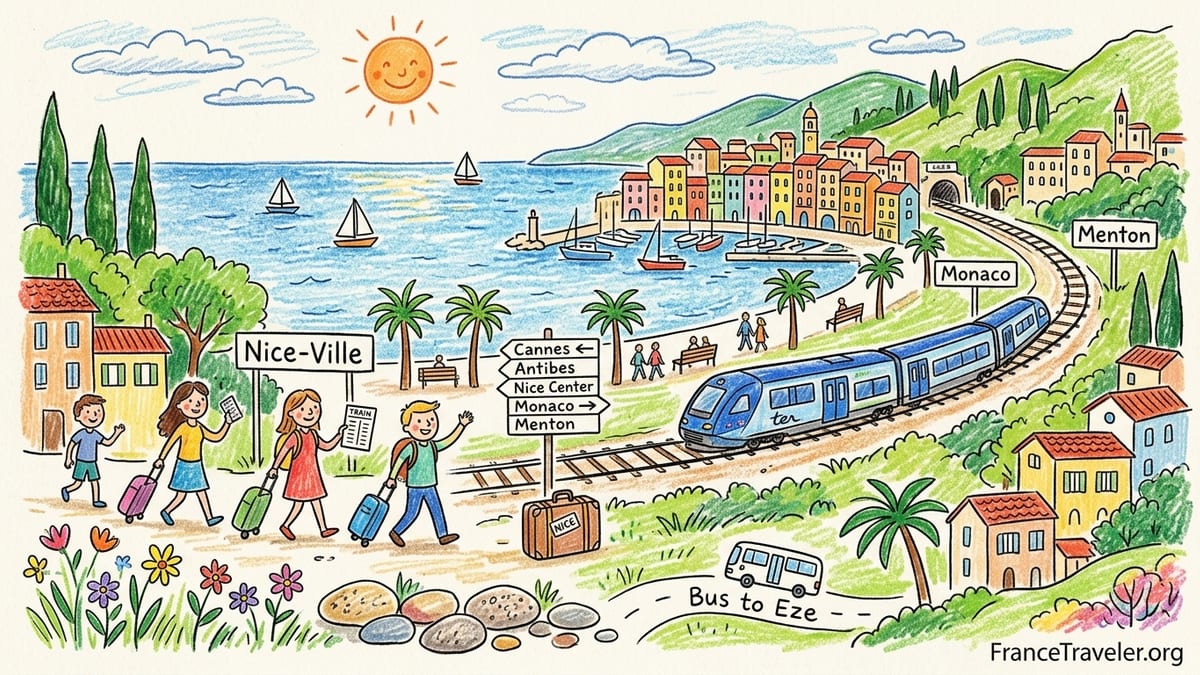
The core of the French Riviera runs along a single coastal rail line from Cannes in the west to Ventimiglia just across the Italian border in the east. Local TER trains typically stop at Cannes, Antibes, Juan-les-Pins, Nice-Ville, Villefranche-sur-Mer, Monaco, Menton and finally Ventimiglia, with journey times between neighboring towns often under 20 minutes. For example, the direct train from Nice to Cannes usually takes around 30 to 35 minutes, while Nice to Menton is roughly 35 to 40 minutes, making day trips realistic even if you do not like early starts.
In practice, this means that for a car-free trip your “commute” is almost always a walk to the local station, a short train ride with sea views, then another short walk at the other end. Tickets on TER trains are typically modest in price for such short hops, and during the main season there are dozens of departures per day in each direction. Timetables can change, but services between Nice and Ventimiglia via Monaco and Menton, and Nice and Cannes via Antibes and Juan-les-Pins, are among the most frequent in the region.
Buses still matter for certain inland or hilltop destinations such as Eze village or Saint-Paul-de-Vence, but for most first-time visitors the trains will cover at least 80 percent of what you want to see. This rail backbone is the main reason it makes sense to skip a rental car: you avoid parking costs, dense traffic and narrow streets, while gaining the ability to walk, swim and have a glass of wine at dinner without thinking about driving back.
Because the train is so central, the real decision is which station and which town you want to walk out of every morning. Nice offers the widest spread of directions for day trips. Smaller bases like Villefranche-sur-Mer or Menton trade some of that flexibility for a quieter, more atmospheric daily routine. The rest of this article looks at each major option through the same lenses: railway station location, airport transfers, walkability, beach access and day-trip potential.
Nice: The Most Flexible Car-Free Base
Nice is the undisputed transport hub of the French Riviera, which is why so many car-free itineraries start and end here. Nice-Ville station sits in the city, roughly a 10 to 15 minute walk from the seafront for most visitors, and is served by regional trains that run west to Cannes and Grasse and east to Monaco, Menton and Ventimiglia. The suburban Riquier and Saint-Augustin stations add even more options, but for most travelers Nice-Ville is the key: a place where you can simply show up and usually find a train in your direction within the hour, even outside peak times.
Airport access is also the simplest from Nice. Nice Côte d’Azur Airport sits at the western edge of the city, and tram line 2 usually takes under 30 minutes to run between the terminals and central stops like Jean Médecin or the port, with frequent services during the day. For a typical arrival in the afternoon, you can be sitting in a hotel near Place Masséna or the Old Town less than an hour after landing, without ever needing a taxi. This matters if you are managing luggage, children or just long-haul fatigue.
On the ground, Nice is a big city by Riviera standards but very walkable in its central districts. The Old Town, Promenade des Anglais, port area and the shopping streets around Jean Médecin line up in a compact, roughly flat strip along the waterfront and valley floor. You may choose accommodation closer to the station, such as around Avenue Thiers, or closer to the sea and Old Town, around the Promenade or Cours Saleya. In both cases you are generally within a 15 to 20 minute walk of either the beach or the station, with trams filling any gaps. That makes daily excursions and evening strolls easy, even for travelers who dislike hills.
Nice’s beaches are mostly long, shingle arcs rather than soft sand, but they stretch for several kilometers along the Promenade des Anglais with a mix of free public stretches and private beach clubs. For a concrete example, it is perfectly normal to spend your morning on a day trip to Antibes or Monaco, return on a mid-afternoon train, and still have time to swim off the Promenade, shower and be out for dinner in the Old Town by 8 pm. That combination of excursion capacity and city life is what sets Nice apart: from one base you can day trip west to Cannes and Antibes, east to Villefranche-sur-Mer, Eze-sur-Mer, Monaco and Menton, or even into the hills on bus routes that leave from central hubs like Grand Arénas or the port.
Cannes: Resort Atmosphere with Solid Connections
Cannes offers a more overtly resort feel than Nice, with its famous Croisette, palm-lined promenade and concentration of upscale hotels and boutiques. For travelers without a car, its main advantage is that the train station is located right in the center of town, a short walk from both the Croisette and the older Le Suquet quarter. You can step off a regional TER service and be checking into a hotel on Rue d’Antibes or heading for the beach within 10 minutes on foot, luggage permitting.
There is no major commercial airport in Cannes itself, so you will almost always arrive via Nice Airport and then continue by train or bus. The train journey from Nice-Saint-Augustin or Nice-Ville to Cannes is usually in the 30 to 40 minute range. In practice, many visitors land at Nice, ride the tram or a direct bus to the nearest rail station, then take a straightforward train ride to Cannes. This adds a layer of logistics compared with staying directly in Nice, but it is easy enough if you are comfortable reading station boards and handling a connection.
Once in Cannes, walking is simple. The central area between the station, the old port, Le Suquet and La Croisette is compact and mostly flat. Many mid-range and higher-end hotels cluster within a short walk of both the sea and the station, so you can choose a base that works for you. Beaches are a headline draw here. Much of the Croisette is lined with private beach clubs, but there are also public sandy stretches, especially towards the eastern and western ends, which are convenient if you want to bring your own towel and avoid hiring a sun lounger.
For day trips, Cannes works well in the western half of the Riviera. It is a short hop by train to Antibes and Juan-les-Pins to the east or to coastal towns like Théoule-sur-Mer and Saint-Raphaël further west. You can still day trip to Nice, Monaco or Menton, but each journey involves an extra 30 to 45 minutes each way compared with basing in Nice itself. In exchange, you get evenings in a smaller, more polished resort environment with plenty of restaurants and a nightlife scene that is busy during the festival season and pleasantly calmer at other times of year.
Antibes and Juan-les-Pins: Central, Charming and Beach Friendly
Antibes, with its walled old town and yacht-filled Port Vauban, sits roughly midway between Nice and Cannes, making it a strategic base for travelers who want a bit of both. The main Antibes station stands just inland from the historic center, usually around a 10 to 15 minute walk from the old town lanes and seafront. This station is on the same TER line as Nice and Cannes, so you can be in either city in roughly 20 to 25 minutes by train on a typical timetable.
The atmosphere in Antibes is more small-town than Nice and more historic-feeling than Cannes. Cobbled streets, ramparts, the Picasso Museum and a daily covered market create a lived-in feel that many visitors prefer when they imagine the south of France. At the same time, beaches such as Plage de la Gravette offer sheltered, often family-friendly swimming within walking distance of the center, with sand underfoot rather than the larger pebbles found in Nice.
Just across the headland lies Juan-les-Pins, technically part of Antibes but with its own smaller train station and distinct personality. Juan-les-Pins is known for sandy beaches, a summer jazz festival atmosphere and a more modern resort strip, with many hotels that appeal to travelers who want to step out of their accommodation and onto the sand in a few minutes. The Juan-les-Pins station sits a short stroll behind the seafront, allowing easy trips to Cannes and Nice without needing to walk back into central Antibes.
As a car-free base, Antibes and Juan-les-Pins work best for visitors who care more about beach time and ambiance than maximizing the number of different day trips. You can still reach Monaco and Menton by train, but the journeys are longer than from Nice. On the other hand, Cannes, Nice and local highlights such as the Cap d’Antibes coastal path are very accessible. Many travelers settle into a rhythm of one or two excursion days and several slower days built around the harbor, the market and nearby beaches.
Villefranche-sur-Mer: Quiet Bay Between Nice and Monaco
Villefranche-sur-Mer is a small, picturesque bay just east of Nice, often photographed for its colorful houses rising steeply above a deep natural harbor. The railway station is set just behind the main beach at sea level, connected to the old town and waterfront restaurants by a short but sometimes steep walk. For most visitors, the distance is manageable even with luggage, especially if you choose accommodation close to the seafront, but it is worth checking your hotel’s exact location because some properties higher on the hillside involve regular stair climbing.
There is no airport in Villefranche-sur-Mer, so arrivals almost always pass through Nice. From Nice Airport, you would typically take the tram or another form of public transport into central Nice and then a TER train for about 10 minutes east to Villefranche-sur-Mer. The transfer is short, but this extra step is one of the trade-offs for choosing a smaller village base rather than staying in Nice itself.
Once installed, the advantages become clear. Villefranche-sur-Mer is very walkable within its own confines. The waterfront promenade, old town lanes and main beach are all concentrated in a compact area. The beach itself is pebbly but more sheltered than parts of Nice, and the bay’s deep water often provides calm swimming conditions. Many visitors enjoy mornings in the sea and late afternoons on the train to nearby towns, returning in the evening to a quieter, more intimate atmosphere than they would find in central Nice.
Day-trip potential is strong given the town’s position between Nice and Monaco. Trains east reach Monaco and Menton quickly, while trains west reach Nice in around 10 minutes and continue to Antibes and Cannes. However, there are fewer non-stop connections compared with Nice, and you do not have the same easy access to Nice’s tram network or bus hubs. As a result, Villefranche-sur-Mer favors travelers who are happy with a small selection of well-chosen outings and who value waking up in a peaceful bay over being at the heart of the network.
Menton: End-of-the-Line Charm and Italian Access
Menton sits at the eastern end of the French Riviera, just before the Italian border, and feels noticeably quieter than Nice or Cannes. Its main railway station is inland from the seafront but still within a reasonable walk of the old town and beaches, usually 10 to 15 minutes on foot depending on where you stay. There is also a smaller Menton-Garavan station further east, useful if your accommodation is closer to the Italian side of town.
Reaching Menton from the airport usually involves travel via Nice. A standard route is to take tram line 2 or a bus from Nice Airport to a central tram stop or Nice-Ville station, then a regional TER train east. Depending on the specific service, the journey from Nice to Menton typically takes in the region of 35 to 45 minutes. This is an easy ride for most travelers, but it does mean that if you want to explore Antibes or Cannes, you will spend a bit more time on trains than if you were based further west.
Within Menton, walkability is a major plus. The old town, seafront promenade and many hotels form a narrow strip between the hills and the sea, so daily life tends to be a flat stroll along the waterfront or a deliberate climb into the historic upper streets and cemetery for views. Beaches are a mix of shingle and coarse sand, and the town has a long-standing reputation as a gentler, garden-filled corner of the Riviera, famous for its lemons and a relatively calm evening scene. This makes it particularly appealing to visitors looking for a slower pace, longer stays or a base suitable for older travelers.
Day trips from Menton lean strongly east and north. Trains and buses link quickly to Monaco and to Ventimiglia in Italy, where you can browse markets or continue further into Liguria. You can still reach Nice, Antibes and Cannes in a day, but the returns become longer, especially if you are trying to fit two destinations into a single outing. For many travelers, the sweet spot is to use Menton as either a quieter second base after time in Nice, or as a primary base if their priority is the Italian border area, coastal walks around Cap Martin and a less crowded Riviera experience.
Why Nice Usually Wins for Day Trips
While each town along the Riviera has its own appeal, Nice tends to offer the most efficient overall package for car-free travelers who value variety. The combination of Nice-Ville station on the central TER line, direct tram access to the airport and a dense local bus network means that most of the region’s classic day trips feel straightforward. You can take a morning train west to Antibes or Cannes, another day east to Monaco and Menton, or ride a bus into the hills to places like Eze village or Saint-Paul-de-Vence, all while returning to the same hotel each night.
Another practical advantage is departure frequency. Although schedules vary by season, the stretches of line immediately around Nice generally see some of the highest volume of TER services in the area. That translates to more spontaneous travel: if you decide at 10 am that you feel like lunch in Antibes, you will usually find a train that gets you there around lunchtime without detailed planning. From smaller bases, you may rely on less frequent services or need to be more conscious of last trains back in the evening.
Nice also offers richer options for filling partial days. If you have a morning arrival or an early evening departure, it is easy to squeeze in a walk along the Promenade des Anglais, a visit to the Old Town and Cours Saleya market, or a climb up Castle Hill without feeling rushed. In contrast, if you stay in a smaller town like Villefranche-sur-Mer or Menton, you may love the atmosphere but feel more locked into your base on days when travel time is limited.
That said, the very strengths that make Nice such a good hub can make it feel less relaxing to some visitors. It is a working city with traffic, tram lines and busy summer crowds. Travelers who prefer a village-like feel may reasonably accept longer day trips in exchange for waking up each morning to the quieter harbor of Villefranche-sur-Mer or the lemon-scented promenades of Menton. The trade-off is not about what is possible, but about the kind of daily rhythm you want.
Balancing Transport Convenience With Atmosphere
Choosing a base without a car on the French Riviera ultimately comes down to where you want your trade-offs to fall. Nice is ideal if this is your first visit, if you have limited time, or if you know you will want to pack in several different day trips. You get the best airport access, the most train connections and the widest range of dining, markets and nightlife, from simple neighborhood bistros to high-end restaurants along the Promenade.
Cannes, Antibes and Juan-les-Pins offer a middle ground: still well connected by rail, but with a stronger resort identity and easier access to sandy beaches. They work especially well if your priority is a traditional seaside holiday with the option of one or two excursions to Nice, Monaco or hill villages rather than a different destination every day. In these towns it is common to spend long, slow afternoons on the sand, punctuated by occasional forays along the coast by train or boat, such as a trip from Cannes to the Lérins Islands.
Villefranche-sur-Mer and Menton sit at the quieter end of the scale. Both give a strong sense of place in a small radius, from the deep bay and pastel facades of Villefranche to the gardens and Italian-influenced architecture of Menton. For some travelers, especially couples or solo visitors looking to recharge, that depth of atmosphere outweighs the extra minutes spent on trains when they do choose to explore. For others, especially those who enjoy nightlife or want to keep options flexible in case of bad weather, Nice’s bigger-city energy is a safer bet.
In practice, many experienced visitors combine bases, spending three or four nights in Nice for concentrated sightseeing and day trips, then moving for two or three nights to a smaller town such as Antibes or Menton for a slower finale. If you wish to avoid changing hotels, though, it is reassuring to know that any of the main towns discussed here can support a full car-free week, provided your expectations about pace, beaches and daily logistics match the character of your chosen base.
FAQ
Q1. Is it realistic to visit the French Riviera for a week without renting a car?
Yes. For a typical one-week stay, the coastal train line and local buses easily cover popular destinations like Cannes, Antibes, Villefranche-sur-Mer, Monaco and Menton, especially if you base in Nice or another town with a central station.
Q2. Which town is best as a first-time base without a car?
For most first-time visitors, Nice works best. It combines direct airport tram access, frequent trains in both directions along the coast and plenty of things to do in the city itself on days when you do not feel like a long excursion.
Q3. If I stay in Cannes, will day trips to Monaco or Menton be too long?
They are very possible, but you should expect longer days. From Cannes you first travel past Antibes and Nice before continuing to Monaco or Menton, so each leg can take around 1.5 hours or more depending on connections.
Q4. How close are the train stations to the beaches in Antibes and Juan-les-Pins?
In Antibes, the main station is usually a 10 to 15 minute walk from the old town and beaches. In Juan-les-Pins, the smaller station sits a short stroll behind the seafront, making it especially convenient if your priority is quick access to the sand.
Q5. Is Villefranche-sur-Mer suitable for travelers with mobility issues?
The area around the beach and waterfront is relatively flat, but much of Villefranche-sur-Mer climbs steeply up the hillside with stairs and slopes. Travelers with limited mobility should choose accommodation close to the seafront and check access details carefully before booking.
Q6. Are Menton’s beaches sand or pebbles?
Menton’s beaches are a mix of shingle and coarse sand, generally more comfortable underfoot than the larger stones in Nice but not as consistently sandy as the main stretches in Cannes or parts of Antibes and Juan-les-Pins.
Q7. How early and late do trains typically run between Nice and nearby towns?
Exact times vary by season and day, but it is common to find morning departures starting relatively early and evening services continuing until late enough for dinner outings. It is still wise to check the last train times for your specific dates, especially if you plan to stay out late.
Q8. Is it worth splitting my stay between Nice and a smaller town?
Many travelers enjoy two bases: a few nights in Nice for easy day trips in several directions, then a quieter spell in Antibes, Villefranche-sur-Mer or Menton to slow down. This does mean packing up once, so it depends on how much you mind changing hotels.
Q9. Do I need to reserve regional train tickets in advance?
For local TER trains along the Riviera, most travelers simply buy tickets shortly before travel using station machines or staffed counters. Peak summer periods can be busy, but these are commuter-style services, not long-distance high-speed trains that require reservations.
Q10. If my priority is beaches, which base should I choose without a car?
If beach time matters most, consider Cannes for long sandy stretches, Antibes or Juan-les-Pins for a mix of charm and sand, or Villefranche-sur-Mer for a scenic bay. Nice has extensive beaches too, mostly pebbly, and makes up for this with excellent transport and city life.