


On the French Riviera, world famous names sit surprisingly close together. Nice, Cannes, Antibes, Saint Tropez, Villefranche sur Mer, Saint Jean Cap Ferrat, Èze, Menton and inland villages like Saint Paul de Vence and Grasse are all within roughly two hours of each other. Official tourism offices actively promote this compact geography as a single playground of beaches, old towns, gardens and hilltop escapes. In practice, that creates one key question for travelers: where should you actually base yourself, and which places are best for your style of trip?
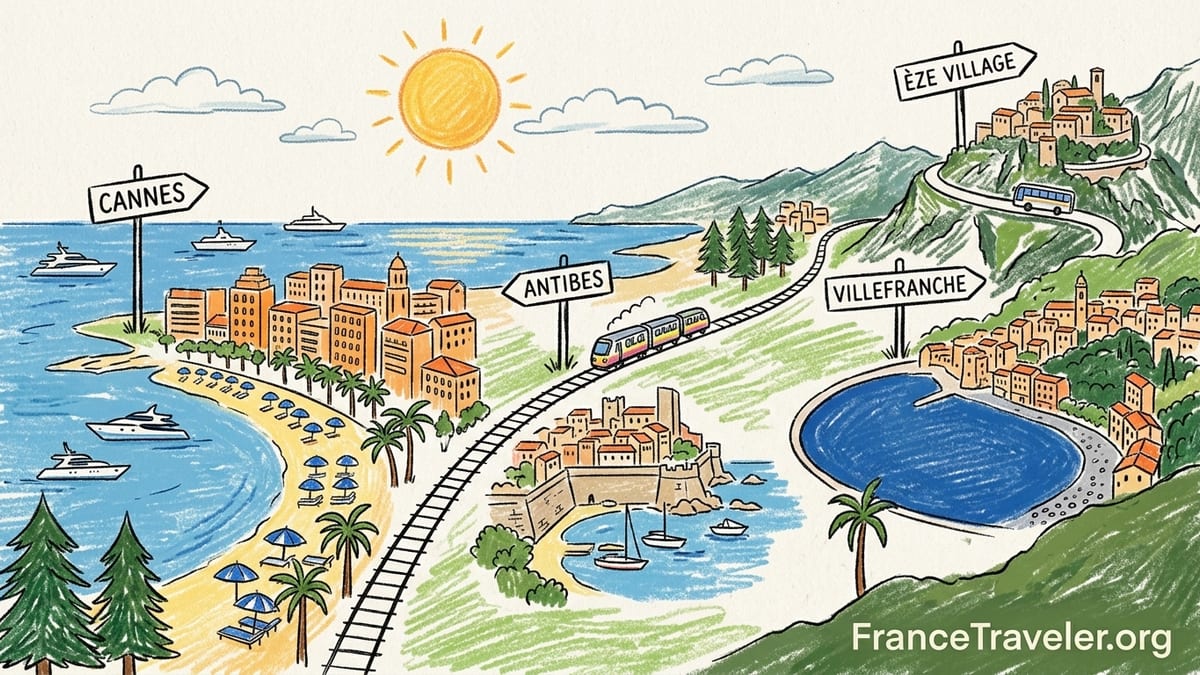
Understanding the Layout of the French Riviera
Before choosing your base, it helps to picture the Riviera as a narrow coastal strip backed by low mountains. The main railway line and coastal road run from Saint Raphaël through Cannes, Antibes, Nice, Villefranche sur Mer, Èze sur Mer and Menton towards the Italian border. This is what makes it realistic to have breakfast in Nice, a beach afternoon in Antibes and a sunset drink in Cannes on the same summer day if you really want to. Local tourism offices describe the region as a 360 degree destination, with easy movement from sea to hill villages and national park in less than an hour or two.
For first time visitors without a car, the dense cluster of towns around Nice is especially practical. There are regular trains between Cannes, Antibes and Nice, and then on to Villefranche sur Mer, Èze sur Mer and Menton, usually in 10 to 30 minute hops. Buses link coastal stations to hilltop villages such as Èze village and Saint Paul de Vence, while organized excursions take visitors inland to Grasse and the pre Alps. This integrated public transport network is one reason Nice is often promoted as the starting point for exploring the wider Côte d Azur.
Distances that look big on a map are often modest in reality. Nice to Cannes by train is roughly 30 to 40 minutes, while Nice to Menton can be under 40 minutes depending on the service. Nice airport sits between Nice and Antibes, which keeps transfer times short to many resorts. Saint Tropez is the main exception. It is further west, beyond Saint Raphaël, and not on the railway line, so road journeys can easily be 90 minutes or more in summer traffic. That relative remoteness is part of its exclusive appeal, but it makes it less convenient for quick multi town hopping.
This compact geography means you do not have to see everything from one base. A common strategy is to spend three or four nights in a central hub such as Nice or Antibes to explore easily by train, then finish with a couple of slower nights in a more secluded spot like Saint Jean Cap Ferrat, Villefranche sur Mer or a hill village. With this in mind, it is worth looking at what each place does best.
Nice: Best All Round Base and First Time Choice
Nice works well for first time travelers, car free trips and mixed interest groups. It has a long urban seafront, a substantial old town and big city services without losing its Mediterranean feel. The tourism office highlights seven kilometers of pebble beach along the Promenade des Anglais, lined with a mixture of free public stretches and private beach clubs that rent sun loungers by the day. On a typical summer day you might pay around 25 to 40 euros for a lounger and umbrella at a mid range beach club, with food and drinks available at your chair. Public beaches, while less serviced, remain free and open to everyone.
The old town of Nice, Vieux Nice, is dense and atmospheric, with narrow lanes, baroque churches and orange facades. In practice this is where many visitors gravitate at night for socca stands, wine bars and small bistros. A visitor following the local tourism board’s suggested one day itinerary might start on the Promenade des Anglais, detour past the historic façade of the Hotel Negresco, then climb Castle Hill for a panorama over the bay before dropping into the old town’s ice cream parlors and family run restaurants in the evening. This combination of seaside, viewpoints and food culture makes the city attractive for couples, solo travelers and families alike.
Nice’s nightlife is varied rather than extreme. You will find rooftop bars above hotels near the seafront, student bars around the old town and Port Lympia, and music venues and clubs that stay open late in summer, but the overall tone is more casual than in Cannes or Saint Tropez. For families, the city promotes green spaces like the Promenade du Paillon, with its fountains and playgrounds, as well as tram lines that make cross town movement easy with strollers. Budget conscious travelers appreciate that you can combine reasonably priced local restaurants in districts like Libération with day trips along the coast without needing a car or private driver.
In terms of accommodation, Nice covers almost every bracket, from simple studios up to five star properties with sea views and historic décor. If you are watching costs, it is often cheaper to base in a neighborhood set a few tram stops back from the seafront and rely on public transport to access the beaches. If your priority is waking up to the sea every morning, splurging on a room along or near the Promenade des Anglais puts that view right outside your window.
Cannes and Saint Tropez: Glamour, Nightlife and Luxury
Cannes and Saint Tropez are the Riviera names most associated with glamour, nightlife and luxury shopping. In Cannes, the Boulevard de la Croisette runs parallel to the bay, fronted by designer boutiques, grand hotels and a string of sandy beaches. The city’s visitors bureau regularly underlines its role as a global event hub, mentioning the Cannes Film Festival and more than one hundred other international events across the year. In practice this means that certain dates in May, June and autumn see hotel rates rise sharply and restaurant reservations become essential.
For beaches, Cannes has the advantage of sand directly in front of the city center. Private beach clubs line much of the Croisette, with neatly arranged loungers that can cost roughly 40 to 60 euros per day in high season at the more upscale spots, and a little less at the simpler clubs. There are also public sandy sections closer to the Palais des Festivals and out towards Palm Beach. Behind the postcard frontage, the old quarter of Le Suquet rises on a hill above the Vieux Port. Official city material describes Le Suquet as the historic heart of Cannes, with cobbled lanes and intimate squares leading to viewpoints over the bay. This gives Cannes a genuine old town atmosphere beyond its glossy surface.
Nightlife in Cannes centers on hotel bars, beach clubs that stay open late in high season and a handful of established nightclubs around the Croisette and the port. A typical night might start with an aperitif on a hotel terrace, continue with a seafood dinner around the Vieux Port, then move on to a club that attracts a mix of visitors and event delegates. The overall tone is upscale and occasionally showy, with dress codes more formal than in Nice or Antibes.
Saint Tropez, further to the west, is even more synonymous with superyachts, luxury boutiques and beach clubs. The port of Saint Tropez is described by its tourist office as a flagship stopover for luxury yachting, with modern harbor services and terraces overlooking rows of large yachts at the quayside. Behind the harbor, the streets are dense with designer labels and high end restaurants, particularly from late spring to early autumn. Day visitors often arrive via shuttle boats from Saint Maxime or Saint Raphaël, stepping onto the quay directly in front of the pastel houses made famous in film and advertising.
The legendary beach scene is actually a short drive away at Pampelonne, in the neighboring commune of Ramatuelle. This long sandy beach is dotted with renowned private clubs where a pair of sunbeds and an umbrella can approach or exceed 80 to 100 euros for the day in peak summer at the most exclusive venues, with bottle service and lively afternoon parties. For luxury seekers and nightlife focused groups, both Cannes and Saint Tropez deliver a sense of spectacle that smaller towns cannot match. The trade off is higher costs and, in the case of Saint Tropez, heavier reliance on cars, taxis, private drivers or boats.
Antibes, Villefranche and Saint Jean Cap Ferrat: Beaches and Relaxed Seaside Atmosphere
Antibes, Villefranche sur Mer and Saint Jean Cap Ferrat sit between Nice and Cannes and suit travelers who want swimmable beaches, a softer atmosphere and good access to larger hubs. Antibes blends a fortified old town, a traditional market and sandy coves. Around Plage de la Gravette, near the old ramparts, families spread towels on the sand while older children swim inside the protected bay. A short walk away, Port Vauban hosts a mixture of sailing boats and megayachts, reinforcing the Riviera’s luxury image without overwhelming the town center.
The old town of Antibes, with its covered Provençal market, casual wine bars and the Picasso Museum in the former château, attracts visitors who like a more human scale environment than Cannes. Nightlife exists in the form of harbor side bars and late opening cafés, but it is less intense than in Cannes or Saint Tropez. Prices for basic restaurant meals can be lower than in Cannes, particularly on back streets away from the sea. For multi generational groups, the ability to walk from a rental apartment to both a sandy beach and the old town within ten minutes is a practical advantage.
Villefranche sur Mer, just east of Nice, curves around a deep natural harbor with an old town that drops directly to the water. The bay shelters a long sandy and shingle beach that French tourism material often highlights as one of the closest fine sandy options to Nice. Trains pull into the station just behind the beach, which makes Villefranche a classic day trip from Nice or a calm overnight base for those who want something smaller. The waterfront is lined with cafés and bistros where you can eat simple grilled fish or a plate of pasta while watching cruise tenders ferrying passengers into the harbor.
On the peninsula between Villefranche and Beaulieu sur Mer lies Saint Jean Cap Ferrat, a compact world of villas, pine shaded coastal paths and residential calm. It has small public beaches such as Paloma and Passable, facing different sides of the bay, along with upscale hotels that appeal to honeymooners and discreet luxury travelers. While nightlife here is minimal, the peninsula excels for romantic walks along the coastal path, picnics on small coves and quiet evenings on hotel terraces. Buses and occasional boats link it to Nice and Monaco, so a car is helpful but not strictly required.
Èze, Menton, Saint Paul de Vence and Grasse: Romance, Culture and Inland Escapes
Èze, Menton, Saint Paul de Vence and Grasse show a different side of the Riviera, with hilltop streets, gardens and perfume heritage. Èze village perches high above the sea, its cobbled lanes climbing through stone arches to panoramic terraces and a hilltop exotic garden. Many visitors pair Èze with Monaco on a single day, riding the coastal train to Èze sur Mer then transferring by bus or taxi up to the village. The ascent rewards you with what are often described as some of the best viewpoints on this stretch of coast, especially at sunset when the Mediterranean shifts through deep blues and oranges.
Menton, near the Italian border, promotes itself as a city of art and gardens, with an old town climbing above a gentle bay and a microclimate that favors citrus. The Menton tourism office highlights gardens with histories stretching back to the eighteenth century, such as the Jardin Serre de la Madone and the botanical paths in the hillside estates. Families appreciate the relative calm compared with Nice in peak season, along with seaside promenades where children scoot and cycle. Menton’s beaches are a mixture of pebble and coarse sand, suitable for relaxed swimming and paddle boarding rather than intense water sports.
Inland, Saint Paul de Vence is among the most famous hill villages in France, known for its art galleries, stone ramparts and the modern art foundation just outside the walls. The village makes a romantic half day excursion from Nice or Antibes, with couples wandering the lanes, stopping for a glass of rosé on a shaded terrace and browsing small galleries. Because much of the center is pedestrian, parking is usually just outside the historic walls, and it is wise to arrive early in summer to avoid congestion.
Grasse, further inland, is recognized worldwide for its perfume industry. Historic perfumeries offer guided tours that explain how local flowers inspired iconic fragrances and allow visitors to create their own simple scents for a reasonable fee. A typical visit might include a free factory tour followed by an optional workshop costing around 30 to 60 euros per person, depending on complexity. Combined with views over the surrounding hills and easy access by bus or train from Cannes and Nice, Grasse works well for travelers interested in local industry, history and cooler air on hot days.
Families, Romantic Trips and Car Free Travel
For families, the best bases are usually Nice, Antibes or Menton, with possible extensions to Villefranche or Saint Jean Cap Ferrat. Nice’s trams and buses, combined with wide promenades and city parks, make it particularly workable with strollers. Many hotels and apartments cater explicitly to families, and local tourism materials talk about equipment hire and child friendly attractions, from beach clubs with gentle access to the water to museums offering free or reduced entry for children. Antibes adds sandy coves and family oriented attractions in the broader area, such as a marine park on the outskirts of town, while Menton offers a quieter, small town version of beach and promenade life.
For romantic stays, couples often gravitate towards Saint Jean Cap Ferrat, Villefranche sur Mer, Èze village, Saint Paul de Vence and certain parts of Antibes. In these places, evenings are more about strolling hand in hand on a coastal path, dining on a candlelit terrace or nursing a glass of wine with distant views of the sea than about nightclubs. In Èze, for example, a couple might spend the day wandering the village streets, visit the exotic garden for views over the Riviera, then book dinner on a terrace overlooking the coast as the sky darkens. In Saint Paul de Vence, watching locals play pétanque at the foot of the ramparts at sunset can feel like stepping into a painting.
Car free travelers are generally best served by staying close to the coastal train line. Nice is the most obvious base, followed by Antibes, Cannes and Menton, each of which has a station near the center. From there, it is straightforward to hop between beach towns and connect with buses heading up to hill villages. For example, a traveler based in Nice could take a morning train to Villefranche sur Mer for a swim, continue to Monaco or Èze sur Mer after lunch, and return to Nice for dinner, all for the cost of a handful of inexpensive regional tickets. Saint Tropez, by contrast, is more complicated without a car or boat transfers and may be better as a one or two night splurge rather than a practical base.
If you plan to use public transport heavily, booking accommodation within an easy walk of the station or a major tram stop is worth the small price premium. This reduces the stress of moving luggage and makes early morning departures for day trips more realistic. Equally, travelers who know they will be out late in Cannes or Nice might choose an apartment near nightlife areas to avoid relying on late night taxis, which can be scarce and expensive during festivals and peak weekends.
Putting It Together: How to Choose Your Base
Choosing the right Riviera base is often about deciding what you care about most and where you are willing to compromise. If you want an all round experience, with good transport, varied food, beaches and nightlife without extremes, Nice is usually the strongest choice, especially for a first visit or if you are nervous about driving. You can then add day trips to Cannes for glamour, Antibes for sandy coves, Villefranche for a beach day that feels like a postcard and Èze or Saint Paul de Vence for drama and art.
If your priority is sandy beaches and a more relaxed seaside feel, Antibes and Villefranche sur Mer stand out. Antibes offers more infrastructure and slightly livelier evenings, while Villefranche delivers a compact, photogenic bay and quick train access back to Nice. For travelers who want their hotel to feel like a peaceful retreat after busy days, Saint Jean Cap Ferrat and certain residential areas of Antibes strike a nice balance between calm and convenience.
Travelers chasing luxury, nightlife and big event energy will feel most at home in Cannes or Saint Tropez. Choose Cannes if direct rail connections, sandy city beaches and a mix of old town charm and Croisette glamour appeal. Opt for Saint Tropez if you like the idea of arriving by boat, spending your days at flagship beach clubs on Pampelonne and lingering on terraces above a harbor filled with superyachts. In both cases, be prepared for higher budgets, especially during festivals or peak summer, and consider booking well ahead.
Those who value gardens, a softer climate and border town charm should look closely at Menton, which combines beachfront promenades with historic villas and botanical gardens. Pairing a few nights in Menton with a stay further west, in Nice or Antibes, gives you two distinct flavors of the Riviera in one trip. For cultural depth away from the water, weaving in day trips to Saint Paul de Vence and Grasse will round out your impression of the region beyond its beaches.
The Takeaway
The French Riviera’s great strength is the extraordinary concentration of destinations in a small area, all stitched together by trains, buses, coastal roads and boat services. That compactness means you can choose a base that suits your priorities without feeling that you are missing out on everything else. Whether you are dreaming of a family friendly week on sandy coves, late nights under palm trees, quiet walks on cliff paths or afternoons wandering art filled hill villages, there is a corner of the Côte d Azur that fits.
In practice, many travelers find that starting in a well connected hub such as Nice or Antibes, then branching out to more specialized places, gives the best of both worlds. You can enjoy the comforts and services of a larger town while sampling the glamour of Cannes, the seclusion of Saint Jean Cap Ferrat, the romance of Èze and the gentler rhythms of Menton or Grasse. With a little planning around your interests, the Riviera’s short distances become an asset, turning even a week long trip into a rich sequence of distinct experiences.
Above all, remember that there is no single best town for every traveler, only the best town for your particular trip. Once you have chosen whether beaches, nightlife, old towns, luxury, family practicality or car free convenience matter most, the map of the French Riviera starts to make immediate sense. From there, it is simply a matter of stepping off the train or boat, feeling the salt air on your face and letting the Riviera’s everyday pleasures carry you into holiday mode.
FAQ
Q1. Which French Riviera town is best for a first time visitor without a car?
Nice is usually the best choice for first timers without a car, thanks to its airport, extensive public transport, long seafront, sizable old town and easy train links to Cannes, Antibes, Villefranche sur Mer, Èze and Menton.
Q2. Where should I stay if sandy beaches are my top priority?
If you want sandy beaches right in town, Cannes and Antibes are strong options, with long sandy stretches and many beach clubs. Villefranche sur Mer and Pampelonne near Saint Tropez also offer appealing sandy or fine shingle bays that are ideal for swimming and sunbathing.
Q3. Which places are best for nightlife and partying?
Cannes and Saint Tropez are the main nightlife hotspots, with high end beach clubs, cocktail bars and nightclubs that attract international crowds in summer. Nice has a more casual, varied nightlife scene, while smaller towns like Villefranche, Menton or Saint Jean Cap Ferrat are much quieter after dark.
Q4. What is the most family friendly base on the French Riviera?
Nice, Antibes and Menton tend to work very well for families, offering promenades, playgrounds and beaches plus shops and services that make everyday logistics easier. Antibes is especially convenient for families who want sandy coves and a compact old town within walking distance of many rentals.
Q5. Where is best for a romantic or honeymoon trip?
For romance, consider Èze village, Saint Jean Cap Ferrat, Villefranche sur Mer, Saint Paul de Vence or a quiet corner of Antibes. These places combine scenic views, intimate restaurants and peaceful evening atmospheres that suit couples more than groups of friends looking for nightlife.
Q6. Is Saint Tropez worth visiting if I am not into luxury shopping?
Saint Tropez can still be enjoyable even if you are not focused on shopping, thanks to its pastel harbor front, nearby beaches and coastal walks. However, prices for dining, beach clubs and accommodation are generally higher than in many other Riviera towns, so it is best approached as a short splurge rather than a budget base.
Q7. Can I see several Riviera towns in one trip without renting a car?
Yes, it is entirely realistic to visit multiple towns by train and bus, especially between Cannes, Antibes, Nice, Villefranche sur Mer, Èze sur Mer and Menton. Choosing a base near a railway station, such as central Nice or Antibes, makes day trips straightforward and keeps travel times modest.
Q8. Which destinations are best if I want a quieter atmosphere?
For a calmer stay, look at Menton, Saint Jean Cap Ferrat, Villefranche sur Mer outside peak cruise days, and inland villages like Saint Paul de Vence or Grasse. These offer slower rhythms and fewer late night crowds while still giving access to the coast and larger hubs.
Q9. How far apart are the main Riviera towns in practice?
In practice, most coastal towns are closer than they appear on a map. By train, Nice to Cannes or Nice to Menton can take roughly 30 to 40 minutes, while Nice to Antibes is often around 20 minutes. The main exception is Saint Tropez, which requires a longer road or boat journey as it sits off the rail line.
Q10. How many days do I need to get a good overview of the French Riviera?
A stay of five to seven days is usually enough to experience one main base and several day trips. For example, you might spend four nights in Nice or Antibes for coastal and city highlights, then add two or three nights in a quieter spot such as Menton, Saint Jean Cap Ferrat or a hill village to round out the trip.