


On the French Riviera, renting a car can feel like the default choice. In reality, the coastal rail line between Cannes, Antibes, Nice, Monaco and Menton is so frequent and practical that many travelers regret paying for a car they barely use. The smarter approach is to decide where you are actually going, then rent only for the days and places where four wheels genuinely improve your trip.
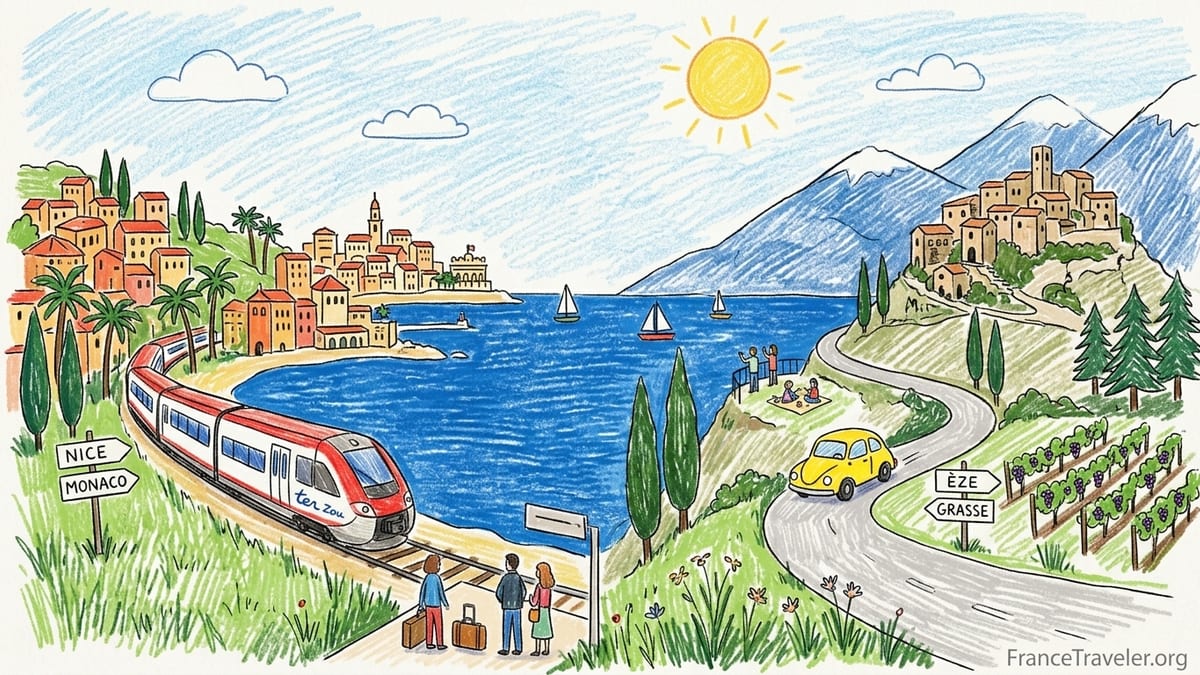
Do You Really Need a Car on the French Riviera?
Before you book a rental, map your itinerary. If most of your time is in the Nice to Menton corridor with perhaps a day in Cannes or Antibes, you can comfortably stay car free. Regional TER Zou trains run along the coast between Cannes, Antibes, Nice, Monaco and Menton as often as every 15 to 30 minutes during the day, with journey times of around 20 to 40 minutes between the main towns and fixed, low fares compared with taxis. This makes the train network far more convenient than sitting in coastal traffic and hunting for parking each time you move.
For example, a typical daytime TER train from Nice to Menton takes around 40 minutes and there are dozens of departures per day, starting roughly before 6 in the morning and running into the late evening. Similar frequency exists for Nice to Cannes and Nice to Antibes. Travelers frequently report using a single regional day pass to hop between Beaulieu sur Mer, Villefranche, Monaco, Antibes and Cannes in one day without ever needing a car, simply stepping off the train and walking a few minutes to beaches, ports and old towns.
Where a rental car starts to earn its cost is when you plan to reach places that are awkward by train or bus, or when you want maximum flexibility with luggage, children or mobility issues. Classic examples include countryside villages above Nice, vineyard areas in Provence, the Gorges du Verdon, lavender plateaus in season, or Saint Tropez and the surrounding peninsula, which can involve multiple bus changes or slow summer traffic if approached without a car. In those cases, having your own vehicle lets you design loop drives, stop for viewpoints and reach trailheads that public transport does not serve well.
A good rule of thumb is to stay car free for the urban and coastal rail section between Cannes and Menton, then add a short rental for specific inland or western Riviera days. This approach converts car hire from a default habit into a targeted tool: you only pay for the days when a vehicle genuinely improves your experience, instead of financing an idle car that sits in an underground garage while you take the train along the waterfront.
Nice Airport Car Rental: How Pickups Actually Work
Nice Côte d’Azur Airport is the main gateway to the French Riviera and one of the busiest airports in France. Most major international rental brands operate here with on site desks at both Terminal 1 and Terminal 2. In practice, cars are collected from dedicated rental car areas a short walk or shuttle ride from the terminal doors. If you arrive at Terminal 2, you typically follow the “Car Rental” signs to the multi level car park where fleets from companies like Hertz, Avis, Europcar, Sixt and Enterprise are grouped.
Many travelers are surprised by how compact the airport is and how quickly they are driving on the Promenade des Anglais after pickup. In light traffic, it can take as little as 15 to 20 minutes from leaving the terminal to reaching central Nice. However, if you arrive on a busy summer Saturday, queues at the rental counters are common, and it is not unusual to wait 30 to 60 minutes to complete paperwork. To speed things up, consider joining a loyalty program for your chosen brand or using online check in, which can reduce time at the counter.
When comparing prices, note that airport rentals often include surcharges that can make them more expensive than downtown locations. For a traveler spending six nights mainly in Nice and only planning one countryside day trip, it can make more sense to delay the rental until the day you leave the city. In that scenario, you might take the tram or taxi from the airport into Nice on arrival, collect a car later from a city branch near Nice Ville station, then return it at the airport or another city on your final day.
Another detail is operating hours. While major providers at Nice Airport broadly match flight schedules and stay open late, smaller local agencies may close earlier. If you land after 22:00, verify that your rental counter will be staffed and that late pickup is confirmed. In peak season, prebooking is essential for automatic cars, family SUVs and anything larger than a compact, as walk up availability can be limited on busy weekends and during major events such as the Cannes Film Festival or Monaco Grand Prix.
Automatic vs Manual, Insurance and Deposits
France remains a largely manual transmission market, and this is very evident in French Riviera rental fleets. Manual cars are usually cheaper and more abundant in each category. Automatic vehicles exist but are often categorized as higher or “special” classes, meaning daily rates can be significantly higher, especially in summer. If you only drive automatic at home, resist the temptation to save money by booking a manual unless you are genuinely comfortable handling one on narrow hill roads and in tight parking garages.
From a practical safety standpoint, an automatic gearbox lets you concentrate on unfamiliar road signs, roundabouts and scooters without worrying about stalling on a steep ramp or mis shifting on the A8 motorway slip roads. If you are planning drives into the hinterland, such as the perched villages of Èze, Saint Paul de Vence or Gourdon, an automatic can reduce stress. Because automatic stock books out quickly, especially for US and Canadian travelers, reserve early and be prepared to pay a premium over the cheapest advertised price.
Insurance and deposits are another area where first time visitors are often caught off guard. Standard rates usually include basic legally required liability and a collision damage waiver with an excess. That excess can be substantial, sometimes running to a four figure sum that will be blocked on your credit card as a security deposit. You can reduce or eliminate that excess by purchasing the rental company’s full coverage option, by using independent excess insurance, or by relying on coverage provided by a premium credit card, but each path has its own rules and paperwork.
Before you leave the airport car park, walk slowly around the vehicle and photograph every panel, wheel and window, noting any scratches or dents on the form. This is particularly important in crowded Riviera cities where door dings and bumper scuffs are common. On return, allow time for the car to be inspected and keep the final report or email confirmation that no additional damage was noted. Doing this at the airport before catching your flight is far less stressful than discovering an unexpected charge on your credit card weeks later.
Parking, Tolls and Coastal Traffic in Real Life
Once you are on the road, parking and traffic patterns will shape how enjoyable your car feels. In central Nice, Cannes and Antibes, on street parking is heavily regulated and mostly paid during daytime hours, with payment by meter or mobile app and fines for non compliance. Many visitors prefer to use underground or multi storey car parks close to old towns and beaches, accepting a daily cost in exchange for security and convenience. In some Riviera towns such as Antibes, public information indicates that certain car parks offer a free first hour on meters, which can be handy for short visits, but you still need to register your plate at the machine.
Cannes and Saint Tropez are classic examples of destinations where parking shortages define the high season experience. Cannes offers a mix of covered car parks and surface lots around the Palais des Festivals, Forville market and the Croisette. Even so, during congresses or film festival periods, spaces can fill quickly, and drivers may need to use more distant park and walk options. Saint Tropez, with its narrow historic center and limited street space, pushes most visitors into dedicated marina car parks and peripheral lots, often with higher tariffs in July and August and very heavy traffic queues in and out of town at peak beach hours.
The A8 motorway runs above the coast between Italy and Provence and is the main toll route that bypasses urban traffic. It is often the fastest way to move between, for example, Nice and Cannes or Nice and Saint Raphael, but tolls and fuel costs add up over longer trips. Official information indicates that annual toll increases apply to networks that include the A8 section, so expect to pay a modest fee each time you pass through a toll barrier, rather than a flat vignette. Many frequent travelers use an electronic toll badge to glide through dedicated lanes, but occasional visitors can simply take a ticket at entry and pay by card on exit.
On the coastal corniche roads and Promenade des Anglais, congestion is a fact of life in summer, during long weekends and anytime there is a major event. A drive from Nice to Monaco that can take 30 minutes by train might stretch toward an hour or more by car when traffic is dense, and you still face the challenge of finding a parking spot once you arrive. This is one of the main reasons seasoned Riviera travelers advise using the train for hops between major seaside towns, reserving the car for inland excursions and itineraries that avoid peak coastal traffic.
Where Trains Shine and When a Car Adds Real Value
The coastal rail corridor between Cannes and Menton is unusually practical by European standards. Regional TER services, now branded Zou in the region, link Cannes, Antibes, Biot, Cagnes sur Mer, Nice Saint Augustin, Nice Ville, Villefranche sur Mer, Beaulieu, Monaco and Menton, with some services continuing to Ventimiglia in Italy. Official timetables indicate that on many days there is a train every 15 to 30 minutes in each direction during daytime hours, tapering to slightly less frequent in the late evening.
For a visitor staying in Nice, this means you can step onto a train at Nice Ville or the closer Nice Saint Augustin station near the airport and be in Antibes in roughly 20 to 30 minutes, Cannes in around 35 to 45 minutes, Monaco in under 30 minutes and Menton in about 40 minutes, depending on the service. Real travelers frequently report using regional passes or day tickets that cover unlimited train, tram and bus travel between Cannes and Menton, allowing them to string together monop day hops such as Nice to Èze to Monaco and back, or Nice to Antibes and Juan les Pins for dinner, without touching a steering wheel.
By contrast, consider Saint Tropez. Reaching the village by public transport from Nice or Cannes usually involves a train to Saint Raphael or Les Arcs, then a bus or boat transfer to the peninsula, with timetables that are less frequent and services that can be packed in high season. Many visitors default to driving, but in summer they encounter long traffic jams near the entrance to the village and crowded paid parking around the port and beaches. In this case, a car has value if you are staying on the peninsula itself and plan to explore its quieter beaches and backroads early or late in the day. If you only want a quick look at the old port, it can be more relaxing to go by ferry from Saint Raphael or Sainte Maxime and leave the car behind.
The story is similar in the inland hills. Villages like Saint Paul de Vence, Gourdon, Tourrettes sur Loup, or the perfume town of Grasse are accessible via a patchwork of buses, but services can be infrequent, especially on Sundays and public holidays, and journeys can take a long time with connections. A rental car turns this into a flexible loop: one day you might drive from Nice to Saint Paul de Vence in the morning, continue up to Gourdon for lunch with a view over the coast, then wind back through the Gorges du Loup to Pont du Loup, stopping at waterfalls or farms along the way. That kind of multi stop countryside routing is precisely where a private vehicle shines.
One Way Rentals and Combining Car & Rail
One way rentals are widely offered in the region, but they come with surcharges that can be modest or significant depending on distance and availability. Common patterns include picking up a car in Nice, using it to tour Provence or the Luberon, then dropping it in Avignon, Aix en Provence or Marseille for a high speed train connection back to Paris. In the other direction, travelers might start in Marseille or Aix, explore the western Riviera, and finish in Nice without backtracking. In all these cases, check the one way fee during booking, as it can sometimes double the effective daily cost on short rentals.
A strategic approach is to pair a car free coastal base with a one way countryside leg. For example, you might spend four nights in Nice using trains and local buses to cover Monaco, Menton, Antibes and Cannes, then pick up a car in Nice on day five, drive inland through the Var or Luberon for three or four days, and drop the car at Avignon or Aix before taking the TGV to your next destination. This splits the trip into a rail powered seaside half and a road trip inland half, avoiding the pain of parking in dense coastal cities while still giving you full freedom in rural areas.
Within the Riviera itself, you can also use one way rentals to avoid backtracking on scenic drives. Some travelers, for example, pick up a car in Nice, drive through the Alps Maritimes toward the Italian border, and finish in Menton or Ventimiglia, dropping the vehicle there and returning by train. While this is logistically more complex, it can be attractive for hiking focused itineraries where you walk between hill villages or along coastal trails and want your car waiting further along the route rather than where you started.
Always factor in timetable reliability and possible strikes when planning tight connections. While regional trains on the Riviera generally run frequently and reliably, summer crowds can make certain departures very busy, and occasional industrial action can disrupt schedules. Building a buffer between your car drop off time and a long distance train or flight departure gives you breathing room in case traffic, queues at the rental return, or a delayed TER conspire against you.
Sample Itineraries: When to Stay Car Free and When to Rent
To make these principles concrete, consider a couple from North America flying into Nice for eight nights. If their goals are old towns, markets, coastal walks and a day trip to Monaco, they could easily spend the entire stay without a car. They might base themselves in central Nice, using the tram from the airport on arrival, then catch regional trains for day trips: one day to Antibes and Juan les Pins for beach and museums, another day to Menton with a stop in Monaco or Villefranche, and perhaps a coastal walk from Beaulieu to Saint Jean Cap Ferrat. In this scenario, a rental car would spend most of its life parked underground while they enjoy pedestrian streets.
Now picture a family of four planning two weeks that combine the Riviera with Provence. They fly into Nice, stay car free in the city for three nights using trains and trams, then pick up a compact SUV from a downtown branch. With the car they drive up to Grasse, across to the Gorges du Verdon for kayaking, then on to the Luberon for four nights in a farmhouse near Gordes. After exploring lavender fields, hilltop villages and wineries by car, they drop the vehicle in Avignon and catch a TGV to Paris. In this case, renting is clearly worth it for the countryside section, but unnecessary for the initial urban segment.
A third example is a group of friends intent on beach clubs and nightlife. They base themselves in Cannes during the second week of August and want to visit Antibes, Juan les Pins, Monaco and perhaps Saint Tropez. Here a car could be a burden at night, when parking is tight and alcohol is involved, and can be trapped in traffic exiting popular beach areas at sunset. Many such groups now choose to remain car free on the Cannes to Monaco axis, relying on trains and occasional rideshares, then perhaps rent a car or take a boat for a single focused day in Saint Tropez, minimizing the time they spend inching along congested peninsula roads.
By thinking in terms of segments rather than entire vacations, you can match each part of your trip to the transport mode that fits it best. City and coastal rail segment: car free. Countryside loops and low frequency bus zones: rent. High season Saint Tropez or peninsula stays: possibly rent, but research parking and accept that road congestion may be part of the experience.
The Takeaway
The French Riviera rewards travelers who resist automatic habits. Renting a car from the moment you land until the moment you fly out feels convenient on paper, but the combination of frequent coastal trains, dense historic centers and complex parking can turn that convenience into unnecessary cost and stress. In the Nice, Cannes, Antibes, Monaco and Menton corridor, regional trains, trams and buses form a practical backbone that covers nearly all classic highlights without the need for a private vehicle.
Where a rental car truly proves its worth is beyond that coastal spine: in the hills where buses are sparse, on the Provençal backroads that connect farms, vineyards and perched villages, and for certain peninsula or lake destinations where public transport is slow or indirect. By dividing your itinerary into car free and car based segments, choosing automatic or manual transmission realistically, and preparing for real world issues such as deposits, tolls and parking, you can turn car hire from a default expense into a targeted tool that elevates the right parts of your journey.
FAQ
Q1. Is it worth renting a car if I am only visiting Nice, Monaco, Cannes and Antibes?
For most travelers, no. The coastal TER trains between these cities are frequent, relatively inexpensive, and usually faster than driving once you factor in traffic and parking. A car is more likely to be a burden than a benefit on this particular stretch.
Q2. Should I pick up my rental car directly at Nice Airport or in the city?
If you plan countryside or long distance driving immediately, airport pickup is practical. If you will spend your first days inside Nice, it is often cheaper and less stressful to take the tram into town and rent later from a city branch only for the days you need a car.
Q3. How hard is it to find parking in Nice and Cannes?
Parking is manageable but rarely free in central areas. Expect to use underground or multi storey car parks and pay hourly or daily rates. In peak summer and during major events, garages near old towns and beaches can fill up, so arriving early in the day helps.
Q4. Do I really need an automatic car on the French Riviera?
If you normally drive automatic, it is safer and less stressful to book one, especially for hill roads and dense city traffic. Manuals are cheaper and more common, but learning stick shift on steep village streets and in tight garages is not advisable.
Q5. How big are the rental car deposits and how can I avoid problems?
Deposits often run to a four figure sum blocked on your credit card, especially if you decline full coverage. To avoid disputes, photograph the car thoroughly at pickup and return, understand your insurance excess, and keep the final inspection report or email confirming no damage.
Q6. Are motorway tolls on the A8 very expensive?
Tolls on the A8 are not extreme for short hops between Riviera towns, but they do add up on longer journeys. Consider the A8 for faster intercity travel, while using coastal roads for scenic short drives, and budget a modest extra amount for tolls if you plan multiple long distance days.
Q7. Is Saint Tropez easier by car or by public transport?
Neither option is perfect. Driving gives flexibility once you are on the peninsula but can mean long traffic jams and paid parking in peak season. Trains plus bus or ferry avoid driving stress but take longer and depend on timetables. For many visitors, a targeted day trip by boat or a short car rental focused on the peninsula works best.
Q8. Can I rely on trains for day trips from Nice to Monaco and Menton?
Yes. Regional trains between Nice, Monaco and Menton run many times per day and are the preferred mode for both locals and tourists. Seats can be busy at rush hour or in summer, but the system is generally reliable for day trips.
Q9. Are one way car rentals between Nice and Provence cities easy to arrange?
Major rental companies usually allow one way hires between Nice and cities such as Avignon, Aix en Provence or Marseille, but they may charge an additional fee. Check this cost when comparing prices and build a time buffer between dropping the car and catching a long distance train.
Q10. What is the best overall strategy for mixing trains and car rental on the Riviera?
Use trains, trams and buses for the dense coastal strip between Cannes and Menton, then rent a car only for days in the hills, rural Provence or specific areas like Saint Tropez where public transport is weaker. This minimizes hassle in cities and focuses your rental budget on the parts of the trip where a car adds the most value.