


The French Riviera, or Côte d’Azur, is one of Europe’s classic seaside escapes: a chain of sunlit bays, Belle Époque villas and palm-lined promenades that runs from just west of Saint-Tropez to the Italian border at Menton. For first-time visitors, the hardest part is not deciding whether to go, but how to make sense of so many famous names in a short trip. This guide explains what the Riviera is, how to move along it easily by train or car, when to visit, and how to choose one or two smart bases instead of trying to stay everywhere.
Understanding the French Riviera and How It Works
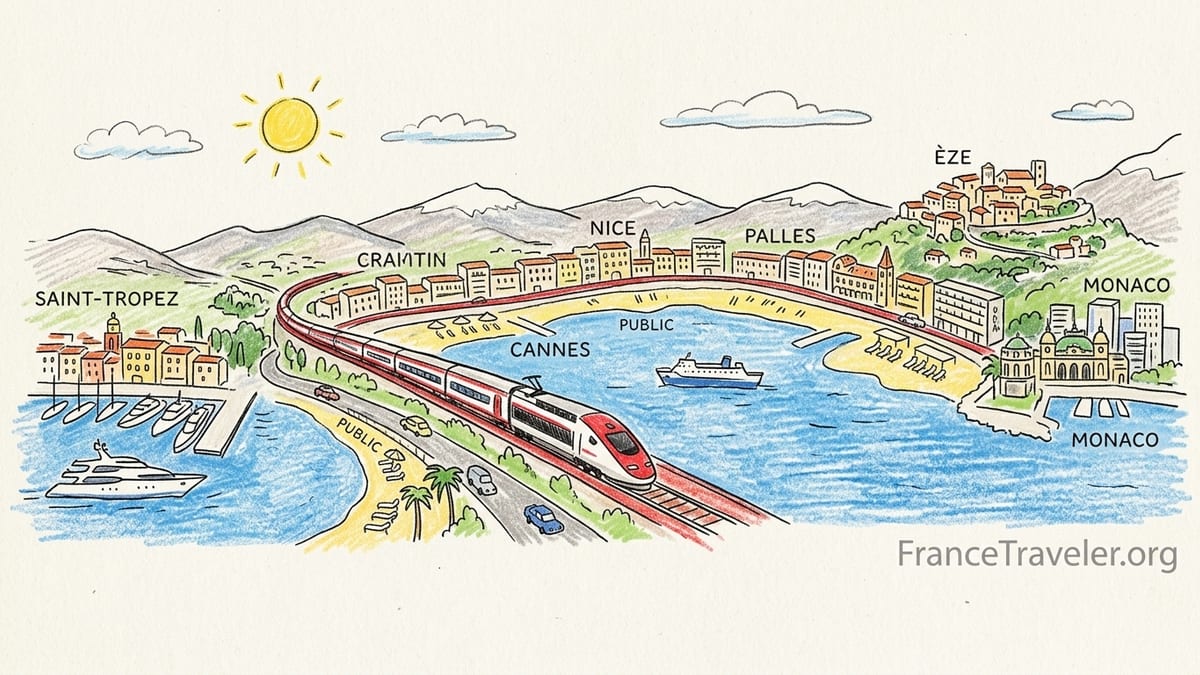
The French Riviera is the Mediterranean coastline of southeastern France, stretching roughly from the area around Saint-Tropez through Cannes, Antibes, Nice, Monaco and on to Menton near the Italian border. In practice, most visitors focus on the arc between Saint-Tropez and Menton, a strip of coast with an almost continuous chain of resort towns, marinas and beaches backed by low mountains and dramatic hill villages. The sea is typically calm and intensely blue, the climate is mild for most of the year, and the Riviera has a long history as a winter resort for European royalty that later evolved into a summer playground.
Distances look short on a map, but travel times can stretch out at peak times. Driving the 30 kilometers between Cannes and Nice can take over an hour on a busy August afternoon, while the regional TER train typically covers the same route in about 30 to 40 minutes. This contrast shapes how visitors experience the coast. The Riviera is not one long beach; it is a chain of individual towns, each with its own character, beaches and nightlife, linked by an efficient if sometimes crowded train line.
First-time visitors often imagine they should spend one night in each famous place: a night in Cannes, one in Nice, another in Monaco and so on. In reality, packing and unpacking in so many hotels for such short distances wastes time and money. The Riviera works best when you choose a primary base, usually a city such as Nice or Cannes, and then day trip to nearby towns by train, bus or occasional ferry. A typical one-week trip might split time between two bases, such as three nights in Nice and three in Antibes, instead of five different hotel changes.
Prices vary widely from town to town and by season. In July and August, a midrange hotel in central Nice or Cannes can easily reach around 250 to 350 euros per night, and simple sun loungers at private beaches might start around 25 to 40 euros per person per day. In May, June, September or early October, the same rooms and beach clubs can drop significantly, sometimes by a third, and you benefit from milder temperatures and lighter crowds. For a first visit, planning around these seasonal swings is as important as picking the right town.
How to Get There and Move Along the Coast
Nice Côte d’Azur Airport is the main gateway to the French Riviera and one of France’s busiest airports after Paris. It sits directly on the water at the western edge of Nice, so arriving passengers see the coastline the moment they land. From the terminals, a tram runs into central Nice in around 25 to 30 minutes for only a few euros, and connects with the main train station for onward regional trains. Many visitors arriving from North America or elsewhere in Europe never rent a car at all, instead using this airport tram and the coastal train network.
From Paris, high-speed TGV trains reach Nice in roughly five and a half to six hours, and also serve Cannes and Antibes. For many travelers, a practical route is to fly into Paris, spend a couple of days in the capital, then take a late-morning TGV south and arrive on the Riviera by mid-afternoon. Regional TER trains then link the coastal towns between Saint-Raphaël and Ventimiglia just across the Italian border, stopping in hubs such as Cannes, Antibes, Nice, Monaco and Menton. Tickets for short hops, for example Nice to Antibes or Nice to Monaco, are usually inexpensive compared with similar distances in North America, and can often be bought at the station on the day.
Driving gives freedom to explore inland Provence and hill villages that are poorly served by public transport, but it comes with trade-offs on the coast. Summer traffic can be heavy, especially on weekends and in August when many French travelers take vacation, and parking in old towns such as Antibes or in Monaco is often in underground garages that charge by the hour. It is common for visitors who rent a car to park it for days at a time while they use trains or walk within a chosen base town. If you plan to stay mainly in Nice, Cannes or Antibes and focus on the coastal towns, skipping a rental car entirely can be both cheaper and more relaxing.
Ferries supplement trains in a few important spots. In season, boats connect Cannes with the Lérins Islands just offshore, and there are also seasonal services linking Saint-Tropez with Saint-Raphaël, Sainte-Maxime and sometimes Nice or Cannes. These crossings are more expensive than the train but can save time in traffic and offer scenic approaches into crowded harbors. For example, in summer it is often quicker and more pleasant to reach Saint-Tropez by passenger boat from Saint-Raphaël than to drive the twisting coastal road and search for parking.
When to Go and How to Choose a Base
The Riviera enjoys around 300 days of sunshine per year, but that does not mean every month feels the same. July and August are hot, busy and expensive, with daytime highs regularly in the high 20s to low 30s Celsius and a lively nightlife scene in beach clubs and marinas. These peak months suit travelers who prioritize a party atmosphere, late dinners and warm sea temperatures, and who are comfortable booking restaurants and beach clubs in advance. Hotel rates and airfares are usually at their highest, and some smaller coves and lanes can feel crowded from late morning until evening.
For many first-timers, the sweet spots are late May and June, and September into early October. In these shoulder seasons, the sea is pleasant enough for swimming, daytime temperatures are warm but not oppressive, and it is easier to find last-minute restaurant reservations. For example, a couple visiting in mid-June may be able to book a seafront room in Nice or Antibes for noticeably less than in early August and still enjoy long daylight hours and open beach clubs. March, April and late October can be quieter and cheaper again, but the weather is more variable and some seasonal businesses close or keep shorter hours.
Choosing a base matters more than trying to sleep everywhere. Nice is the default base for many first-time visitors, partly because the airport, tram and rail line all converge there, and partly because it combines city life with a Mediterranean beach. From Nice, it is around 20 minutes by train to Antibes, about 35 to Cannes, around 25 to Monaco and roughly 40 to Menton. This means you can wake up in the same hotel each morning, have breakfast at a café in Nice, then take a mid-morning train to spend the day exploring a different town before returning in the evening. For travelers staying four to six nights, this can be the most time-efficient structure.
Other towns work well as bases for particular travel styles. Antibes, for instance, has a compact old town, a daily covered market and a mix of sandy beaches on the Cap d’Antibes and gravel stretches closer to the center, and often feels slightly more relaxed than Cannes or Nice. A family might choose Antibes for access to larger sandy beaches and a water park nearby, while a couple focused on luxury hotels and designer shopping might prefer to base in Cannes or even Monaco. First-time visitors who want to see multiple parts of the coast in one trip sometimes split their time, for example three nights in Nice followed by three nights near Saint-Tropez, but moving every night or two along such short distances usually adds more hassle than value.
Saint-Tropez and the Ramatuelle Beaches
At the western end of the classic Riviera, Saint-Tropez is both a real fishing village and a global symbol of glamorous seaside life. Its old harbor fills with superyachts in high season, and narrow streets rise behind the quays lined with pastel houses and designer boutiques. Prices reflect its celebrity status: in July and August, rooms in many waterfront hotels can climb far above 500 euros per night, and even simple cafés on the harbor may charge a premium compared with similar places in nearby towns. For most first-time visitors, Saint-Tropez works best as a focused visit of a day or two rather than a week-long base unless budget is flexible.
The best-known beaches are not in the town itself but along the bay of Pampelonne in the neighboring commune of Ramatuelle. This several-kilometer stretch is a mix of public areas, where you can bring your own towel, and private beach clubs that rent loungers and umbrellas. Iconic names here range from long-established institutions with high-end restaurants to newer, more casual clubs. In summer, loungers in the most famous clubs can easily cost 60 euros or more per person for a day, while smaller operations and public zones offer more modest options. Parking in the area is usually in pay lots behind the dunes, which can fill by late morning on peak days.
Reaching Saint-Tropez without a car requires a bit of planning. Buses connect the town with Saint-Raphaël and other regional hubs, but services can be infrequent, particularly in the evening. Many visitors without a car take a ferry from Saint-Raphaël or Sainte-Maxime during the season, arriving directly in the harbor and avoiding the sometimes congested approach roads. For a first-time Riviera trip of one week, Saint-Tropez is often best treated as an add-on at the beginning or end, perhaps two nights to enjoy early-morning walks through the old town, a lunch at a beach club along Pampelonne, and an evening drink overlooking the harbor before continuing east to the main coastal train corridor.
Cannes, Antibes and Juan-les-Pins
Cannes is famous for its film festival, luxury hotels along the Boulevard de la Croisette and private beaches that line much of its central bay. The main beach here is mostly sandy and gently sloping, in contrast to the pebbles found in Nice. This makes Cannes attractive for travelers who prioritize classic sandy beaches and are willing to pay for a lounger or a central hotel. In May, outside festival dates, a midrange hotel a street or two back from the Croisette might price in the 200 to 250 euro range, rising significantly in July, August and during major events. Cannes also offers good train connections, making it a practical base for exploring westward to smaller resorts such as Théoule-sur-Mer and eastward to Antibes and Nice.
Just a short train ride away, Antibes offers a different atmosphere. Its old town is enclosed by ramparts and looks out over a picturesque harbor that mixes fishing boats and yachts. The town has a daily covered market selling produce, cheese and local specialties, which gives it a lived-in feel even amid tourism. Beaches near central Antibes are a mix of small sandy coves and more open stretches with views of the old walls. The nearby Cap d’Antibes peninsula offers walking trails with sea views and a few more exclusive beach spots attached to hotels and clubs. Many travelers find Antibes a comfortable balance between everyday life, history and resort, and prices often undercut Cannes slightly for similar quality.
Juan-les-Pins, effectively the western side of the Antibes peninsula, faces a different bay and has a long tradition as a jazz resort. Today it is known for its nightlife, bars and beach clubs that stay lively in summer evenings. The main beach here is sandy, and because the bay is sheltered it can feel more gently lapped by the sea than some exposed parts of the coast. For younger travelers or groups of friends who want both sea and after-dark energy, staying in Juan-les-Pins with day trips into Antibes and Cannes can work well. For a quieter first-time base with broader train connections, however, most visitors still choose Antibes or Cannes.
Nice, Villefranche and Cap-Ferrat
Nice is the largest city on the Riviera and for many first-time visitors the most practical base. It combines an international airport, a mainline TGV station and the coastal TER line with a long waterfront promenade and an old town that still functions as a lived-in neighborhood. The main city beach is mostly made of smooth pebbles rather than sand, and this surprises some visitors who associate the Riviera only with fine sand. Public stretches alternate with private beach clubs that rent sunbeds and serve food and drinks. Even if you do not plan to swim, evenings on the Promenade des Anglais, with locals strolling, families cycling and the sun lowering into the sea, often become a daily ritual.
Accommodation in Nice ranges from budget guesthouses inland from the station to boutique hotels in the old town and luxury properties along the seafront. For example, a well-reviewed midrange hotel a few minutes’ walk from the promenade might cost around 180 to 230 euros per night in shoulder season, while seafront rooms in upscale hotels can be several times that in peak summer. The city also offers a wide spread of restaurants, from simple socca stands serving chickpea pancakes in the old town to contemporary bistros in emerging neighborhoods. This variety, plus easy rail access east and west, makes Nice especially appealing if you want a single base.
Just a short train or bus ride east, Villefranche-sur-Mer curves around a deep natural harbor that often hosts cruise ships and yachts. Its old town tumbles steeply down to the water, with narrow lanes and staircases leading to a small but scenic pebbly beach. Villefranche feels quieter than central Nice, particularly outside of high summer and cruise days, and can be a good choice for travelers who want a village feel while still being only minutes away by train from the city. A typical pattern is to stay in Nice, then spend a day wandering Villefranche, swimming near the harbor and having a long lunch on a terrace overlooking the bay before heading back at sunset.
On the next peninsula, Cap-Ferrat is one of the Riviera’s most exclusive enclaves, dotted with private villas and a few luxury hotels. Public coastal paths encircle much of the headland, offering some of the region’s most rewarding sea views and small rocky coves where locals swim. There are fewer accommodation options here than in Nice or Villefranche, and prices tend to be high, so first-time visitors usually visit as a day trip rather than a base. Still, walking a section of the coastal trail and visiting one of the historic villas open to the public offers a glimpse into the Riviera’s early 20th-century elite history.
Èze, Monaco and Menton
East of Cap-Ferrat, the mountains push closer to the sea and the coastline becomes more dramatic. The medieval hill village of Èze sits several hundred meters above the water on a rocky outcrop, with steep cobbled lanes, stone houses and a famed botanical garden at the very top that overlooks the sea and the curves of the corniche roads below. Reaching Èze without a car usually involves a train or tram to central Nice followed by a bus up the hillside, or an organized tour. Because the lanes are steep and mostly cobbled, it is not ideal for travelers with mobility issues. Many visitors combine a morning in Èze with an afternoon in Monaco.
The Principality of Monaco, one of the world’s smallest countries, is often associated with its casino, yacht harbor and Formula 1 race. In practice, it is a dense, hilly city built in tiers above the sea, with a mix of luxury hotels and apartment blocks. The Monaco-Monte-Carlo train station is served regularly by TER trains running between Menton and Cannes, and its central platform exits put visitors close to the harbor and casino district. Accommodation and dining prices are on the high side; it is common for first-time Riviera visitors to stay in nearby towns such as Nice or Menton and visit Monaco as a long afternoon or evening trip for a harbor stroll and a look at the famous square.
Menton, near the Italian border, has a softer, less hectic feel than many Riviera neighbors. Known for its lemon groves and pastel façades, it is backed by hills that shelter it and help create a mild microclimate. The old town climbs above a seafront lined with a mix of pebbly and coarser sandy beaches. Prices in Menton are often a touch lower than in Nice or Cannes, and it can make a strong base for travelers who prefer a smaller town but still want rail access along the coast. From Menton, trains reach Monaco in around 10 to 15 minutes and Nice in under an hour, making day trips straightforward.
Together, Èze, Monaco and Menton showcase a different side of the Riviera than the bays of Cannes or the urban sprawl of Nice. They are steeper, in parts quieter, and in Monaco’s case more vertical and compact. A common first-time approach is to base in Nice and plan one full day eastward: a morning bus or tour up to Èze, an afternoon exploring Monaco’s old town and harbor, and an early evening train ride back along the coast, perhaps stopping in Villefranche for a quick seaside dinner before returning “home.”
Hill Villages, Beaches and Where to Sleep
Beyond the main coastal strip, a constellation of hill villages offers a change of pace. Places such as Saint-Paul-de-Vence, Vence and Biot sit in the hills above the sea, with stone lanes, shaded squares and views back to the coast. These villages are less connected by train and more by regional buses or car, so they work best as day trips from a base in Nice or Antibes or as part of a road trip that combines the Riviera with inland Provence. For example, a couple might spend a morning at the beach in Antibes, then drive 40 minutes inland in the late afternoon for dinner in Saint-Paul-de-Vence and sunset views from the ramparts.
Beaches along the Riviera vary more than first-time visitors often expect. Nice and much of the eastern stretch have largely pebbly or coarse-gravel beaches, which can be more comfortable with water shoes or thick towels but keep the water remarkably clear. Cannes, Juan-les-Pins and parts of Antibes offer more classic sandy beaches, though many of the most central strips are backed by busy roads or promenades rather than dunes. Public beaches are free to use but come without services; private beaches rent loungers, umbrellas and often have locker rooms and full-service restaurants, effectively functioning as daytime beach clubs. Choosing between them comes down to budget and preference for comfort versus a simple towel on the shore.
Accommodation decisions should follow your chosen base and budget. In the main towns, you can usually choose among three broad categories: simple two-star hotels and guesthouses often a little inland from the waterfront, midrange boutique properties in central neighborhoods, and full-service luxury resorts with pools and direct beach access. For a first-time trip with a moderate budget, a common pattern is to spend a little more for a well-situated hotel in your primary base town, then save by taking day trips on the train instead of moving between multiple hotels. Families sometimes look for apartment rentals near supermarkets and bakeries, especially in Nice and Antibes, to manage meal costs.
Booking strategies depend on season. For August and major events such as the Cannes Film Festival or Monaco Grand Prix, booking accommodation months in advance is advisable, and some properties require minimum stays. For shoulder seasons, visitors often find a good choice of hotels six to eight weeks out, with last-minute deals appearing for midweek nights or shorter stays. Flexibility on exact dates and willingness to stay a few blocks back from the water can open better-value options while still keeping you within easy walking distance of beaches and stations.
The Takeaway
A successful first trip to the French Riviera is less about ticking off famous place names and more about understanding how this compact coastline works. The core decisions are simple: choose when to go, pick one or two base towns that match your style, and then use the coastal trains, buses and occasional ferries to sample neighboring resorts and villages. With that framework in place, you are free to enjoy the everyday pleasures that make the Riviera so enduring, from a morning coffee at a street café in Nice to an evening swim in a quiet cove near Cap-Ferrat.
For most first-time visitors, basing in Nice or Antibes and building day trips to Cannes, Monaco, Menton and one or two hill villages offers the best mix of convenience and variety. Saint-Tropez and the Ramatuelle beaches can be a glamorous detour if time and budget allow, but they are not essential for a rewarding first visit. Whether you come for the beaches, the food, the light or the history, the region’s scale and transport network make it surprisingly easy to experience several very different towns in a short trip, without the constant packing and unpacking that can weigh down other coastal itineraries.
FAQ
Q1. What is the easiest place to base myself for a first visit to the French Riviera?
Most first-time visitors find Nice the easiest base because it combines the main airport, a central train station on the coastal line, a wide choice of hotels and restaurants, and an old town with a city beach. From Nice you can reach Cannes, Antibes, Monaco and Menton by frequent regional trains without needing a car.
Q2. Do I need to rent a car to explore the French Riviera properly?
No, you do not need a car for the main coastal towns. Regional TER trains and local buses connect Nice, Cannes, Antibes, Monaco, Menton and several smaller resorts. A car becomes more useful if you want to explore inland hill villages in depth or combine the Riviera with rural Provence, but for a typical first-time stay focused on the coast many travelers manage comfortably with public transport.
Q3. Are the beaches on the French Riviera sandy or pebbly?
It depends on the town. Nice, Villefranche and much of the eastern stretch have mostly pebbly or coarse-gravel beaches, while Cannes, Juan-les-Pins and parts of Antibes offer more sandy stretches. If soft sand is important to you, choosing a base near Cannes or Antibes makes sense, while accepting pebbles in Nice and Monaco often rewards you with clearer water and dramatic views.
Q4. When is the best time of year to visit the French Riviera?
For many travelers the most comfortable times are late May and June, and September into early October, when the sea is warm enough for swimming, the weather is generally sunny but not extreme, and crowds and prices are lower than in July and August. Winter can be mild and pleasant for city breaks, while March, April and late October have more changeable weather and a quieter, off-season feel.
Q5. How expensive is the French Riviera for accommodation and food?
Costs vary by town and season, but the Riviera is generally on the higher side compared with many other French regions. In peak summer, midrange hotels in central Nice, Cannes or Antibes can easily reach a few hundred euros per night, and dinners at midrange restaurants might cost roughly what you would expect in a major European city. Traveling in shoulder season, staying a few streets back from the seafront and mixing restaurant meals with café lunches or market picnics can keep budgets more manageable.
Q6. Should I try to stay in several different towns, or pick one base?
For most first-time visitors, choosing one main base, or at most two, works better than moving every night or two. The distances between towns are short, so frequent hotel changes add stress without much practical benefit. A week split between Nice and Antibes, or a single-base stay in Nice with day trips to Cannes, Monaco and Menton, usually offers plenty of variety with far less packing and unpacking.
Q7. Is Saint-Tropez worth including on a first Riviera trip?
Saint-Tropez and the nearby Pampelonne beaches at Ramatuelle are iconic and can be memorable, but they are more remote than the main train-served corridor. Reaching them involves buses, ferries or driving, and costs for accommodation and beach clubs are often higher. If you have more than a week or are particularly drawn to its glamorous reputation, adding one or two nights there makes sense. Otherwise, focusing on the central Riviera around Nice, Antibes and Cannes will already give you a rich first taste of the coast.
Q8. How crowded does the French Riviera get in summer?
July and especially August can be very busy, with popular beaches, promenades and old-town streets feeling crowded from late morning into the evening. Trains can be standing-room only at peak times, and getting restaurant reservations or beach loungers often requires booking ahead. If you prefer a quieter atmosphere but still want warm sea temperatures, late June or September are typically calmer while still feeling very summery.
Q9. Is the French Riviera suitable for families with children?
Yes, many families visit the Riviera each year. Towns like Antibes and Cannes, with their sandy beaches and relatively gentle sea access, are particularly popular with families. Apartment rentals near supermarkets and bakeries can help with meal costs and routines, and many coastal promenades are stroller-friendly. Parents should note that pebbly beaches such as those in Nice may require water shoes for children’s comfort.
Q10. Can I visit Monaco, Èze and Menton in a single day from Nice?
It is possible but will feel busy. An ambitious day might include an early bus or tour up to Èze village, a midday or afternoon visit to Monaco, and an evening train to Menton before returning to Nice. Many travelers prefer to focus on Èze and Monaco in one day, then take a separate half-day or full day to enjoy Menton’s old town and seafront at a more relaxed pace.