


The French Alps around Mont Blanc and Annecy are some of the easiest big-mountain landscapes to experience in a single day, especially if you are starting from Geneva, Lyon or Annecy itself. The challenge is not finding tours but choosing which experiences really deserve a guide and bundled transport, and which are better, cheaper and calmer to arrange on your own. This guide focuses on bookable, real-world experiences around Chamonix, Mont Blanc and Annecy, with practical examples of durations, prices, family suitability and when to go it alone.
How to Choose the Right Type of French Alps Tour
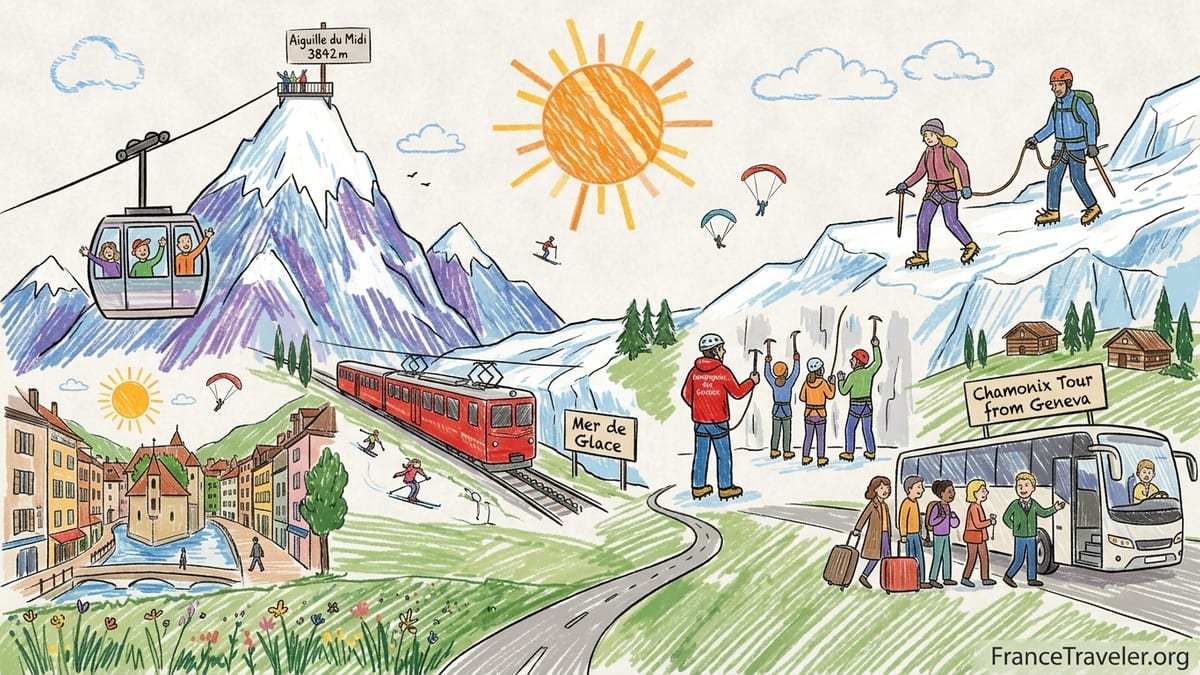
Before you start comparing operators and prices, it helps to understand the basic categories of experiences around Chamonix, Mont Blanc and Annecy. At one end are straightforward sightseeing lifts and lake towns that are easy to do independently: the Aiguille du Midi cable car, the Montenvers train to the Mer de Glace and strolling Annecy’s old town all fall into this camp. You can simply buy tickets, follow clearly signposted routes and enjoy the views at your own pace.
At the other end are activities where a guide adds real value or is functionally essential. Glacier hiking on the Mer de Glace, guided high-altitude routes such as the Vallée Blanche in winter, or multi-day Mont Blanc treks demand technical skills, route knowledge and safety judgment. For these, booking with a certified guide through the Compagnie des Guides de Chamonix or similar local bureau is the norm rather than an upgrade. Prices are higher but include equipment you are unlikely to own, such as crampons, harness and ice axe.
Between these two extremes sit bundled day tours from Geneva, Lyon or Annecy. These typically package transport, key tickets and a light guiding element for 175 to 250 euros per adult for a full day to Chamonix and Mont Blanc from Geneva in 2026, including the Aiguille du Midi cable car and the Montenvers train. These tours are not always the cheapest option, but they remove the stress of bus connections, parking, time-slot bookings and language barriers, which matters on a first trip or on tight schedules.
A useful rule of thumb is this: if the experience involves technical terrain or complex logistics across borders or languages, a guide or packaged tour is worth serious consideration. If it is mainly about wandering a town, sitting on terraces and riding one or two obvious lifts, you are usually better off planning it yourself, especially if you are comfortable using public transport booking apps and can read basic French or English information boards.
Chamonix & Mont Blanc Day Trips from Geneva and Lyon
For most visitors, the classic French Alps excursion is a day trip to Chamonix and Mont Blanc from Geneva. In 2026, shared shuttles like Mountain Drop-offs, AlpyBus and FlixBus take about one hour fifteen minutes from central Geneva or Geneva Airport to Chamonix, with early departures around 07:30 that line up well with morning cable car slots. Return fares typically start around 40 euros per adult, varying by season and how far in advance you book. If you are based in Lyon, expect closer to two and a half hours by car or coach each way to reach Chamonix, so full-day tours are long but still feasible.
Once in Chamonix, the two headline attractions for a first-time visitor are the Aiguille du Midi cable car and the Montenvers rack railway to the Mer de Glace glacier. Both start from the town and are easy to reach on foot or by a short local bus. In summer 2026, a return ticket for the Aiguille du Midi has hovered around the low-80-euro mark per adult, while the Montenvers train is around 40 euros return for adults. Many travelers choose to do both in a single day: Aiguille du Midi in the morning when the light is clear, lunch in town, then Montenvers in mid-afternoon.
If you prefer not to handle any of the logistics, consider an organized Geneva to Chamonix, Aiguille du Midi and Mer de Glace day tour. Major brands and local operators advertise hotel pickup in Geneva, a coach to Chamonix, reserved cable car and train slots, some guiding at viewpoints and free time in town. Typical prices in 2026 range from about 175 to 250 euros per adult, depending on inclusions such as lunch or extra stops. This can be excellent value for first-timers or short-stay travelers who simply want to guarantee they see the summit platforms and glacier in one smooth day.
For independent travelers, especially families, it can be cheaper to book shuttle transport and lift tickets separately. The trade-off is that you need to watch weather forecasts, cable car time slots and shuttle times yourself. Experienced visitors often wait to buy Aiguille du Midi tickets until a clear-weather day, or choose a flexible pass such as the Mont Blanc Multi-Pass if they plan to combine several lifts over two days. If you are staying in Chamonix for more than one night, doing Montenvers and Aiguille du Midi on separate days with slower starts can be far more relaxed, especially with younger children.
Aiguille du Midi & Mer de Glace: When a Guide and Tour Add Value
The Aiguille du Midi is one of the most spectacular yet accessible viewpoints in the Alps, rising to 3,842 meters above sea level by cable car. For a standard visit that involves riding the cable car, exploring the viewing platforms, stepping into the glass “Step into the Void” box and walking through the panoramic tunnels, you do not need a guide. Everything is clearly signed, and staff are present to direct people. What you do need is warm clothing, sun protection and awareness of altitude. Most visitors spend two to three hours at the top, longer if they linger over coffee at the summit café.
The Mer de Glace, reached by the Montenvers rack railway and a short gondola and stair section down to the ice cave, is also straightforward as a self-guided outing. The viewpoints, café terraces and walkways are signposted, and there is an educational trail explaining how the glacier has receded. Families with school-age children generally handle this well, although the long staircases to the ice grotto can be tiring for younger kids or anyone with mobility issues. A typical visit takes two to three hours from boarding the train to returning to Chamonix.
A guide becomes valuable once you leave the built infrastructure and step onto the glacier or into high-mountain terrain. Glacier hiking and introductory ice climbing days on the Mer de Glace, for example, are normally run as small-group outings by the Compagnie des Guides de Chamonix or specialized mountain schools. A day course often includes all technical equipment except boots and costs in the region of a few hundred euros per person, depending on the ratio of clients to guide. Participants learn how to walk safely tied to a rope team, use crampons correctly and try basic ice climbing on safe walls.
Similarly, if you intend to ski the Vallée Blanche in winter or traverse from the Aiguille du Midi to routes like the Cosmiques ridge, a qualified high-mountain guide is strongly recommended. These outings involve crevassed glaciers, exposed ridges and route-finding that change with conditions. Even confident skiers or scramblers usually choose to hire a guide for the day, either privately or as part of a small group, because local knowledge of snow bridges, weather windows and avalanche risk is critical. For most travelers, the “unguided” version of Aiguille du Midi and Mer de Glace remains the viewing platforms and train, while any step beyond that should be guided.
Guided Hiking and Glacier Experiences around Chamonix
Chamonix is a hub for all levels of mountain walking, from gentle balcony paths above the valley to multi-day treks around the Mont Blanc massif. For low-altitude, waymarked hikes such as the trail from Plan de l’Aiguille back down to Chamonix, or the popular Grand Balcon Nord between Plan de l’Aiguille and Montenvers, most reasonably fit visitors can hike without a guide. Trails are well signposted, guidebooks and apps describe the routes, and you are rarely far from lift stations or a train line. Families with active children often enjoy taking a lift up, walking three to four hours largely on contour and descending by train.
However, as soon as your route touches a glacier, permanent snow or technical scrambling, professional guidance is highly advisable. Introductory glacier hikes on the Mer de Glace, for example, are typically marketed for beginners with good fitness but no prior experience. The guide provides crampons, harness, helmet and rope, teaches basic movement and manages risk in a landscape that can change significantly within weeks. The same applies to classic entry-level ascents such as the Aiguille du Tour, often proposed as a “warm-up” 3,500-meter summit for those considering Mont Blanc later in the week.
For multi-day hiking such as the Tour du Mont Blanc, many travelers opt for self-guided packages booked through specialist companies. These services arrange your accommodation, luggage transfers and route notes while you walk independently, meeting other hikers along the way. Fully guided versions with a leader walking every day are also common, especially early in the season when snow patches linger on passes. The choice often comes down to your comfort with navigation and decision-making in mixed weather: if you are nervous about whiteouts, snow crossings or adjusting itineraries, a guide can make the experience more relaxed.
Families should be realistic about what children enjoy. A half-day guided nature walk on a balcony path, focusing on marmots and wildflowers, is almost always more successful with young kids than a full-day 1,200-meter climb. Chamonix tourist offices maintain up-to-date brochures of family-friendly trails and can point you to mid-mountain restaurants with playgrounds or paddling areas nearby. Guides accustomed to working with families will propose loops that combine lift rides, short walks and cable car descents, building in reward stops such as ice cream at Planpraz or Lac Blanc viewpoints.
Annecy: When to Take a Tour and When to Go It Alone
Annecy, often called the “Venice of the Alps,” is one of the easiest and most rewarding day trips from Geneva. Buses from Geneva to Annecy typically take 45 minutes to one hour, with fares often starting under 15 euros one way when booked in advance. The old town, canals and lakefront are all within walking distance of the bus station, which makes Annecy particularly suitable for independent travelers who prefer flexible timetables and unstructured wandering. It is entirely realistic to keep a Geneva to Annecy day under 50 euros per person, including transport, coffee, a casual lunch and a short boat ride.
Guided half-day or full-day tours from Geneva to Annecy are widely available and usually combine a short orientation walk with free time. As of 2026, many organized excursions run around 90 to 180 Swiss francs or roughly similar amounts in euros per adult, depending on whether they include extras such as a lake cruise. These can make sense if you want hotel pickup in Geneva, commentary en route and a clear schedule, or if you are traveling in a group where not everyone is comfortable navigating on their own. They are also convenient for time-poor business travelers who have a free morning and prefer to book everything on a single voucher.
Once you are in Annecy, a guide is generally optional rather than essential. The charm lies in strolling the cobbled streets of the Vieille Ville, browsing the weekly markets, walking or cycling along the lake and perhaps visiting the Château d’Annecy above town. Signs and tourist maps make orientation easy, and the town is compact enough that you cannot stray too far. Many visitors simply book their own bus from Geneva, arrive around 10:00, enjoy a long lunch of local dishes like tartiflette or raclette, rent a pedal boat or stand-up paddleboard in the afternoon and catch a late bus back.
However, guided experiences can deepen your understanding of Annecy’s history and environment. Themed walking tours focusing on the canals and medieval architecture, or food-focused tours that lead you through delicatessens and cheese shops, are available through local guides and tourism offices. Families may appreciate a guide who can tailor stories to children and highlight safe swimming areas or playgrounds. Still, the underlying logistics are simple enough that even first-time visitors to France can comfortably organize an Annecy day trip independently from Geneva, Lyon or nearby resorts without needing to book a full package.
Paragliding, Alpine Food and Other Specialty Experiences
For many travelers, a tandem paragliding flight above the Chamonix valley is the single most memorable moment of a French Alps trip. Tandem flights in Chamonix are offered by several long-established schools. As of 2026, typical prices for a standard discovery tandem flight are around 140 to 150 euros per adult, with discounted flights for children sometimes starting around 130 to 135 euros. Higher-altitude or longer-duration flights, including those launching from Aiguille du Midi, can cost well over 300 euros. Flights usually last 15 to 30 minutes in the air, but you should allow one and a half to two hours total including briefing, drive or lift to the takeoff and return.
Paragliding is one area where you do not need a “tour” in the classic sense but you absolutely do need to book with a licensed professional operator. The tandem pilot is effectively your guide, managing safety and conditions. Most companies provide all necessary equipment and basic insurance, and will advise on clothing and footwear. In Chamonix, it is common for paragliding operators to require you to buy your own lift ticket if the flight launches from a cable car station, so factor that into your budget. Families should check minimum age and weight requirements; younger children often fly in calmer morning conditions.
Alpine food experiences, by contrast, are often best approached independently unless you are particularly short on time. In Chamonix and Annecy, you will find a dense concentration of restaurants serving Savoie specialities such as fondue, tartiflette and croziflette, along with pastry shops and cheese mongers stocking local Reblochon, Tomme and Beaufort. Rather than booking a structured “food tour,” many travelers simply build their own by making a lunch reservation at a well-reviewed bistro, stopping at a fromagerie for tasting portions and finishing with ice cream or pastries from a popular patisserie.
If you enjoy more curated experiences, look for small-group cooking classes or cheese-and-wine tastings arranged through local schools or your hotel’s concierge. These often limit groups to eight or ten participants and last two to three hours, giving more depth than a quick walking food tour. Prices vary widely but expect roughly 70 to 130 euros per person for hands-on classes with generous tastings. In all cases, a clear advantage of a guided food experience is the opportunity to ask questions about producers, appellations and seasonal dishes, which can enrich the rest of your time in the region.
Family Suitability and Practical Durations
Families often worry whether French Alps day trips will be too strenuous or rushed for children. In practice, both Chamonix and Annecy can work very well with kids if you choose the right pace. A Geneva to Chamonix day with Aiguille du Midi and Montenvers is ambitious but manageable for children around eight and older, provided you build in rest stops and snacks. You should expect to be out for 10 to 11 hours door-to-door, including about three hours on the road, two to three hours at the Aiguille du Midi, a leisurely lunch and two to three hours on the Mer de Glace trip.
For younger children, consider focusing on just one major lift plus relaxed playtime in the valley. In Chamonix, that might mean riding the Montenvers train, visiting the ice grotto if the stairs feel feasible, then spending the afternoon in one of the riverside parks or at the adventure playgrounds near town. In Annecy, a four-and-a-half to six-hour visit is often ideal, combining a gentle walk through the old town, an hour at the lakeside playground and beach, a boat ride and an early dinner. Half-day guided tours that leave Geneva mid-morning and return by late afternoon can fit well around naps and bedtime.
Transport-included tours are particularly helpful for families because they remove the stress of driving mountain roads, finding parking in high season and managing tolls or vignette requirements. Hotel pickup, reserved lift slots and a guide who knows where the nearest toilets and kid-friendly lunch spots are can make a significant difference on a one-off special excursion. On the other hand, independent travel allows you to adjust on the fly if a child is tired or the weather turns, skipping a lift or shortening a walk without worrying about a group schedule.
One practical tip is to schedule major high-altitude elements like Aiguille du Midi early in your trip when everyone is fresher and before cumulative fatigue sets in. Allow at least one rest day or low-key outing between big mountain days. From Geneva, alternating a full Chamonix day with a shorter Annecy afternoon or a simple lakeside excursion can keep the overall experience enjoyable. Always check the latest opening times and weather notices for lifts on the morning of your trip, as high winds or storms can temporarily close cable cars with little warning.
The Takeaway
Planning the best French Alps tours around Chamonix, Mont Blanc and Annecy is less about finding a single perfect itinerary and more about matching guided support to the complexity of each experience. Straightforward sightseeing such as riding the Aiguille du Midi cable car, visiting the Mer de Glace viewing platforms or exploring Annecy’s canals is easily arranged independently, especially if you are comfortable booking buses or shuttles online. This approach can save money and leaves room to linger in cafés, wander local markets and respond to changing weather.
By contrast, highly technical or logistically dense activities are where guides and bundled tours prove their worth. Glacier hiking on the Mer de Glace, tandem paragliding above the Chamonix valley, multi-day treks and long day trips that combine several lifts and cross-border transfers all benefit from professional organization. Day tours from Geneva that include transport, reserved tickets and light guiding usually cost more than do-it-yourself versions but repay that premium in simplicity and reduced stress, particularly for first-time visitors and families.
Whether you start from Geneva, Lyon or Annecy, think about your group’s fitness, comfort with altitude, appetite for adventure and tolerance for early starts before committing to specific tours. On a short trip, it can be wise to book one or two cornerstone experiences with reputable operators, then keep the rest of your schedule flexible for independent discovery. The French Alps reward both approaches: there is as much pleasure in an unplanned lakeside evening in Annecy as there is in stepping out onto a glass platform high above Chamonix with a guide at your side.
FAQ
Q1. Do I need to book a guided tour to visit Chamonix and Mont Blanc from Geneva?
For basic sightseeing, no. Many travelers simply book a shuttle bus from Geneva to Chamonix and buy Aiguille du Midi and Montenvers tickets themselves. A guided day tour, however, bundles transport, reserved lift slots and basic commentary, which is helpful if you are short on time, nervous about logistics or traveling with a larger family group.
Q2. Is Aiguille du Midi suitable for children and older travelers?
Yes, many families and older visitors ride the Aiguille du Midi every year. The cable car and platforms are accessible, but the altitude of 3,842 meters can cause shortness of breath or mild headaches. Children over about eight usually cope well if they move slowly and stay warm. Anyone with serious heart or respiratory issues should consult a doctor before visiting high-altitude sites.
Q3. Can I combine Aiguille du Midi and the Mer de Glace in a single day trip?
Yes, combining both is common on full-day Chamonix visits. Plan roughly three hours for Aiguille du Midi, including queues and exploring, then two to three hours for the Montenvers train and Mer de Glace. This makes a full but achievable day, especially in summer when lifts run later. Booking early cable car slots and watching the weather forecast are key.
Q4. When is it worth hiring a mountain guide in Chamonix?
Hire a guide whenever your plans involve glacier travel, snowfields, technical ridges or off-piste skiing. This includes glacier hikes on the Mer de Glace, introductory alpine climbs like Aiguille du Tour, the Vallée Blanche ski descent and mixed climbing routes. For marked valley hikes and balcony paths in good weather, confident walkers can usually go without a guide.
Q5. Is Annecy better as a guided tour or a DIY day trip from Geneva?
For most people, Annecy works beautifully as a DIY trip. The bus ride is short, the town is compact and the main attractions are easy to walk between. Guided tours from Geneva, typically half or full day, are worthwhile if you want hotel pickup, commentary and a fixed schedule, or if you are traveling with people who prefer not to handle any logistics.
Q6. How much does tandem paragliding in Chamonix cost and is it safe for beginners?
Tandem paragliding flights in Chamonix generally cost around 140 to 150 euros for a standard discovery flight, with premium high-altitude options costing more. Safety standards are high and beginners are the norm; you fly seated in front of a licensed pilot who handles all control. Good shoes and appropriate clothing are essential, and you should always book with a reputable, insured operator.
Q7. Are guided glacier hikes on the Mer de Glace suitable for complete beginners?
Yes, introductory glacier hikes are designed for fit beginners with no prior experience. Guides provide technical equipment such as crampons, harness and helmet, explain basic techniques and choose terrain appropriate to the group. You should be comfortable walking for several hours and on uneven ground, but you do not need climbing skills.
Q8. What is the typical duration of a Geneva to Chamonix and Mont Blanc day tour?
Most full-day Geneva to Chamonix tours last around 10 to 11 hours door-to-door. They usually depart Geneva between 7:30 and 8:30 in the morning, include transport, Aiguille du Midi, free time in Chamonix and sometimes the Mer de Glace, then return to Geneva early evening. Half-day options that focus on one main attraction are shorter but less common.
Q9. Do I need a car to explore Annecy and the surrounding lake?
You do not need a car to enjoy Annecy town itself. The bus station, old town and lakefront are all within easy walking distance, and you can rent bikes, pedal boats or small electric boats by the hour. A car becomes more useful if you want to reach distant villages, high passes or trailheads around the lake, but many visitors are satisfied without one.
Q10. Which French Alps experiences should I definitely organize independently to save money?
Independent organization works especially well for Annecy day trips, simple strolls around Chamonix, and standard lifts such as Aiguille du Midi and Montenvers when you are comfortable booking tickets yourself. Buying shuttle or bus tickets directly and reserving cable car slots online typically costs less than packaged tours. Reserve guides and bundled tours mainly for glacier activities, complex hiking routes and all-in-one day trips when convenience outweighs the extra cost.