


I have lost count of how many times I have crossed Brittany in the past decade, but when I look back, only a handful of places truly earned a second or third stay. This is not a ranking of every pretty town between Rennes and Finistère. It is a short list of places where I actually slept, wandered after dark, worried about parking, tested the train timetables and asked myself, "Would I come back here, and if so, how?"
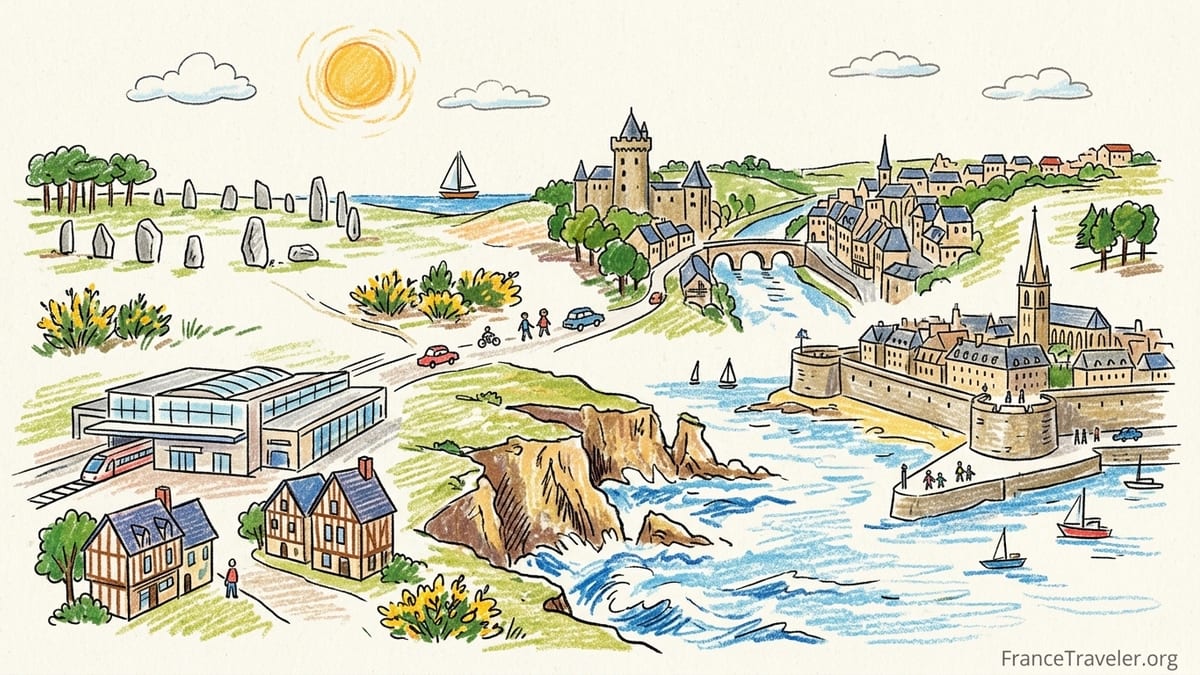
Rennes: Practical City Base With Just Enough Character
Rennes is rarely the star of a Brittany wish list, yet it has quietly become my most reliable base. I have spent a total of five nights here across three trips, always arriving by train from Paris. The TGV run of about two hours into Rennes station makes it the logical entry point to the region, and from there the TER and TGV web fans out to Saint-Malo, Quimper, Brest, Vannes and beyond. The station area itself is modern and busy, but a ten-minute walk brings you to the half-timbered streets around Place Sainte-Anne, which is where the city starts to feel distinctly Breton rather than generic provincial France.
As a base, Rennes works because the logistics are simple. I have used it as a one-night jump-off before heading to the coast, and once as a three-night hub to test how far day trips would stretch. That experiment convinced me that two nights is ideal. It gives you one full day to enjoy the Saturday market at Place des Lices, explore the old town and Parc du Thabor, then another day to fit in a straightforward day trip such as Saint-Malo or Vannes by TER. On my three-night stay I noticed that by the third evening I was walking the same streets on autopilot and wishing I had shifted my luggage to the sea.
Evenings in Rennes feel student-driven rather than touristy. The terraces on Rue de la Soif and the lanes around Sainte-Anne fill up early with locals, especially when the university is in session, and you hear more French than English. In practical terms that means restaurants can be busy but not over-priced. A casual crêperie dinner with cider has consistently landed in the 15 to 25 euro range per person in 2024 and 2025, which feels fair for a regional capital. Crowding is noticeable on festival weekends and during big football matches, but it is the kind of crowd that belongs there, not bus convoys disgorged for an hour of photos.
If I changed anything about my first visit, I would have trimmed my time in Rennes and moved one night to the coast. The charm of the old half-timbered squares is real, but this is a city that shines as a transport and services hub more than a destination to linger in for four or five nights. I now treat it as my Brest and Quimper connector, a place to arrive late, sleep well, enjoy a proper market the next morning, then catch a TER toward the sea.
Saint-Malo: Walled City That Impressed Yet Felt Saturated
Saint-Malo had lived in my imagination for years as the archetypal Breton walled city, and visually it delivers. I have stayed twice inside the intra-muros walls, for one night each time, and visited twice more on day trips. The stone ramparts, the curve of the Sillon beach and the tidal pools are as striking in reality as in the photographs. If your goal is to stand on old granite and watch the tide swallow the sandbanks around Grand Bé, Saint-Malo more than delivers that scene.
What surprised me was how quickly beauty tipped into saturation. Both of my overnight stays were in late June and early September, outside peak August, yet the streets inside the walls felt busy from mid-morning until late evening. By 10 a.m., narrow lanes around the cathedral filled with day trippers following flags and families lining up for ice cream. I walked the full circuit of the ramparts on a Tuesday evening around 7 p.m. expecting some quiet corners, but there was a near-continuous stream of people with cameras and strollers. It never felt unsafe or unpleasant, simply less atmospheric than the architecture suggested.
In practice, Saint-Malo has worked better for me as a one-night stop or even a day trip from Rennes rather than a multi-night base. The TER train from Rennes takes roughly an hour, and the walk from the station to the gates is under twenty minutes. That combination makes it simple to arrive mid-morning, circle the ramparts, explore a bit of the Sillon beach and linger for an early crêpe dinner before catching a train back inland. My two nights inside the walls helped me see how the city changes with the tides and light, but they also confirmed that I did not need three or four nights here.
If I returned, I would choose accommodation just outside the walls or across the water in a quieter neighborhood, and I would avoid July and August. Saint-Malo earns its place on this list because it is the emblematic Breton walled city, but it is also my example of a famous place that felt less rewarding than its reputation. The core is gorgeous, yet the constant visitor churn means that for me it remains a spectacular stop rather than a place I am eager to settle into for a week.
Dinan: Medieval Town That Finally Matched My Imagination
Dinan is where my idea of medieval Brittany finally aligned with reality. I first visited as a rushed half-day stop on the way between Saint-Malo and Rennes and left frustrated, so I returned for two nights on a later trip and stayed inside the old town near the basilica. That second stay made all the difference. Dinan is small enough to walk entirely on foot yet dense with ramparts, towers and steep cobbled streets that seem designed for slow exploration rather than checklists.
As a medieval town, Dinan has a clear structure: the upper town is crowned with timber-framed houses and squares, while Rue du Jerzual plunges down to the river port. I spent a full afternoon wandering the ramparts, cutting through gardens and small viewpoints that look out over the Rance valley. That loop alone takes a couple of unhurried hours if you stop for photos and coffee. On my rushed first visit, I tried to cram that walk, lunch and the port into three hours and ended up power walking the last stretch up Jerzual in a way that felt more like a workout than a visit.
Evenings in Dinan were the surprise highlight. By 7 or 8 p.m., the day trippers had largely vanished back to Saint-Malo or their buses, and the old town quieted into a softer rhythm. Restaurants around the main squares were busy on my June stay, but I could still get a table for two with a short wait. Prices felt slightly lower than Saint-Malo for similar meals, and there was far less pressure to reserve every single dinner days in advance. Walking the ramparts at dusk with only a handful of other people, bells in the distance and swifts looping over the rooftops, was one of the most atmospheric moments of my time in Brittany.
If I planned it again, I would still spend two nights and possibly add a third, especially with a car. Dinan works well as both a destination and a base for exploring smaller villages along the Rance or even crossing over to Dinard and back. Arriving by car makes it easier to reach rural guesthouses and river viewpoints, but the town itself is compact enough that once parked, you can forget the vehicle entirely for a day.
Quiberon Peninsula and Côte Sauvage: My First Choice Quiet Coast
When friends ask me where I would go back to first in Brittany, my answer is no longer Saint-Malo or Dinan. It is the Quiberon peninsula. I have stayed there twice, for three nights each, using Quiberon town as a beach and walking base. What drew me initially was the promise of the Côte Sauvage, the wild western coastline that faces the Atlantic with cliffs, coves and surf, and that is exactly where I ended up spending most of my time. The peninsula is attached to the mainland by a narrow isthmus, which makes it feel like a near-island without the ferry logistics.
On my first stay, I arrived by TER train to Auray and transferred to the seasonal “Tire-Bouchon” train that runs down the peninsula in summer, stopping near Carnac and at several small stations before reaching Quiberon. Once there, a local bus and my own feet were enough. The town itself is a classic fishing and ferry port with boats to Belle-Île and other islands, but a short walk or bike ride takes you out along the Côte Sauvage trail. I spent two full days walking different stretches of that coastal path, watching surfers near Port Blanc and wave spray exploding against the rocks even at mid-tide.
Summer traffic into Quiberon is a real consideration if you are driving. There is only a single main road down the peninsula, and local tourism offices regularly warn about slowdowns in July and August. That is partly why I liked staying in town without moving the car. Once you are based in Quiberon, life shrinks to the harbor, beaches, bakeries and the buses or coastal paths. Even in early July, when the harbor felt lively and ferries were busy in the morning, I could still find long, quiet stretches of sand a bit away from the center or near Saint-Pierre-Quiberon with only a scattering of people, especially outside weekend peak hours.
Evenings here are gentle rather than glamorous. Quiberon town has a handful of promenade restaurants with terraces that fill up early, but I often found myself sitting on a low wall near Port Maria with a takeaway galette, watching the last ferries return under a pale sky. The air carries more sea salt than chatter compared with Saint-Malo. If I changed anything about my first stay, it would be the season. I have now visited both in early July and late August, and I would choose late June or September next time for lighter traffic and cooler evenings while still being able to swim without a wetsuit.
For me, the Quiberon peninsula is the quieter place that I would return to before many others. It balances wild coast, real working harbor and walkable scale in a way that lets you slow down without feeling cut off. Three nights felt comfortable, but I could easily imagine a full week here, using one or two days for island day trips and the rest for coastal walks.
Carnac and Its Megaliths: Impressive History, Mixed Experience
No conversation about Brittany can ignore Carnac, with its famous alignments of standing stones. I have visited twice, both as half-day trips while staying elsewhere along the south coast, and each time I left with a similar impression. The scale of the megalithic fields is extraordinary, row upon row of stones stretching over low hills, and the sense of human time involved is humbling. Yet my overall experience in the village and resort felt less compelling than I had hoped.
On my first visit in late July, I drove in from a base near Auray and immediately ran into what defines Carnac in high season: traffic and parking stress. Roads into Carnac-Plage moved slowly behind campervans and families hunting for spaces, and by late morning most of the obvious parking near the main beach and market area was already full. Once on foot, the seafront had a classic, upbeat holiday-town feel, with kids on bikes, ice cream queues and beach gear shops. There is nothing wrong with that; it simply did not match what I was looking for after a morning among prehistoric stones.
The alignments themselves are partly fenced and regulated to protect the site, which means your interaction with them depends on the season and timing. In peak months, access is more restricted and guided tours fill up, so both times I ended up viewing large sections from the perimeter paths rather than walking freely among the stones. The interpretation center helped contextualise what I was seeing, but between the crowds at the most famous sections and the resort feel of Carnac-Plage, I left both visits feeling that I had seen something important without quite finding the atmosphere I had imagined.
Carnac is a place I now treat as a focused excursion rather than a base. I would return outside July and August, ideally staying somewhere quieter along the coast and driving or taking a regional bus in for a morning among the megaliths before continuing on to a different beach or village. For travelers fascinated by prehistoric sites, it remains an essential stop, but for me it fills the role of an emblematic yet slightly over-hyped destination, particularly if you are seeking calm rather than a busy seaside resort after your dose of ancient history.
Pont-Aven: Artistic Village That Works Best As A Gentle Day Trip
Pont-Aven, “the town of painters,” pulls you in with its art history and reputation for charm. I stayed one night on my first visit and returned later on a half-day trip while based near Concarneau. Both experiences confirmed that Pont-Aven is lovely in small doses. The role it plays in a Brittany itinerary is clear: it is a riverside village turned artistic hub, with galleries and a well-regarded museum devoted to Gauguin and the Pont-Aven school.
The village itself is compact. On my overnight stay, I arrived by car in the late afternoon, checked into a small hotel near the river and spent the evening wandering the paths along the Aven, watching the light drop over the water mills and stone bridges. The center is lined with a surprising number of art galleries relative to its size, many open into the evening in summer. That created a pleasant, contained buzz on the streets, but I also noticed a strong focus on selling art and local biscuits, with fewer everyday services than in a working town like Quimper or Vannes.
Visiting the museum the next morning took around ninety minutes, including a lingering look at the works that link Pont-Aven to the wider story of modern art. After that, I walked the “Bois d’Amour” path upstream, which offers the soft, wooded landscapes that inspired so many painters. Taken together, museum plus riverside walk made a satisfying half day. By lunch, though, I found that I had mentally covered the village. On my later return from Concarneau, I timed my arrival for mid-morning, visited a few galleries, picked up galettes at a bakery and drove back out by late afternoon, which felt just right.
If you are driving through southern Brittany, I would recommend treating Pont-Aven as a day trip from a larger base, perhaps Quimper or Concarneau, rather than staying overnight. Parking can be tight in the absolute center in July and August, but once parked, everything you are likely to visit is within a few minutes’ walk. Evenings are calm rather than lively, and by nine or ten at night much of the commercial life has wrapped up. I am glad I stayed once, but next time I would simply time a day visit to catch the museum, a riverside walk and an unhurried lunch before heading back to a town with more varied evening options.
Crozon Peninsula: Dramatic Coast I Underestimated
The Crozon peninsula, in western Finistère, was the part of Brittany I knew least about before visiting. I spent three nights there, staying in a small rental near Morgat, and quickly realised I had underestimated both its scale and its beauty. Crozon is effectively the dramatic coast chapter of this personal list. It is a series of cliffs, headlands and beaches that feel wilder and more spacious than the already-impressive coasts around Saint-Malo and Quiberon.
Reaching Crozon required a bit more planning. I arrived by train in Quimper, picked up a rental car and drove the remaining distance to Morgat, which took a bit over an hour on a mix of main and smaller roads. Without a car, you can reach parts of the peninsula by regional bus, but the frequencies are not designed around day trippers, especially outside summer, so I would strongly recommend driving. Once based near Morgat, I found that most of what I wanted to see, from Cap de la Chèvre to the cliffs above the Tas de Pois near Camaret-sur-Mer, was within a thirty to forty minute drive.
Days on Crozon revolved around walking sections of the coastal path, known as the GR34, and dropping down to beaches when the weather allowed. On my June stay, the climate felt closer to early autumn than high summer, with misty mornings, bright afternoons and cool evenings where a windproof jacket was essential. That cooler, often breezy weather worked in my favour on long walks between headlands. I rarely shared the path with more than a handful of other hikers once I was a kilometre from the nearest parking area, even on a Saturday.
Evenings on Crozon are quiet, sometimes very quiet. Morgat offered a small cluster of seafront restaurants and bars around the marina that filled up modestly by local standards but never felt crowded in mid-June. Camaret-sur-Mer, with its waterfront of cafes and view of the Tour Vauban, had a bit more of a promenade feel, yet by 10 p.m. the streets cleared quickly. This is not a nightlife destination but somewhere you go to watch the last light fold over cliffs and anchored boats. If I changed anything about my planning, I would add at least one more night. Three nights allowed for two full walking days and a partial one, but another night would have let me include a boat excursion or slower inland explorations without sacrificing the coastal hikes.
The Takeaway
Looking back across these trips, Brittany has become a region where I choose depth over breadth. I have driven or ridden trains past plenty of names that show up on tourism posters, but only a few places have drawn me back or made me wish for extra nights. Rennes works as the efficient city base, where trains connect and markets hum. Saint-Malo shines as a dramatic walled city and a spectacular day or one-night stop, even as crowds take the edge off its romance. Dinan is the medieval town that finally lived up to my mental picture, at its best once the buses leave.
Further west and south, the Quiberon peninsula is the quiet coast I would return to first, a place where you can forget the car and walk from harbor to wild headlands in an afternoon. Carnac, with its megaliths and lively resort, is worth a targeted visit but, for me, not a place to linger in peak season. Pont-Aven earns its reputation as an artistic village yet fits most comfortably as a half-day wander from a bigger base. And Crozon is where Brittany’s rugged coastline feels most expansive, rewarding those extra transport steps with cliff paths and wide horizons.
If you plan your own route, my most honest advice is to pick two, at most three, of these places and give them real time. A night in Rennes to arrive and organise, two or three nights in a coast or peninsula base such as Quiberon or Crozon, and two nights in a historic town like Dinan will show you much more of Brittany’s real character than a race through every postcard stop. The region is compact on a map, but on the ground, its tides, small roads and slow, social evenings reward those who stay put and let the Atlantic set the pace.
FAQ
Q1. Is it better to base in Saint-Malo or Dinan for a first visit?
For atmosphere and slightly calmer evenings, I would choose Dinan for two nights and visit Saint-Malo as a day trip or one-night stop, especially in summer.
Q2. How many nights should I spend on the Quiberon peninsula?
I found three nights ideal, with time for at least two full days of coastal walks and one day reserved for a ferry trip or simply relaxing on the beaches.
Q3. Do I need a car to explore Brittany properly?
You can reach major towns like Rennes, Saint-Malo, Vannes and Quimper by train, but a car makes peninsulas such as Crozon and smaller coastal villages much easier to enjoy.
Q4. When is Carnac least crowded?
Outside July and August, particularly in June and September, I encountered noticeably fewer visitors at the megalithic alignments and in Carnac-Plage.
Q5. Is Rennes worth more than one night?
Yes, but I would cap it at two nights for most trips, which gives you time for the old town, the main market and a simple day trip before moving to the coast.
Q6. How does Crozon compare with other Breton coasts?
Crozon feels wilder and more expansive than the Saint-Malo area, with longer cliff walks and fewer crowds, but it requires more effort to reach and works best with a car.
Q7. Is Pont-Aven a good place to stay without a car?
I would not choose it as a base without a car, because transport options are limited; it works better as a daytime excursion from a larger, better-connected town.
Q8. Can I visit both Dinan and Saint-Malo in one day?
Yes, it is possible with a car or careful train and bus planning, but I prefer giving each at least most of a day, or better yet an overnight, to enjoy the evenings.
Q9. Which place should I choose if I want a quieter coastal base?
From my own stays, I would look first at the Quiberon peninsula or the Crozon area, especially in June or September, rather than the busier resorts around Carnac.
Q10. How should I split a week in Brittany for a balanced trip?
A practical split is one night in Rennes, two nights in a historic town such as Dinan, and three or four nights on a peninsula like Quiberon or Crozon for coastal walks and beaches.