


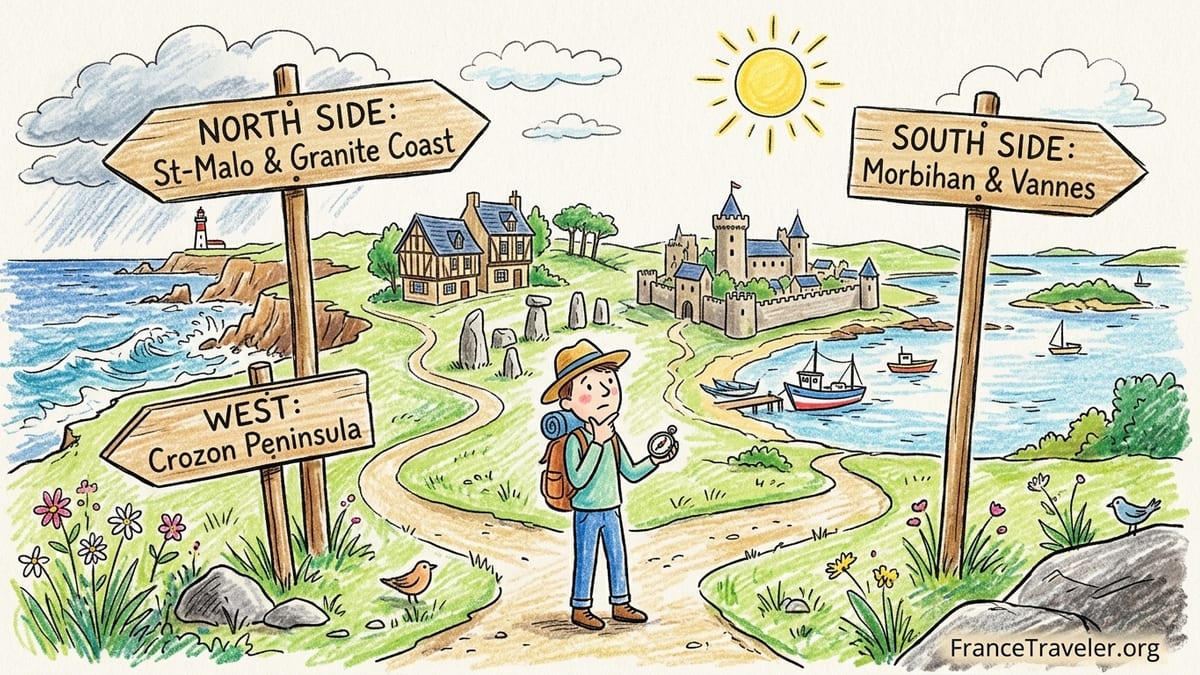
Brittany rewards travelers who slow down. With more than 2,700 kilometers of deeply indented coastline, inland villages and several inhabited islands, it is simply too large and varied to "do" in a long weekend. The key to a satisfying 5, 7, 10 or 14 day trip is not how many pins you can collect on a map, but which side of Brittany you choose to savor, how few bases you use, and how you build in time for tides, ferries and weather to shape your days.
Understanding Brittany’s Scale And Why You Must Choose A Side
Brittany looks compact on a map of France, but its coastline alone runs for more than 2,700 kilometers, twisting around capes, bays and islands. Tourism authorities regularly highlight this figure to explain why a single week is only enough for a slice of the region rather than a grand loop. Trying to “circle Brittany” in three or four days means spending most of your time in a car instead of on coastal paths, café terraces or beaches.
Even point to point, distances add up. Official regional distance tables show Rennes to Brest at roughly 240 kilometers by road and Rennes to Quimper at roughly 200 kilometers, both often taking around 2.5 to 3 hours in normal traffic. Rennes to Saint-Malo is closer to 70 kilometers, yet can still take more than an hour once you account for leaving the city ring road and crossing the Rance estuary. Add in summer traffic near popular resorts such as Carnac or the Pink Granite Coast, and it becomes clear that hopping every night is a recipe for fatigue.
The good news is that Brittany’s major highways are toll free, which keeps one way car costs between hubs limited to fuel and possibly a modest rental fee difference if you return the car in another city. The trade off is that Brittany has very few motorways in the strict sense, so outside the main expressways speeds drop quickly and scenic detours can be slow. For travelers who do not want to drive, the regional TER train network links cities such as Rennes, Saint-Malo, Vannes, Lorient, Quimper and Brest in around one to two and a half hours, but some cross country routes require a change in Rennes that can effectively double journey times.
All of this shifts the core decision away from “How many highlights can I cram in?” toward “Which side of Brittany matches my interests?” In five days you realistically choose one zone, for example the northeast coast around Saint-Malo and Dinan, or a section of the southern coast around Vannes and the Gulf of Morbihan. Seven days lets you combine two compatible areas, such as the Emerald Coast with the Pink Granite Coast, or southern Morbihan with one nearby island. Ten days unlocks a meaningful north to west or west to south journey without moving every night. With 14 days you finally have room to explore multiple coasts, include an island like Belle-Île or Groix, and spend time inland in towns such as Vitré or the forest of Brocéliande without feeling rushed.
How Many Bases Make Sense For 5, 7, 10 Or 14 Days?
The number of bases you choose in Brittany often matters more than the exact number of days. Each change of base costs at least half a day once you factor in packing, checking out, driving or taking the train, and settling into a new place. In most cases, one base for five days, two bases for seven days, up to three bases for ten days and three or at most four for a full two weeks is a comfortable upper limit.
Consider five days focused on the northeast. Using Saint-Malo as a single base, you could arrive by train via Rennes, then reach Dinan in around 40 minutes by car or just under an hour by regional bus, visit Cancale and the oyster farms by bus or car in under 30 minutes, and reach Cap Fréhel or Fort La Latte in roughly an hour. Your longest day trip might be Mont Saint-Michel just over the border in Normandy, which by car typically takes a bit more than an hour from Saint-Malo. That keeps every excursion to a manageable loop and you are back to the same hotel or rental each night.
With seven days that combine, for example, the Emerald Coast and the Pink Granite Coast, two bases work well: three or four nights around Saint-Malo or Dinard, then three or four nights around Perros-Guirec or Tréguier. The drive between Saint-Malo and the Pink Granite Coast is around 2.5 to 3 hours if you stay mainly on main roads, which comfortably fills a travel morning with time for a lunch stop in Saint-Brieuc or a coastal walk at Cap d’Erquy on the way.
For ten days, three bases can make sense if you are changing region, such as combining Saint-Malo, the Crozon peninsula near Brest, and Vannes in the south. In practice that looks like three nights in each coastal area plus an extra night in the one that best matches your interests. Distances between these zones are in the 2.5 to 3.5 hour range by car, so each move takes real time and you should regard the travel days as light sightseeing days rather than full beach or hiking days.
With 14 days the temptation is to add more and more bases, but many travelers report that three well chosen hubs work better: for example Dinan or Saint-Malo for the northeast, somewhere near Lannion or Perros-Guirec for the Pink Granite Coast, and Vannes or Auray for the south. From these three you can take ferries to islands like Bréhat or Belle-Île, explore inland villages on quiet days, and still enjoy rest time. Rental apartments or gîtes often offer significant weekly rate discounts, so staying six or seven nights in a single base can cost much less per night than changing every two or three days once cleaning and booking fees are added.
Realistic Drive Times, Trains Versus Car And When To Go Car Free
For planning purposes, assume most intercity drives in Brittany will take between 1 and 3 hours, depending on whether you are going along the main east west spine or cutting across country. Rennes to Saint-Malo is commonly around 1 to 1.5 hours in steady traffic. Rennes to Vannes is typically 1.5 hours. Rennes to Quimper or Brest is often 2.5 to around 3 hours, especially in summer when approaches to coastal areas slow down. On smaller peninsula and island departure roads, such as the Quiberon peninsula or the approach to the Crozon peninsula, traffic can slow to a crawl on peak weekends and you should avoid arriving or leaving on Saturday afternoons in high season if you can.
The regional train network offers fast and relaxing alternatives on some axes, especially for car free trips. High speed trains from Paris to Rennes can take as little as around 1.5 hours, and from Rennes to Saint-Malo local TER trains often need around 55 to 75 minutes depending on stops. Rennes to Vannes is usually just over an hour, while Vannes to Quimper via Lorient is often under 2 hours. Cross country journeys remain trickier: Vannes to Saint-Brieuc in the north can take 2 to 3 hours by train because it usually requires a change in Rennes rather than a direct line.
A hybrid approach works well for many itineraries. For example, a seven day trip could start with two or three car free nights in Saint-Malo reached by train via Rennes, then add a rental car picked up in Saint-Malo or back in Rennes for five days of exploring farther flung coasts such as the Pink Granite Coast or Crozon. This reduces the hassle of having a car in a walled town or larger city, where parking may be in paid municipal lots or underground garages, and focuses car days on areas where public transport is sparse.
Going fully car free is viable if you accept a narrower geographic focus. For a five day trip, using Rennes as a rail hub and making day trips to Saint-Malo, Vannes, Dinan or even Mont Saint-Michel by a combination of TER trains and regional buses can deliver an excellent overview of one side of Brittany without ever renting a vehicle. Another car free option is to stay a full week on a well served island like Belle-Île, using local buses that operate between Easter and late October, or renting a bike or e-bike on arrival, and skipping the mainland car entirely.
Ferry Days, Tides, Weather Buffers And Why You Need Slack
Island and coastal experiences are often the most memorable parts of a Brittany itinerary, but they depend on ferries, tides and weather that you cannot control. Planning buffers around these elements is essential, particularly in shorter trips where losing a day to wind, fog or delayed sailings has more impact.
Regional ferries managed for the Brittany region, such as BreizhGo Océane, connect the mainland to islands like Belle-Île, Groix, Houat and Hoëdic. Typical crossing times range from about 30 minutes between Quiberon and Belle-Île for the fastest passenger launches on summer schedules to around 45 minutes between Lorient and Groix on standard ferries. Tickets for foot passengers on these routes usually cost a few tens of euros return depending on season and operator, with vehicle space priced significantly higher and often selling out in peak summer weeks. Because capacity for cars is limited, many visitors either travel as foot passengers and rent bikes on the islands or park in secure lots at the ports.
On the north coast, smaller passenger ferries run to islands like Bréhat from the Pointe de l’Arcouest, and to Batz from Roscoff. Crossings are short, often under 20 minutes, but the experience is very exposed to wind and sea conditions. If you plan to include an island day in a five or seven day trip, avoid scheduling it on your departure day from Brittany. Instead, allow at least one spare mainland day on either side, ideally in the same base, so you have flexibility to switch plans if crossings are disrupted.
Tides also shape visiting hours at headline sites. In the Bay of Saint-Malo and Mont Saint-Michel, for example, some of the largest tidal ranges in Europe mean that beach access, dramatic sea walls and certain boat trips can only be fully enjoyed at particular states of the tide. In practice that means checking tide tables in advance and being willing to swap the order of your days: you might prioritize a walk around the ramparts in Saint-Malo at high tide one afternoon, then schedule a low tide beach walk or oyster tasting at Cancale the next morning.
Weather is changeable year round, with Atlantic systems bringing wind and showers even in July and August. Many experienced visitors deliberately keep at least one “soft” day in each block of three or four days, which can be spent in inland towns like Dinan, Vannes, Quimper or Rennes with covered markets and historic streets if the coast is wet or windy. In a ten or fourteen day trip, this kind of slack becomes even more valuable, because it allows you to delay a major coastal hike on the GR34 path or a boat trip around the Gulf of Morbihan by a day to catch better conditions instead of trudging through driving rain.
Frameworks For Different Styles Of Trip
While the length of your stay sets the outer limits, the style of trip you want should drive which side of Brittany you choose. A first time visitor who wants a broad sampler does not need the same framework as a repeat visitor planning a food focused fortnight or a family juggling naps and playgrounds.
For a first trip, five days work best concentrated in a single coast and its hinterland. A realistic option is to arrive in Rennes by train, connect immediately to Saint-Malo and stay there for the full five nights. Day trips can cover Dinan’s half timbered streets, Cancale’s oyster farms, the Pointe du Grouin, and, if you are comfortable with an early start, Mont Saint-Michel. With seven days you could add a second base on the Pink Granite Coast around Perros-Guirec, breaking the drive with lunch in Saint-Brieuc and a stroll on the cliffs near Cap d’Erquy. Ten or fourteen day first trips can layer on a south coast base, perhaps around Vannes and the Gulf of Morbihan, to introduce a different landscape of sheltered islands and sailing harbors.
A coastal road trip framework suits travelers keen to drive, walk the GR34 coastal path in sections, and stay in smaller harbors. Here, seven days could focus solely on the north coast between Cap Fréhel and the Pink Granite Coast, with two bases such as Erquy or Saint-Quay-Portrieux for the first half and Perros-Guirec or Trébeurden for the second. Ten days could extend west to the Crozon peninsula and Pointe du Raz, using three bases in total. Fourteen days might link the Emerald Coast, Pink Granite Coast, Crozon and Quiberon Bay into a gentle arc, as long as you avoid the urge to stop for just one night in every scenic village.
Car free trips work best when you anchor yourself to towns with rail and bus hubs. Rennes, Saint-Malo, Vannes, Quimper and Brest all have stations with regular services. Seven days based entirely in Vannes, for example, could include boat excursions into the Gulf of Morbihan, a day trip to Auray and the old port of Saint-Goustan by short train ride, and an organized excursion or bus to Carnac’s alignments. Another car free framework is to split a week between Rennes and Saint-Malo, keeping journeys under 1.5 hours and relying on regional buses to reach Dinan or Cancale.
Family trips, especially with younger children, benefit from fewer moves and easy access to beaches and playgrounds. In five days, choosing one child friendly base such as a campsite or self catering apartment near Carnac, Saint-Lunaire or Fouesnant lets you alternate beach days with short excursions to animal farms, small aquariums or fortified towns. Ten and fourteen day family trips might use two coastal bases and one inland base near a lake or forest, limiting travel days to at most 3 hours door to door. In practice that could look like a week near Vannes, four nights near Perros-Guirec, and three nights near Paimpont forest for Arthurian legend sites.
Food or history focused trips call for different geography again. Travelers chasing seafood, creperies and markets may favor the Emerald Coast and the Gulf of Morbihan, where fishing ports like Cancale, Erquy, Concarneau and numerous smaller harbors support restaurants and boatside stalls. History enthusiasts interested in megaliths can spend multiple days around Carnac, Locmariaquer and the Morbihan Gulf, while those drawn to medieval and Renaissance towns may prioritize Vitré, Fougères, Dinan and Quimper, supplementing coastal time rather than dominating it. In all these frameworks, the length of your stay simply determines how many of these interest clusters you can realistically string together without feeling rushed.
Example Itinerary Decisions At 5, 7, 10 And 14 Days
To make these frameworks concrete, it helps to walk through how you might choose in real life. Imagine you have five days in early June and are flying into Paris. One realistic plan would be to take a high speed train from Paris to Rennes on day one, connect immediately to Saint-Malo and settle into a hotel inside or just outside the ramparts for four nights. Over the next three full days you could devote one day to Saint-Malo itself and a walk to nearby beaches, one day to a bus or car excursion to Dinan, and one flexible day to either Cancale’s oysters and coastal viewpoints or to Mont Saint-Michel. Your fifth day returns you to Rennes and Paris. You have stayed in a single base, kept transfers simple, and limited your scope to the northeast coast, yet still enjoyed a variety of towns and experiences.
With seven days in late spring and a rental car, a couple interested in scenery and small towns could plan three nights in Dinan followed by four nights on the Pink Granite Coast. The drive from Dinan to Perros-Guirec might take around 2.5 hours if you spend some time along the Côtes-d’Armor shoreline, stopping at Cap Fréhel or Erquy. Once on the Pink Granite Coast, you have time for several moderate coastal walks between Perros-Guirec and Ploumanac’h, a boat trip to the Sept-Îles bird reserve if operating, and a day exploring inland towns like Tréguier or Pontrieux if the coast is windy.
For ten days in July focused on a north to west arc, you could start with three nights in Saint-Malo without a car, then pick up a rental in Rennes or Saint-Malo and drive to the Crozon peninsula for four nights, finishing with three nights in Quimper. Driving Saint-Malo to Crozon through the interior might take around 3.5 hours, with a break in Morlaix or Huelgoat. From a base on Crozon, you can spend full days on the peninsulas of Cap de la Chèvre and Pointe de Pen-Hir, then move on to Quimper for riverside markets, day trips to Bénodet or Concarneau, and a boat trip to the Glénan archipelago if sea conditions and schedules permit.
A fourteen day food and heritage trip in early September might combine the northeast, inland Brittany and the southern coast with three bases. After arrival by train, you spend four nights in Dinan, exploring Saint-Malo, Cancale and the Rance valley. Next you drive a couple of hours to an inland base near Paimpont forest or in a town like Vitré, staying four nights and visiting castles, chapels and forest walks associated with Arthurian legends. Finally, you continue for about 2 to 3 hours to Vannes or Auray for six nights, using ferries to explore the Gulf of Morbihan, reserving at least one day for a crossing to an island such as Île aux Moines, and another for seafood tasting in ports such as Quiberon or La Trinité-sur-Mer. This trip uses three bases in fourteen days, keeps drive days under 3 hours, and mixes coasts, islands and inland history without ever racing around the entire peninsula.
First Trip, Coastal Road Trip, Car Free, Family And Food Or History: Which Side To Pick
For a first trip, it is logical to ask which side of Brittany gives the clearest introduction. If you have five days, the northeast around Saint-Malo and Dinan is a strong candidate: arrival is easy via Rennes, the scenery shifts quickly from walled ports to river valleys, and day trips to Mont Saint-Michel and Cancale introduce the region’s extreme tides and seafood culture. With seven days, you can either deepen this area by adding time on the Pink Granite Coast, or pair the Emerald Coast with the Gulf of Morbihan to contrast wild cliffs with sheltered island studded waters.
Coastal road trippers who enjoy longer drives and scenic stops tend to favor a roughly linear route along either the north or south. On the north side, a 7 to 10 day framework might run from Saint-Malo to the Pink Granite Coast and then on to Crozon, using Erquy or Saint-Quay-Portrieux as an intermediate base if time allows. The south side rewards a similar 7 to 10 day line from Quimper or Bénodet through Lorient to Vannes and the Quiberon peninsula. Here you can follow marked coastal routes promoted by local tourism boards, stopping at surf beaches such as La Torche or sheltered coves around Guidel and Ploemeur near Lorient.
Car free travelers should bias toward the northeast and south central corridors where rail and bus networks are densest. A 7 day car free framework could split time between Rennes and Saint-Malo, or between Vannes and Auray, adding organized boat trips into the Gulf of Morbihan or to nearby islands. For 10 days without a car, combining Rennes, Saint-Malo and Vannes keeps every transfer under roughly 2 hours by train and lets you layer on several ferry or bus based excursions.
Families often prefer the south and west coasts, where wide sandy beaches, gentler seas in certain bays and family oriented campsites are common. Choosing a base near Carnac, La Trinité-sur-Mer or Fouesnant gives easy access to shallow beaches at low tide, short drives to megalithic sites or small aquariums, and frequent ice cream and playground stops along seafront promenades. With older children, the Pink Granite Coast around Ploumanac’h and the Crozon peninsula add a more rugged feel, but still offer well signposted coastal paths and bodyboarding beaches.
Food and history travelers can be happy almost anywhere in Brittany, but each side expresses these themes differently. The Emerald Coast and north provide dramatic settings for oyster and mussel farms around Cancale and the Bay of Saint-Malo, fishing ports serving scallops and langoustines, and fortified towns layered with maritime history. The south, particularly around the Gulf of Morbihan and Quiberon Bay, adds shellfish farms, salt marshes and ports with long fishing traditions. Inland, towns like Vannes, Quimper, Fougères and Vitré preserve ramparts, cathedrals and medieval streets that pair naturally with creperies, cider houses and weekly produce markets.
The Takeaway
Planning Brittany as a framework rather than a checklist changes the conversation from “Can we drive the whole coast in four days?” to “Which side of Brittany suits us, and how can we see it well in the time we have?” Five days realistically means choosing one area and one base, perhaps the northeast coast or a pocket of the south around Vannes. Seven days can sustain two compatible areas with two bases. Ten days lets you link the north to the west or west to the south without moving every night. Fourteen days finally allows room for multiple coasts, at least one island and meaningful inland time.
Within those time frames, the most important practical decisions are how many times you change base, whether you rely on trains, a rental car or both, how you build ferry and tide dependent days into your plan, and how much weather slack you are willing to leave. Brittany Tourism’s own sample itineraries, which often use seven widely spaced destinations to cover just parts of the coastline, implicitly acknowledge that the region is too extensive to rush. By keeping transfers short, focusing on a side of the peninsula that matches your style, and treating the ocean’s rhythms as part of the experience rather than an obstacle, you give yourself the best chance of leaving Brittany already planning your return.
FAQ
Q1. Can I “do all of Brittany” in a week if I rent a car?
You can drive around most of the peninsula in a week, but you will spend a large share of your time on the road and only scratch each place. A week is far better used focusing on one or two compatible areas, such as the northeast coast plus the Pink Granite Coast, or the south coast around Vannes and Quiberon Bay.
Q2. Is a car essential for a first trip to Brittany?
No, a car is not essential if you are happy to focus on rail connected towns. You can reach Rennes, Saint-Malo, Vannes, Quimper and Brest by train, and use regional buses and ferries for day trips. However, a car greatly expands your options for peninsulas, small harbors and rural inland sites, especially outside peak summer schedules.
Q3. How many bases should I plan for five, seven, ten and fourteen days?
As a rule of thumb, plan one base for five days, two bases for seven days, two or three bases for ten days and three bases for fourteen days. Adding more bases than this usually means you lose too much time to packing, checking in and driving between locations.
Q4. When is the best time of year to visit Brittany?
Late spring and early autumn offer a good balance of milder weather, longer daylight and fewer crowds than peak summer. July and August bring more reliable warmth and a full range of ferries and festivals, but also busier roads and higher accommodation prices. Winter trips can be atmospheric in cities and larger towns, though some coastal services reduce their schedules.
Q5. How far in advance should I book ferries to islands like Belle-Île or Groix?
In July and August, it is wise to book vehicle spaces several weeks or even months ahead for popular holiday periods, especially weekends. Foot passenger tickets are often easier to obtain at shorter notice, but can still sell out on the busiest days. Outside peak season, you may be able to book just a few days ahead, provided you remain flexible about sailing times.
Q6. Are Brittany’s roads difficult or stressful to drive?
Main routes between cities are generally well maintained and relatively straightforward, although summer traffic can slow near major resorts and peninsula roads. Smaller coastal and village roads can be narrow and winding, with limited passing places and frequent cyclists or walkers. Most visitors who are comfortable driving in rural Europe adapt quickly, especially if they avoid arriving in unfamiliar towns after dark.
Q7. Can I visit Mont Saint-Michel as a day trip from Brittany?
Yes, many visitors use Saint-Malo, Dinan or even Rennes as a base for a day trip to Mont Saint-Michel just across the regional border in Normandy. By car, travel times from Saint-Malo are typically a little over an hour in each direction, while organized bus tours and regional buses take longer but remove the parking and navigation concerns.
Q8. Is it realistic to travel car free with children in Brittany?
Traveling car free with children is feasible if you limit the number of bases and choose towns with good beaches or playgrounds in walking distance. Staying in Saint-Malo, Vannes or a resort town with direct train access can work well, supplemented by short bus rides and boat trips. For very young children or more remote beaches and campsites, having a car usually adds significant flexibility.
Q9. How expensive is seafood and eating out in Brittany?
Seafood ranges from modestly priced moules frites or galettes in casual creperies to multi course tasting menus in fine dining restaurants. In many coastal towns you can find a daily fixed price lunch menu that includes fresh fish or seafood at a relatively accessible cost compared with dinner. Prices vary by location and season, so it is worth checking menus posted outside restaurants before sitting down.
Q10. If I love history, which side of Brittany should I prioritize?
History enthusiasts might prioritize the northeast and inland areas for fortified towns such as Saint-Malo and Dinan, medieval centers like Vitré and Fougères, and the forest of Brocéliande associated with Arthurian legend. Those drawn to prehistoric sites should favor the south around Carnac, Locmariaquer and the Gulf of Morbihan, where dense clusters of standing stones, tumuli and alignment fields are concentrated.