


I have lost count of the Breton beaches I have driven to, walked to, loved in photographs and quietly abandoned after ten chilly minutes on the sand. Brittany’s coast is long, the marketing is polished, and almost everywhere looks beautiful at golden hour. That does not mean every cove is worth planning a precious holiday afternoon around, especially if you want to swim safely, avoid shivering children or simply sit out the wind with a book. What follows is not a ranking compiled from postcards, but a comparative look at corners of the Emerald Coast, Pink Granite Coast, western Finistère, Crozon and Morbihan that I have actually spent time on, weighed against the basics that matter in real life: sand and rock, tide, water temperature, facilities, access, crowds and how long I genuinely wanted to stay.
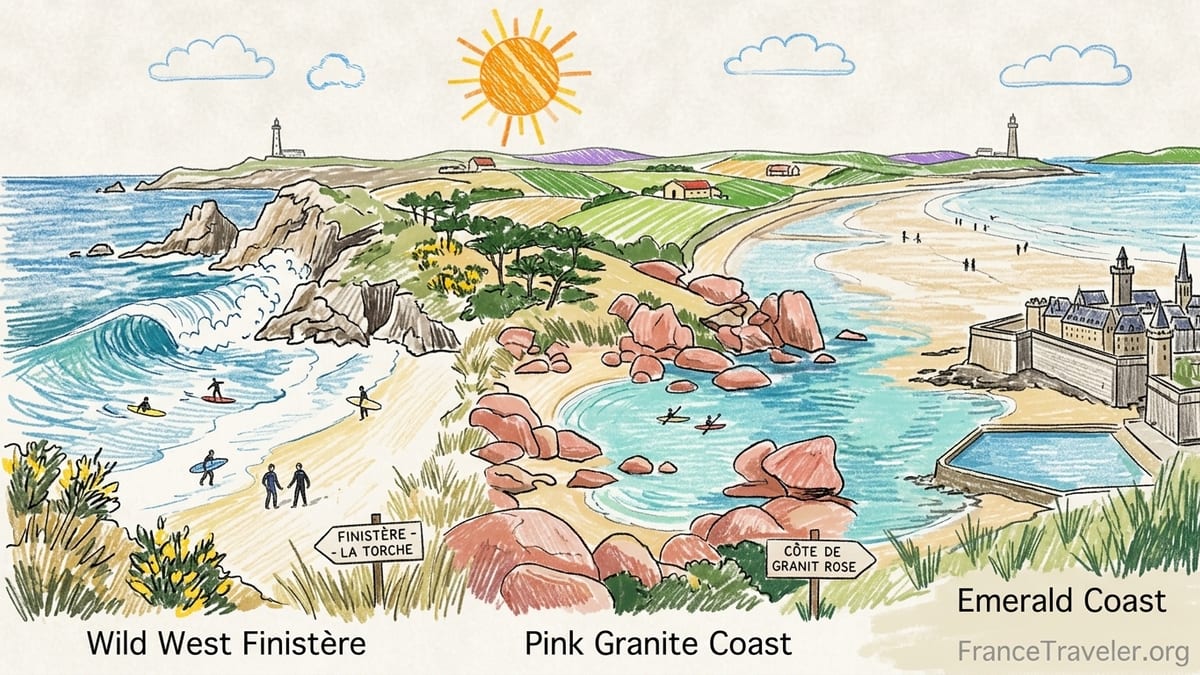
How Brittany’s Coasts Really Feel On The Ground
Brittany Tourism is not wrong when it says the region offers both established family seaside resorts and dramatic rocky headlands. Drive an hour and you can move from a gentle south-facing bay in Morbihan, where children paddle in glassy water, to the wild surf of La Torche in Finistère, where even in August the Atlantic feels bluntly cold and the rip currents demand respect. The problem for visitors is that the same brochure that sells you sheltered Carnac will also show you the cliffs near Cap Sizun, with no hint that one is a safe swimming day with toddlers and the other is essentially a viewing platform for waves.
On the Emerald Coast around Saint-Malo and Dinard, the sea can rise and fall by up to around 13 metres on spring tides, some of the largest tidal ranges in Europe. At high tide your chosen beach may be a lively, swimmable bay; three hours later it can be a kilometre of wet sand and rock pools with the water so far away that carrying a bodyboard feels theatrical. On the Pink Granite Coast, bays like Trégastel’s Coz-Pors look almost Mediterranean at high tide, yet turn into a maze of boulders, seaweed and ankle-deep channels at very low tide. West Finistère and parts of Crozon add Atlantic swell into that equation, while Morbihan’s inner coast, partially sheltered by the Quiberon peninsula, generally offers smaller chop and slightly warmer-feeling water in summer.
Water temperatures in Brittany rarely climb above the high teens Celsius, even in late July and August. In my own notes from repeated August trips, surface temperatures on the north coast have typically hovered around 17 to 19 degrees, with the south a degree or two milder on calm, sunny runs of weather. The difference in comfort is real. On exposed Atlantic beaches in Finistère, a shorty wetsuit turns a bracing dash into a relaxed half-hour swim, whereas in Carnac or sheltered parts of Quiberon I have happily stayed in without neoprene, provided the wind dropped and the sun stayed out.
The following sections look at specific stretches of coast that I would actively plan to revisit, and one I mostly admire from the path. For each, I focus on how the place actually works across a tide cycle, what the wind does, how easy it is to swim without drama, where shade or shelter exists, and how long I honestly wanted to linger before sand, cold or crowds sent me looking for the car.
Emerald Coast: Saint-Malo, Dinard And The Tidal Game
The Saint-Malo and Dinard area is where Brittany’s marketing about “family resorts” and my own experience align most closely, provided you understand the tides. Saint-Malo’s long Sillon beach, Bon-Secours below the ramparts and the smaller coves like Le Nicet to the east are, on paper, simple city beaches with golden sand and lifeguards in summer. In reality, they are also shaped by very fast-moving water and a tidal range so big that local tourism offices publish detailed guidance on safe swimming times. At Sillon, I have walked on firm, clean sand at low tide for so long that the walled city felt like a set on the horizon, only to swim later the same day almost under the sea wall when the tide returned.
For reliable swimming, I have stopped treating Sillon as my main bathing spot and turned to the seawater pool at Bon-Secours instead. Built below the Saint-Malo ramparts, this tidal pool holds water when the sea retreats and is refilled naturally every high tide. In August it is staffed, clearly marked and busy, but not in a theme-park way. The basin has a diving platform, ladders and a firm concrete rim, and the sandy beach inside the pool is small but gentle underfoot. On windy days when whitecaps roll across the outer bay, the pool still provides relatively calm, manageable water, though it feels cooler when the wind swings north. The downside is that there is no natural shade: the stone walls radiate heat, and I rarely last more than two hours in the middle of the day without retreating up onto the ramparts or into the old town.
Across the Rance estuary, Dinard offers a softer, more classic resort experience. The main Écluse beach and the slightly quieter Saint-Énogat bay are backed by Belle Époque villas, promenades and, crucially for parents, multiple staffed children’s beach clubs in summer. The sand is fine and light, the slope into the water gentle, and the town has invested in facilities like a seawater pool beside Écluse and accessible ramps down to the sand. When the tide is in, swimming feels relaxed and almost pool-like, particularly on calm days when the bay is protected from westerly wind. At low tide, the water pulls a long way back but does not feel as distant as at Saint-Malo; I have usually been happy to walk out in bare feet, although you hit patches of ripple-marked sand that can be tiring for small children.
In practical terms, the Emerald Coast works best for me when I plan days around tide times. A typical August day might look like a morning swim at Bon-Secours around high tide, followed by a late-afternoon walk and café stop in Dinard when the Rance ferries are running often and the light softens over the villas. Parking in high season is competitive in both towns, but multi-storey car parks near the Saint-Malo walls and near Dinard’s central market hall take away most of the stress if you arrive before late morning. What keeps drawing me back is not only the scenery but also the mix of real facilities, lifeguards, cafés and easy wet-weather alternatives such as Saint-Malo’s walled city or the spa complex on the Sillon.
Pink Granite Coast: Beautiful, Bouldery And Tide-Dependent
If you have ever seen a photograph of Brittany with house-sized stones glowing pink above turquoise water, it was probably taken somewhere between Perros-Guirec and Trégastel on the Pink Granite Coast. This thirty-kilometre stretch between Plestin-les-Grèves and Louannec includes Ploumanac’h, Coz-Pors and other coves where the granite really does show reddish hues in late afternoon sun. As a walking and photography destination, it is one of the most rewarding coastlines in Europe that I have experienced. As a pure swimming playground, it is more complicated and, for me, less consistently satisfying than the Emerald Coast or Morbihan.
Coz-Pors in Trégastel is a good example of the trade-offs. The bay is a pleasant curve of light sand framed by rounded boulders, backed by a small cluster of cafés and the glass-fronted marine aquarium. In July and August, lifeguards supervise the swimming area, and families spread out with pushchairs and parasols. At mid to high tide on a calm, warm day, the water here can be as inviting as anywhere in Brittany, with a reasonable patch of depth near the shore and less chop than along the fully exposed Atlantic. I have happily stayed here for three hours at a stretch, alternating short swims with time watching the kayaks and stand-up paddlers thread through the rocks.
Drop the tide significantly, however, and Coz-Pors becomes a maze. The sea retreats to reveal a rocky plateau of pools, seaweed and sandbars that is fascinating if you join one of the local marine discovery walks, but not ideal for a straightforward swim. The same is true further along the coast at Ploumanac’h, where the GR34 path winds between sculpted stones. At very low tide, it can take ten or fifteen minutes of cautious stepping to reach knee-deep water, and you must watch the clock because the returning tide moves fast around the rocks. I have also found that on breezy days the Pink Granite bays offer limited shelter; the cliffs are low, and once the wind shifts north or west, the perceived temperature drops sharply, even if the actual water temperature is no different to Dinard.
For these reasons, while I strongly recommend the Pink Granite Coast as a place to walk, photograph and learn about the intertidal environment, I plan my swimming there as a bonus rather than the main act. Parking at spots like Trégastel and Ploumanac’h is usually paid and can fill by late morning on sunny weekends in July and August. Arriving early not only makes parking easier but also buys you a couple of hours of relative calm before day-trippers crowd the paths. If I have just one high-tide slot to swim on a short northern Brittany trip, I tend to favour Saint-Malo or Dinard over Trégastel, and then drive to the Pink Granite Coast on a separate day dedicated to walking rather than bathing.
Wild West Finistère: Surf, Swell And Big Horizons
Western Finistère feels like another country compared with the manicured bays of Morbihan. The beaches around the Baie d’Audierne, including Penhors and La Torche, are long, unbroken sweeps of pale sand facing straight into the Atlantic. Local tourism material highlights La Torche as a two-kilometre surf spot in an almost entirely natural setting, with a Natura 2000 designation and supervised swimming area in July and August. Standing on the dunes behind the beach, looking down at the lines of swell rolling in, it is hard not to be impressed by the scale of sea and sky.
As a swimmer rather than a surfer, my feelings here are mixed. On small-swell days, when the lifeguard flags are set for general bathing, I have enjoyed powerful, invigorating swims in clear water, with firm sand underfoot and enough waves to keep things fun without being overwhelming. In those conditions, I would happily stay on the beach for half a day, using a windbreak and a decent jacket between dips. On typical summer afternoons, though, the onshore breeze picks up, the Atlantic swell stands taller, and the flagged zone can feel uneasy if you are not confident in waves. Red-flag days are not rare, and outside the supervised periods, you need to be very cautious about currents and shore breaks.
Penhors, a little further north along the same bay, offers a slightly mellower version of the La Torche experience. At low tide the beach opens out for almost ten kilometres of walking, to the point where you can cross the sand all the way to the La Torche headland if you time it correctly. Families cluster near the small port, where there is a promenade, a few café terraces and an access ramp. The sand is clean, but there are patches of rounded pebbles higher up the beach that can be awkward in bare feet. Again, this is a place where a short wetsuit makes sense for anyone who wants to spend longer than five or ten minutes in the water, even in August, because the wind quickly saps warmth from wet skin.
I recommend the west Finistère beaches to travellers who value wild scenery, space and dramatic skies over guaranteed easy bathing. Parking tends to be in surface lots behind the dunes, which are often free or modestly priced, with basic toilets in season and little to no shade. I usually visit in late afternoon or early evening, when the light turns the dunes gold and the wind sometimes eases. For families with small children or nervous swimmers, I would treat La Torche and Penhors as walking and sandcastle beaches first, and use calmer bays elsewhere in Brittany for most swimming.
Crozon Peninsula: Amphitheatre Coves And Cliff Walks
The Crozon peninsula, roughly between Brest and Quimper, feels like Brittany’s amphitheatre coast. The cliffs are higher and more sculpted than around Saint-Malo, and the beaches tend to lie in deep coves framed by headlands. Morgat, on the southern flank, is the main resort town. Its beach is broad, gently shelving and directly backed by cafés, ice-cream stands and a promenade. In settled summer weather, Morgat delivers exactly what family brochures promise: relatively calm water, kayaks and pedalos for rent, and lifeguards during peak season, with the woods above the town providing some late-afternoon shade if you step inland.
I have found Morgat one of the easier places in Brittany to manage a full beach day without needing a detailed plan. At mid to high tide there is ample depth for swimming close to shore, but even at low tide the water does not retreat as far as on the Emerald Coast. The bay orientation reduces the impact of Atlantic swell compared with exposed spots like La Torche, so even on breezy days there is often a substantial area of knee to waist-deep water with manageable chop. Water temperatures feel similar to the north coast in summer, and on still evenings the surface can even feel slightly warmer, possibly thanks to the sheltered shape of the bay.
Beyond Morgat, smaller coves like Lostmarc’h and Goulien offer wilder experiences under higher cliffs. These beaches typically involve parking in cliff-top lots and walking down a path that can be steep or uneven in sections, which naturally reduces crowds. When I have gone down to Lostmarc’h on days with moderate swell, the atmosphere was closer to a low-key surf spot than a family resort, with a few boards in the water and small groups stretched out along the sand. There were no formal facilities on the sand itself, and only limited natural shade cast by the cliffs later in the day as the sun moved west.
For walkers, Crozon is outstanding. Sections of the GR34 coastal path link coves with cliff-top viewpoints, including panoramas over the Tas de Pois rock stacks. On trips when the forecast has been mixed or windy, I have sometimes walked for several hours along the headlands and then dropped to Morgat or Goulien for a single swim, rather than trying to sit on the beach all afternoon. That balance seems to fit Crozon’s character: part swimming destination, part clifftop stage for watching the Atlantic from a distance.
Morbihan And Quiberon: Softer Light, Calmer Bays
Move south into Morbihan and the coastline changes personality. The Quiberon peninsula, Carnac and La Trinité-sur-Mer form a chain of bays and inlets that are partly sheltered by the peninsula itself and by the islands further offshore. Carnac’s main urban beach is an example often cited by local authorities as a “perfectly sheltered” town beach, with fine sand backed by a boulevard and only modest exposure to ocean swell thanks to the barrier of Quiberon. When I first arrived, I half-expected something bland, but after several visits in different weathers, Carnac and nearby bays have become my default recommendation for families who genuinely want to swim every day.
On calm July and August days, Carnac’s long arc of sand offers knee to chest-deep water over a wide area with only small wind chop. The tidal range is still there, but far less theatrical than at Saint-Malo, so you do not spend half the day watching the sea retreat into the distance. Lifeguards are present in defined zones in high season, and the town’s five main beaches between the yacht club and the Men Du headland share a similar profile: easy access ramps, nearby car parking, ice-cream stands and early-evening pony rides on some sections. The sand is fine and comfortable underfoot, and I have often stayed here from late morning through to early evening without feeling either too windswept or too cold.
Across the water on the inside of the Quiberon peninsula, coves such as those around Saint-Pierre-Quiberon face into Quiberon Bay rather than the open Atlantic. A small sandy bay like Kéraude, for example, benefits from the bay’s sheltered water used by local sailing clubs for lessons and regattas. Standing on these beaches in summer, you watch dinghies rather than crashing surf. Swimming here is usually easier and psychologically calmer for less confident bathers, with gentler waves and warmer-feeling water on sunny afternoons. Facilities vary, but many of these small bays have at least seasonal lifeguard cover, toilets and a snack bar within a short walk.
For longer walks, Morbihan lacks the high cliffs of Crozon but compensates with coastal paths that thread through pine trees, salt marsh and low dunes. I have happily spent quiet afternoons on the smaller, less-known coves, where parking is often in simple roadside pull-offs or small lots under trees, and shade is easier to find than on the dunes of Finistère. Crowds concentrate on the best-known Carnac and Quiberon town beaches, so if you are willing to walk ten or fifteen minutes along the shore or through the woods, you can still find space even in late July. Overall, Morbihan is where I personally manage to combine swimming, reading and short walks in a single day without compromising comfort for drama.
The Beach That Photographs Better Than It Feels
Among the places I hesitate to recommend as a full swimming day, the classic Pink Granite viewpoint around Ploumanac’h stands out. In wide shots, with a telephoto lens compressing the lighthouse, sea and stacked boulders into one frame, it looks like an almost mythical coastline. Walk it in person and that magic is still there, but for me it is a magic best kept to the path rather than the beach towel.
The small sandy pocket at Saint-Guirec, for instance, is hemmed in by rocks and the harbour wall. At high tide on a calm evening, the reflections between the stones can be exquisite, and a quick dip with the granite glowing around you is memorable. The rest of the tidal cycle is less romantic: the bay empties into a convoluted landscape of weed and puddles, the sand stays damp for much of the day, and the limited space means that even a modest crowd feels busy. The only shade comes late in the day when the low cliffs or buildings throw narrow strips of shadow, and the orientation leaves the area exposed to any north or east wind.
I now visit Ploumanac’h for what it truly excels at. I park once, accept that it will probably be paid and busy, and spend my time on the GR34 path, stopping on benches cut into the rock, watching seabirds spiral around the stacks and, if the weather turns, diving into a café for hot chocolate. If I want to swim the same day, I drive ten or fifteen minutes to a broader, simpler beach at Trégastel or back towards Perros-Guirec. In other words, this is the archetype of a photogenic Breton coast that is not automatically a good swimming beach at every tide or weather. Recognising that makes planning a lot less frustrating.
The Takeaway
Across repeated trips to Brittany, a pattern has emerged that now shapes how I recommend the region to friends. The Emerald Coast around Saint-Malo and Dinard is where I go when I want a mix of strong scenery, city comforts and the slightly theatrical experience of enormous tides. The seawater pool at Bon-Secours and the lifeguarded bays in Dinard mean you can swim even when the tidal range is against you, as long as you accept crowds and some wind exposure. The Pink Granite Coast is my choice for slow days of walking and photography, with swimming as a pleasant extra at specific tide windows rather than the day’s anchor activity.
When I crave a sense of scale and wild Atlantic energy, I head to west Finistère, to beaches like La Torche and Penhors that feel more like the edge of the continent than a seaside resort. There I limit swimming to clearly supervised, small-swell periods and rely on a wetsuit and windbreak to stay comfortable. Crozon sits somewhere in between, with Morgat providing a practical family base and the nearby cliff paths turning even a simple beach day into a small adventure. Morbihan and Quiberon, finally, are where I default to for relaxed swimming, especially with children or less confident bathers: the water feels marginally warmer in summer, the bays are calmer, and shade is easier to find without sacrificing sand quality.
The single biggest lesson from these coasts is that in Brittany, beauty and swim-ability do not always line up. A stunning cliff cove or rock garden can, at certain states of tide or wind, be almost unswimmable, while a more ordinary-looking town beach might deliver the safest, most enjoyable hours in the water. Planning around tide tables, choosing coast types that match your priorities, and being willing to separate your “photography day” from your “swimming day” will do more for your holiday than any ranked list of beaches. The individual coves and resorts can come later. Start with the character of each coast, and you are far more likely to find the beach you will genuinely want to return to.
FAQ
Q1. Is the water in Brittany too cold for comfortable swimming in summer?
The water is cool but swimmable for most people from roughly late June to early September, often around the high teens Celsius in August. On exposed Atlantic beaches a short wetsuit makes longer swims far more comfortable, while in sheltered Morbihan bays many bathers manage fine without neoprene on sunny, calm days.
Q2. Which part of Brittany is best for a family that wants to swim every day?
For daily, low-stress swimming with children, I would start with Morbihan and the Quiberon peninsula, plus Carnac and nearby bays. The water there is more sheltered from swell, the tidal range feels less extreme than around Saint-Malo, and family-oriented facilities like lifeguard zones, ramps, toilets and snack bars are widely available in peak season.
Q3. Where should confident swimmers go for a more adventurous sea experience?
Confident swimmers who also respect currents tend to enjoy the west Finistère beaches such as La Torche and Penhors, or some of the more open coves on Crozon. These offer stronger waves, bigger horizons and a wilder feel, but you must pay attention to lifeguard advice, flag systems and local weather before getting in.
Q4. Are Emerald Coast beaches like Saint-Malo and Dinard safe given the huge tides?
They can be safe and enjoyable if you time your swims for suitable states of tide and stay inside supervised zones in summer. The very large tidal range means water levels and currents change quickly, so checking local tide times and using facilities like the Bon-Secours tidal pool or Dinard’s monitored bays is important.
Q5. Is the Pink Granite Coast a good base if I mostly want to swim?
The Pink Granite Coast is better treated as a walking and scenery destination with some opportunistic swimming. Bays like Trégastel’s Coz-Pors are pleasant at higher tides in settled weather, but very low tides reveal a rocky, shallow plateau that is better for rock-pooling than straightforward bathing, and wind exposure can shorten beach time.
Q6. Can I rely on natural shade on Breton beaches, or do I need to bring my own?
Natural shade is limited on many exposed dunes and surf beaches in west Finistère, where low vegetation and open sand dominate. In resort towns such as Saint-Malo, Dinard, Carnac and Morgat you can usually retreat to promenades, cafés or nearby trees, but for long sessions on the sand a beach tent or umbrella is still very useful.
Q7. How crowded are Brittany’s main beaches in peak season?
In late July and August, headline resorts such as Saint-Malo, Dinard, Carnac and parts of Quiberon can become busy from late morning onwards, especially in settled weather. Arriving early, using paid car parks near the centre and being willing to walk ten or fifteen minutes along the shore usually allows you to find more space, even at popular spots.
Q8. Do I need a car to enjoy these different coasts properly?
A car makes it much easier to compare coast types in a single trip, particularly if you want to mix Emerald Coast cities with Pink Granite walks and Morbihan bays. That said, rail and bus links do exist to hubs such as Saint-Malo, Rennes, Quimper, Brest and Vannes, from which you can reach several beaches on foot, by local bus or by seasonal shuttles.
Q9. Are there strong currents that swimmers should worry about in Brittany?
Yes, some areas are known for strong tidal currents and rip currents, particularly where large tidal ranges combine with constricted channels or surf. It is important to heed local signage, ask lifeguards about conditions, avoid swimming outside supervised areas in heavy surf, and avoid venturing far from shore on inflatables.
Q10. When is the best time of day to visit Breton beaches for quieter conditions and good light?
Early mornings and late afternoons tend to be quieter and more atmospheric, with softer light for photographs and often calmer winds than mid-afternoon. Planning those visits around favourable tides, especially on the Emerald and Pink Granite coasts, helps ensure there is enough water near shore for comfortable swimming or paddling.