


Brittany is one of France’s easiest regions to reach without a car, yet some of its loveliest corners still reward having your own wheels. High speed TGV lines, the TER BreizhGo regional network and integrated tickets with buses, metro, trams and boats now cover much of the peninsula. At the same time, toll free expressways and hundreds of small coastal roads make road trips deeply appealing. Deciding between train and car has become less about what is possible and more about what kind of Brittany you want to experience.
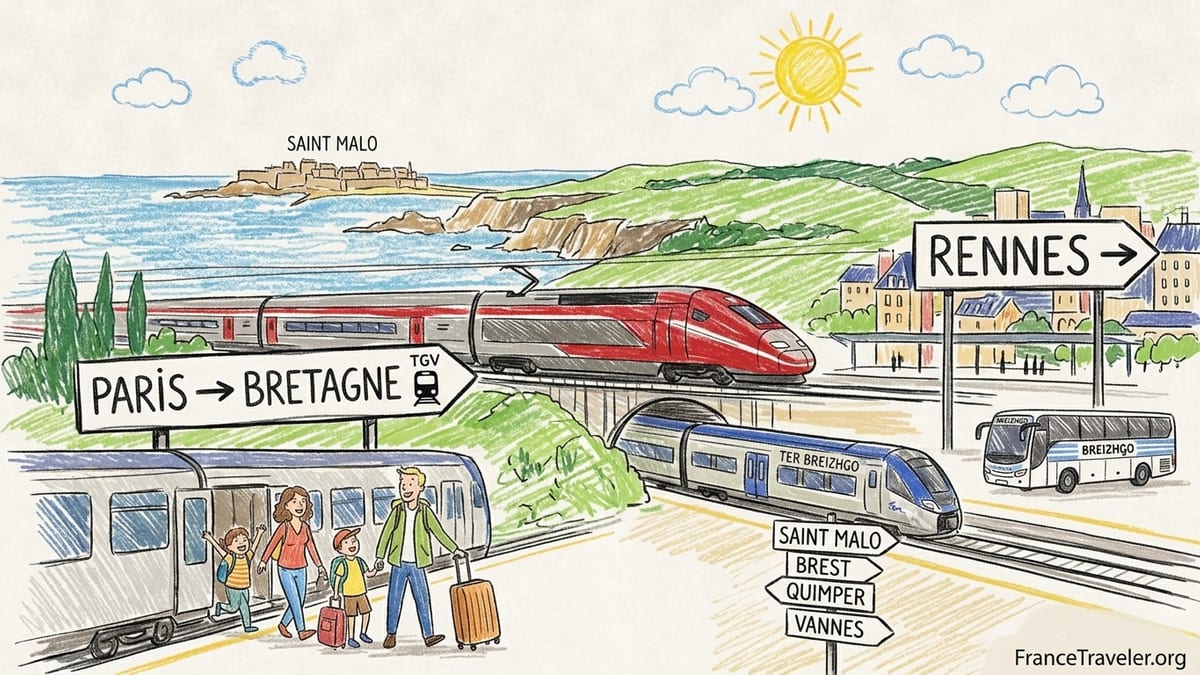
High speed rail into Brittany: fast, simple and low stress
If you are starting from Paris, the train is the most efficient way to enter Brittany. The high speed TGV line links Paris Montparnasse to Rennes in around 1 hour 30 minutes on the fastest direct services, turning the Breton capital into an easy side trip or gateway for a longer stay. Many visitors simply board a morning TGV and arrive in time for lunch on Rennes’s half timbered squares.
From Paris, Saint Malo is usually reached in under three hours, with a quick change in Rennes. Typical daytime journeys range from about 2 hours 15 minutes to 2 hours 45 minutes depending on the connection. Brest and Quimper at Brittany’s western tip are now under four hours from Paris on direct or one change TGVs, which makes even these far flung ports very realistic for train based itineraries.
Once in Brittany, the TER BreizhGo regional trains take over. Operated for the region by SNCF, they connect key cities like Rennes, Saint Malo, Saint Brieuc, Brest, Quimper, Lorient and Vannes, along with many smaller stops. For example, you can ride a TGV from Paris to Rennes, then continue on the same station platform by TER to Saint Brieuc on the north coast or Vannes on the south, using one combined ticket if you booked through a national rail platform.
For travelers used to congested ring roads around Paris and toll booths on the autoroutes, arriving relaxed in central Rennes instead of at the end of a long highway drive is a major advantage. You step out in the historic center, with luggage already off the train, free from parking worries and ready to walk, take the metro or pick up a regional bus.
BreizhGo, KorriGo and coaches: the integrated public transport web
Brittany has invested heavily in weaving trains, buses and boats together under the BreizhGo banner. The regional BreizhGo network combines TER regional trains, long distance coaches and several maritime links to offshore islands. Information planners bring together more than 20 local networks, from intercity coaches to city buses and trams, so you can often plan an entire day’s travel across multiple modes on a single journey planner.
In and around Rennes, Brest, Saint Malo, Lorient, Vannes and other cities, the KorriGo system ties local transport into this regional web. A KorriGo card can be used on Rennes’s metro and buses, on Brest’s tram and buses, and on many BreizhGo buses and some trains, depending on the product you load. Even if you never buy a card, knowing that these systems are meant to work together means you can expect coordinated timetables and through tickets on many routes.
Intercity coaches branded as BreizhGo Cars fill the gaps where rail does not go. Practical examples include routes along the Côte de Granit Rose between Lannion and Perros Guirec, services between Brest and smaller towns in western Finistère, or buses from Vannes to Quiberon for ferries to the islands. In summer, extra departures are often added to serve popular beaches or coastal festivals, which is useful if you prefer not to drive at peak times.
This integration matters in everyday planning. A traveler could, for instance, arrive by TGV in Rennes, use the metro to the bus station, then take a BreizhGo coach to Dinan, and finally a local bus out to the riverside port, all paid as individual legs but designed to connect. Compared with managing a rental car through heavy traffic and tight medieval streets, the appeal of this networked public transport can be significant.
Where trains and buses shine: city heavy and corridor based trips
Rail and buses are especially strong for itineraries that focus on cities and a few well served coastal towns. A classic first timer route might be Paris to Rennes, two nights in Rennes, then TER to Saint Malo, followed by a coach or organized excursion to Mont Saint Michel, and finally a return to Paris or onward to another French region. None of this requires a car, and your travel days are mostly time to read, look out the window or plan your next meal.
Another rail friendly corridor runs along the south coast from Lorient to Vannes and Auray. TGV or TER services connect these cities, and from Auray a seasonal branch line runs to Quiberon, popular in summer with those heading to Belle Ile and nearby islands. In high season the small road into Quiberon peninsula can be very congested, so the little train and connecting BreizhGo buses to the ferry terminals can be faster and far less stressful than driving and searching for parking.
Urban explorers will also appreciate not needing to park in dense historic centers. Rennes and Brest both have structured public transport networks, with metro or tram plus buses, and regulated parking in the central districts. Staying near the station in Rennes makes it easy to pop out on day trips by TER to Saint Malo, Saint Brieuc or Vitré and return in the evening, without ever touching a steering wheel.
If your wish list is mostly cities, mid sized towns and a few well known seaside resorts with train or coach access, the case for doing Brittany entirely by rail and bus is very strong. You will trade some spontaneity in remote areas for predictable travel times and the ability to arrive right in the center of the places you came to see.
Where the car wins: headlands, hidden coves and western Finistère
For all the progress of regional transport, there are still areas of Brittany where a car is an undeniable advantage. Western Finistère is the prime example. The wild headlands of Pointe du Raz or Pointe de Pen Hir, the narrow lanes of the Crozon peninsula, or tiny harbors like Camaret sur Mer and Le Conquet are reachable by BreizhGo buses, but frequencies can be limited and services may drop back to school oriented timetables outside summer.
Similarly, many of the region’s most memorable beaches and small coves sit at the end of small departmental roads or lanes with no regular bus at all. Examples include stretches of coast between Cancale and Saint Malo, the smaller beaches near Plougasnou and Locquirec on the north coast, or little inlets scattered between Concarneau and Pont Aven on the south coast. Reaching several of these in a single day is far simpler with a car, where you can park at trailheads and move on when you are ready.
Road trippers are also drawn to Brittany’s innumerable villages and chapels, which are rarely on main transit routes. A loop through the interior might connect Moncontour, Josselin, Rochefort en Terre and La Gacilly. You can link some of these by TER and coach, but you will spend much of your day waiting at bus stops or checking timetables. In a car, the same loop becomes a relaxed wander along quiet country roads, stopping at viewpoints or craft workshops as you go.
France’s national and regional policy further encourages driving here by keeping Brittany’s main internal expressways toll free. Routes like the RN12 between Rennes and Brest, the RN165 from Nantes to Brest via Vannes, Lorient and Quimper, and the RN24 towards Pontivy and Lorient do not have toll booths. This means that once you have paid for fuel and car hire, fast long distance driving inside Brittany does not add motorway toll costs on top, which is different from many other regions in France.
City stays, north coast routes and island trips: choosing mode by itinerary
If your trip is anchored on one or two cities, such as a long weekend in Rennes with a side trip to Saint Malo, staying car free usually makes the most sense. You can ride the TGV into Rennes, use the metro and buses on a simple day ticket, and hop on a TER to the coast for a day by the sea. Hotels near the stations in Rennes or Saint Malo often advertise that parking space is limited or paid, so skipping the car also reduces your accommodation costs and logistics.
On the classic north coast, which runs from Saint Malo across the Emerald Coast to the Pink Granite Coast and beyond, the choice is more balanced. Towns like Saint Malo, Dinard, Dinan and Lannion are linked by rail or coach for at least part of the way. For example, you can ride a train from Rennes to Saint Malo, a coach toward Dinard, and another coach north to Saint Cast, but reaching smaller cliff top walk trailheads in a single day becomes difficult. A north coast tour that focuses on a few hubs, such as Saint Malo and Perros Guirec, works very well by train and bus. A route that aims to stop in a different small fishing village every night is smoother with a car.
Island trips introduce another layer. Ferries to Belle Ile, Groix, Houat, Hoëdic or the Glénan archipelago are often reached by public transport, but the links can be fragile. For Belle Ile, a common route is train to Auray, BreizhGo bus or seasonal train to Quiberon, then ferry to Le Palais. Without a car you avoid leaving a vehicle in long stay parking at the peninsula end, but you must match your timing carefully to the ferry schedules. For the Bréhat archipelago off Paimpol, you can arrive by TER to Paimpol and local bus or taxi to the embarkation point, which suits travelers who prefer not to drive narrow roads.
In Morbihan, many of the best experiences are water based: cruising the Gulf of Morbihan by boat from Vannes, visiting the standing stones at Carnac, or spending time in La Trinité sur Mer. Trains bring you close to several of these, and buses and seasonal shuttles cover popular sites. A couple spending four nights in Vannes, for instance, could explore the historic center on foot, join a boat tour in the gulf, and take buses to Carnac for a guided visit of the alignments. A family wanting to combine Carnac, multiple beaches around Erdeven and several inland villages in three days, however, would find a car far more flexible.
Long coastal loops and family travel: comfort, cost and convenience
Ambitious coastal loops highlight the trade offs between car and train. A classic driving circuit might start in Rennes, sweep along the north coast through Saint Malo, the Pink Granite Coast and Morlaix, then cut along the Crozon peninsula, continue via Quimper and Concarneau, and return via Vannes and the Gulf of Morbihan. Public transport reaches many of these places, but stitching them together as a continuous loop with frequent overnight changes demands close timetable reading and tolerance for multi hour gaps between services.
For solo travelers or couples without tight time pressure, building such a loop with trains, coaches and occasional taxis can be rewarding. You have no parking or driving fatigue, and you experience Brittany alongside locals on everyday services. For families, particularly those with younger children, frequent changes and fixed departure times can be more stressful. Juggling luggage, strollers and snacks through several transfers on a rainy day is often when parents decide that a rental car is worth the extra cost.
Budget calculations also differ by group size. Two adults buying TGV and TER tickets plus local buses may well spend less overall than hiring a compact car, paying for fuel and parking. A family of four paying standard fares might find that rail tickets for several legs approach or surpass the cost of a week’s economy car rental booked in advance, especially if they plan to move every couple of days. On the other hand, long stay parking in popular coastal towns can be a noticeable line in the budget, so it is worth checking hotel parking policies and municipal car park prices when comparing options.
Comfort considerations are equally real. On busy summer Saturdays, the main expressways can slow with holiday traffic, and access roads to bottlenecks such as Quiberon or parts of the Pink Granite Coast may crawl at peak times. Trains and coaches are not immune to crowding, and popular TER services to the coast can be busy with beachgoers, but at least you are free to read or doze rather than concentrate on the road. Weighing these practicalities against your group’s patience and energy levels is essential when choosing your main mode.
Hybrid strategies: TGV gateways plus 3 to 6 days of car hire
For many trips, the smartest solution is not to choose strictly between train and car, but to combine them. A common hybrid pattern is to take a TGV from Paris to Rennes, Vannes or Quimper, spend one night car free in the arrival city, then pick up a rental car for three to six days of exploring the surrounding region before returning it to the same station.
This approach cuts out the least enjoyable driving. You avoid the long autoroute haul from Paris or another distant city, along with the tolls that apply outside Brittany. You also start the driving portion fresh, already in the region, with shorter daily legs. Concrete examples include riding the TGV to Quimper, then hiring a car for five days to tour the Cornouaille coast, Pointe du Raz and inland Pont Aven villages, or arriving in Vannes by train, then renting a car to combine Carnac, the Gulf of Morbihan and the wild beaches near Erdeven.
Station based car rental is widely available in the larger Breton hubs. Rennes, Brest, Quimper, Lorient, Vannes and Saint Malo all have agencies either in or very close to the station, with opening hours adapted to train arrivals on many days. If your itinerary is linear, you can look for one way bookings, such as collecting a car in Rennes and dropping it in Quimper or Brest, though booking well in advance is important and a one way fee is common.
Hybrid strategies are also useful for trips that include island stays. One practical pattern is to take the train to a coastal hub, leave heavy luggage in station lockers or at your hotel, then continue with a small overnight bag by bus and ferry to an island like Belle Ile or Groix. On return you can pick up a rental car to explore the mainland coast. This avoids paying to store a car in a long stay car park while you are on an island where vehicles are either restricted or unnecessary.
Parking, summer traffic and practicalities of driving
Brittany is generally comfortable for visitors who drive, but it helps to understand a few local realities. In historic centers such as Rennes, Vannes, Dinan or Quimper, many streets are one way, narrowed for pedestrians or traffic calmed, and surface parking is limited. Most travelers end up using underground or multistorey car parks on the edge of the old town, paying by the hour or day. Over a week this adds up, so it can be cheaper and easier to choose accommodation that includes a parking space, especially outside the absolute center.
On the main toll free expressways like the RN12 and RN165, driving is straightforward, but summer weekends can bring dense holiday traffic. This is especially true on approach to coastal peninsulas such as Quiberon or Crozon, and near major resort towns during changeover days for vacation rentals. If your schedule allows, it is wise to time longer drives for weekdays or early mornings, keeping shorter hops and local walks for weekends.
Village parking usually remains uncomplicated once you leave the major tourist zones. Many small towns still have free car parks near the church or market square, though signed time limits may apply on market days or in July and August. At popular beaches you are more likely to find paid or time limited lots, particularly where fragile dunes or protected areas limit informal parking on verges.
For drivers used to large automatic transmissions, note that many French rental fleets still default to manual gearboxes, especially in compact categories. Automatics are increasingly available but often cost more and sell out earlier at busy times. Booking early and specifying your preference is the best way to avoid surprises at the rental desk.
Luggage, bicycles and seasonal TER bike rules
Rail and bus travel in Brittany handle ordinary luggage well, but still require some thought. On TGVs and TER BreizhGo trains, suitcases generally go on overhead racks or at the end of the carriage. Traveling with one medium suitcase and a small daypack per person makes boarding and connections much easier than bringing several large bags. On coaches, your main luggage travels in the underfloor hold, so it is sensible to keep documents, water and valuables in a small bag you keep with you.
For cyclists, Brittany is attractive partly because of the growing network of greenways and cycle routes. The region and SNCF operate a specific TER BreizhGo bicycle reservation system in summer to manage demand. From 1 May to 27 September 2026, for example, a reservation is mandatory for standard bicycles on certain TER BreizhGo trains, with a small fee of about 1 euro per bike and per train. Outside this period, on most lines bikes are carried free without reservation on a space available basis, though folding bikes in covers are usually allowed at any time as standard luggage.
These summer rules especially affect coastal lines that see heavy leisure use, such as trains between Rennes and Saint Malo or services that connect with popular cycling routes. If you plan to combine bike touring with rail, it is important to check which TER BreizhGo departures require a reservation, and to book both your passenger ticket and bike space at the same time through official sales channels. Capacity for bikes can be limited to a small number of spaces per train, so spontaneous boarding in peak season may not always be possible.
New regional initiatives, such as secure bike shelters at many stations and the gradual rollout of a “Vélo BreizhGo” bike rental service near key hubs, aim to make it easier to leave your own bike at home and still explore by pedal. In practice, that might look like taking a TGV to Rennes, renting a regional branded bike near the station for local rides, and later using another rental or local operator on the coast, instead of managing bike reservations across multiple trains.
The Takeaway
Brittany today is neither purely a driver’s playground nor a region that demands car free virtue. It is a place where fast TGVs deliver you from Paris to Rennes in around ninety minutes, TER BreizhGo trains and coaches spread out to most major towns, and integrated systems like KorriGo help you ride metro, tram, bus and boat on a single network. At the same time, toll free expressways and a lacework of quiet country lanes invite meandering road trips to lighthouses, chapels and remote coves the buses never reach.
If your plan centers on cities, a couple of well known resorts and perhaps one island, trains and buses will serve you very well. You will spend less energy on logistics, avoid parking charges in tight old towns, and experience travel that feels more local. If your heart is set on western Finistère’s headlands, on stitching together many small beaches in a single day or on weaving through inland villages at your own rhythm, a car still opens doors that public transport only half unlocks.
For many travelers, the most satisfying answer is to blend the two. Take the TGV into Brittany, breathe out as countryside replaces the Paris suburbs, enjoy a night or two in your arrival city without any keys in your pocket, then collect a car for three to six days of deeper exploration. When you return it and step back onto the train home, you will likely have enjoyed the best of both worlds: efficient low stress long distance travel and the freedom to turn down that intriguing side road whenever the mood took you.
FAQ
Q1. Is it realistic to visit Brittany without renting a car at all?
Yes, if you focus on cities and well served coastal towns. With TGVs to Rennes, Brest, Quimper and TER BreizhGo trains and coaches linking many resorts, you can build a full itinerary without driving, especially if you stay several nights in each base.
Q2. How long is the train from Paris to Rennes, Saint Malo and Brest?
Fast TGV services do Paris to Rennes in about 1 hour 30 minutes. With a change at Rennes, Paris to Saint Malo usually takes under three hours, while Paris to Brest or Quimper is commonly under four hours on direct or one change trains.
Q3. Are the main roads in Brittany really toll free?
Yes. The principal expressways inside Brittany, such as the RN12 between Rennes and Brest and the RN165 between Nantes, Vannes, Lorient, Quimper and Brest, have no toll booths, so once you are in the region you do not pay motorway style tolls on these routes.
Q4. When does it make sense to combine train and car for a Brittany trip?
A hybrid strategy works well if you want both easy long distance travel and flexible local exploring. Typical patterns are taking a TGV to Rennes, Vannes or Quimper, then hiring a car for three to six days to tour headlands, villages and beaches before returning the vehicle to the same station.
Q5. How difficult is parking in Brittany’s cities and popular towns?
In historic centers like Rennes, Vannes, Dinan or Quimper, surface parking is limited and many visitors use underground or multistorey car parks, usually paid. In smaller towns and villages, free or low cost car parks are still common, though summer and market days can be busier.
Q6. Are there good public transport options for island trips like Belle Ile or Bréhat?
Often yes. For Belle Ile, many travelers go by train to Auray then bus or seasonal train to Quiberon for the ferry. For Bréhat, you can reach Paimpol by TER and continue by local bus or taxi to the boat. Schedules may be seasonal, so checking times in advance is important.
Q7. What are the rules for taking a bicycle on TER BreizhGo trains?
Outside the main summer period, standard bikes usually travel free on TER BreizhGo trains without reservation, within the limit of available spaces. From early May to late September, many routes require a low cost reservation per bike and per train, so cyclists should book both seat and bike space together.
Q8. Is driving in Brittany suitable for visitors not used to French roads?
Generally yes. Roads are well maintained, main expressways are free of tolls and rural traffic is often light. Challenges mostly involve narrow village streets, parking in old centers and heavier traffic on certain coastal routes in peak summer weekends.
Q9. For a family with children, is car or train better in Brittany?
It depends on your route and travel style. For city based stays and a couple of side trips, trains and buses mean no car seats, no parking and less stress. For packed itineraries with frequent stops at beaches and villages, a car gives families more flexibility around naps, snacks and sudden changes of plan.
Q10. How far in advance should I book trains and car hire for summer in Brittany?
For July and August, it is wise to book long distance TGV tickets several weeks or months ahead to secure good fares and times, and to reserve car hire early, especially if you need an automatic or plan a one way rental between different Breton cities.