


Brittany’s food is written in its geography. This peninsula in France’s far northwest is almost encircled by water, with ragged coastlines, sheltered gulfs and deep estuaries pushing the Atlantic far inland. Inland, low hills and bocage hedgerows shelter orchards, dairy farms and buckwheat fields. The result is a regional cuisine that makes immediate sense on the ground: briny oysters eaten within sight of their beds, nutty buckwheat galettes filled with local cheese and ham, pastries built on serious salted butter, and cider pressed from hundreds of apple varieties that thrive in the mild, damp climate.
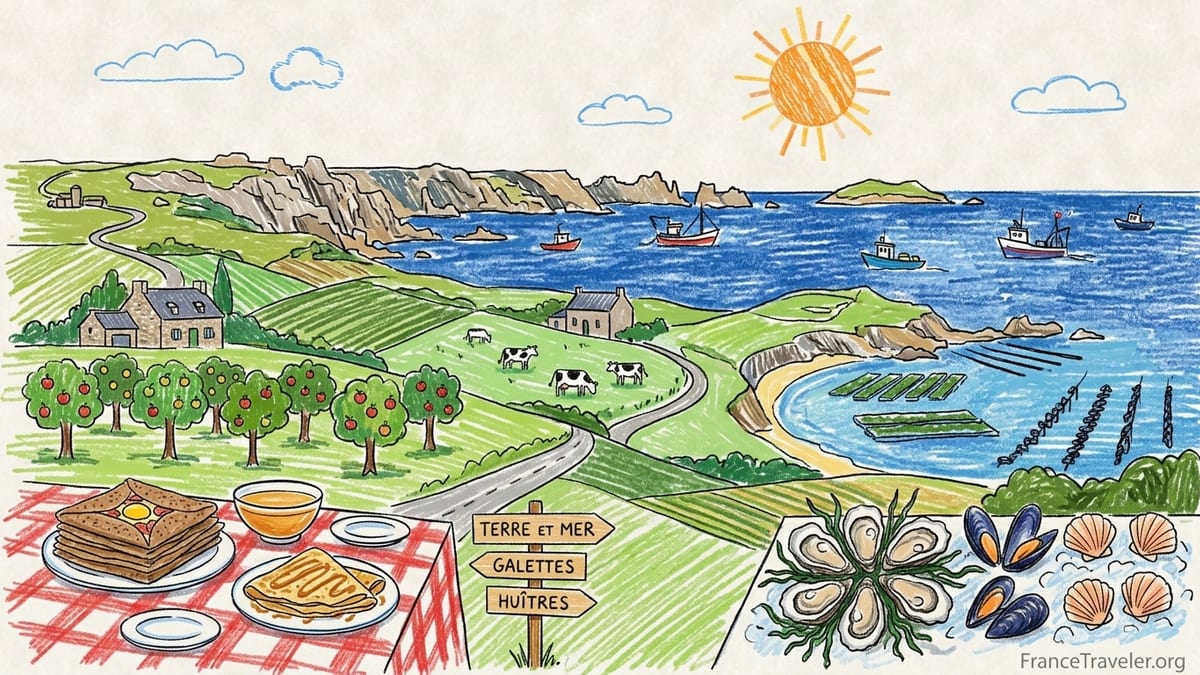
How Brittany’s Landscapes Shape What Appears On Your Plate
To understand a Breton menu, it helps to picture a map. No point in Brittany lies very far from the sea, and the region is fringed with bays and inlets where tides race in and out twice a day. These powerful tides oxygenate the water and constantly renew the plankton that shellfish feed on, which is one reason oysters, mussels and scallops are so central to local cooking. In contrast, the interior is a patchwork of small fields, moorland and orchards. Dairy herds, buckwheat plots and apple trees fill the spaces between granite farmhouses, supplying the milk, butter, flour and fruit that underpin crêpes, galettes and cider.
The climate is temperate and often wet. Winters are mild compared with much of inland France, while summers rarely reach the scorching temperatures of the south. This means long growing seasons but also conditions that favour hardy crops. Buckwheat, known locally as blé noir, has been cultivated here since the Middle Ages precisely because it copes well with poor, acidic soils and damp weather. That history is still visible every time a galette emerges from a hot bilig griddle in a village crêperie.
Apples tell a similar story. Brittany is one of France’s main cider-producing regions, with more than 600 apple varieties identified across its orchards. Many are tannic, bittersweet or sharp rather than simply sweet, adapted over generations to the region’s maritime climate. Those apples produce the structured, refreshing ciders poured into ceramic bowls in crêperies and on farm tables. In short, Brittany’s geography and weather do not just provide a backdrop to its food. They dictate which ingredients thrive and how they are transformed.
Buckwheat Galettes and Sweet Crêpes: Reading the Griddle
Travellers often enter a Breton crêperie thinking “pancakes for everyone” and then face a two-part menu divided between galettes and crêpes. The difference is more than sweet versus savoury. Galettes are made with buckwheat flour, water and salt, sometimes with a touch of egg, which produces a lace-edged, slightly crisp disc with a distinct nutty and earthy flavour. This buckwheat, grown across Brittany and protected by a geographical indication, is a direct product of inland fields that could not easily support wheat but welcomed this resilient pseudocereal.
In the west and north, particularly around Quimper, Morlaix and Brest, galettes remain the backbone of everyday meals. A classic “complète” will arrive folded around ham, grated Emmental and a sunny egg, the yolk still liquid. Look for regional twists that reflect local produce: on the Pink Granite Coast, galettes might be filled with scallops or smoked fish, while in the interior, you may see andouille de Guémené (a rustic smoked sausage) or farm eggs with leeks and cream. East of Rennes, in Haute-Bretagne, the galette-saucisse turns buckwheat into street food, wrapping a grilled pork sausage in a warm galette at markets and football matches.
Sweet crêpes, by contrast, are made from wheat flour with milk and eggs, yielding a softer, more elastic texture. They emerged later, once wheat became more affordable, but are now just as emblematic. Here the geography of dairy-rich inland Brittany asserts itself. Crêpes are brushed with generous quantities of demi-sel salted butter and often topped with local products such as salted butter caramel, farm cider jelly or preserves made from Plougastel strawberries. Ordering both savoury galettes and sweet crêpes in sequence is not overindulgence. It is how Bretons have long structured a full meal based around the griddle.
Inside a Crêperie: How a Typical Meal Unfolds
Sitting down in a Breton crêperie is one of the most relaxed ways to experience the region’s food culture. Menus usually begin with savoury galettes. You might start with something simple, like a galette beurre with nothing more than good salted butter melted into the hot buckwheat, or go straight to a complète. More elaborate galettes combine local seafood, vegetables and cheeses, for example scallops with leeks in cream in the Morbihan or smoked salmon with fresh goat cheese near the Rance estuary.
Once everyone has finished their galettes, the table typically pivots to sweet crêpes. Expect combinations that spotlight Breton butter and dairy: crêpe au sucre with butter and sugar caramelised on the griddle, crêpe caramel au beurre salé drizzled with salted butter caramel, or crêpes with local honey and toasted almonds. Many crêperies also offer flambéed crêpes with cider or apple brandy from the region. A family of four can usually enjoy galettes, crêpes and a bottle of cider for a total that remains moderate by French restaurant standards, especially outside the most touristy coastal towns.
Cider is almost always served in ceramic bowls called bolées rather than in stemware. You will be asked whether you prefer brut, demi-sec or doux. Brut refers to dry cider, fermented until most of the sugar has turned to alcohol, and it is the classic match for savoury buckwheat. Doux means sweet, usually lower in alcohol and popular with children or those who prefer a gentler drink. Demi-sec sits in the middle, making a useful option if some diners are ordering seafood galettes while others lean toward creamy or cheesy fillings. Sharing a bottle is the most common approach, but many places also serve cider by the bolée if you wish to sample different styles during a single meal.
Salted Butter, Kouign-amann and the Sweet Side of the Coast
If buckwheat and apples come from fields and orchards, Brittany’s devotion to butter is tied to the Atlantic. For centuries, salt harvested along the nearby Atlantic littoral provided an easy way to preserve dairy. Breton butter developed a distinct identity as a salted product, and that savoury edge still runs through local pastries. It is not an exaggeration to say that kouign-amann, arguably Brittany’s most famous cake, could not exist without the abundance of high-quality salted butter from coastal dairies.
Kouign-amann, whose name means “butter cake” in Breton, originated in the port town of Douarnenez in Cornouaille. Bakers laminate bread dough with a striking amount of butter and sugar, then bake it until the exterior caramelises to a deep golden crust while the interior stays moist and slightly chewy. Many bakeries across Brittany now produce their own versions, but in Cornouaille you may find cakes labelled as “véritable kouign-amann de Douarnenez,” made to a shared charter by local bakers. The taste is inseparable from salted butter, which keeps the sweetness in check and adds a faint minerality that echoes the sea air.
Salted butter caramel, another modern classic, is also anchored in place. Shops in towns like Quiberon, Saint-Malo and Vannes sell jars and candies made by heating local cream and butter with sugar until it turns amber. You will encounter it as a sauce on crêpes, a filling in chocolates, or an ice cream flavour. Even shortbread-like biscuits from Pont-Aven and other coastal towns rely on salted butter for their texture and flavour. Travellers who avoid dairy will quickly notice how central this ingredient remains to Breton baking, a legacy of centuries of cattle farming in the mild, rain-fed meadows behind the coast.
Oysters, Shellfish and Fish: Eating With the Tides
With water on three sides, Brittany offers an exceptional range of seafood, but the experience varies dramatically from bay to bay. Along the north coast, between Cancale and Paimpol, strong tides and cool, nutrient-rich waters foster dense plankton blooms that give oysters and mussels a brisk, iodine-laced flavour. Cancale, overlooking the Mont-Saint-Michel Bay, is one of France’s emblematic oyster towns, recognised nationally for its mollusc-breeding traditions. Here, travellers buy a dozen oysters from simple stalls on the seafront, have them opened on the spot, and eat them perched on the seawall, returning the shells to the foreshore at low tide.
Moving westward to the roadstead of Brest and south around the tip of Finistère, oyster beds occupy more sheltered inlets where freshwater from rivers meets the sea. In the Bélon and Aven estuaries, flat oysters develop a distinctive nutty flavour that locals describe as hazelnut-like, while cupped oysters from nearby areas taste saltier. Farther south, in the Quiberon Bay and the Gulf of Morbihan, hundreds of islets and channels create calm, well-oxygenated basins where oysters, mussels and clams grow steadily. Official regional tourism materials highlight this arc, from Cancale and Paimpol through Brest, Bélon, Quiberon and the Gulf of Morbihan, as Brittany’s main oyster-growing corridor.
Seasonality matters. Many restaurants serve oysters year-round, but the traditional rule of thumb favours the cooler months, roughly from September to April, when the shellfish are firmer and less milky. Mussels and scallops have stricter seasons tied to fishing regulations. In the Bay of Saint-Brieuc, one of France’s major scallop grounds, dredging generally opens in autumn and runs through spring, with local festivals celebrating the first catches in late October. In practical terms, visiting between late autumn and early spring gives seafood lovers the widest choice of wild shellfish, while summer still provides farmed oysters and mussels along with line-caught fish like sea bass and mackerel.
The experience of eating seafood directly from producers differs markedly from ordering a plateau de fruits de mer in a restaurant. At low tide in Cancale or along parts of the Gulf of Morbihan, you may find simple kiosks where oyster farmers sell by the dozen, often at prices lower than in brasseries. You eat standing up or on a bench, with a wedge of lemon and a view of the beds. In coastal towns such as Concarneau, Quiberon or Lorient, restaurants plate seafood on crushed ice, pairing it with sauces and breads, and charge for service, table setting and cooking. Both approaches are authentic; the former foregrounds the product and place, while the latter folds seafood into a broader dining ritual.
Kig ha Farz and the Flavours of the Breton Interior
Venture a little way from the coast and Brittany reveals a more rustic, land-focused side that coexists with its maritime identity. In the Léon and Trégor areas of northern Finistère, as well as pockets of inland Cornouaille, fields produce cauliflower, artichokes and other hardy vegetables, while cattle and pigs supply meat and charcuterie. Dishes here often respond to the cooler, wetter climate of the interior, where comforting stews and substantial starches have long been welcome after days of agricultural work.
Kig ha farz is perhaps the emblematic expression of this inland cooking. The name means “meat and far,” referring to a buckwheat and wheat dough that is tied in a cloth bag and simmered in a pot with a variety of meats and vegetables. The geography of the dish is plain to see. Buckwheat flour comes from the same inland fields that produce galettes, root vegetables from local gardens, and pork or beef from nearby farms. Served with a sauce of browned salted butter and onions, the dish feels far removed from the lightness of seaside oysters, yet it emerges from the same regional pantry.
Eating kig ha farz in a farmhouse restaurant near Morlaix or in a village inn around Saint-Pol-de-Léon provides a different window onto Breton identity. Here the table celebrates the resilience of inland communities that historically lived more from land than sea. These are good areas for food-focused stays if you want to balance coastal seafood meals with hearty rural cooking and visits to vegetable markets, cider farms and working mills where buckwheat is still ground.
Breton Cider and Apple Products: Drinking the Orchard
Brittany’s cider culture is inseparable from its patchwork of orchards. Official tourism materials count more than 600 apple varieties across the region, from sharp, high-acid fruit to tannic bittersweet types that lend structure and length to cider. The hedgerows that divide small fields create a sheltered microclimate well suited to apple trees, especially in south Finistère, around the Cornouaille area, and in parts of the Morbihan and Côtes-d’Armor departments. Here, apples share the landscape with dairy cows and vegetable plots, and many family farms still produce cider for both home use and commercial sale.
For visitors, the key distinctions to understand are brut, demi-sec and doux. Brut cider is dry, with most of the natural sugar fermented, resulting in an alcohol level often around 4 to 5 per cent. It feels crisp and refreshing, cutting through the richness of buckwheat galettes, seafood platters or roasted pork. Demi-sec, or semi-dry, retains a bit more sweetness and pairs well with creamy dishes, cheeses and some desserts. Doux cider is sweeter and lower in alcohol, generally below brut levels, and is frequently offered to children or those who prefer a gentler drink. Many labels from artisan producers list the dominant apple varieties and whether the blend leans more bitter, bittersweet or sharp.
Cornouaille, in south Finistère, holds Brittany’s flagship cider designation. Cidre de Cornouaille AOP must come from a defined area around Quimper and be made from traditional local apple varieties. The mild coastal climate and specific soils give these ciders notable aromatic intensity and a balance of sweetness, bitterness and acidity that makes them popular pairings for both main courses and desserts. Travellers can visit farms along dedicated cider routes, where tastings are often inexpensive. On-site, you may also encounter apple juice, pommeau (a fortified blend of cider and apple spirit) and lambig, an apple brandy aged in casks, all reflecting how deeply apples are woven into local agriculture.
Tasting cider at the source differs from ordering it in a restaurant in much the same way that quayside oysters differ from a plated seafood tower. At a farm, you generally sample several cuvées with the producer, who explains the orchard, harvest and fermentation. Bottles are often priced lower than in retail shops, and the setting, surrounded by trees, underlines the drink’s rural roots. In crêperies or bistros, cider is chosen primarily as a food pairing, and house selections may come from respected regional producers without always specifying individual orchards. Both approaches are worthwhile. A balanced trip might include at least one afternoon devoted to farm visits and one evening of carefully matched cider and food in town.
Where to Base Yourself for Food-Focused Stays
Because Brittany’s food culture is so tied to geography, choosing the right base shapes your experience. For travellers who prioritise oysters, shellfish and seafood markets, the north coast between Saint-Malo, Cancale and Saint-Brieuc offers dense clusters of producers and boats. Cancale’s harbour provides direct-from-farmer oyster tastings, while Saint-Malo and Dinard offer a mix of crêperies, fish restaurants and urban markets within easy reach of coastal walks. Farther west, the Bay of Morlaix and the ports of Roscoff and Carantec combine shellfish with vegetable production, making them good bases for exploring both sea and land products.
On the south coast, Quiberon and the Gulf of Morbihan surround you with shellfish farms, weekly markets and access to island communities where fishing remains central. Morning markets in towns like Vannes or Auray lay out langoustines, crabs and local vegetables, and nearby farms open their doors for cider tastings. The light and mild climate of this area also favour apple orchards, so it is an efficient choice if you want to combine cider visits with coastal walks and seafood lunches.
For a more pastry and crêpe focused itinerary, western Cornouaille around Quimper and Douarnenez makes sense. This is kouign-amann country, and many bakeries are proud to explain their methods. You can pair morning bakery visits with afternoons in crêperies and excursions to nearby fishing ports such as Concarneau. Inland areas north of here, near Morlaix and Saint-Pol-de-Léon, are ideal for those drawn to vegetable farming, kig ha farz and quieter country inns where menus lean heavily on buckwheat, cabbage, carrots and pork.
Urban centres create yet another angle. Rennes, although not on the sea, acts as a hub for the region’s inland and coastal produce, with a major Saturday market and a lively dining scene. From here, it is easy to take day trips toward Saint-Malo, the Rance valley or the cider-producing countryside around Fougères and Vitré. Whichever base you choose, planning at least one market visit, one crêperie meal, one seafood experience and one cider farm tasting will give a rounded sense of how Brittany’s landscapes translate into food and drink.
The Takeaway
Brittany’s gastronomy is not a random list of specialties but a coherent reflection of a place shaped by sea winds, gentle rain and human persistence. Buckwheat fields in the interior become galettes on your plate. Orchards sheltered by hedgerows supply the apples that ferment into brut and demi-sec ciders, poured into bolées in crêperies or sampled in shaded farmyards. Salt-air pastures and coastal dairies furnish the salted butter that defines kouign-amann and caramel sauces, while a restless tide washes over oyster beds from Cancale to the Gulf of Morbihan.
For travellers, this means that eating in Brittany is a way to read its map. Sitting on a sea wall in Cancale with a dozen oysters puts you in direct contact with the bay’s particular salinity and light. Sharing a steaming pot of kig ha farz inland connects you to centuries of farming in a harsher climate. A crepe beurre-sucre near a village church or a glass of Cornouaille cider looking out over orchards turns seemingly simple foods into expressions of landscape and history.
Plan your days around both geography and appetite. Follow the coastline when you crave shellfish and fish, head inland for orchards and hearty stews, and let markets and farm signs guide your detours. With a little attention, every galette, every crêpe and every sip of cider becomes not just a meal but a story about Brittany itself.
FAQ
Q1. What is the difference between a Breton galette and a crêpe?
Galettes are savoury pancakes made from buckwheat flour, usually filled with ingredients like ham, cheese or egg, while crêpes are wheat-based, softer and typically served with sweet toppings such as sugar, salted butter caramel or jam.
Q2. When is the best time of year to eat oysters and shellfish in Brittany?
Restaurants serve oysters year-round, but many locals favour the cooler months from roughly September to April, when oysters are firmer, and scallop and mussel fishing seasons provide the widest choice of wild shellfish.
Q3. How does a typical meal in a Breton crêperie work?
You usually start with a savoury buckwheat galette, often a complète with ham, cheese and egg, accompanied by cider, then move on to a sweet wheat crêpe for dessert, such as one with sugar and salted butter or caramel.
Q4. What is kouign-amann and where should I try it?
Kouign-amann is a rich Breton cake made from layered dough with large amounts of salted butter and sugar, baked until caramelised, and it is especially associated with the coastal town of Douarnenez and the wider Cornouaille area.
Q5. What do brut, demi-sec and doux mean on Breton cider labels?
Brut indicates a dry cider with most sugars fermented, demi-sec is semi-dry with some sweetness remaining, and doux is sweeter and lighter, often chosen by those who prefer a gentle, lower-alcohol drink.
Q6. Where are the main oyster-growing areas in Brittany?
Key oyster-growing zones run from Cancale and Paimpol on the north coast through the roadstead of Brest and the Bélon estuary to the south-coast areas around Quiberon and the Gulf of Morbihan.
Q7. What is kig ha farz and where can I find it?
Kig ha farz is a traditional inland Breton dish of meat, vegetables and a buckwheat-based dough cooked together in broth, most commonly found in north Finistère, particularly around Léon, Trégor and the Morlaix area.
Q8. Is it better to taste oysters and cider at the producer or in a restaurant?
Both are worthwhile; direct-from-producer tastings, such as oyster stalls on the quayside or farm cider cellars, emphasise freshness and origin, while restaurants integrate these products into composed dishes and offer more comfortable, sit-down meals.
Q9. Which areas are best for a food-focused stay in Brittany?
Seafood lovers might base themselves around Cancale, Saint-Malo, Quiberon or the Gulf of Morbihan, while those interested in pastries, crêpes and cider could focus on Cornouaille around Quimper and Douarnenez or the inland countryside near Morlaix and Rennes.
Q10. Can I find good vegetarian options within traditional Breton cuisine?
Yes, buckwheat galettes can be filled with vegetables, eggs and cheese, many markets offer excellent local produce, and inland dishes increasingly highlight seasonal vegetables and dairy, although seafood and meat remain central to the region’s cooking.