


Planning a trip to Brittany and trying to work out what it will really cost is surprisingly hard. Most guides quote national averages for France that do not reflect the quirks of this peninsula of fishing ports, offshore islands, crêperies and cheap rural hotels that sit many winding kilometres from where you actually want to be. To give you something more concrete, this article walks through a real one-week Brittany itinerary in late May 2024, detailing what I actually paid for hotels, trains, rental car, fuel, parking, ferries, food and island transport, plus where I quietly overspent and where costs could easily be trimmed.
Trip Setup: When, Where And How I Traveled
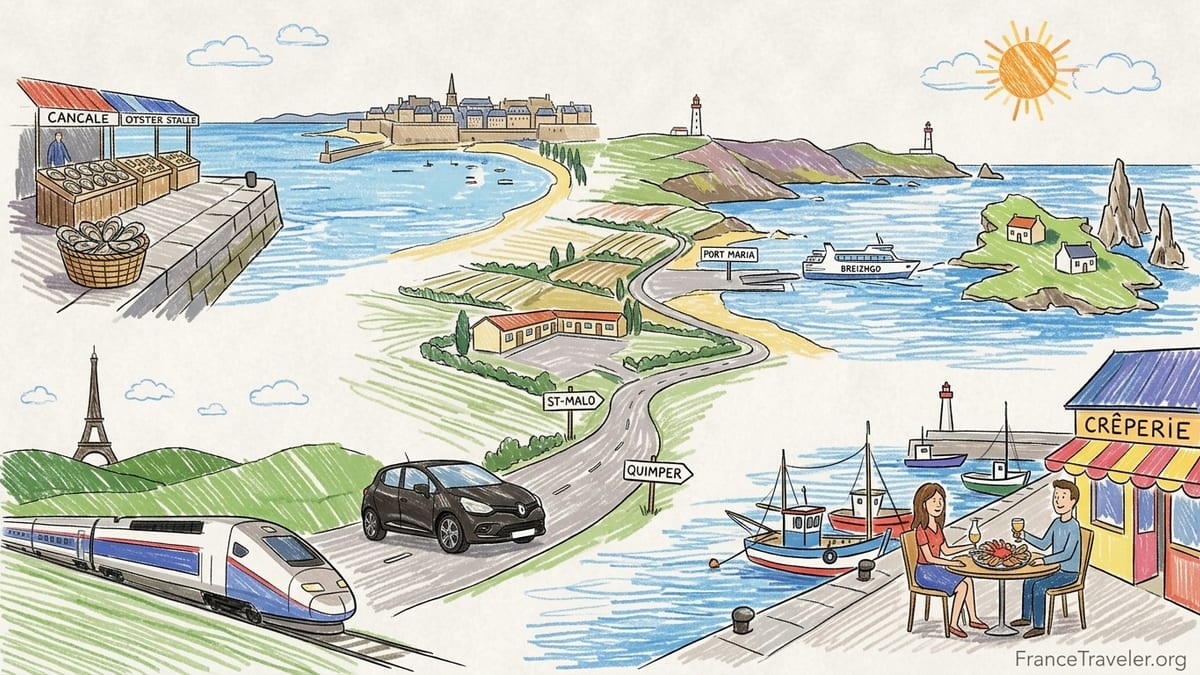
My numbers come from a seven-night trip in Brittany in late May 2024, travelling as a couple. We flew into Paris, took the train to Rennes, picked up a rental car there and looped through the north and south coasts before returning the car at Lorient. From there we took a train back to Paris. The route was Rennes, Cancale and Saint-Malo on the Emerald Coast, then a long driving day south via Quimper to Quiberon for an island side trip to Belle-Île-en-Mer. This timing matters because late May sits just before French school holidays and peak summer pricing. You will usually pay more in July and August and a little less in early spring or late autumn.
I used mid-range choices almost everywhere, with a mix of seafront hotels, a simple inland motel and an island guesthouse. We ate breakfast in hotels when reasonably priced, grabbed a lot of lunches from bakeries and markets, and treated dinner as our splurge with several seafood plates, crêperies and one more formal meal. Parking and tolls were modest but ferries and the rental car itself added up quickly. If you travel solo, by public transport and sleep mostly in rural guesthouses, your bottom line will look quite different even if you visit the same places.
All prices here are what I personally paid or what was on receipts and posted tariffs on the ground in 2024, rounded to the nearest euro. Where I quote a public fare rather than my own ticket, such as a ferry or producer price list, I specify that clearly. Prices in Brittany move up slightly each year, especially on fuel, ferries and seafood, but this should give you a realistic order of magnitude for a similar style of trip in 2025 or 2026.
Getting Into Brittany: Trains, Car Hire And Fuel
From Paris Charles de Gaulle Airport I booked an advance ticket on the TGV to Rennes. In May 2024 this cost 54 euros per person in second class, including a mandatory seat reservation. Typical advance fares on this route are often in the 35 to 70 euro range depending on how far ahead you book and the exact time of day. Buying a flexible ticket on the day can cost more, so locking this in a few weeks ahead was a worthwhile saving for us.
In Rennes I rented a compact petrol car for six days, picking up at the railway station and dropping at Lorient. For late May 2024, a manual transmission Renault Clio class car booked through a major broker worked out at 268 euros including basic insurance. Adding the one-way drop fee of 70 euros and a second driver supplement of 42 euros brought the total to 380 euros for six days. That is just over 63 euros per day before fuel. An automatic transmission would have been roughly 25 to 30 percent more. In high summer these same contracts can climb toward 80 to 100 euros per day including drop fees, so seasonality here is a major budget driver.
Over six days we drove about 780 kilometres, taking in Rennes, Cancale, Saint-Malo, Dinard, the Pink Granite Coast around Ploumanac’h as a detour, then south along the N165 toward Quimper, Auray and Quiberon, plus local pottering on Belle-Île-en-Mer with the car left on the mainland. Petrol in Brittany in May 2024 cost around 1.85 euros per litre for SP95-E10 at highway and supermarket stations. We spent 112 euros on fuel in total, which matched the car’s real-world average consumption of about 5.3 litres per 100 km. Urban driving in Saint-Malo and around Quimper pushed consumption up a little, while the relatively flat dual carriageways lowered it.
Parking and tolls were modest but not negligible. The N165 and other main dual carriageways in Brittany are toll free, so our only motorway toll was a 9 euro stretch leaving the greater Paris region. In Saint-Malo we paid 12 euros for an overnight hotel garage space near the intramuros in May 2024 and another 7 euros for evening street parking in Cancale’s lower town. The Quiberon peninsula operates peak season access controls, but in late May 2024 we were able to park near the ferry terminal at Port Maria for 15 euros per 24 hours in a supervised lot while we were on Belle-Île-en-Mer. Across the week we spent 57 euros on parking and urban tolls combined.
Sleeping In Brittany: Town, Coast And Island Compared
Accommodation created the biggest swings in our daily spend, especially between inland motels, seafront rooms and an island guesthouse. In Rennes, our arrival night was at a modern mid-range hotel near the train and metro stations. In May 2024 that double room, booked a month ahead, cost 102 euros for one night without breakfast. Comparable chain hotels in Rennes centre were posted around 90 to 120 euros in shoulder season and 120 to 150 euros in mid summer for similar rooms.
The next two nights we based ourselves in Cancale to explore both the port and nearby Saint-Malo. We chose a three-star seafront hotel on the quay, the sort of address that other travellers were paying roughly 130 to 180 euros for in 2024 depending on the view and day of week. Our partial sea view room with a small balcony was 158 euros per night in late May, booked six weeks in advance. Breakfast was a buffet at 14 euros per person. For the two nights with breakfasts for two, Cancale accommodation came to 344 euros. We could have saved around 40 to 60 euros per night by sleeping a few kilometres inland, but would then have spent more time and fuel driving in for dinners and tidal walks.
On the way south, we broke the long drive with a basic roadside hotel on the outskirts of Quimper. This was the cheapest bed of the trip at 79 euros for a double including parking but excluding breakfast in May 2024. Rooms were simple but clean, and the location near a supermarket made self-catering an option. There are genuine rural bargains in inland Brittany, especially away from the coasts, where similar family-run hotels and chambres d’hôtes often advertise double rooms in the 70 to 100 euro range outside high summer. The trade-off is that you will need to drive to most sights and restaurants, and evening atmospheres can be quiet.
Our most expensive stay was two nights on Belle-Île-en-Mer. We booked a small guesthouse within walking distance of Le Palais harbour for 186 euros per night in late May 2024, breakfast included. Accommodation on the island runs notably higher than on the mainland coast. In May 2024 many simple two-star hotels and guesthouses on Belle-Île showed rates around 150 to 220 euros per night for doubles, with summer prices higher again. The payoff was being able to stroll to restaurants and explore on foot or by bike, without clock-watching for the evening ferry back to Quiberon.
Ferries, Boats And Island Transport
Brittany’s islands and headlands add specific line items that you will not encounter on a classic inland France trip. The main one for us was the ferry between Quiberon and Belle-Île-en-Mer. The year-round service is operated under the BreizhGo Océane banner. In 2024, a standard low-season adult return ticket without a vehicle was sold from 23 to 30 euros depending on dates, with tariffs rising in high season. On our dates in late May 2024, we paid 27 euros per person for a same-day return on the traditional ferry, while leaving the car parked at Port Maria on the mainland. Taking the car on the boat would have pushed that into the 90 to 120 euro range for the vehicle alone in 2024, plus passenger fares.
Alternative operators such as the ILIENS fast catamaran also run crossings between Quiberon and Belle-Île, pitching themselves as a quicker and more ecological service. In 2024 published information showed single fares in high summer at roughly 29 euros one way for adults on the catamaran compared with just under 20 euros by the conventional ferry on some dates. I met a French couple in our guesthouse who had chosen the catamaran for the experience and paid around 58 euros each for a round trip in August 2023, compared to our 27 euro return in May 2024. Season, operator and whether you bring a car are what matter here.
Once on Belle-Île-en-Mer we relied on buses and bikes. The island bus network had tickets at 2.50 euros per ride in 2024 when bought on board, with a simple day pass option at 6 euros that worked out cheaper for us. We spent 24 euros total on island buses over two days for two people. Bicycle rental near the harbour was 18 euros per standard hybrid bike for a day in 2024, which we used once to ride out to the Côte Sauvage. Other islands along the Brittany coast have similar costs. For example, in 2024 posted passenger fares to smaller islands like Houat and Hoëdic sat in the 25 to 35 euro return range per adult in high season. None of these are ruinous on their own, but if you chain several island day trips together on one holiday they significantly inflate your transport budget.
For harbour excursions we kept things modest. In Saint-Malo, a one-hour boat trip around the bay on a small excursion vessel was 18 euros per adult in May 2024, booked the same morning from a kiosk on the quay. Tide-dependent Rance river cruises ran more expensive at around 32 to 40 euros per adult that season, so we skipped those. In Cancale, there are seasonal boat trips focused on oyster beds and the bay, commonly advertised around 25 to 35 euros for 90 minutes in 2024, but poor weather on our full day meant they were not operating. If I had squeezed several more of these into the week, the on-water budget would easily have doubled.
Eating And Drinking: From Crêperies To Oyster Stalls
Food in Brittany can be as affordable or as indulgent as you like. We averaged about 34 euros per person per day on meals and drinks, but that hides big variations between bakery lunches and seafood feasts. Breakfast was often the simplest meal. Hotel buffets in Rennes and Cancale were 12 to 14 euros per person in May 2024 and typically offered pastries, bread, yogurt, cereal and cold cuts. On mornings when breakfast was not included, we walked to a local boulangerie instead and spent around 6 to 7 euros each on a coffee and a pastry.
Lunch for us was usually light. In Cancale we bought picnic supplies in a supermarket above the harbour. A baguette, local cheese, fruit and a packet of butter came to about 8 euros for two in 2024. In Saint-Malo intramuros, a filled galette and a soft drink at a casual crêperie on a side street cost 12 to 15 euros per person. In Quimper, a plat du jour of fish with vegetables in a modest brasserie off the cathedral square was posted at 14.50 euros in May 2024 and included a small carafe of house wine. These lunches show the pattern: eat in touristier waterfront spots and a simple meal quickly hits 18 to 20 euros per person, step just inland and prices soften.
Dinners were where Brittany’s food identity and our budget collided. Our cheapest night was a crêperie in Quiberon town. A savoury buckwheat galette, a sweet crêpe dessert and a shared 50 cl pitcher of local cider cost 21 euros per person before tip in late May 2024. In Cancale, where seafood and oysters dominate, the menu at a popular harbour crêperie showed complete menus around 18 to 22 euros, while a more traditional seafood brasserie on the quay priced its assiette de fruits de mer for one at 39 euros in 2024, and for two at 72 euros. Pernod, wine and coffee nudged the bill higher. One such seafood dinner for two with starter oysters, a mixed seafood platter, dessert and a bottle of Muscadet came to 118 euros in May 2024, our single most expensive meal.
Oysters deserve a special mention, since Brittany is one of the easiest places in Europe to taste them straight from the producers. Brittany Tourism and local tourist boards highlight how direct oyster tasting at farms and markets is widespread. Cancale’s year-round oyster market on the harbour wall is the most famous. On a sunny afternoon there in late May 2024, producers were selling dozen-strong trays of Cancale oysters for 7 to 10 euros depending on size, with a lemon wedge included. You open them yourself or have them opened, then sit on the sea wall looking across Mont-Saint-Michel Bay. We bought a dozen medium oysters for 8 euros and a chilled bottle of supermarket Muscadet for 6 euros and had a feast with the same oysters that would have cost two to three times more on a restaurant terrace.
Cider and local drinks are another manageable cost. A glass of Breton cider in a crêperie was typically 3.50 to 4.50 euros in 2024, while a 75 cl bottle at a supermarket in Quimper or Auray was 4 to 6 euros. We joined a short cider tasting at a farm outside Quimper in late May 2024 where a guided tasting flight and cellar tour was 9 euros per person, redeemable against any bottle purchase over a certain amount. This was a good value activity that doubled as an edible souvenir stop. Beer on tap in casual bars ran around 5 to 7 euros per pint-size glass, and house wine in half-litre carafes at restaurants around 10 to 14 euros, depending on the address.
Attractions, Museums And Local Experiences
Unlike some regions where major museum tickets routinely hit 20 euros, most paid attractions on our Brittany route were in the single digits or low teens. In Saint-Malo we climbed the ramparts for free, paying only 7 euros each to visit a small private maritime museum in May 2024. The main municipal history museum in the Saint-Malo castle had a posted adult rate around 8 euros that season. Walking the fortified walls and exploring the tides cost nothing, and that lack of entry fees helped to balance out our restaurant spending.
In Cancale, the main draw beyond oysters is the scenery of the bay. We drove to Pointe du Grouin, parked in a small lot for 4 euros for the afternoon and followed the coastal path. There was no entry charge. In Quimper, the cathedral and old town were free to explore. The Musée départemental Breton, housed in the former bishops’ palace, charged 7 euros per adult in May 2024. We spent about two hours there on folk art, costumes and regional history. Out on Belle-Île-en-Mer, the citadel at Le Palais had tickets around 10 euros per adult, while visits to beaches and coastal trails were entirely free.
Paid experiences added up most on Belle-Île because there were fewer casual free diversions. We rented bikes for a day at 18 euros each and also booked a short coastal bus tour to the Aiguilles de Port-Coton, the jagged rock needles famously painted by Monet. That bus commentary and return ticket cost 14 euros per person in 2024. All told, we spent about 86 euros on admissions and organised small experiences across the week, which is far less than we spent on food or ferries.
How Costs Shift Between Towns, Rural Coast And Islands
Brittany is compact on the map, but the cost profile changes noticeably as you move between major towns like Rennes and Saint-Malo, the more remote stretches of coast and offshore islands. In Rennes we could rely on trains, trams and walking, sleep in a straightforward city hotel, and find lots of inexpensive bistros. Our daily spend there, excluding arrival transport, was around 80 to 90 euros for two people in May 2024. The only splurge was a dinner at a bistronomic restaurant where the three-course menu was 36 euros per person, but we offset that with a bakery breakfast and light lunch.
On the Emerald Coast in Cancale and Saint-Malo the baseline cost of everything rose slightly. Hotels charged a premium for sea views, parking became a line item, and seafood-heavy menus encouraged indulgence. Here our daily spending, including accommodation, hovered closer to 230 to 260 euros per day for two people in late May 2024 when we said yes to oysters, boat trips and aperitifs. We could have pushed this down under 200 euros by sleeping inland, limiting seafood dinners and choosing a single harbour-front meal rather than two.
Along the south coast near Quimper and Quiberon, we saw more price contrast between touristy pockets and everyday life. A rural motel night with home-style dinner in a village near Quimper was significantly cheaper than equivalent beds on the coast, yet fuel costs rose slightly as we drove more to get to beaches and historic towns. In these rural areas, supermarket prices for staples were similar to elsewhere in France, but small corner shops on peninsulas like Quiberon had visible mark-ups on convenience goods in 2024. Factoring in extra driving and occasional parking, our daily spend in this rural phase without islands would have been about 160 to 180 euros.
Islands changed the picture again. Belle-Île-en-Mer turned out to be both the most memorable and the most expensive part of the trip once we added up ferry fares, higher room rates and constrained dining options. There were fewer mid-range restaurants to choose from, so we ended up at slightly pricier places than on the mainland. Even with the car left behind, two nights on the island with a mid-range guesthouse, one seafood dinner, bike hire and local buses came in at roughly 280 to 300 euros per day for two in late May 2024. A couple travelling off-season on foot and staying in simpler accommodation could cut that, but the island premium was still obvious compared with mainland bases.
Where I Overspent And What I Would Do Differently
Looking back over the receipts, the main areas where I overspent were linked to how many bases we used, my weakness for seafront views and how often we ate seafood. Switching hotels four times in seven nights created friction costs. Every new base meant check-in and check-out windows that narrowed our sightseeing day and gently pushed us to splurge on convenient dinners and hotel breakfasts. If I repeated the trip, I would pick three bases for a week: Rennes, a single north coast base that covers both Cancale and Saint-Malo, and either Quimper or Quiberon for the south. That change alone would have saved at least one night of higher-priced coastal accommodation and two hotel breakfasts, probably trimming 150 to 200 euros.
Another subtle overspend was my determination to wake up right on the harbour in Cancale. Paying 158 euros per night for a seafront room in late May 2024 was lovely, but sleeping in a simple guesthouse or hotel a short walk uphill from the port could easily have cost 40 to 60 euros less per night. Walking down to the harbour for oysters takes minutes and nothing tastes better because you saw the tide from your bedroom. Over two nights we likely paid about 100 euros for romance and convenience that could have been found with a sea glimpse rather than a direct view.
On food, the big indulgence was ordering full seafood platters in sit-down restaurants when cheaper and equally fresh options were right on the quay. In Cancale, buying a dozen oysters at the market for 8 euros and pairing them with a supermarket Muscadet created a memorable, inexpensive meal. Eating effectively the same oysters as a restaurant starter, followed by a seafood platter and wine, cost around 118 euros for two in May 2024. I do not regret doing that once, but doing it twice in three nights was unnecessary. Sticking to one major seafood blowout and otherwise defaulting to crêperies and casual bistros would have cut at least 80 to 100 euros from the week.
Finally, I underestimated how much leaving the rental car on the mainland would shape our island time. We sensibly did not take the car to Belle-Île, but I also chose a guesthouse close to the harbour that was more expensive than inland ones because I pictured us needing absolute convenience. In practice the island bus system was reliable and tickets were cheap. Choosing a slightly more remote guesthouse on Belle-Île with lower nightly rates and relying more on buses and bikes would have maintained the experience while saving perhaps 40 to 60 euros per night in late May 2024. On a multi-night stay that becomes a noticeable figure.
The Takeaway: What Really Drives A Brittany Budget
The point of this breakdown is not to present one definitive daily number for Brittany, but to show how quickly choices about bases, islands, seafood and comfort compound. For our late May 2024 trip as a couple, excluding flights to France but including trains, car hire, fuel, ferries, accommodation, meals and activities, the total spend landed a little above what mid-range calculators predict for Brittany based on generic France data. The culprits were predictable in hindsight: seafront rooms, island nights and multiple seafood feasts.
If you are trying to shape your own budget, start with the number of bases. Staying in two or three hubs for a week instead of changing beds every night keeps costs down in small ways: fewer hotel breakfasts, less temptation to eat in the most convenient restaurant, and lower parking fees. Next look at season. The difference between April and August can be dramatic in coastal towns where French holidaymakers push up demand. Then decide whether you truly need a rental car. A car gives huge freedom in rural Brittany but is almost always the single highest line item after accommodation once fuel, insurance and parking are included.
Islands are nearly always worth one splurge, but not every itinerary needs two or three. Factor in not just the passenger and vehicle ferry fares, but also more expensive island accommodation and less competitive restaurant pricing once you are there. Plan your seafood and oyster indulgences. Buying direct from producers at Cancale’s year-round market or similar coastal farms gives you some of the freshest shellfish at low per-dozen prices, while restaurant platters turn the same raw ingredients into a celebration meal with a steep mark-up. Finally, be honest about how often you will eat out. Self-catering even one meal a day from supermarkets and markets shifts the budget curve significantly over a week.
If you combine a small number of well-chosen bases, travel just before or after peak season, rent a compact car only for the coastal portion of your stay, limit islands to one focused visit, enjoy seafood selectively and balance crêperies and markets with the occasional big night out, you can experience Brittany richly without frightening your bank account. The region rewards thoughtful planning far more than lavish spending, and knowing where the real costs lie lets you put your money into the memories that will stay longest.
FAQ
Q1. Is Brittany generally cheaper than Paris for accommodation and food?
Brittany is usually cheaper than Paris for mid-range hotels and everyday meals, especially outside high summer, but seafront rooms and seafood restaurants narrow the gap.
Q2. How much did you personally spend on ferries during this Brittany trip?
On this seven-night May 2024 trip, I spent 54 euros on passenger ferries to and from Belle-Île-en-Mer for two people, plus 30 euros on a short Saint-Malo boat tour.
Q3. Are car rentals in Brittany essential or can I rely on trains and buses?
You can reach larger towns like Rennes, Saint-Malo and Quimper by train and bus, but a rental car becomes very useful if you want to explore smaller coastal villages and inland countryside.
Q4. How much should I expect to pay for oysters in Cancale from producers?
In late May 2024 I paid 8 euros for a dozen medium Cancale oysters at the harbour market, with most producers charging roughly 7 to 10 euros per dozen depending on size.
Q5. Did island accommodation on Belle-Île-en-Mer cost significantly more than the mainland?
Yes. In May 2024 my guesthouse near Le Palais cost 186 euros per night with breakfast, compared with 79 to 160 euros for comparable doubles on the mainland during the same week.
Q6. What was your average daily food and drink spend for two people?
Across the week in late May 2024, including breakfasts, bakery lunches, crêperies, seafood dinners and drinks, we spent about 68 euros per day for two, with seafood splurges pushing some days higher.
Q7. How much did fuel and parking add to the trip cost?
For about 780 kilometres of driving we spent 112 euros on petrol at around 1.85 euros per litre, plus 57 euros on parking and small tolls, mainly in Saint-Malo, Cancale and Quiberon.
Q8. Are crêperies in Brittany genuinely budget friendly for dinner?
Yes. A savoury galette, sweet crêpe and shared cider in May 2024 typically cost around 20 to 24 euros per person, making crêperies one of the best-value sit-down dinner options.
Q9. How can I reduce costs without feeling deprived on a Brittany trip?
Limit yourself to two or three bases, travel outside peak summer, choose inland or partial sea-view lodging, self-cater some breakfasts and lunches, and reserve seafood platters and island stays as occasional treats.
Q10. What single factor increased your Brittany budget the most?
The combination of car hire and island time was the biggest driver: a six-day rental with fuel plus two nights on Belle-Île-en-Mer and ferry fares added several hundred euros to the overall cost compared with a simpler mainland-only, train-based trip.