


I arrived in Brittany in early June on a grey afternoon, stepping off a Paris-to-Saint-Malo train with a small suitcase, a rental-car reservation and a head full of clichés. I had pictured one endless wild coastline, striped sailor shirts, bowls of cider and dramatic lighthouses on every headland. Over eleven days, with three different bases and more driving than I care to admit, what I found instead was a region that kept changing under my feet: walled corsair ports giving way to medieval river towns, windswept cliffs in western Finistère, soft-sand bays in the south, and even quiet inland forests where the sea felt very far away. It was beautiful, occasionally frustrating, and the kind of trip that teaches you how big Brittany really is.
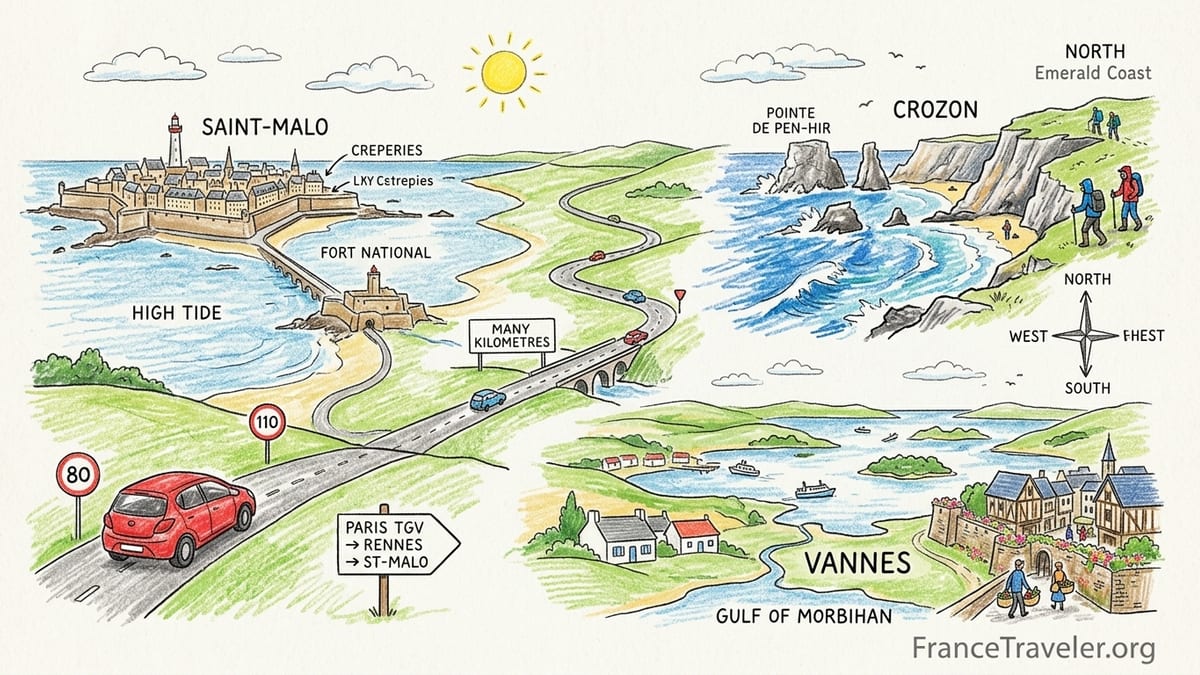
How I Structured the Trip (And What I Got Wrong)
My route started in Saint-Malo because it was the easiest point to reach without a car. From Paris Montparnasse, fast TGV trains run to Rennes in around 1 hour 30 minutes, with a regional connection to Saint-Malo taking about 55 minutes after that, so I was in Brittany by mid-afternoon. From Saint-Malo station, I picked up a compact rental car and set up my first base inside the walled old town, trading parking headaches for the pleasure of walking the ramparts at night when day-trippers had left.
Across eleven days I used three main bases: Saint-Malo on the Emerald Coast in the north, Crozon out on the western Finistère peninsula, and Vannes on the sheltered south coast near the Gulf of Morbihan. In between, I did day trips to nearby places such as Dinan on the Rance river, Cancale, and a long push to Quimper that, in retrospect, I would not repeat. On paper it looked efficient. On real roads, with 80 to 110 km speed limits and frequent two-lane sections, it often meant more time behind the wheel than by the water.
Part of the problem was how I planned. I booked my bases based on mileage rather than realistic driving time. For example, distances between some well-known coastal spots such as Perros-Guirec, Paimpol and Crozon can be more than 120 to 170 kilometres once you follow actual roads, which typically translates to at least two hours of driving. I assumed that two places that shared the same romantic coastline name would be natural day-trip partners. In reality, official Brittany tourism itineraries treat them as stops on multi-day routes precisely because of how spread out they are.
Changing bases three times in eleven days also turned out to be one base too many. Packing, checking out, driving several hours and checking in again consumed most of two full days. If I were planning for a friend, I would recommend a maximum of two bases for a ten or eleven day trip, or even a single base for a week along either the north or the south coast, rather than trying to “collect” both.
Saint-Malo and the Emerald Coast: Walled Cities and Tides That Matter
Saint-Malo was my introduction to how dramatically Brittany’s tides shape daily life. The Bay of Saint-Malo experiences some of the highest tidal ranges in Europe. At low tide the sea retreats hundreds of meters, revealing broad wet sand flats and tidal pools along Plage du Sillon. At high tide, waves can slap directly against the sea wall and cut off access to small islets just offshore. The first evening, I nearly walked out to the Fort National without checking tide tables; a local couple gently pointed out that the incoming tide could surround the causeway in under an hour.
Inside the ramparts the mood felt more urban than I had expected. The old corsair city is dense with creperies, busy terrace bars and seafood restaurants touting plateau de fruits de mer with local oysters from Cancale. In early June, most kitchens opened for lunch roughly between 12:00 and 14:00 and again for dinner from about 19:00, with a noticeable lull in the late afternoon. I learned the hard way that arriving hungry at 15:30 typically meant surviving on a kouign-amann pastry from a bakery rather than a sit-down meal.
Driving and parking around Saint-Malo demanded more planning than in smaller Breton towns. The streets immediately outside the walls had narrow lanes and dedicated resident zones. I quickly discovered it was easier to use one of the designated parking lots a short walk from the old town and leave the car there for the day, especially when taking side trips by bus or on foot. On a cloudy day I walked across the Rance estuary ferry to Dinard, timing it with the tide for the best views of villas and moored boats, and another day I drove inland to Dinan, where the character of Brittany shifted from maritime to medieval.
Dinan, perched above the Rance river, felt like a different region entirely. Half-timbered houses leaned over cobbled streets, and from the port below I followed a towpath lined with houseboats and cyclists. Here, the tide still mattered for the appearance of the river but less for everyday logistics than in Saint-Malo. The atmosphere in the evening was quieter, too. By around 21:30 on a weekday, most non-restaurant businesses had shuttered and side streets felt almost village-like, a contrast to Saint-Malo’s late-night buzz inside the walls.
West into Finistère: Wind, Cliffs and the Long Roads to Crozon
From the Emerald Coast I drove west toward Finistère, the “end of the land,” trading walled bastions for raw headlands and longer distances. The drive from the Saint-Malo area to Crozon required around four hours once coffee stops and slower stretches were included. Crossing Brittany this way highlighted the region’s scale; there is no continuous clifftop corniche but rather a web of national routes and local roads connecting inland towns, ports and peninsulas.
Crozon itself, set on a peninsula between Brest roadstead and Douarnenez Bay, felt exposed and elemental. Thick hydrangea hedges framed roads that often ran close to high cliffs. At Pointe de Pen-Hir, I walked out along a gravel path to a viewpoint where the Atlantic crashed against rock stacks, the wind strong enough to whip spray into the air. Even in early summer, a waterproof layer was essential. Rain showers blew in quickly, sometimes lasting only twenty minutes but intense enough to drench anyone caught on an unprotected stretch of path.
This was where my map mistakes became clearest. On a flat map, Perros-Guirec on the Pink Granite Coast and Crozon look like neighbours along the same north-facing edge of Brittany. On the ground, cutting from one to the other would take roughly two hours or more of driving each way, across a mix of dual carriageways and slower local routes. I had originally sketched a day trip that linked Crozon and the Pink Granite Coast in a single loop. Facing the real distances, I abandoned that idea and focused on exploring closer headlands such as Cap de la Chèvre and small beaches like Morgat instead.
Non-coastal experiences in Finistère were quieter but just as memorable. One cloudy morning I drove inland to the Parc naturel régional d’Armorique and walked in the Monts d’Arrée hills. Here, heather-covered slopes and scattered boulders framed small lakes and bogs. The wind that felt bracing on the cliffs became a steady inland breeze, and for long stretches I saw more sheep than people. It was the first time on the trip the sea disappeared from view, and it reinforced how much of Brittany is forest, farmland and moor rather than just a string of seaside resorts.
South Coast Base: Softer Light around Vannes and the Gulf of Morbihan
My final base was Vannes, on the south coast, a drive of around three hours from Crozon when traffic was light. Shifting here, I realized how wrong it had been to treat north and south Brittany as one compact destination. Vannes opened onto the Gulf of Morbihan, a large sheltered inlet dotted with dozens of small islands, with a far milder feel than the cliffs of Finistère. The water was calmer, the light softer, and the coast broke into sandy coves and low rocky points instead of high dramatic headlands.
In Vannes’ walled old town, timbered facades and flowered ramparts framed a tight grid of lanes that became pleasantly pedestrian in the evenings. Here again, restaurant schedules dictated rhythm. Lunch service was busiest between 12:30 and 13:30, dinners rarely started before 19:00, and outside those windows many kitchens simply closed rather than offering all-day dining. One misjudged afternoon, I returned from a boat trip around the gulf at 16:00 expecting to find a hearty late lunch, only to be turned away by multiple brasseries preparing for evening service. I learned to carry a snack from the morning market whenever ferries or longer outings were involved.
Island travel in the gulf added another layer of timing. Ferries to popular islands such as Île-aux-Moines and Île d’Arz usually depart from nearby ports like Port-Blanc or Vannes itself, following published timetables that vary between high and low season. While crossing times are short, often under half an hour, missing a return sailing can mean waiting more than an hour for the next one, especially outside peak summer. On Île-aux-Moines I cycled along narrow lanes lined with stone walls and low whitewashed houses, the atmosphere almost Mediterranean compared to Crozon’s Atlantic mood.
South of Vannes, the broader Atlantic coast felt calmer too. Around the Presqu’île de Rhuys and near Quiberon, beaches were longer, often backed by dune systems with boardwalk access. Yet the same tidal logic applied. Wide sandy bays that were perfect for swimming a couple of hours either side of high tide turned into ankle-deep shallows or long walks to the water at low tide. On one beach day near Sarzeau, I arrived at midday to an inviting high-tide swim, then returned after a leisurely lunch in town to find the sea had retreated far into the distance, transforming the scene.
Weather, Tides and Daily Logistics You Actually Feel
What surprised me most on this trip was how much weather and tides structured each day. Brittany’s maritime climate meant I could experience bright sun, steady drizzle and gusty wind in a single afternoon. In Crozon, forecast apps would show a rainy icon for the day, yet the reality was often alternating short showers and clear spells. I learned to treat any patch of blue sky as a cue to head for a headland or beach walk, keeping a light waterproof jacket and a dry bag in the car.
Tides were not just a curiosity but a real planning factor. On the north coast, visits to islets, causeways and some beaches depend heavily on tide times. Access to small islands off Saint-Malo, and even the appearance of classic coastal views along the Emerald Coast, changes dramatically between high and low water. In the south, the Gulf of Morbihan’s channels run with strong currents as the tide squeezes through narrow openings. Boat operators time departures with these flows, and kayakers often plan outings around the gentler mid-tide periods.
Parking also shifted with the character of each destination. In Saint-Malo and Vannes, paid parking zones close to the historic centers were common, with better value in car parks a 10 to 15 minute walk away. In smaller coastal villages and along scenic stretches of the GR34 coastal path, parking was usually free but limited. Popular trailheads near headlands might have a small gravel lot that filled by late morning, especially on weekends, pushing late arrivals further down narrow lanes where turning around could be awkward.
Road distances were another daily reality. National routes along the north and south coasts connect major cities efficiently, but many of the most beautiful spots sit at the end of peninsulas or along smaller departmental roads. A nominal 100 kilometre drive could take two hours once you factored in slower sections through villages, tractors on rural stretches and short photo stops. The long coastline invites the fantasy of “hugging the shore,” but in practice you are often moving inland and out again like a comb, especially when linking different coastal areas in one trip.
Small-Town Rhythms, Restaurant Hours and When Places Go Quiet
Brittany rewarded early arrivals and punished late ones, especially in smaller towns. In Crozon and nearby villages, mornings started slowly. Bakeries opened for bread and pastries, but many other shops waited until around 10:00. By contrast, evenings in places without a strong nightlife scene could become very quiet by 21:30, particularly outside July and August. After dinner, village squares that had felt lively at 19:00 emptied quickly, with only a few bar terraces still open.
Restaurant schedules followed a broadly similar pattern across the region. In Saint-Malo and Vannes, there were always a few brasseries or creperies serving at nearly any time, but even there the best-regarded places kept to set services. Booking ahead for Friday and Saturday dinners proved useful, especially for seafood restaurants with limited seating. In smaller coastal towns, I found that failing to sit down by 13:30 for lunch could mean having to piece together a picnic from a supermarket instead.
Beach access also had its own rhythms. In many spots, especially along the Emerald Coast and around Crozon, parking areas sat above the shoreline, with access via steps or steep paths. Carrying less and wearing proper footwear mattered more than on flat resort promenades elsewhere in France. In a few places with dramatic scenery, such as coves backed by cliffs, signage reminded visitors to be mindful of rockfall and to avoid lingering close to eroding faces, another small reminder that this is an active coastline, not a manicured theme park.
One pleasant surprise was how much space you can still find outside peak weeks. In early June, even well-known viewpoints in Finistère felt busy but not overwhelmed, and on overcast days I sometimes had entire stretches of coastal path almost to myself. However, locals consistently warned me that August changes the equation, with heavier traffic, fuller car parks and more competition for restaurant tables, especially in famed areas like the Pink Granite Coast and around Saint-Malo.
Dislikes, Missteps and Why Scale Matters in Brittany
As striking as Brittany was, not everything worked. My biggest dislike was spending so much time in the car. By trying to sample north, west and south coasts in one trip, I turned several days into long, slightly stressful transfers. A more focused itinerary would have meant trading three or four “seen it” pins on a map for more relaxed, repeated walks along a single favourite stretch of coast.
I also underestimated how different two things that look adjacent on a map can feel in real life. The official regional itineraries that promote “Brittany by the sea” often highlight famous stretches in a single brochure: the Emerald Coast around Saint-Malo, the Pink Granite Coast dotted with lighthouses, the deep bays of Finistère and the gentler south around the Gulf of Morbihan. In practice, each of those zones can easily absorb three or four days of slow travel on its own. Trying to link places like Perros-Guirec, Paimpol, Saint-Malo and Crozon in a single short week, as some sample routes suggest, would mean almost constant motion.
Another mistake was planning a couple of outings around low tide views without thinking about what that did to swimming and general atmosphere. On the south coast, arriving at Carnac or Quiberon when the sea had pulled back left wide expanses of damp sand and seaweed. It was photogenic in its own way but less appealing for beach time. The opposite happened once in Saint-Malo, where I targeted a high-tide walk to watch waves but discovered that a favourite sandy cove simply disappeared under water at peak tide, leaving no place to sit at all.
Finally, I underestimated the cumulative effect of small-town quiet. I enjoy peaceful evenings, but after several nights in Crozon and smaller villages, I felt ready for the slightly more sustained buzz of Vannes or Saint-Malo. Travelers who want bars open late into the night every day might prefer to base in the larger towns and visit smaller places by day, rather than the other way around.
The Takeaway
By the time I boarded my return train from Vannes, Brittany had shaken off most of my preconceived ideas. It was not one endless line of similar beaches but a mosaic of distinct coasts and inland pockets: walled Saint-Malo trading on corsair history and enormous tides, river towns like Dinan leaning into half-timbered charm, Finistère’s western peninsulas offering rugged wind and long horizons, and the south coast around Vannes turning soft and sheltered, with island-studded waters suited to slow ferry days.
If I were planning the same amount of time again, I would change the structure. With about eleven days, I would choose just two bases instead of three. One option would be five or six nights around Saint-Malo or Dinan to explore the Emerald Coast and nearby inland towns, followed by five nights around Crozon or further west in Finistère for hiking and wild headlands. Another would be a week based near the Pink Granite Coast and a shorter stay around Vannes to experience the Gulf of Morbihan and a taste of south-coast beaches.
The key lesson is to respect Brittany’s size and its rhythms. Build days around tide tables and restaurant hours, allow more time between coastal areas than raw kilometres suggest, and accept that sudden rain and wind are part of the story. Do that, and the long drives shrink, the small frustrations fade, and the region’s variety becomes its greatest asset, turning what could have been a rushed checklist into a genuinely layered journey.
FAQ
Q1. How many days do you really need for a first trip to Brittany?
For a first visit focused on one part of the region, a week is comfortable. If you want to experience both a northern area such as Saint-Malo or the Pink Granite Coast and a western or southern area like Crozon or Vannes, ten to twelve days allows you to travel at a more relaxed pace.
Q2. Is it possible to visit Brittany without renting a car?
You can reach major towns such as Rennes, Saint-Malo, Vannes and Quimper by train and use local buses or occasional boats, but many of the most scenic headlands and small beaches are difficult to access without a car. For maximum flexibility, especially in Finistère and on peninsulas, driving is highly practical.
Q3. How far apart are the main coastal areas in Brittany?
Distances are longer than they look on the map. Drives between well-known coasts such as the Pink Granite Coast and the Crozon Peninsula can take around two hours or more, and crossing from Saint-Malo on the Emerald Coast to the western or southern shores can easily fill half a day with stops.
Q4. What is the best season to travel in Brittany for this kind of trip?
Late spring and early autumn often offer a good balance of milder weather, lighter crowds and open services. July and August bring warmer conditions and more ferries and activities but also busier roads, fuller car parks and higher accommodation prices.
Q5. How important is it to check tide times when visiting Brittany?
Tide times are very important on the north coast and around island causeways, and still relevant in the south. They affect beach size, the safety of walking to islets and the character of views in places such as Saint-Malo, Cancale and the Gulf of Morbihan.
Q6. Are small Breton towns lively at night?
Larger towns like Saint-Malo and Vannes can stay active into the evening, especially in summer. Smaller inland or coastal villages often become very quiet by around 21:30 outside peak season, with restaurants and shops closing early and only a few bars open later.
Q7. What should I pack for the weather in Brittany?
Even in summer, it is wise to bring layers, including a light waterproof jacket, a warm sweater and shoes suitable for wet paths. Weather can shift quickly from sun to showers, particularly along exposed coasts in Finistère.
Q8. Is swimming comfortable in Brittany’s Atlantic waters?
The sea is generally cooler than in southern France but can be pleasant for swimming in late spring and summer, especially on sheltered south-coast beaches. Water temperatures vary by year and location, so checking recent local reports before planning long swims is sensible.
Q9. How early should I book accommodation and restaurants?
For July and August, booking accommodation several months ahead is prudent in popular areas. Outside peak season, you have more flexibility but it is still wise to reserve Friday and Saturday dinners in well-known restaurants, particularly in compact old towns.
Q10. If I have only one week, should I try to see both north and south Brittany?
With just a week, it is usually better to focus on either the north and west coasts or the south, choosing one base or two close bases. Trying to include both Saint-Malo and the Gulf of Morbihan in seven days tends to create rushed transfers and less time enjoying the places you came to see.