


Brittany is not a place to "do" in two hurried days between Paris and Mont Saint-Michel. It is a varied region about the size of Belgium, with fast trains linking a handful of cities and slower roads threading through fishing ports, pink-granite headlands and quiet inland valleys. Choosing the right base or combination of bases is the single decision that will shape your trip more than any specific hotel. This guide focuses on picking the best areas to stay. A separate guide can help you choose the exact property once you know your strategy.
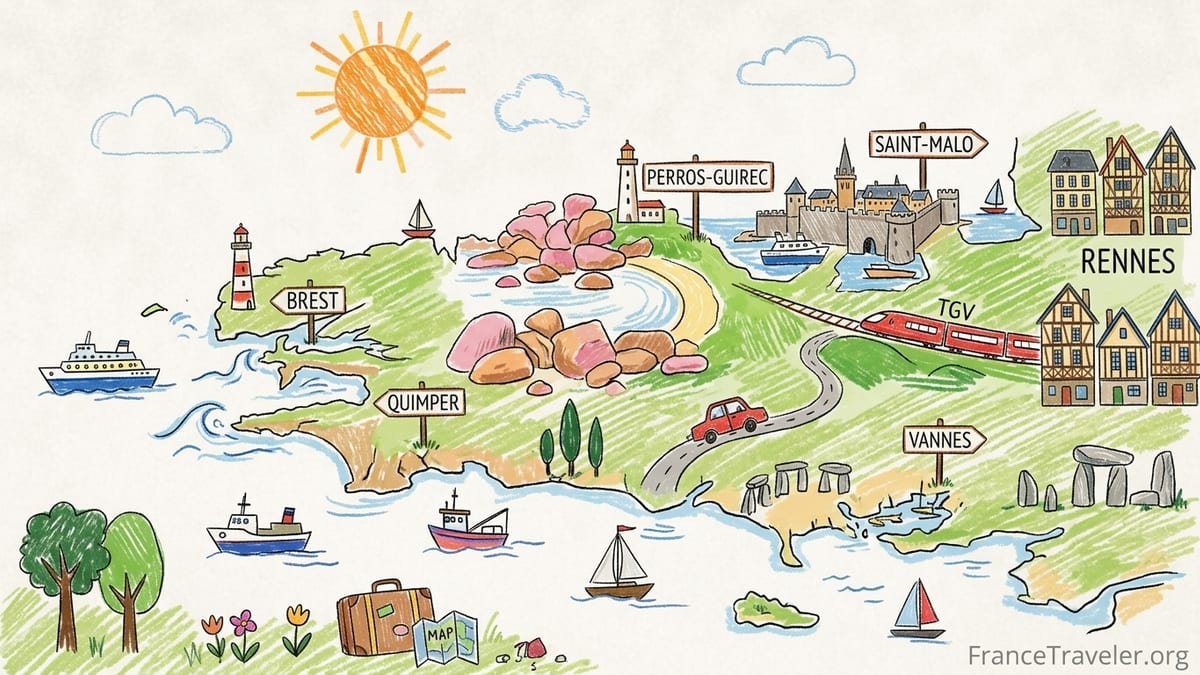
How to Think About Bases in Brittany
Brittany’s rail backbone runs west from Rennes towards Brest and Quimper, with a northern spur to Saint-Malo and coastal TER lines and buses filling in the gaps. High-speed TGVs from Paris reach Rennes in about 1 hour 30 minutes and continue toward Saint-Malo, Brest and Quimper, while regional TER BreizhGo trains and buses connect cities such as Vannes, Lorient and smaller hubs like Lannion and Auray. This means some areas work very well without a car, while others are best explored with at least a few days of rental.
For most trips you will combine one practical arrival hub, such as Rennes or Saint-Malo, with one or two scenic coastal or rural bases. A traveler flying into Paris might, for example, take a TGV straight to Rennes for a night, continue by train to Saint-Malo for the Emerald Coast, then rent a car in Vannes to explore the Gulf of Morbihan and southern beaches. Another traveler might skip cities entirely and spend a week between Perros-Guirec on the Côte de Granit Rose and an inland village on the edge of the Brocéliande forest.
Throughout this guide, the focus is on the strengths and trade-offs of each geographic base: how you arrive, whether a car helps, what the evening atmosphere feels like, and which day trips are realistic. When you see a base you like, note it for your route planning. Then, when you are ready to book, you can look at a separate hotel guide covering specific addresses, price ranges and styles.
As you read, keep your total trip length in mind. A single base works for a relaxed five-day stay, two bases are ideal for a week, and three bases begin to make sense from ten days upward. Because Brittany is compact but not tiny, constantly changing hotels to chase every lighthouse wastes precious time you could spend walking a harborfront or lingering over a seafood platter.
Rennes: Efficient Arrival Hub and Urban Base
Rennes is Brittany’s capital and its best-connected rail hub, with frequent TGVs to and from Paris and through trains onwards to Brest, Quimper and Saint-Malo. Journey times from Paris Montparnasse to Rennes are typically around 1 hour 30 to 1 hour 40, and onward trains to Saint-Malo take about 55 minutes. Trains west to Brest or Quimper usually take around 2 hours 30 to 3 hours depending on the service. These times can shift slightly by season, but they give a good sense of how compact the rail journey is once you reach Rennes.
As a base, Rennes works well if you want urban energy, restaurants and nightlife at the start or end of your trip. The historic centre has half-timbered houses, a large Saturday market on Place des Lices, and a student population that keeps bars and bistros busy most evenings. You can arrive from Paris in the late afternoon, walk to your hotel or tram in from the station, and be sitting on a terrace with a galette and cider within an hour of your train pulling in.
Without a car, Rennes is one of the easiest places to stay in Brittany. The station is a short walk from the centre, and onward day trips are straightforward. Popular options include Saint-Malo by direct train for a full day on the Emerald Coast, Vannes for a sampler of the Gulf of Morbihan, or even Brest or Quimper if you accept longer rides. With a rental car, Rennes is less compelling as a long base because you will often drive back and forth along the same arteries to reach the coast.
In practice, Rennes makes sense for 1 or 2 nights at most. Use it as an arrival buffer if you land in Paris in the morning and do not want to drive jetlagged, or as a final night before an early TGV back to Paris. For a longer stay of 4 nights, most travelers will be happier based by the sea or nearer the Gulf of Morbihan, coming into Rennes just for a day trip if they want museums or shopping.
Saint-Malo and Dinard: Gateway to the Northeast Coast
The northeast corner of Brittany, often called the Emerald Coast, centres on the walled corsair city of Saint-Malo and the elegant seaside resort of Dinard across the Rance estuary. Saint-Malo is easily reached by direct train from Rennes, often in under an hour, which makes it an excellent first coastal base if you prefer to stay car-free. The pedestrian old town sits right by the station-area bus links, so you can roll your suitcase across cobbles instead of navigating ring roads.
Saint-Malo combines sweeping beaches, a complete circuit of ramparts, and an active ferry port. From here, seasonal sailings link to the Channel Islands such as Jersey and Guernsey and to the UK, and there are short coastal cruises along the Rance and around nearby capes. Day-trip options without a car include Dinard by bus or boat shuttle, Cancale for oysters, or even Mont Saint-Michel with organized excursions that bundle transport and tickets. In the evening, the intramuros streets fill with diners choosing between creperies, brasseries and seafood places, so you can treat it as a compact mini-city.
Dinard, just across the estuary, feels quieter and more resort-like, with Belle Epoque villas, coastal walks and family-friendly beaches. It works best if you have a car or are happy to juggle buses and boat shuttles, since long-distance trains serve nearby Saint-Malo rather than Dinard itself. Couples looking for a less touristy feel than Saint-Malo’s walled core sometimes prefer to stay in Dinard, making day trips back to Saint-Malo instead of the other way round.
For trip length, Saint-Malo or Dinard work well for 2 to 4 nights. With two nights you can walk the walls, take a boat or bus to Dinard, and fit in a half-day excursion to Cancale. With four nights you have time for a Channel Islands day trip with an early morning ferry and late return, weather permitting, and perhaps an inland detour to medieval Dinan. If you only have one night, Saint-Malo still functions as a dramatic introduction to coastal Brittany, though you will barely scratch the surface.
Perros-Guirec and the Côte de Granit Rose
The Côte de Granit Rose, or Pink Granite Coast, is one of Brittany’s most photographed stretches of shoreline, known for rounded pink boulders and turquoise coves between Perros-Guirec and Ploumanac’h. It is less directly connected by rail than Saint-Malo, which is why it often suits a second or third base rather than a first stop. The usual rail gateway is Lannion, reached by TER from Saint-Brieuc or Guingamp. From Lannion, local buses link to Perros-Guirec in around 30 to 40 minutes, and in summer there may be additional seasonal services and long-distance buses from Paris.
Because of these connections, the area is technically feasible without a car but easier if you can drive. With a vehicle you can hop between beaches, short sections of the GR34 coastal trail, and small harbors such as Trébeurden, Trégastel and Ploumanac’h in a single day. Without a car, you will focus more on walking out and back from your base and using buses where they exist. Many visitors choose Perros-Guirec as their base because it has a cluster of hotels and restaurants, including places overlooking the sea and the marina, while still giving easy access by bus or short drive to the most scenic granite formations around Ploumanac’h.
Evenings on this part of the coast are quieter than in Saint-Malo, especially outside July and August. Expect relaxed dinners with sea views or village squares rather than bar-hopping. This makes the Côte de Granit Rose a good choice for travelers who prioritise walking, photography and coastal scenery over nightlife. Restaurant choice is still solid, but you might have ten options within a short walk instead of thirty.
The Côte de Granit Rose works particularly well as a 2 to 4 night base. Two nights give you one full day to hike a section of the GR34, perhaps from Perros-Guirec through Ploumanac’h and back, and another day for beaches or a boat trip out to the Sept Îles bird reserve, which often departs from Perros-Guirec in season. With four nights you can add side trips to Lannion’s old town, further west towards Morlaix, or inland villages, and still leave time for lazy afternoons on the sand.
Brest, Crozon and Quimper: Western Brittany and Finistère
Western Brittany, in the department of Finistère, feels wilder and more remote than the northeast coast, with deep bays, lighthouses and long Atlantic swells. The two main rail-served cities are Brest in the north and Quimper further south. Both are reached by TGV or Intercités trains from Rennes, typically in about 2 hours 30 to 3 hours. From there, regional TER and bus lines continue to smaller towns and peninsulas, including the Crozon peninsula which sits roughly between the two.
Brest is a substantial working port and university city rather than a pure resort. As a base it offers good public transport, an oceanographic attraction at Océanopolis, and access to the northern stretches of the GR34 along the goulet, as well as ferries across the harbor to small communities. It suits travelers who like a maritime atmosphere and do not mind a more modern skyline. Without a car, Brest is the easier choice in western Finistère because of its rail and bus links, including trains and TER BreizhGo services along the coast towards Morlaix and inland towards Quimper and Vannes.
Quimper, by contrast, is a pretty historic town on the Odet river, with a Gothic cathedral, half-timbered houses and a compact medieval core. It has direct trains east to Rennes and south along the coast towards Lorient and Vannes, and buses out to seaside towns such as Bénodet. As a base, Quimper is excellent for combining small-city comforts with day trips to sandy beaches, fishing ports like Concarneau, and inland villages. In the evening you will find a good choice of creperies and bistros but a calmer nightlife than Brest.
The Crozon peninsula, often accessed by car from either Brest or Quimper, offers some of Brittany’s finest coastal scenery, from the cliffs at Cap de la Chèvre to sheltered beaches like Morgat. Public transport exists but is limited, so most visitors rent a car to stay in Morgat or nearby villages and then drive to trailheads and viewpoints. You can also treat Brest or Quimper as your rail hub and base yourself on Crozon if you are prepared for one longer transfer at the start and end of your stay.
For stays of 2 to 4 nights, Brest or Quimper both make sense depending on your priorities. If you want urban energy and do not plan to rent a car, lean towards Brest. If you prefer a historic centre and plan to rent a car for day trips to the coast, Quimper is very attractive. A four-night stay based on Crozon makes sense mainly for hikers and coastal scenery lovers with a car, who are comfortable having fewer restaurant choices in return for easier access to wild headlands and surf beaches.
Vannes and Auray: Gulf of Morbihan and Southern Brittany
Southern Brittany curves around the sheltered waters of the Gulf of Morbihan between Vannes and Auray to the north and peninsulas such as Arzon and Sarzeau to the south. The gulf itself covers roughly 40 square kilometres and is dotted with dozens of islands and islets, forming one of France’s most celebrated inland seas. Vannes is the primary urban base here, with a well-preserved old town and a rail station on the main Rennes to Quimper and Brest line.
Vannes is straightforward to reach by train. From Rennes, direct services run throughout the day, often taking around 1 hour 30. From Paris, most travelers connect in Rennes, with total journey times typically around 3 hours 15 to 3 hours 30. Once in Vannes, you can walk from the station to the walled old town, then on to the small harbor in about 15 to 20 minutes. From the harbor, boats operate cruises around the Gulf of Morbihan and out to islands such as Île-aux-Moines. These boat trips vary by season, with denser schedules in late spring and summer.
It is important to understand that Vannes itself is not a traditional oceanfront resort with long surf beaches. The town sits at the head of the gulf, with sheltered, often shallow water and small local beaches on nearby peninsulas. To find larger Atlantic-facing beaches such as those near Carnac, Quiberon or Erdeven, you will usually take a train or bus west to Auray or Plouharnel, then continue by local bus or car. Many visitors choose Vannes for its restaurants, medieval streets and easy access to gulf boat trips, then travel out to beaches for day excursions.
Auray, one stop west of Vannes on the main line, is smaller and quieter, with the postcard harbour of Saint-Goustan a short walk from the modern station area. As a base it offers a more village-like feel and slightly closer access by road and bus to the beaches around Carnac and the Quiberon peninsula. Rail connections are still good, with regular TER and TGV trains linking Auray to Rennes, Vannes, Lorient and Quimper. Car rental options are more limited than in Vannes, so if you plan to drive, check availability in advance.
For a car-free traveler, Vannes makes an excellent 3 to 4 night base. You can combine one or two days of gulf cruises and island visits with a day trip west to Auray and Carnac to see megalithic stone alignments and nearby beaches reached by local buses or taxis. If you have a car, Auray or a village between Auray and Carnac can be even better for a week, letting you reach surf beaches, small islands and the gulf within short drives. Either way, this part of Brittany rewards slower travel, with time built in for boat trips, picnics on islands and evenings lingering along the harbors.
Inland Towns and Forests: Slower Rural Bases
While Brittany’s coasts attract most visitors, an inland base can give your trip a very different rhythm. The area between Rennes and the Morbihan coast is dotted with small towns, rivers and woodlands, including areas linked in local lore to the Arthurian forest of Brocéliande. These rural bases suit repeat visitors, slow travelers and anyone who values quiet lanes, stone farmhouses and village markets as much as sea views.
Smaller inland towns are usually best combined with a car, since rail services tend to focus on the main Rennes to Brest and Rennes to Quimper corridors. That said, some bus routes link Rennes with Brocéliande-area villages and with historic inland towns. Once you are settled in a rural gîte or bed-and-breakfast, you can spend days walking in nearby forests, visiting chapels and standing stones, and making slower drives out to either coast for the day. Shopping is centred on weekly markets and a handful of supermarkets rather than big-city malls.
Because evenings are so low key in these areas, an inland or forest base works best as part of a longer trip rather than your only destination. One approach is to start with three or four nights on the coast, for example in Saint-Malo or Vannes, then move inland for three nights of quiet walks and reading by a fire. Another is to stay a full week in a countryside rental house with a car, treating both coasts as day-trip territory. In either case, plan your arrival carefully so you do not attempt narrow country lanes after an overnight flight and long drive.
In terms of stay length, an inland base can feel too quiet for just a single night. Aim for at least two nights, ideally three or four, so that you can adapt to the slower pace. Check practical details in advance, such as whether your rental includes bicycles, how far the nearest bakery and supermarket are, and which days local markets run. Unlike coastal cities where last-minute dining is easy, rural areas reward a bit of planning.
How Long to Spend in Each Base
Thinking in terms of one base per region keeps your route realistic and enjoyable. As a rough guide, major arrival hubs like Rennes are often best for 1 or 2 nights, northeast coastal bases like Saint-Malo or Dinard for 2 to 4 nights, scenic coasts such as the Côte de Granit Rose for 2 to 4 nights, and the Gulf of Morbihan or southern Brittany for 3 to 5 nights. Western Brittany around Brest, Quimper or Crozon can absorb anything from a quick 2-night taste to a full week for walkers and surfers.
When you match this with your interests and transport choices, patterns appear. A traveler arriving by train who does not want to rent a car could combine 1 night in Rennes with 3 nights in Saint-Malo and 3 nights in Vannes, prioritising walkable city centres, boat trips and a handful of bus-based excursions. Someone keen on hiking might choose 4 nights on Crozon, 3 nights on the Côte de Granit Rose and skip larger cities almost entirely, using a rental car to bridge the gaps between rail lines and trailheads.
Day-trip radiuses also affect your decision. From Saint-Malo you can comfortably reach Dinard, Cancale, Dinan and even Mont Saint-Michel. From Vannes you can explore the Gulf of Morbihan by boat and reach Carnac and Quiberon by road or train plus bus. From Quimper, Concarneau, Bénodet and several Atlantic beaches fall within a short drive. If you find yourself tempted by day trips that require more than 2 hours of travel each way, consider adding another base instead.
The key is to resist the urge to see all of Brittany from a single point. Distances on the map may look modest, but coastal roads slow you down and there is always another tempting chapel, point or village to explore. Decide which two or three coastal characters appeal most emerald northeast, pink granite north, wild Finistère west or gentle Morbihan south and let those shape your base strategy before you commit to individual hotels.
Sample Base Combinations for 5, 7, 10 and 14 Days
For a 5-day trip focused on trains, one efficient plan is to begin with 1 night in Rennes and then 4 nights in Saint-Malo. Arrive in Rennes from Paris, stretch your legs in the old town and recover from travel. Next day, take the short train to Saint-Malo and spend three full days on the coast. Use one for the walled city and beaches, one for Dinard and Cancale, and one for a boat excursion or day trip further afield. This keeps hotel changes to a minimum while still giving variety.
For a 7-day trip, you can add southern Brittany. One option is 2 nights in Saint-Malo, followed by 3 nights in Vannes and a final 2 nights in Rennes or back in Paris. From Vannes, use one day for a cruise on the Gulf of Morbihan with island stops and another for a rail or car trip toward Carnac, Auray and nearby beaches. If you prefer the north coast, swap Vannes for Perros-Guirec, using trains to Lannion and a connecting bus to reach your base on the Côte de Granit Rose.
A 10-day itinerary allows you to layer in western Brittany. Consider starting with 2 nights in Rennes and Saint-Malo, then 3 nights around Perros-Guirec for the pink granite coast, followed by 3 or 4 nights in Quimper or on the Crozon peninsula. With a rental car, you can drive between these bases without looping back to Rennes, stopping in villages and small harbors along the way. If you remain car-free, focus on rail-linked towns such as Saint-Malo, Lannion, Brest and Quimper and accept that you will see a slightly narrower set of coastal viewpoints.
For a 14-day stay, think of Brittany in three or four chapters. One strong pattern is 3 nights in Saint-Malo or Dinard, 3 nights on the Côte de Granit Rose, 4 nights in Quimper or Crozon for western Finistère, and 4 nights in Vannes or Auray for the Gulf of Morbihan and southern beaches. Another is to mix coast and countryside more explicitly, for example 4 nights in Vannes, 3 nights on Crozon, 3 nights inland near Brocéliande, and 4 nights in Saint-Malo. Both approaches give you time to slow down, repeat favorite walks and fit in a few weather-dependent boat trips without pressure.
The Takeaway
Picking the right base in Brittany is less about chasing a single famous sight and more about matching transport, atmosphere and day-trip options to your style of travel. Rennes is the obvious rail gateway and a convenient place to catch your breath, but the real character of Brittany comes through once you settle in along the Emerald Coast, on the pink granite headlands, in western Finistère or beside the calm waters of the Gulf of Morbihan. Each of these areas rewards at least a few unhurried nights, and each suggests different combinations for 5, 7, 10 or 14-day trips.
This article has focused on choosing regions and towns rather than specific hotels or guesthouses. Once you have decided that Saint-Malo, Perros-Guirec, Quimper or Vannes fits your needs, the next step is to look at detailed accommodation guides that compare concrete properties, from simple seaside apartments to historic manor houses. With your base strategy in place, those choices become far easier: you will know that what matters is not just the room, but the set of day trips, walks and ferry rides that begin at your front door.
FAQ
Q1. Can I visit Brittany without renting a car?
Yes, if you base yourself in rail-connected towns like Rennes, Saint-Malo, Brest, Quimper, Vannes or Auray, you can see a lot using trains, TER BreizhGo services, local buses and organized excursions, especially from April to October.
Q2. Which base is best for a first short trip to Brittany?
For a first 4 to 5-day trip, Saint-Malo works very well because it combines easy train access from Rennes, dramatic coastal scenery, a walkable historic centre and straightforward day trips to Dinard, Cancale and Mont Saint-Michel.
Q3. Is Rennes worth staying in or should I just connect through?
Rennes is worth at least one night, particularly if you arrive from Paris in the afternoon or evening. It offers a lively old town, good restaurants and one of France’s largest weekly markets, but for a longer stay most travelers prefer to continue to the coast.
Q4. How many bases should I plan for a one-week trip?
For seven days on the ground, two bases are usually ideal. A common pattern is to start with 2 or 3 nights on the northeast coast around Saint-Malo or Dinard, then spend 4 or 5 nights in Vannes, Auray, Quimper or Perros-Guirec depending on your interests.
Q5. Which area of Brittany has the best beaches?
Brittany has fine beaches on all coasts, but many visitors gravitate to the Emerald Coast near Saint-Malo and Dinard, the pink granite bays around Perros-Guirec, and the southern shores near Carnac, Quiberon and the Gulf of Morbihan for slightly warmer, more sheltered swimming.
Q6. Where should I stay if I am interested in hiking the GR34 coastal path?
Good GR34 bases include Saint-Malo, villages around Cap Fréhel, Perros-Guirec and Ploumanac’h on the Côte de Granit Rose, and towns on the Crozon peninsula. These offer direct access to the trail plus lodging and food at the end of each walking day.
Q7. What is the best base if I am travelling with children?
Families often like Vannes or Auray for calmer waters and boat trips on the Gulf of Morbihan, or Perros-Guirec and Dinard for sandy beaches close to town. These bases offer easy walks, playgrounds and plenty of casual dining options.
Q8. Are Channel Islands day trips realistic from Brittany?
Yes, but they require early starts and are very weather-dependent. Ferries from Saint-Malo to Jersey or Guernsey can allow a long day ashore in season, but you should check current schedules and passport rules and keep flexibility in case of cancellations.
Q9. When is the best time of year to use Brittany’s coastal bases?
Late spring through early autumn, roughly May to September, offers the widest range of boat services, open restaurants and frequent public transport. July and August are busiest and book up early, while June and September can feel pleasantly lively but not overwhelmed.
Q10. How should I choose between Vannes and Auray as a Morbihan base?
Choose Vannes if you want a larger historic town with more restaurants, direct access to gulf cruises and easier car rental. Choose Auray if you prefer a smaller base closer by road to beaches like Carnac and the Quiberon peninsula, and you are comfortable with a quieter evening scene.