


The French Alps are home to some of the largest interconnected ski areas on the planet, and France’s tourism boards lean heavily on this fact. Names like Les Trois Vallées, Tignes–Val d’Isère, Paradiski or Portes du Soleil are brands in their own right, promising hundreds of kilometres of pistes and lift-linked valleys. But when you are planning a real trip with finite time and budget, those glossy superlatives quickly raise a simple question: which French mega-resort is actually best for you?
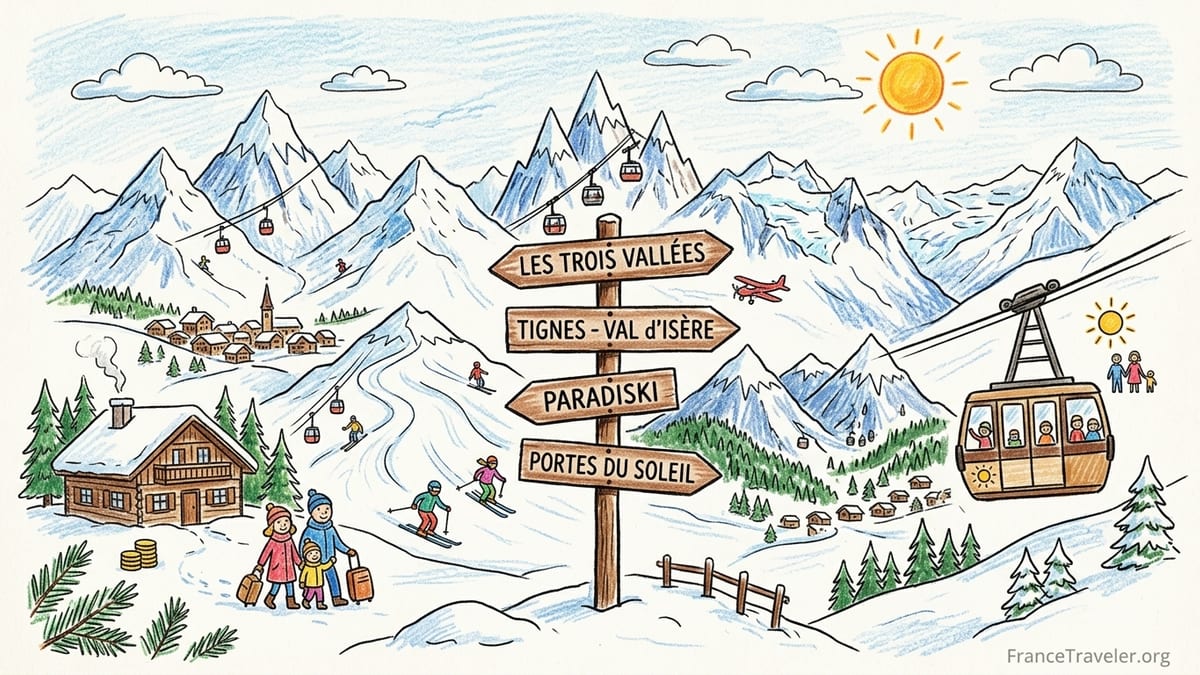
How the French mega-resorts compare overall
For this comparison we focus on nine of the most important French ski domains: Les Trois Vallées, Tignes–Val d’Isère, Paradiski, Portes du Soleil, Chamonix, Alpe d’Huez, Les Deux Alpes, Grand Massif and Serre Chevalier. These are the names that dominate international brochures and booking engines because of their size, lift infrastructure and brand recognition. All of them offer extensive skiing by North American standards and access to high alpine scenery, but they differ significantly in feel, price point and practicality.
On sheer ski-area size, the leaders are Les Trois Vallées and Portes du Soleil, both marketing about 600 kilometres of pistes spread across multiple valleys and villages, followed by Paradiski at around 425 kilometres. These three are the headline “giant” domains that France promotes heavily. Behind them, Tignes–Val d’Isère, Alpe d’Huez, Grand Massif, Les Deux Alpes and Serre Chevalier still offer more terrain than most visitors can cover in a week, while Chamonix stands apart as a collection of separate areas strung along the valley, famous more for big-mountain terrain than for interconnected piste mileage.
From a traveler’s perspective, that raw size only matters if it aligns with your priorities. A family aiming for easy greens and short walks from the accommodation has a different ideal resort from expert skiers chasing couloirs or a group of friends planning long après-ski sessions. In the sections below, each domain is compared against specific criteria that matter in practice: snow reliability, beginner terrain, advanced skiing, après-ski, village atmosphere, typical accommodation prices, airport transfer options and ski-in/ski-out convenience.
Ski-area size: where you get the most ground to cover
Les Trois Vallées is widely promoted as the largest lift-linked ski area in the world, with about 600 kilometres of pistes connecting Courchevel, Méribel, Les Menuires, Saint-Martin-de-Belleville, Val Thorens and Orelle. Most of this terrain is fully interconnected by lifts and pistes, allowing confident intermediates to ski from one end of the domain to the other in a day as long as they watch last-lift times. It is the obvious choice if your main goal is to ski a different route every run and you do not mind larger lift queues at peak times.
Portes du Soleil, straddling the French and Swiss border around resorts such as Avoriaz, Morzine and Les Gets, claims a comparable 600 kilometres of pistes and is marketed as one of the world’s two largest ski areas. In practice, some parts of the network feel more spread out, and snow conditions at the lower French villages can be more variable, but mileage-hungry intermediates can still spend days touring between France and Switzerland without repeating many runs.
Paradiski, which links Les Arcs, Peisey-Vallandry and La Plagne by the Vanoise Express cable car, sits just behind these two with about 425 kilometres of pistes. For most visitors that is still effectively limitless, and the way the terrain is laid out, with long top-to-valley runs and broad intermediate bowls, makes it particularly attractive for strong piste skiers. Tignes–Val d’Isère, sometimes still referred to as Espace Killy, offers a slightly smaller but very concentrated network of high-altitude pistes, including glacier terrain, that feels larger than the trail map suggests because of the vertical drop and off-piste options.
Alpe d’Huez, Grand Massif, Les Deux Alpes and Serre Chevalier all sit in the next tier, with ample piste kilometres for a week-long trip. Alpe d’Huez’s Grand Domaine spreads over several satellites like Auris-en-Oisans and Vaujany and is famous for the 16-kilometre Sarenne run. Grand Massif links Flaine, Samoëns, Les Carroz and other villages with wide intermediate terrain and big views of Mont Blanc. Les Deux Alpes offers one of Europe’s most accessible glaciers above a long ridge of pistes, while Serre Chevalier’s domain stretches along a south-facing valley above historic villages like Chantemerle and Monêtier-les-Bains.
Snow reliability and season length
Altitude and orientation are key to snow reliability in the modern Alps. Tignes–Val d’Isère and Les Trois Vallées both score highly here. Much of Tignes and Val d’Isère’s skiing lies above 2,000 metres, with glacier slopes reaching well over 3,000 metres. That high elevation, combined with extensive snowmaking, gives them some of the best late-season conditions in France and makes them safe bets if you are booking for April. Les Trois Vallées also keeps a large share of its pistes above 1,800 metres and backs this up with thousands of snowmakers, which helps maintain coverage even in lean snow years, especially in Val Thorens, Europe’s highest sizable resort.
Paradiski benefits from similar altitude advantages, particularly on the upper slopes of Les Arcs and La Plagne. Many of its main runs face north or north-west, which helps preserve snow quality. Portes du Soleil on the other hand is more mixed. Avoriaz, perched at around 1,800 metres on a cliff, often has very reliable snow, but lower villages like Morzine and Les Gets sit closer to 1,000 metres and can see rain during warm spells, especially at the start and end of the season. If you are set on Portes du Soleil and traveling in late March, staying in Avoriaz usually offers the best chance of skiing back to your door.
Alpe d’Huez, Les Deux Alpes and Grand Massif combine mid to high-altitude slopes with significant snowmaking. Les Deux Alpes in particular has glacier skiing that provides a safety net in milder winters and allows confident intermediates to ski year-round during limited summer openings. Serre Chevalier and Chamonix rely more on natural snowfall, though both have sizeable snowmaking networks on the main pistes. Chamonix’s higher lifts such as Grands Montets and the Aiguille du Midi access very high alpine terrain, but lower woodland runs can be thin in poor winters. For travelers booking peak winter months such as January and February, all nine areas usually offer good conditions; for very early or very late trips, the highest domains and villages become the more conservative choice.
Beginner and family-friendly terrain
For first-timers and progressing beginners, gentle slopes close to accommodation matter more than record-breaking piste mileage. In this respect, Alpe d’Huez and Grand Massif stand out. Alpe d’Huez has broad sunny nursery slopes directly above the main village and a network of easy green and blue runs that loop back to resort level, which is ideal for cautious skiers and children. Grand Massif’s Samoëns and Les Carroz sectors offer mellow tree-lined pistes with less intimidating gradients and an authentic village feel that many families appreciate.
Paradiski’s La Plagne is another strong contender for beginners. Its multiple altitude villages sit on a wide, mostly gentle plateau with plenty of blue runs and carefully designed learning zones, so learners can quickly progress to scenic circuits without feeling locked to a single nursery slope. Les Arcs has beginner areas too, notably around Arc 1800 and 2000, but some of its home runs feel steeper at the end of the day.
Les Trois Vallées can be excellent for beginners if you choose villages with easy-access greens such as Les Menuires or the lower parts of Courchevel. However, some sectors involve flatter connecting tracks or busy intersections that can feel stressful in school holiday weeks. Tignes–Val d’Isère offers dedicated beginner zones in Tignes Le Lac and Val d’Isère’s village, but the main mountain is relatively steep overall, and nervous novices can feel out of place once they venture beyond the marked beginner areas.
Portes du Soleil, Serre Chevalier and Les Deux Alpes are mixed for beginners. Avoriaz has good progression pistes, but some home runs into Morzine and Les Gets are narrow or busy. Les Deux Alpes’ main beginner area is a large plateau halfway up the mountain, reached by a lift, which gives superb views but can feel logistically complicated for families carrying lots of kit. Serre Chevalier has superb wooded blues and gentle slopes around Chantemerle and Villeneuve, which suit confident beginners and low intermediates especially well once they move beyond the first few days on snow.
Advanced skiing and off-piste potential
For strong skiers, the French Alps are a playground, and these domains cater especially well to advanced and expert visitors. Chamonix is the headline destination, famous for serious off-piste itineraries such as the Vallée Blanche from the Aiguille du Midi and steep, glaciated terrain above Argentière. It is less about clocking up groomed kilometres and more about big-mountain descents, often with a mountain guide. If your dream trip involves harnesses, crevasse training and 2,000-metre vertical drops, Chamonix is usually the first name to consider.
Tignes–Val d’Isère is the most consistently challenging of the fully lift-linked domains. Many of its main runs are steep reds, and there are numerous ungroomed black itineraries and accessible off-piste bowls. Iconic runs such as La Face de Bellevarde, used for World Cup racing, and the steep Couloir des Pistes in Tignes attract confident experts, while guided groups can explore couloirs and powder fields off the Grand Motte glacier.
Les Trois Vallées and Paradiski both offer a huge amount of advanced skiing spread across different sectors. In Les Trois Vallées, Val Thorens has long, steep faces and easy access to high-altitude off-piste, while Courchevel’s Suisses and Saulire sectors serve challenging reds and blacks above attractive forested lower slopes. Paradiski has classic long descents such as the Aiguille Rouge run above Les Arcs, dropping over 2,000 metres of vertical, and itineraries that snake through trees to villages like Villaroger and Peisey.
Portes du Soleil is best known among experts for specific steep runs like the Swiss Wall above Avoriaz and for powder days in its numerous off-piste bowls and forests. Serre Chevalier offers excellent tree skiing and less competition for fresh tracks than you might find in the higher-profile domains. Les Deux Alpes adds glacier steeps and access to the legendary off-piste of La Grave via a short link, though that area is only suitable for very experienced skiers with guides. Advanced skiers can enjoy themselves in all nine domains, but the most reliable challenge comes from Chamonix and Tignes–Val d’Isère.
Après-ski, nightlife and non-ski activities
Après-ski culture varies greatly between these areas. Les Trois Vallées, especially around Méribel and Val Thorens, has one of the liveliest scenes in the French Alps. Slope-side venues with afternoon DJs, busy pubs and late-night clubs make it popular with younger groups and university trips. Tignes–Val d’Isère offers a similar energy, with numerous bars that start filling up from mid-afternoon and carry on late into the night, especially around Val d’Isère’s central streets.
Alpe d’Huez and Les Deux Alpes are also known for active nightlife, with British and Dutch operators running chalet weeks that revolve partly around bar crawls and live music. In both resorts you will find everything from simple pizzerias and sports bars to more refined dining, plus activities such as night tobogganing and ice skating that keep non-skiers and children busy after lifts close.
Portes du Soleil is more diverse. Avoriaz has a compact, high-altitude nightlife scene, with bars clustered around the pedestrianised center, while Morzine offers a town-like atmosphere with a good choice of restaurants and several popular live-music venues. Grand Massif, Serre Chevalier and many parts of Paradiski lean more toward relaxed, family-friendly evenings: think cosy bars with fireplaces, simple local restaurants serving Savoyard specialities and occasional events in the village squares. Chamonix is somewhat different again, with a year-round town population and a cosmopolitan mix of climbers, guides and tourists that gives it a café and bar culture more akin to a small mountain city than a purpose-built resort.
For non-ski activities, Chamonix and Alpe d’Huez stand out. Chamonix offers ice climbing, alpine museums, scenic train rides to viewpoints like Montenvers and numerous walking trails, so non-skiers have plenty to do. Alpe d’Huez has a large sports center, outdoor ice rink and frequent events, while Paradiski and Les Trois Vallées increasingly promote spa facilities, zip lines and toboggan tracks to round out the holiday experience.
Village character, accommodation price and transfers
Village atmosphere is where these domains diverge most noticeably. Chamonix, Samoëns in Grand Massif and many of the Serre Chevalier villages are genuine historic settlements with year-round communities. Expect traditional stone buildings, churches and local markets alongside modern hotels and apartments. Morzine in Portes du Soleil and Bourg-Saint-Maurice below Les Arcs also feel like substantial towns, which appeals to travelers who dislike purpose-built concrete blocks.
By contrast, high-altitude hubs such as Tignes, Avoriaz and some of La Plagne’s satellite villages are unapologetically modern creations. Their architecture is functional rather than charming, but they often deliver excellent ski-in/ski-out convenience. Les Trois Vallées and Alpe d’Huez sit somewhere between these extremes, combining older hamlets and newer developments. Courchevel and Méribel in particular have invested heavily in chalet-style facades and landscaping to create a more upmarket Alpine village feel, albeit at premium prices.
Accommodation prices vary widely within each domain. As a rule of thumb, Les Trois Vallées and Val d’Isère command some of the highest prices in France, especially during New Year and February school holidays, with luxury chalets and five-star hotels commanding rates similar to leading Swiss resorts. More budget-friendly options exist in outer villages such as Brides-les-Bains or in satellite areas like Les Menuires, but overall this is not the cheapest choice for cost-conscious travelers.
Alpe d’Huez, Les Deux Alpes and many Portes du Soleil resorts such as Morzine or Les Gets tend to offer more mid-range and budget self-catering apartments. Paradiski and Grand Massif provide a mix, from simple studios in La Plagne or Flaine to higher-end residences in Arc 1950 or Samoëns. Serre Chevalier often undercuts the headline mega-resorts on price while still offering extensive skiing, which makes it a popular choice for those willing to travel a little further from the main Geneva corridor.
Airport transfers are an important practical consideration. Geneva is the primary gateway for Portes du Soleil, Grand Massif, Chamonix and, with a longer transfer, the Tarentaise giants of Les Trois Vallées, Paradiski and Tignes–Val d’Isère. Shared shuttle companies and private transfer firms operate frequent services from Geneva in winter, which helps keep transfer costs down for small groups. For Alpe d’Huez, Les Deux Alpes and Serre Chevalier, Grenoble, Lyon and sometimes Turin are relevant airports, with transfer times typically ranging from about two to three hours depending on traffic and weather.
Ski-in/ski-out access and on-mountain convenience
One of the main advantages France promotes is the sheer quantity of ski-in/ski-out accommodation. Purpose-built high-altitude resorts such as Tignes, Avoriaz, Les Menuires, parts of La Plagne and Arc 2000 were designed so that many apartment blocks and hotels sit directly on the pistes. In these places it is common to step out of your ski room, clip in and slide down to the nearest lift without walking in boots, which is a major benefit for families with young children or anyone who dislikes lugging skis through town.
Les Trois Vallées combines these practical modern bases with more traditional villages that require short walks or shuttle buses to the lifts. Val Thorens is almost entirely ski-in/ski-out, while Courchevel 1850 and Méribel have a mix of doorstep skiing and short-walk properties depending on exact location. Paradiski shows a similar pattern: La Plagne’s higher villages and Arc 2000 / 1950 have extensive ski-in/ski-out options, whereas some lower hamlets involve a brief bus ride to the lift.
Grand Massif’s Flaine is another strong choice for convenience, offering predominantly car-free streets and accommodation clustered around lift bases. In Portes du Soleil, Avoriaz is fully pedestrian and ski-through, while Morzine and Les Gets are more traditional, with many chalets set back from the slopes. Alpe d’Huez and Les Deux Alpes offer a broad range of properties, from on-piste residences to hotels a few minutes’ walk away, so it is critical to check the exact location before booking if ski-in/ski-out access is a priority.
Chamonix and Serre Chevalier, being older valley settlements strung along roads, generally involve more walking or bus use. In Chamonix you typically take a ski bus or drive to whichever area you plan to ski each day, whether that is Brévent, Flégère, Grands Montets or Le Tour. Serre Chevalier’s different base villages have their own lift stations and parking, with some accommodation within walking distance and others requiring short bus rides. The trade-off is a stronger sense of living in a real place rather than a self-contained resort complex.
The Takeaway
Choosing the “best” French Alps ski resort is ultimately about matching the domain’s character and strengths to your own priorities, rather than chasing the biggest number of piste kilometres. If you want the most expansive, fully interconnected playground with excellent snowmaking and plenty of choice for mixed-ability groups, Les Trois Vallées, Paradiski and Tignes–Val d’Isère remain the headline acts. Portes du Soleil rivals them for scale and adds cross-border charm, with the caveat that lower villages can be more snow dependent.
Families and cautious skiers might gravitate toward Alpe d’Huez, Grand Massif or La Plagne within Paradiski for their gentle terrain and practical layouts. Party-focused groups and younger travelers often choose Val Thorens, Méribel, Val d’Isère, Alpe d’Huez or Les Deux Alpes for their busy après-ski scenes. Meanwhile, advanced skiers seeking more adventurous off-piste are frequently drawn to Chamonix, Tignes–Val d’Isère, parts of Les Trois Vallées or the quieter powder stashes of Serre Chevalier.
Budget, travel logistics and your tolerance for walking in ski boots will refine the shortlist further. High-altitude purpose-built resorts deliver maximum ski-in/ski-out convenience at the cost of some architectural charm and, in a few cases, higher prices. Historic valley towns and villages offer richer local life but may mean relying on buses or cars to reach the lifts. Taking time to weigh these trade-offs against what matters most to your group will almost always yield a better holiday than simply booking the largest domain on the brochure cover.
Whichever of these nine French mega-resorts you choose, you can expect extensive terrain, modern lifts and the distinctive blend of big-mountain scenery and relaxed French mountain culture. With realistic expectations and a clear sense of your priorities, the country’s vast interconnected domains live up to their reputation as some of the best ski playgrounds in the world.
FAQ
Q1. Which French ski area is best overall for a first visit to the Alps?
For most first-time visitors who are confident beginners or intermediates, Paradiski or Les Trois Vallées work particularly well. They combine huge, varied terrain with many accommodation options at different price points. La Plagne and Les Arcs in Paradiski or Méribel and Les Menuires in Les Trois Vallées give a good balance of ease of navigation, reliable snow and village facilities.
Q2. Where is the most snow-sure place to ski among these resorts?
Tignes–Val d’Isère and the higher parts of Les Trois Vallées and Paradiski are among the most snow-sure thanks to their high altitude and glacier or near-glacier terrain. Staying in high villages such as Tignes Val Claret, Val Thorens or Arc 2000 increases the likelihood of being able to ski back to your door even during milder spells.
Q3. Which resort is best for absolute beginners and young families?
Alpe d’Huez, Grand Massif and La Plagne are especially good for absolute beginners and families. They offer broad nursery slopes close to the main accommodation areas, lots of gentle blue runs and a generally relaxed atmosphere. Choosing accommodation that is either ski-in/ski-out or very close to the lifts also makes life much easier when managing children and equipment.
Q4. Which domain should advanced skiers and snowboarders prioritize?
Advanced skiers should look first at Chamonix and Tignes–Val d’Isère, followed by Les Trois Vallées and Paradiski. Chamonix excels for serious off-piste and big-mountain descents with guides, while Tignes–Val d’Isère offers consistently steep pistes and accessible sidecountry. Within Les Trois Vallées, Val Thorens and Courchevel’s higher sectors are particularly rewarding for experts.
Q5. Where will I find the liveliest après-ski and nightlife?
The liveliest après-ski is typically found in Val Thorens and Méribel in Les Trois Vallées, Val d’Isère and Tignes, and in Alpe d’Huez and Les Deux Alpes. These resorts have numerous bars with afternoon DJ sets, live music venues and late-opening clubs. Morzine and Chamonix also offer busy bar scenes, though they feel more like mountain towns than self-contained party resorts.
Q6. Which resorts are best if I want a traditional Alpine village feel?
For a traditional atmosphere, prioritize Chamonix, Samoëns and Les Carroz in Grand Massif, the villages of Serre Chevalier, Morzine in Portes du Soleil and some of the older quarters of Les Trois Vallées such as Saint-Martin-de-Belleville. These places feature historic buildings, village squares and local markets, and often feel more lived-in than the highest purpose-built stations.
Q7. Where can I get the best value for money on accommodation?
Serre Chevalier, parts of Grand Massif and many Portes du Soleil villages beyond the premium hotspots usually deliver better value than the most famous names. Within the big domains, choosing less-hyped bases such as Les Menuires or Brides-les-Bains in Les Trois Vallées or lower satellite villages in Paradiski can significantly reduce costs while still providing access to the full ski area.
Q8. Which areas offer the shortest and easiest transfers from major airports?
Grand Massif and Portes du Soleil generally have some of the shortest transfers from Geneva Airport, often around one to one and a half hours in good conditions. Chamonix is also relatively close to Geneva. The Tarentaise giants such as Les Trois Vallées, Paradiski and Tignes–Val d’Isère typically involve transfers of around two and a half to three hours, while Alpe d’Huez, Les Deux Alpes and Serre Chevalier are more commonly accessed via Grenoble, Lyon or Turin, with similar or slightly longer journey times.
Q9. How important is ski-in/ski-out accommodation when choosing a resort?
Ski-in/ski-out access is a major convenience, especially for families, but it is not essential if you are willing to walk a few minutes or use ski buses. Resorts like Tignes, Avoriaz, Val Thorens, parts of La Plagne and Arc 2000 excel in doorstep skiing. In more traditional towns such as Chamonix or Morzine, you gain atmosphere and non-ski infrastructure but may trade away some on-slope convenience.
Q10. Is it worth paying extra for the largest ski domains if I am a casual skier?
If you ski only a few hours a day at gentle speeds, you may not need the absolute largest domains. Smaller but still substantial areas like Grand Massif, Serre Chevalier or Alpe d’Huez can offer more than enough variety at a lower total trip cost. The very largest domains come into their own if you enjoy full days exploring new sectors or if your group mixes keen mileage-hunters with others who prefer to stay closer to base, since everyone can still find terrain to suit them.