

The French Alps in summer feel like an entirely different country from the ski world you see in winter. Alpine meadows replace pistes, chairlifts carry hikers and bikers instead of skiers, and lakeside towns buzz with swimmers, gelato stands and evening markets. With new attention on warm-season routes like Lonely Planet’s 2026 French Alps summer drive from Annecy through Chamonix, Val d’Isère and Briançon, and France’s tourism board heavily promoting lakes and summer crossings, advance planning matters more than ever.
Why the French Alps Work Brilliantly in Summer
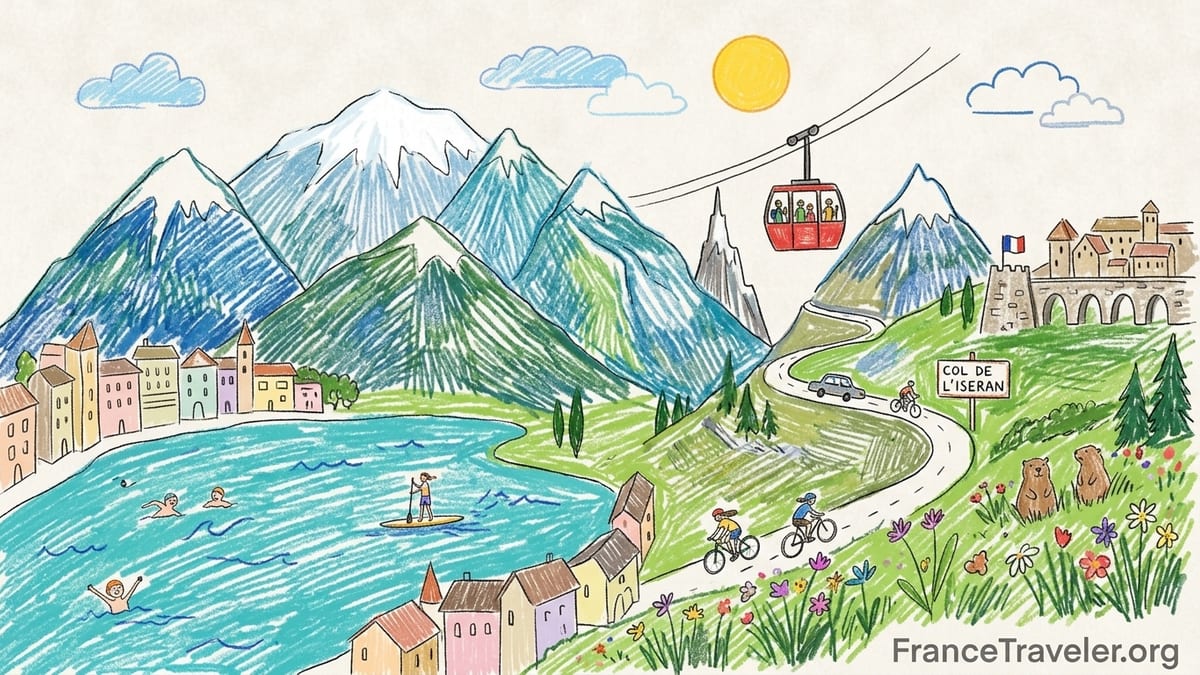
Summer in the French Alps is about contrast. In a single week you can swim in Lake Annecy’s clear water, stand eye level with Mont Blanc from a cable car, hike through marmot-filled meadows in Vanoise National Park, and drive high passes like the Col de l’Iseran or Col du Galibier that are snowbound most of the year. Unlike some winter-focused regions, many French ski resorts now work hard to keep trails, lifts and village life running from June to September, attracting hikers, cyclists and families who prefer mountain air to crowded beaches.
Tourism boards and guidebook publishers have been quick to respond. Lonely Planet recently mapped a dedicated French Alps summer route linking Annecy, Chamonix, Val d’Isère and Briançon, underlining how strong warm-season demand has become. France’s own national tourism promotion highlights Alpine lakes such as Annecy, Bourget and Serre-Ponçon, along with summer crossings of the big passes that form the backbone of the Route des Grandes Alpes. For travelers, this means better-marked hiking, more lift openings, and a broader choice of activities that go far beyond skiing.
Practically, the main summer season runs from late June to early September at higher altitudes, with lake towns like Annecy and lower valleys stretching their season from May into early October. Many key cable cars and gondolas in Chamonix, Val d’Isère and Les Deux Alpes open specifically for hikers and sightseers in this window, with dates that vary slightly each year depending on maintenance and snowfall. Booking accommodation and popular experiences several weeks ahead is advisable in July and August, especially if you are targeting marquee sights like the Aiguille du Midi.
Costs in summer are often similar to, or slightly lower than, peak winter weeks, but big-ticket items such as major lift passes remain significant line items. As an example, a return ticket from Chamonix up to the Aiguille du Midi in summer 2026 is priced in the region of 80 euros for adults, with dynamic pricing and discounts for advance web purchase and families. Mountain passes like the Mont Blanc Multipass bundle several lifts and can quickly pay off if you are riding more than two or three major installations across a few days.
Annecy and Its Lake: The Ideal Summer Base
Annecy is one of the most appealing warm-season bases in the French Alps. The compact old town, with its canals and pastel facades, sits directly on Lake Annecy, with the Bauges and Bornes massifs rising behind. In July and August the lake becomes the region’s swimming pool: public beaches in Albigny, Marquisats and Saint-Jorioz set up lifeguards, snack bars and shaded lawns. Afternoon water temperatures typically sit in the low to mid 20s Celsius in high summer, warm enough for long swims, paddleboarding and pedalo rentals.
For many travelers, Annecy works as an arrival and acclimatization point on a longer loop through the Alps. Trains from Paris and Geneva arrive at Annecy station, and car rentals are straightforward here. A common pattern is to spend two or three nights in town, using morning hours for excursions and afternoons for lake time. A half-day hike to the Parmelan plateau or the Roc de Chère nature reserve offers balcony views of the lake without serious exposure, while the well-known Semnoz ridge above town has family-friendly walking trails, a summer luge track and paragliding take-off points.
Cyclists flock to Annecy’s greenway that runs along the lake’s western shore on a converted railway line, popular with families towing trailers and road cyclists on training rides. E-bikes are widely available for hire, making a full loop of the lake’s 40-plus kilometers manageable for casual riders. Many cafes in villages like Talloires or Menthon have adapted with bike racks, refillable water and easy terrace seating, turning a simple spin into a relaxed day out.
Accommodation options range from family-owned lakeside hotels and campsites with direct beach access to design-led boutique properties in the old town. In peak summer, lakeview rooms often match winter ski-resort prices, so budget travelers may prefer nearby villages like Sévrier or Doussard, which are connected by bus and bike path. From Annecy you can day-trip to the Aravis villages of La Clusaz and Le Grand-Bornand, both of which run chairlifts for hikers and mountain bikers in July and August, giving you a first taste of Alpine valley life before heading deeper into the high mountains.
Chamonix, Mont Blanc and the Big Cable Cars
Chamonix remains the headline act for many Alpine summer visitors, and with good reason. The town sits under the north face of Mont Blanc and operates an extensive network of lifts that stay open through much of the summer specifically for hikers, climbers and sightseers. Two of the most iconic are the Aiguille du Midi cable car and the Montenvers cog railway to the Mer de Glace. Schedule brochures for summer 2025 and 2026 show the Aiguille du Midi typically running from early May through late October, with first cabins around 8 am and final descents in late afternoon, always subject to weather and maintenance.
A return ticket to the Aiguille du Midi gives you access to terraces at nearly 3,800 meters, glass-floored viewing boxes and the start point for the summer-only Vallée Blanche cable car that floats over glaciers to the Italian side at Pointe Helbronner. The ride is expensive but unforgettable, and on clear days you can see deep into France, Italy and Switzerland. Altitude can affect some visitors here; planning a gentler first day in Chamonix, perhaps on the lower Plan de l’Aiguille trails or around the valley floor, is a sensible strategy before heading straight to the top.
Across the valley, the Brévent and Flégère areas provide classic balcony views over Mont Blanc and form the backbone of many medium-grade hikes. Recent lift timetables have these gondolas opening in mid June and running into September, often with continuous operation during high season. For example, in 2025 Brévent’s main cable car is scheduled from mid June to mid September, while Flégère opens slightly earlier in June and runs through most of September. Combined with local buses and trains that run roughly hourly along the valley, this makes one-way hikes feasible, such as the long traverse from Brévent to Flégère or the Grand Balcon Sud.
Chamonix is also an important hub for summer mountaineering, via ferrata and trail running. The town hosts major races like the Marathon du Mont-Blanc and UTMB later in the season, which can crowd certain dates but add a festival atmosphere with gear expos and outdoor concerts. If you are primarily interested in sightseeing and moderate walks, aim for late June, early July or early September, when key lifts are open but paths and accommodation are slightly less pressured than the late July and August school-holiday peak.
Vanoise, Écrins and Classic Hiking Regions
Beyond Annecy and Chamonix, two national parks illustrate why the French Alps work so well in summer: Vanoise and Écrins. Vanoise National Park stretches between resorts like Val d’Isère, Tignes, Pralognan-la-Vanoise and Termignon, with dozens of refuges reachable on day hikes or multi-day circuits. Popular routes include the loop around Lac de la Plagne above Peisey-Nancroix and the balcony paths overlooking the Grande Casse, Vanoise’s highest summit. Trail grading here typically runs from easy valley walks to red-grade hikes with 600 to 900 meters of climb.
Val d’Isère, known in winter for its Espace Killy pistes, becomes a summer hiking and mountain biking base once the snow melts. Key lifts such as the Olympique and Solaise gondolas have summer opening periods, usually from late June to early September, allowing non-hikers to reach panoramic terraces at over 2,500 meters with cafés and family-friendly loops. Mountain bikers ride purpose-built enduro and downhill tracks under the chairlifts, with full-suspension rental bikes, pads and full-face helmets available in town shops for daily hire.
Further south, Écrins National Park offers a wilder feel, with fewer lifts and more traditional valley bases such as La Grave, Vallouise and the surrounding hamlets above Briançon. Classic hikes include the approach to Glacier Blanc from Pré de Madame Carle and the balcony path above Vallouise toward the refuge of Bans. Briançon itself, a UNESCO-listed fortified town at about 1,300 meters, serves as the warm-weather base on Lonely Planet’s new summer route. From here, you can access high passes like the Col d’Izoard and explore side valleys where small chairlifts open for short summer windows to serve hikers and bikers.
Difficulty in these regions varies widely. Many signed routes from resort lift stations are suitable for reasonably fit walkers with hiking shoes and basic gear, while glacier approaches and certain cols require experience, a guide or at least careful route planning. When in doubt, local tourist offices provide free printed maps and daily conditions boards noting snow patches, recent rockfall and whether bridges over torrents are in place for the season.
Which Winter Resorts Feel Alive in Summer
Not every ski resort in the French Alps is equally appealing in summer. The liveliest typically share three traits: a genuine year-round community, lift infrastructure that is intentionally opened for walkers and bikers, and proximity to lakes or passes that draw non-skiing traffic. On the main Annecy to Chamonix to Briançon axis, places that tend to feel animated in July and August include La Clusaz, Le Grand-Bornand, Megève, Chamonix, Les Houches, Les Deux Alpes, Alpe d’Huez, Les Saisies, Les Gets, Morzine, Val d’Isère and the Briançon / Serre-Chevalier valley.
Chamonix stands out for its high proportion of year-round residents and visitors engaged in climbing and hiking, which keeps restaurants and shops running even in shoulder periods. Val d’Isère has invested heavily in summer mountain biking trails and lift-served pedestrian access, hosting events like bike festivals and trail races. Les Deux Alpes is known for its long-standing glacier-skiing tradition, though dates and extent of summer snow operations have been evolving as glaciers retreat, with the focus increasingly shifting to hiking, biking and downhill scooter tracks from the mid-mountain.
In contrast, some smaller, purpose-built ski stations at higher altitudes can feel quiet once the winter crowds vanish, especially if they lack lakes or major through-roads. Travelers who prefer café life, evening strolls and varied dining may be happier basing in valley towns like Bourg-Saint-Maurice, Sallanches or Saint-Jean-de-Maurienne, then using lifts or short drives to reach high viewpoints. This is particularly true if you are relying on public transport instead of a car.
As a rule of thumb, if a resort markets specific summer products such as a bike park, trail running festival, yoga weeks or lift-inclusive pedestrian passes, it is more likely to feel lively. When booking, look at whether the main supermarket, bakery and at least a handful of restaurants are advertised as open in July and August, not just a couple of snack bars at lift bases. This information is usually available on resort websites or in their downloadable summer guides for 2026.
Swimming, Weather and Outdoor Safety
Summer in the French Alps rarely feels oppressively hot, but conditions vary significantly with altitude and region. Lakeside towns like Annecy, Aix-les-Bains or the shores of Lake Serre-Ponçon can see daytime highs in the high 20s Celsius during July and August, with warm, often crowded late-afternoon swimming sessions. Higher villages such as Chamonix and Val d’Isère are usually several degrees cooler, especially at night, which suits travelers who struggle with heat but still want bright, sunny days.
Swimming is central to the experience in many areas. Lake Annecy has well-developed public beaches with lifeguards during school holidays, marked swimming zones and rental stands for paddleboards, kayaks and pedalos. Further south, reservoirs like Serre-Ponçon or Monteynard offer similar watersports, often combined with nearby via ferrata routes and suspension bridges. Most natural high-mountain lakes remain extremely cold even in late summer and may be subject to restrictions, so always respect local guidance on swimming and avoid disturbing fragile shorelines.
Afternoon thunderstorms are a recurring feature, particularly in July and August. It is common to wake up to clear skies, hike in cool conditions until early afternoon, then see clouds building and storms rolling in by mid or late afternoon. Planning early starts, carrying lightweight waterproofs and checking daily mountain forecasts at tourist offices or lift stations are simple habits that greatly reduce risk. If you see dark clouds and hear thunder, descend from ridges and avoid exposed passes, chairlifts and metal structures.
Sun intensity at altitude can surprise visitors, even on days that feel cool. A walk from 1,500 to 2,200 meters in the Vanoise or above Chamonix exposes you to stronger UV radiation than at sea level, so good sunglasses, high-SPF sunscreen and a hat matter as much as sturdy shoes. Budget for basics: a pair of mid-range hiking boots from familiar outdoor brands, trekking poles if you have sensitive knees, and at least a small backpack with a water bottle and snacks. You do not need full expedition gear for waymarked day hikes, but treating the mountains with respect is non-negotiable.
Choosing Where to Base Yourself and How to Move Around
For a one to two week French Alps summer trip, many travelers structure their route around a few key bases rather than moving every night. A classic pattern that aligns with new warm-season itineraries is to start in Annecy for two to three nights, move to Chamonix for three to four nights, then continue to Val d’Isère or Tignes for access to Vanoise, and finish with three nights around Briançon or Serre-Chevalier for the Écrins and high passes. This roughly follows the Annecy to Chamonix to Val d’Isère to Briançon arc outlined in recent guidebook coverage of the region.
Travel between these hubs is easiest by car, particularly if you want to drive scenic passes like the Col des Aravis, Cormet de Roselend, Col de l’Iseran or Col du Galibier, which tend to open between late May and late June and stay accessible until the first significant autumn snow. Cycling these passes is a major summer activity, with road riders tackling gradients that feature regularly in the Tour de France. Drivers should be comfortable with hairpin bends, slow campervans and occasional livestock on the road, and plan fuel and food stops in valley towns rather than assuming cafés at every col.
Public transport is workable for a slower, more focused trip. Regional trains connect Annecy to Chamonix via St-Gervais and the valley railway, then onward to places like Modane for access to Vanoise. Local buses shuttle between valley stations and resort villages, especially in Chamonix and the Tarentaise. For example, in the Chamonix valley, regular TER trains run from Saint-Gervais-le-Fayet up through Les Houches to Chamonix-Mont-Blanc and beyond, giving you a backbone service onto which local buses and lifts connect. In summer, many of these services are integrated into visitor cards provided by accommodation or town halls.
When picking bases, consider your priorities. If you want a blend of culture and lakeside lounging with moderate day hikes, Annecy plus Chamonix may be enough. If you are keen on multi-day hut-to-hut hiking, plan extra nights in Vanoise or Écrins valleys. Mountain bikers will want significant time in resorts that invest heavily in bike parks such as Les Gets, Morzine, Les 2 Alpes, Alpe d’Huez and Val d’Isère. Families with younger children might favor places with short lift-served walks, playgrounds and swimming access, like La Clusaz combined with Annecy, or Les Saisies with its easy plateau trails and nearby lakes.
The Takeaway
Summer in the French Alps is no longer a quiet secret season. With guidebooks dedicating full routes to warm-weather road trips and France’s tourism authorities heavily promoting lakes and high passes, villages that once shut down after spring are now curating a full calendar of hikes, bike events and lake festivals. For travelers, that means more choice and better infrastructure, but also the need to plan lift usage, bases and key reservations ahead, particularly in July and August.
Anchoring your trip around Annecy’s lake, Chamonix’s big cable cars and views of Mont Blanc, plus time in Vanoise and Écrins for classic Alpine hiking, gives you a concentrated taste of the region’s variety. Add swims in clear lakes, drives over legendary mountain passes, and evenings in stone-built villages that still feel lived-in outside winter, and you have a summer itinerary that rivals any Mediterranean beach holiday. With thoughtful pacing and respect for mountain conditions, the French Alps in summer offer one of Europe’s richest outdoor playgrounds.
FAQ
Q1. When is the best time to visit the French Alps in summer?
The core season for most activities runs from late June to mid September, when high passes are generally open and key lifts in Chamonix, Val d’Isère and other resorts operate for hikers and bikers. Early July and early September often balance good weather with slightly fewer crowds than late July and August.
Q2. Are Chamonix cable cars open all summer?
Major Chamonix lifts such as the Aiguille du Midi cable car, Brévent and Flégère typically have long summer opening periods, often from late spring into autumn, but exact dates vary each year with maintenance and conditions. Always check the current season’s timetable shortly before your trip, as high winds or storms can temporarily close installations.
Q3. Is Lake Annecy warm enough for swimming?
In July and August, Lake Annecy’s surface temperatures usually reach the low to mid 20s Celsius in the afternoon, which most people find comfortable for swimming. Public beaches around the lake provide lifeguarded zones, changing facilities and equipment rentals, making it an easy and popular summer activity.
Q4. Which winter ski resorts are lively in summer?
Resorts with strong summer programs and a year-round community tend to feel the most alive, including Chamonix, La Clusaz, Les Gets, Morzine, Val d’Isère, Les Deux Alpes, Alpe d’Huez and the Briançon area. They host events, open key lifts for hikers and bikers, and keep a good selection of restaurants, shops and services running through July and August.
Q5. How difficult are typical summer hikes in the French Alps?
Marked trails range from easy valley walks and short loop paths near lift stations to full-day routes with 800 meters or more of ascent. Around Annecy, Chamonix, Vanoise and Écrins you will find green and blue-grade hikes suitable for fit beginners, as well as steeper red routes and alpine itineraries that are best tackled with experience or a mountain guide.
Q6. Do I need a car to follow the Annecy to Chamonix to Briançon route?
You can travel between Annecy, Chamonix, Val d’Isère and Briançon using regional trains and buses, but a car offers far more flexibility, especially for scenic detours over high passes like the Col de l’Iseran or Col du Galibier. If you prefer public transport, plan extra time for connections and base yourself in well-served valleys so you can combine local buses, lifts and walking.
Q7. What should I pack for a summer trip to the French Alps?
Bring lightweight layers, a waterproof jacket, sturdy walking shoes or hiking boots, sun protection, and a small backpack for water and snacks. Even in August, evenings can be cool at altitude, so a fleece or light insulated jacket is useful, and sudden storms make a packable rain shell essential for day hikes.
Q8. Are there family-friendly activities besides hiking?
Yes. Many resorts operate summer luge tracks, adventure parks with zip lines, beginner-friendly bike trails and children’s discovery paths. Around Annecy and the southern lakes, families can also enjoy paddleboarding, pedalo rides, sailing lessons, pony rides and easy gondola trips to viewpoints with short stroller-friendly walks.
Q9. How expensive are cable cars and lift passes in summer?
Single tickets on major lifts such as the Aiguille du Midi are a significant cost, often in the 70 to 90 euro range for an adult return by 2026, with dynamic pricing. If you plan to use several lifts over a few days, look at multi-day passes such as the Mont Blanc Multipass or local pedestrian passes, which can reduce the per-ride cost.
Q10. Is it safe to drive the high mountain passes in summer?
In summer, passes like the Col de l’Iseran, Col du Galibier and Col de la Cayolle are usually well cleared and signposted, but they involve narrow roads with steep drop-offs and tight hairpins. Drive cautiously, allow extra time, watch for cyclists and livestock, and avoid planning long pass drives in poor weather or at dusk, especially if you are not used to mountain driving.