


Renting a car for a trip into the French Alps can feel more complicated than planning the holiday itself. Geneva has two separate car rental zones, French and Swiss. New French winter rules require snow tires or chains in mountain areas. One-way rentals can suddenly triple your costs. And many travelers discover too late that they did not actually need a car at all for Annecy or Chamonix. This guide walks through the real-world decisions you will face, with concrete examples from Geneva, Lyon, Grenoble, Chambéry and Annecy to help you choose the smartest and safest option for your itinerary.
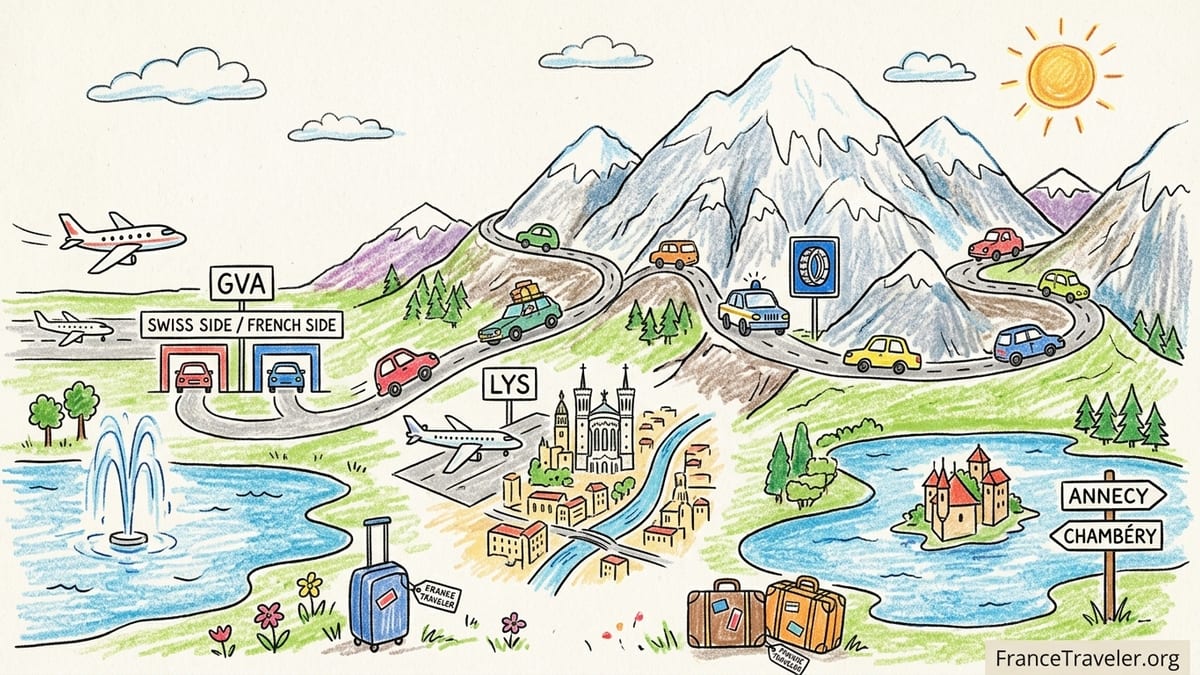
Geneva, Lyon, Grenoble, Chambéry or Annecy: Where to Pick Up Your Car
If you are flying from North America or the UK, the choice usually starts with Geneva versus Lyon or Grenoble. Geneva Airport is closest to major Haute-Savoie resorts such as Chamonix, Megève, Morzine and La Clusaz, typically 1 to 1.5 hours’ drive in good conditions. Lyon Saint-Exupéry sits further west, around 2 hours from Grenoble city and 2.5 to 3 hours from resorts like Alpe d’Huez or Les Deux Alpes. Grenoble Alpes-Isère Airport is a small seasonal gateway used mainly for ski charters; it can be very convenient on Saturdays in winter, but car rental desks may have limited hours and fleets outside peak days.
Price and choice differ noticeably between these airports. In winter, Geneva’s large volume of ski traffic means many international brands compete on price, but Swiss-side rentals often include winter tires in the base rate, which makes them look more expensive at first glance. At Lyon, base daily rates can be lower, especially midweek, but you may pay more in fuel and tolls and spend an extra half-day of your trip driving in each direction. Grenoble Airport can sometimes be the cheapest for charter-package travelers who pre-book with a tour operator, yet walk-up rentals there are often limited and expensive.
Chambéry and Annecy airports are much smaller and mainly serve seasonal or regional flights. Rental facilities exist, but fleets are limited. Many independent travelers flying to the region still choose to land at Geneva or Lyon, then drive to Annecy or Chambéry. If your plan is a lakeside stay in Annecy with only a short foray into the mountains, it can be more flexible to take the train from Geneva or Lyon into Annecy and rent a car there for just a day or two rather than for your whole trip.
Think practically about your first and last days. If you land late evening in Geneva after a long-haul flight, picking up a car at Lyon or Grenoble the next morning after an overnight there is usually not worth the lost time. Conversely, if you plan a circuit taking in Burgundy or the Rhône Valley before the Alps, starting and ending in Lyon can cut down on one-way fees and avoid the complexity of cross-border rentals from Geneva.
Geneva Airport: Swiss Side vs French Side Explained
Geneva Airport is jointly used by Switzerland and France, and the car rental area is physically split into a Swiss sector and a French sector. The Swiss side is the main arrivals area for most international flights that are not coming from France. Here you will find large car parks and desks from the major brands, with cars registered in Switzerland. On the French side, accessed by a separate road connection into France, the same brands usually operate smaller fleets of French-registered cars tailored to people driving straight into France.
In practice, this matters for both price and logistics. A compact car for a February week booked far in advance on the Swiss side might show a higher base price but will almost always include winter tires as standard in season, since Swiss regulations and local practice expect it. On the French side, base prices can be significantly cheaper on comparison sites, but winter tires and chains are often optional extras that can add several hundred euros to a week’s rental once you tick the boxes at checkout. Travelers regularly report that a Swiss-side car that looks 50 to 80 percent more expensive at first can end up costing the same, or even less, once proper winter equipment and a cross-border surcharge are added to a French-side booking.
Access also trips up many first-time visitors. If your flight into Geneva originates outside France, you normally arrive into the Swiss sector. To collect a car from the French sector, you must either follow the clearly signposted route landside to the French sector during its opening hours, or exit the airport by road into Switzerland and re-enter the French sector by its dedicated road access from the French side. You cannot simply walk back and forth between sectors airside without a same-day boarding pass. This confusion leads to missed pickups, closed desks at night, and last-minute re-bookings on the Swiss side at much higher prices.
Finally, consider your itinerary. If you are driving only in France to resorts like La Clusaz, Megève or Les Saisies and returning to Geneva, a French-side rental can work very well if you book with winter tires and chains included, understand the access route, and keep pickup and drop-off within desk hours. If you plan to spend several days in Switzerland, for example in Lausanne or Verbier before heading into France, a Swiss-registered car from the Swiss side is usually the simpler choice, especially since it will have the Swiss motorway vignette already included.
Understanding Winter Tires, Chains and the New French Mountain Rules
Driving into the French Alps in winter now comes with clearer legal obligations. Under the so-called Mountain Law, many communes in departments such as Savoie, Haute-Savoie and Isère require vehicles to be equipped with winter tires or to carry chains or snow socks between 1 November and 31 March. Local prefects publish lists of affected municipalities and you will see a specific blue sign at the roadside when you enter a mandatory equipment zone, with a corresponding sign marking the end of the zone. In these zones you must either have four proper winter tires bearing the Alpine 3-peak mountain snowflake symbol, or keep suitable chains or textile socks in the car ready to fit when conditions demand it.
Rental companies in mountain regions have adapted, but not all in the same way. A Swiss-registered car picked up at Geneva in January will almost always have winter tires mounted by default. The cost is already baked into the higher winter rental rates. A French-registered car from Geneva’s French sector or from Lyon or Grenoble may still be supplied on summer tires unless you specifically book a winter package or add winter tires as an option. One family driving from Lyon to Les Deux Alpes in February, for example, discovered at pickup that their “optional” winter package was not available on their chosen car class; the agency instead provided snow chains at the counter and warned them they might be turned around by police without them.
Chains remain necessary in heavy snow, even with winter tires. On steeper approach roads such as the final climbs to Alpe d’Huez, Les Arcs or some villages above Megève, local police sometimes set up checkpoints on storm days and require chains to be fitted before you continue. Rental chains are often a modest daily charge, but be sure they actually fit your car’s wheel size and that you understand how to install and remove them in a parking lot before you set off. Returning a set of unused chains is not a waste of money when they were your insurance against being stranded below your resort for a night.
Outside the core winter months, requirements ease but conditions can still be tricky. March and early April can bring early-morning ice on shaded hairpins even when resort roads are officially clear and snow-free by midday. If you are collecting a car in late March in Grenoble for a spring-ski weekend at Les Deux Alpes, choosing a vehicle still on winter tires is sensible, even if not strictly legally mandatory on every road by the calendar. Conversely, in high summer around Annecy or Chamonix you will not need winter tires or chains at all, and a basic compact is usually sufficient for valley roads and short climbs.
One-way Rentals, Cross-border Travel and Automatic Availability
One-way rentals within France, such as Lyon pickup and Grenoble drop-off, are generally straightforward but can carry a one-time drop fee that may not appear until late in the booking process. For instance, a traveler planning to ski in Serre Chevalier might be tempted to fly into Lyon and out of Turin; the quote that looks attractive at first can jump once a cross-border one-way fee is applied at checkout. Cross-border one-ways starting on the Swiss side of Geneva and ending in France, or vice versa, can be particularly expensive, sometimes doubling the base rental price; many travelers adjust their flights to avoid those fees.
Driving a rental car across borders for a round trip is usually permitted but must be declared at booking. A French-registered car collected at Lyon or Geneva French sector will typically be allowed into Switzerland and Italy, but the company may charge a modest cross-border supplement and may restrict certain high-value categories. A Swiss-registered car from Geneva Swiss side is generally permitted to enter neighboring countries like France and Italy, but if you fail to declare your plans and the car is damaged abroad, insurance complications can be serious. If you know you will be doing a day trip from Chamonix through the Mont Blanc Tunnel to Courmayeur in Italy, confirm in writing that your rental contract allows it.
Automatic cars are widely available but not yet the majority in many French fleets. On ski weekends and school holidays, compact automatics can sell out weeks ahead. Travelers who leave it late often find that the only remaining automatic is a much larger SUV with a steep price, or that only manual cars are available. If you are not comfortable with a manual transmission on hairpin mountain roads or when starting on steep slopes in snow, book an automatic as early as possible and consider upgrading class rather than compromising on transmission. For example, taking a slightly larger automatic from Lyon might cost 10 to 15 euros more per day, but it is worth it compared with stalling on the climb up to your chalet in fresh snow.
Keep in mind that winter-ready automatics are in especially high demand. A family flying into Geneva in February and requesting an automatic with winter tires and roof bars for skis is competing with many similar requests from across Europe. Booking through a broker that allows you to specify “guaranteed automatic” and “winter equipment included” can avoid last-minute surprises like being offered a manual at the desk or being told that winter tires are “subject to availability” on arrival day.
Mountain Roads, Alpine Parking and When a Car Is Unnecessary
Mountain driving in the Alps is as scenic as it is demanding. Main autoroutes such as the A40 between Geneva and Chamonix, or the A43 into the Tarentaise, are well maintained and regularly cleared in winter, but once you leave them for resort access roads the character changes. Expect tight hairpins, steep gradients and narrow tunnels, sometimes with minimal guardrails. In bad weather you may encounter snowplows, slow-moving buses and cars pulled over to fit chains. If this sounds stressful rather than enjoyable, consider whether you truly need a car for every day of your trip.
At many purpose-built resorts, a car is more of a liability than an asset once you arrive. In Avoriaz or Flaine, for instance, the village centers are pedestrianized and you must leave your car in paid outdoor or covered parking at the entrance, sometimes at 80 to 120 euros per week in high season. Even in less car-free resorts such as Val Thorens or Les Arcs, on-street parking is limited and strict; misreading signs about snow-clearing times can result in towing or fines. One British couple who drove from Grenoble to Alpe d’Huez overestimated the ease of parking and ended up paying for a multi-storey car park plus a shuttle bus because their residence had no private spaces.
Public transport is often a viable and relaxing alternative. Trains from Geneva or Lyon to towns like Annecy, Chamonix, Grenoble or Bourg-Saint-Maurice connect with dedicated ski buses, funiculars or resort shuttles. From Bourg-Saint-Maurice, for example, a funicular climbs directly to Les Arcs, where you can walk or take internal shuttles to most accommodation. From Grenoble, regular buses head up to Chamrousse and to Alpe d’Huez during the winter season. If you are staying in a single resort for a week and do not plan to explore neighboring valleys, arriving by train and bus can eliminate the stress and cost of winter driving and parking without significantly limiting your skiing.
Think of a rental car as most valuable when you aim to string several valleys together or stay in a low-altitude village with limited transit. A road trip taking in Annecy, then Chamonix, then the Maurienne valley, stopping at different guesthouses each night, is far easier with your own vehicle. On the other hand, a week in a large, lift-linked ski area with door-to-door transfers offered by your accommodation might be the perfect moment to skip driving altogether.
Do You Need a Car for Annecy, Chamonix or Megève?
Many traveler discussions circle back to the same question: is a rental car necessary for Annecy, Chamonix or Megève? For Annecy itself, the answer is often no, especially in summer. The town is compact, with most hotels, restaurants and the lakeside promenade within walking distance of each other. Local buses and seasonal shuttles run along the lake to popular beaches and viewpoints. In recent summers, Annecy’s greater area has even promoted car-free access to nearby viewpoints and mountain pastures using special seasonal bus services, making it realistic to reach hiking areas without driving. For a long weekend of strolling the old town, swimming in the lake and taking an occasional boat trip, a car will likely sit unused.
Chamonix sits in a wide valley that is also well served by public transport. Regular trains and buses link the town with villages such as Argentière and Les Houches, and ski buses serve lift bases throughout the valley in winter. The famous Aiguille du Midi cable car departs from central Chamonix, walkable from many hotels, and buses run to other attractions like the Grands Montets area or the Montenvers railway. Travelers who fly into Geneva can take a dedicated Chamonix shuttle minibus and then rely on local buses and walking. In this scenario, a car is not essential unless you want day trips to Courmayeur in Italy or remote trailheads beyond the valley network.
Megève is a closer call. The village itself is walkable, with many hotels close to lifts and a network of free shuttles connecting the main gondolas. However, public transport access from major airports is less direct than for Chamonix; transfers usually involve a combination of train and bus via Sallanches or a private shuttle. Once in Megève, if you are content to ski the local Evasion Mont-Blanc area and linger in the village, you can manage without a car. Yet some visitors value a car here to explore neighboring villages like Saint-Gervais-les-Bains, Combloux or Les Contamines, which can be awkward to reach at off-peak times using buses alone.
A hybrid strategy is increasingly popular. For example, a traveler might take a shuttle from Geneva to Chamonix, stay car-free for several days, then rent a car in town for two days to explore the Aosta Valley in Italy or drive over to Annecy. Similarly, a couple could train from Lyon to Annecy for a city-and-lake break, then pick up a short-term rental in Annecy on the final two days to drive around the Bauges mountains and return to Lyon or Geneva. This approach keeps costs and winter driving time down while preserving flexibility for the parts of the trip where a car adds the most value.
The Takeaway
Planning a rental car for the French Alps is less about finding the lowest advertised day rate and more about matching the vehicle, pickup point and itinerary to the realities of mountain travel. Geneva, Lyon and Grenoble each suit different types of trips: Geneva for quick access to Haute-Savoie, Lyon for broader circuits that combine wine regions and the Alps, and Grenoble for focused ski weeks in nearby resorts. Within Geneva, the Swiss versus French sector decision affects not only price but also winter equipment, cross-border rules and basic logistics at the airport.
Winter tires and chains are non-negotiable for safe and legal travel in designated mountain zones, even if rental websites treat them as optional extras. One-way rentals and cross-border trips can inflate costs unexpectedly if you do not read the small print, and automatic cars with full winter preparation sell out earlier than many visitors expect. Meanwhile, in destinations such as Annecy and Chamonix, a car can be unnecessary or even inconvenient, especially when public transport and shuttles cover most common routes and parking is expensive or limited.
If you are comfortable with mountain driving and plan to explore multiple valleys, a well-equipped rental car collected from the right airport will open up remote villages, quiet viewpoints and last-minute detours that would be hard to reach otherwise. If not, combining trains, airport shuttles and a short, targeted car rental can give you the best of both worlds: the freedom of the open road only when you truly need it, and stress-free travel the rest of the time.
FAQ
Q1. Do I need winter tires for driving in the French Alps?
In many mountain communes between 1 November and 31 March you must either have certified winter tires on all four wheels or carry chains or snow socks in the car. Even where not explicitly required, winter tires are strongly recommended whenever snow or ice is possible.
Q2. Is it better to rent a car on the Swiss or French side of Geneva Airport?
The Swiss side usually includes winter tires and a motorway vignette in the base price, while the French side often looks cheaper but charges extra for winter equipment. Your choice should depend on where you will drive, your budget and how comfortable you feel navigating the separate French sector access.
Q3. Can I drive a French rental car into Switzerland and Italy?
Often yes, but you must declare this when booking and check the contract. Most agencies allow cross-border travel to neighboring countries for standard categories, sometimes with an extra fee, and may restrict luxury or specialty vehicles.
Q4. Are automatic cars easy to find for Alpine trips?
Automatics are widely available but limited in number, especially for winter-ready models with snow tires and chains. Book as early as possible and be prepared to choose a slightly larger category if you absolutely need an automatic.
Q5. Do I need a car in Annecy?
For a short stay focused on the old town and lakeside, you typically do not. The center is walkable and local buses and seasonal shuttles cover many nearby beaches and viewpoints. A car is most useful if you plan to explore surrounding mountain passes or smaller villages.
Q6. Is a car necessary in Chamonix?
Not for most visitors. Airport shuttles link Geneva and Chamonix, and local trains and buses connect the main villages and ski areas in the valley. A car is mainly useful if you want to make side trips to Italy or remote trailheads beyond the valley network.
Q7. What about Megève, is a rental car recommended?
You can manage without a car if you stay close to lifts and rely on village shuttles, but connections from major airports involve more changes than Chamonix. A car adds flexibility for visiting neighboring villages and spas, especially outside peak bus times.
Q8. Are one-way rentals between Geneva and French cities expensive?
Within France, one-way fees are usually moderate, but cross-border one-ways between Geneva’s Swiss side and French airports like Lyon or Nice can be steep and sometimes double the apparent base price. Check total costs before locking in flights around a one-way car.
Q9. How difficult is parking at Alpine ski resorts?
Parking varies by resort. Some are largely car-free with mandatory paid parking at the entrance, while others have limited on-street spaces, strict snow-clearing rules and busy weekends. Expect to pay for covered or long-stay parking in many popular resorts and factor this into your budget.
Q10. When is it smarter to skip a car and use trains and buses instead?
If you are staying in a single resort or town with good public transport, such as Chamonix, Annecy or Val Thorens via Bourg-Saint-Maurice, and do not plan many side trips, trains and dedicated ski buses or shuttles are usually easier and cheaper than renting a car for the whole stay.