

Choosing where to stay in the French Alps is often harder than planning the rest of the trip. Do you want a lively ski town, a pretty lakeside city, a car free mega resort or a quiet village where children can play in the snow outside the chalet? This guide compares the main bases that English speaking travelers consider for both winter and summer, from Annecy and Chamonix to the big ski domains of the Three Valleys and Espace Killy, plus more affordable mountain villages.
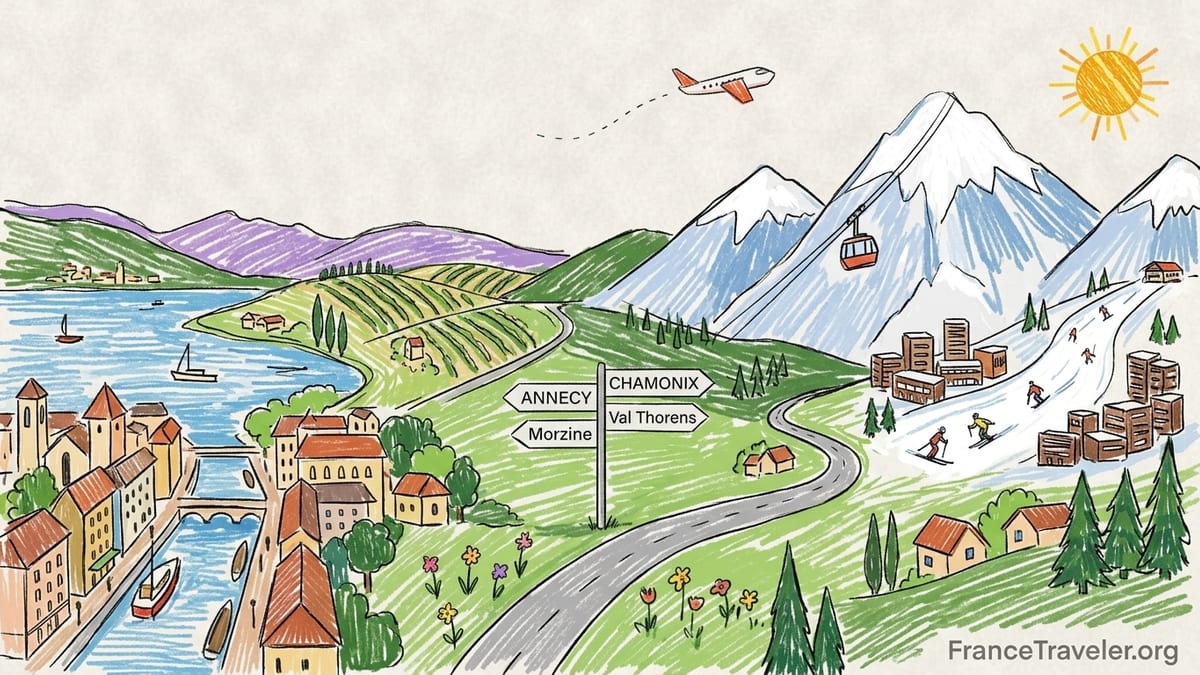
How to Think About “Where to Stay” in the French Alps
The first decision is not the exact resort, but the type of base you want. In the French Alps there is a big difference between a real town like Annecy or Chamonix and a purpose built ski resort such as Val Thorens or Les Arcs. Towns tend to have better year round life, more varied restaurants and easier public transport. High altitude ski stations usually offer better snow and ski in ski out convenience, but can feel quiet or functional outside peak season.
Budget is the next major filter. Annecy and Morzine can be relatively good value outside school holidays, with mid range hotel rooms often found from roughly 120 to 180 euros per night in shoulder seasons, while top addresses in Courchevel 1850 or Val d’Isère can easily reach several hundred euros a night in February. Self catered apartments in satellite villages such as Les Gets, Les Carroz, Saint Martin de Belleville or Bourg Saint Maurice can bring costs down for families who cook at home.
Finally, think about how you will travel. If you are flying into Geneva, resorts like Chamonix, Megève, Morzine and Les Gets are roughly one to one and a half hours away by shuttle or private transfer, which makes them ideal for a short break. If you plan to come by train, the direct TGV to Moûtiers or Bourg Saint Maurice opens up Courchevel, Méribel, Les Arcs and La Plagne with only a short bus or taxi ride from the station.
Annecy vs Chamonix: Lake Town or High Mountain Hub
Annecy and Chamonix are the two names that often appear together when travelers first picture the French Alps. In reality they answer different needs. Annecy is a small lakeside city with a beautifully preserved old town, canals and a wide promenade along Lake Annecy. In summer, supervised town beaches and lidos around the lake create a holiday atmosphere, with water temperatures often in the low twenties Celsius. It is an excellent base if you want a mix of gentle hiking, cycling, swimming and restaurant hopping rather than full days on the slopes.
Chamonix, by contrast, is a true mountain resort town under Mont Blanc. It appeals to skiers, hikers and climbers who want to be close to lifts such as the Aiguille du Midi cable car and the Montenvers cog railway. The valley is easily reached from Geneva Airport in around an hour by road, and has rail connections along the valley via the Mont Blanc Express. Accommodation ranges from simple apartments in Argentière to stylish hotels and chalets near the town center. Prices in high winter and in peak summer weeks are generally higher than in Annecy, reflecting demand for world famous off piste terrain and classic hikes like sections of the Tour du Mont Blanc.
For nightlife, Chamonix clearly wins. It offers busy bars, live music venues and late opening clubs that stay lively in both winter and summer. Annecy has plenty of wine bars and restaurants, but it feels more like a relaxed small city that quietens earlier once you leave the old town. Families weighing these two should ask one question: do you want children to remember playing on a lake beach and renting pedal boats, or looking up at glaciers from a mountain town square and riding cable cars into the high Alps?
Megève, Morzine and Les Gets: Characterful Villages Near Geneva
If you want a mountain village atmosphere without going too far from Geneva, Megève, Morzine and Les Gets are three of the strongest options. All can usually be reached in around 75 to 90 minutes by car or transfer from the airport, which is attractive for long weekends. Megève is the chicest, with cobbled streets around a central church square, horse drawn carriages in winter and a hotel scene that mixes historic grand hotels with modern design properties. Prices in peak winter can be comparable to Courchevel’s mid range, but shoulder season offers can bring five star rates down significantly, especially in June or September.
Morzine and Les Gets sit in the Franco Swiss Portes du Soleil ski area, one of the largest linked lift networks in Europe. Morzine is a working town that turned into a ski resort, so it has a year round local community and a compact center with bars, supermarkets and equipment shops. It is popular with British and Dutch families, mountain bikers in summer and anyone who likes a sociable but not wild nightlife. Les Gets, located about an hour from Geneva and close to Cluses rail station, is smaller and more family focused. The village can be walked end to end in minutes, with children’s ski zones, beginner areas and, in summer, bike parks and gentle hiking trails starting almost from the main street.
In these resorts, price levels are wide ranging. In high winter, a simple self catered apartment in Morzine or Les Gets might start around a few hundred euros per week, while chalets with hot tubs and half board can run into the thousands. Food and drink are generally more affordable than in the most exclusive Tarentaise resorts. For families without a car, free shuttle buses run within Morzine and Les Gets in season, but getting between the two or to Geneva still works best by pre booked transfer. Many visitors accept one transfer each way and then stay car free for the week, walking to lifts and shops.
The Three Valleys: Courchevel, Méribel and Val Thorens
The Three Valleys is the world’s largest connected ski area, centered on the resorts of Courchevel, Méribel and Val Thorens, plus Les Menuires and smaller satellite villages. For skiers and snowboarders who want maximum mileage on groomed pistes, it is hard to beat. Courchevel is split into several levels, with Courchevel 1850 known for luxury hotels, designer boutiques and some of the most expensive chalets in the Alps. Here, five star suites in February are firmly in the premium bracket and restaurant prices reflect the high end positioning. Lower villages such as Courchevel Moriond or La Tania are more approachable, especially if you book self catering and avoid peak school holiday weeks.
Méribel sits in the central valley, making it very convenient for exploring the entire Three Valleys network. The resort is largely chalet based, with many British tour operators established for decades. Nightlife is lively by French Alps standards, with après ski bars and terrace venues that fill on sunny afternoons. Prices in Méribel are generally high but a notch below Courchevel 1850. Val Thorens, at the top of the third valley, is one of the highest resorts in Europe and often holds snow later into spring than lower villages. It has a mix of purpose built apartment blocks, modern design hotels and a few luxury properties. Because it is largely ski in ski out, it can work well for groups who want to focus almost entirely on skiing and late night bars rather than village charm.
Access to the Three Valleys is straightforward without a car. High speed trains from Paris stop at Moûtiers, from where buses and taxis run up to Courchevel and Méribel in around 30 to 45 minutes. From Geneva and Lyon airports, private transfers are common, but there are also seasonal shared shuttles. In summer, the feel of the area is very different. Some lifts operate for hikers and mountain bikers, but many large hotels close, and villages like Méribel become much quieter. If you are planning a summer trip and want a real buzz, you may prefer Chamonix, Morzine or Annecy.
Val d’Isère, Tignes and Les Arcs: High Alpine Domains for Serious Skiers
Further along the Tarentaise valley lie some of the most snow sure and sport focused resorts in France. Val d’Isère and Tignes form the Espace Killy ski area, famous for its steep pistes, freeride terrain and reliable snow cover. Val d’Isère combines a traditional village core with modern lifts and luxury hotels. It has a strong nightlife, with well known après ski bars and late night venues that stay open deep into the season. Prices in peak winter are among the highest in the Alps, especially for centrally located chalets and hotels.
Tignes is a cluster of high altitude villages built around a lake, with most accommodation either ski in ski out or a short walk from lifts. The feel is more functional and sporty, with a big emphasis on skiing rather than shopping or nightlife, although there are still busy bars and restaurants around Tignes Le Lac and Val Claret. Because many buildings are apartments rather than chalets, it can be easier to find comparatively good value, especially for groups willing to stay in older residences a little away from the main fronts de neige. The glacier and high elevation mean summer skiing sometimes operates in early summer, and mountain biking and hiking take over once the main winter season closes.
Les Arcs, linked with La Plagne to form the Paradiski area, offers several different bases at different altitudes. Arc 1600 and 1800 have more trees and a slightly softer feel, while Arc 1950 and 2000 sit higher with very convenient lift access. The architecture ranges from classic 1970s residences to newer, more upmarket apartment hotels. Skiers who prioritize slope access over traditional village atmosphere often choose Les Arcs for its almost ski in ski out layout and good value compared with some neighboring domains. In summer, the resort reorients toward hiking, trail running and downhill biking, with a more laid back atmosphere and lower accommodation prices.
Nightlife, Atmosphere and Family Friendliness by Resort
Nightlife varies hugely across the French Alps. Chamonix, Méribel, Val Thorens and Val d’Isère are consistently the liveliest, with multiple après ski venues, bar crawls and clubs. Here it is normal in winter for people to move from slopeside terraces with live music in late afternoon to bars in town and sometimes to small nightclubs. These resorts suit groups of adults and younger couples who want social evenings as much as skiing or hiking. Accommodation close to the center can be noisy, so families often prefer neighborhoods slightly away from the main strips.
Megève, Morzine and Tignes offer a middle ground. There are good bars, wine spots and occasional live music, but they usually quieten earlier and it is easier to escape any noise. Les Gets and most villages around Les Arcs, as well as many smaller stations like Samoëns or Les Carroz, are noticeably calmer in the evenings, with the focus more on family dinners, early nights and perhaps one relaxed drink by the fire. Annecy is lively in a different way, with lakefront bars and restaurants that are busy on summer evenings and weekends, but it feels more like a small city break than a ski resort party scene.
For families, look for resorts with easy beginner areas, childcare options and compact layouts. Les Gets is frequently recommended as a family favorite in the Portes du Soleil, with dedicated children’s zones and the ability to walk from many chalets to the lifts in a few minutes. Morzine and Samoëns offer swimming pools and indoor ice rinks that help on bad weather days. In high altitude resorts such as Val Thorens or Tignes, parents should be ready for colder temperatures and stronger winds, which can be tiring for very young children. Many families choose to stay at slightly lower altitude villages with tree lined slopes that feel more sheltered.
Car Dependence, Trains and Airport Access
One of the surprises for many first time visitors is that you can explore a lot of the French Alps without renting a car, especially in winter. Major resort valleys are well connected to Geneva, Lyon and Chambery airports by shared shuttle buses and private transfers. Chamonix sits around an hour from Geneva Airport by motorway, and the valley itself has a local bus network and a small regional train line that lets visitors move between Servoz, Les Houches, Chamonix and Argentière without driving. Within Chamonix town, most people walk between accommodation, lifts and restaurants.
For the big Tarentaise domains, the French high speed rail system is the backbone. Trains from Paris and other cities arrive in Moûtiers or Bourg Saint Maurice, from which resort buses, taxis and private shuttles climb the last part of the journey up to Courchevel, Méribel, Les Arcs, La Plagne, Tignes or Val d’Isère. Once in resort, free ski buses usually circle the villages, though in spread out places such as Tignes or Courchevel it can still be convenient to have a car if you plan to explore multiple sectors and neighboring villages.
Annecy and nearby lakeside villages are particularly well suited to car free visitors in summer. Frequent trains connect Annecy with Lyon and Paris, and buses or organized day tours reach Chamonix and other mountain areas. Cyclists can rent bikes to circle the lake on a dedicated path, while boat services link the main lakeside communes. However, if you want to explore smaller, more affordable mountain villages such as Les Contamines, Abondance or Vallorcine, a car does make life easier, especially outside the main winter and summer seasons when local bus timetables are limited.
Summer vs Winter: How the Same Resort Can Feel Different
The French Alps are increasingly a year round destination, but resorts change character dramatically between winter and summer. Chamonix, Morzine, Les Gets and Annecy are among the best bases if you are planning a summer trip. They all have strong networks of hiking trails, access to high viewpoints by cable car or gondola, road cycling routes and, in some cases, major trail running events and mountain bike festivals. In Annecy, the focus in summer is lake life: swimming, stand up paddleboarding and evening strolls along the waterfront. In Chamonix the energy shifts toward hiking, trail running and alpine climbing, with long daylight hours and busy terraces in the town center.
High altitude ski stations such as Val Thorens or some sectors of Les Arcs can feel much quieter in summer. Not all hotels open, and although mountain biking parks and a handful of lifts run, these resorts are more seasonal. They do offer easier access to high alpine hiking with less risk of early season snow blocking trails, but travelers who value café culture and a lived in village atmosphere will usually be happier in lower valley towns. Megève and Morzine are good examples of places that maintain a pleasant buzz in July and August, with weekly markets, outdoor concerts and family activities.
Weather is another factor. In winter, lower resorts like Morzine or Les Gets can occasionally see rain at village level in mild spells, while higher neighbors such as Avoriaz or Val Thorens keep snow. In summer, afternoon thunderstorms are common in the mountains, and clouds can build quickly after clear mornings. It is wise to plan key viewpoints and long hikes early in the day, then keep afternoons flexible for shorter walks, lake time or cafés if the weather closes in.
More Affordable Mountain Villages Worth Considering
Not every trip needs to revolve around the headline resorts. Travelers on a tighter budget, or those who like quieter evenings, often find excellent value and atmosphere in smaller villages. Places such as Samoëns, Les Carroz, Vaujany, Aussois or Saint Gervais les Bains offer access to good ski areas while remaining real communities with local schools, bakeries and weekly markets. Accommodation here is more likely to be in small family run hotels or simple apartments, and prices for both lodging and meals are typically lower than in the big name destinations nearby.
For example, Samoëns links into the Grand Massif skiing, with Flaine as the high altitude neighbor. The village center is flat and easy to walk, making it convenient for families with strollers. Saint Gervais sits on the rack railway to the Nid d’Aigle below Mont Blanc and offers a historic spa, traditional architecture and a relaxed feel compared with Chamonix up the valley. In these types of villages, nightlife is limited to a handful of bars that close relatively early, but daytime life feels more authentically local, especially outside holiday periods.
The trade off in smaller and cheaper bases is usually transport convenience. Public transport from airports may involve several changes, and in summer some cable cars or lifts only open for a short high season window in July and August. If you are comfortable renting a car and driving mountain roads, these villages can deliver a very satisfying and economical Alps experience. If you prefer to stay car free, you may want to base yourself in a larger hub like Annecy, Chamonix or Morzine and visit smaller places on day trips.
The Takeaway
There is no single “best” place to stay in the French Alps. The right base depends on whether you are primarily coming to ski or ride, to hike and swim, to enjoy nightlife or to spend time together as a family. Annecy and Chamonix work well as first timers’ choices that are easy to reach, with very different personalities: one lakeside and relaxed, the other high mountain and energetic. Megève, Morzine and Les Gets are strong all rounders within a short drive of Geneva, while the Three Valleys, Val d’Isère, Tignes and Les Arcs are ideal for snow sure, ski focused trips.
If budget and crowds are a concern, look carefully at dates and consider smaller villages linked to big ski areas. For summer, prioritize places with genuine year round communities and clear plans for hiking, biking and lake activities. For winter, think about altitude, ski area size and how important ski in ski out convenience really is to your group. With a little planning around these questions, you can choose a base in the French Alps that fits your style instead of trying to force your trip to match a resort’s reputation.
FAQ
Q1. Is Annecy or Chamonix better if I am not skiing?
Annecy is usually better if you are not skiing. It has a beautiful old town, an easy to enjoy lakeside setting, good restaurants and simple day trips, while Chamonix is more focused on mountain sports and dramatic viewpoints.
Q2. Which resort is best for families visiting the French Alps for the first time?
Many families start with Morzine or Les Gets because of their gentle beginner areas, family friendly accommodation and short transfer times from Geneva. Les Gets in particular is compact and easy to walk around with children.
Q3. Do I need a car to enjoy the French Alps?
You do not need a car for the main resorts. Chamonix, Morzine, Megève, Courchevel, Méribel, Val Thorens, Val d’Isère, Tignes and Les Arcs can all be reached by train plus bus or airport transfer, and most have local shuttle buses in season.
Q4. Which French Alps resorts have the best nightlife?
Chamonix, Méribel, Val Thorens and Val d’Isère have the liveliest nightlife, with busy après ski terraces, bars and some late night clubs, especially in high winter and around holiday weeks.
Q5. What is the most budget friendly way to stay in the French Alps?
The most budget friendly approach is usually to choose a smaller village linked to a big ski area, book a self catered apartment outside peak school holidays and cook many of your meals at home. Places like Samoëns, Les Carroz or Saint Gervais can be good options.
Q6. How do summer and winter prices compare in the main resorts?
In most resorts, winter high season, especially February, is significantly more expensive than summer. Summer stays in Chamonix, Morzine, Les Gets or Annecy often offer better value, while top tier winter weeks in Courchevel or Val d’Isère are among the priciest in Europe.
Q7. Which resorts are best if I want ski in ski out accommodation?
Val Thorens, Tignes, many parts of Les Arcs and several higher sectors of the Three Valleys were designed for ski in ski out convenience, with apartments and hotels located directly beside the pistes or just a short walk from lifts.
Q8. Is it realistic to visit both Annecy and Chamonix in one trip?
Yes, it is realistic. The two are roughly one to one and a half hours apart by car or bus, so many travelers spend a couple of nights in each to combine lake time with high mountain scenery.
Q9. Which resort is best for serious off piste and challenging skiing?
For advanced skiers and boarders, Chamonix, Val d’Isère, Tignes and some sectors of the Three Valleys offer the most challenging terrain, including steep pistes, couloirs and extensive off piste routes with local guides.
Q10. Are the French Alps worth visiting if I am mainly interested in hiking?
Yes. In summer and early autumn, areas around Chamonix, Annecy, Megève, Morzine, Les Gets and the Tarentaise valleys have extensive networks of marked hiking trails, from easy family walks to demanding multi day treks.