

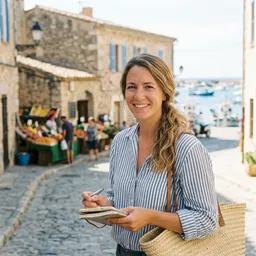
On my last trip to Burgundy I promised myself one thing: I would only order the classics if I genuinely wanted to eat them, and I would keep notes on every plate and every glass. Over six days split between Dijon and Beaune, I ate in covered markets, old-school bistros, wine bars and one splurge restaurant, trying as many of the region’s hallmark dishes and wines as I could without turning the whole journey into a checklist. This is what I actually ate and drank, what was worth the money, and what I would build into an ideal first-time Burgundy meal after having done the legwork in real life.
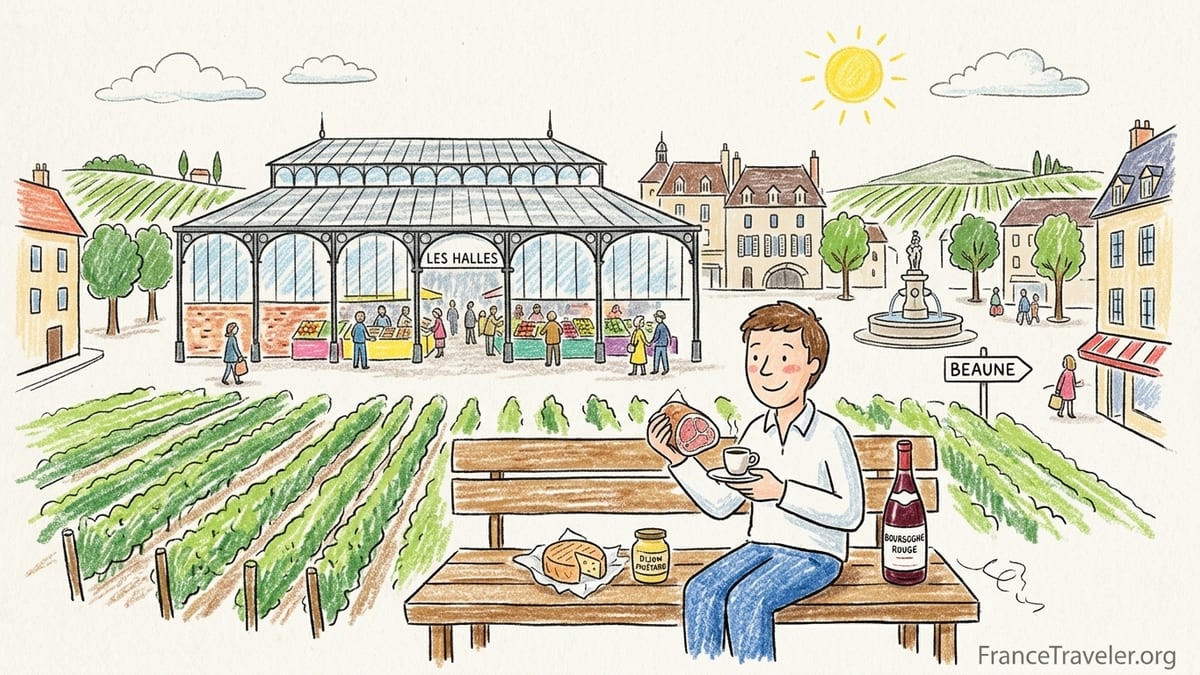
Starting in Dijon: Market Mornings and First Bites of Burgundy
I based my first three nights in Dijon, which turned out to be perfect for understanding Burgundy as an everyday food culture rather than just a wine lover’s playground. My first serious encounter with local produce was at Les Halles, the historic covered market a few minutes’ walk from Place François Rude. The market hall itself dates from the nineteenth century and remains the city’s main shopping address for locals, with several market days each week where butchers, cheesemongers and vegetable producers set up stalls under the iron and glass roof. On a Friday morning around 10 a.m., I followed the crowd to a charcuterie counter selling thick slices of jambon persillé, jars of Burgundy snails and plastic tubs of oeufs en gelée.
There were no tables at that stall, so I did what the locals did and turned the edge of the fountain outside into an impromptu counter. A generous slice of jambon persillé, weighing around 150 grams, set me back 5 euros, with a small plastic fork and paper napkin included. The ham was firm but not chewy, the parsley jelly well seasoned and noticeably garlicky, and the whole thing served fridge-cold. It tasted unmistakably of pork, salt and herbs, far meatier than most terrines I have eaten in Paris, and felt like the sort of substantial snack that could easily stand in for lunch when paired with bread. It matched my expectations of the dish as a Burgundian staple, and if anything exceeded them, although I did wish I had an actual plate and knife. No wine here, just a small takeaway espresso from a nearby counter for 1.50 euros, but for an introduction to Burgundy’s love of pork this was ideal.
Inside the same market hall, I hunted down a stall specialising in regional cheeses and spotted a whole wheel of Époisses, the washed-rind cheese that carries intense local pride along with its powerful aroma. The cheesemonger happily cut me a wedge of about 80 grams for 4.80 euros and wrapped it in paper. I ate it that evening in my rental apartment with a baguette from a bakery on Rue de la Liberté. At room temperature the texture was almost spoonable, collapsing into a thick cream around the slightly firmer core. The rind brought the expected barnyard funk, but on the palate it was more balanced than aggressive, with a deep savoury note that worked incredibly well with a glass of village-level Chardonnay from the Côte de Beaune that I had picked up for around 15 euros at a nearby caviste. The wine had enough freshness to cut through the fat, and the pairing was one of the first I would absolutely repeat.
That first Dijon market morning taught me two practical lessons. The first is that Burgundy’s reputation for luxury can obscure how affordable its everyday foods still are if you shop where residents do. The second is that local products like jambon persillé and Époisses really do taste different in the place they come from, not because of some mystical terroir in the air but because turnover is high and shops are serving regulars who are not shy about complaining if quality slips. For travellers, building at least one self-assembled meal around market purchases is a smart way to taste a range of specialities without committing to a full restaurant bill at every sitting.
Classic Bistro Dishes: Boeuf Bourguignon, Œufs en Meurette and Escargots
Of course I was not going to leave Dijon without sitting down for a proper bistro lunch focused on the region’s most famous dishes. On my second day I booked a midday table at a traditional-style bistro near Les Halles that specialises in hearty classics. For 24 euros they offered a fixed-price lunch that included a starter and main, with Burgundy standards dominating the chalkboard. I chose escargots de Bourgogne to start and bœuf bourguignon as a main, determined to see if these travel-brochure favourites were actually worth their fame.
The escargots arrived as six snails in individual wells of a ceramic dish, each submerged in parsley and garlic butter. Portion-wise it was exactly the right size for a starter, and the price on the à la carte menu was 11 euros. The snails themselves were plump and tender, with a slightly springy bite but no chewiness. The butter was heavy on garlic and salt, deeply aromatic, and almost more the point of the dish than the snails themselves. A glass of simple Bourgogne Aligoté at 7 euros was the recommended pairing, and it worked better than I expected. The wine’s lemony acidity cut through the richness of the butter and reset the palate between mouthfuls, making the dish feel indulgent but not overwhelming. I would order this combination again without hesitation, particularly as a first taste of Burgundy in a sit-down setting.
The boeuf bourguignon that followed was served in a shallow bowl, with roughly six substantial cubes of beef, lardons, pearl onions and carrot batons in a thick, glossy sauce, accompanied by a side of buttered tagliatelle. The portion was generous but not outsized, appropriate for a 19 euro dish on the main menu and comfortably included in the lunch formula. The meat itself was properly braised and yielding, but not falling apart, with enough structure left that you needed a knife. The sauce was concentrated and sticky, rich with red wine and stock. Yet as I made my way through the bowl I realised something: this is a dish that can be almost too rich in a restaurant context, particularly at lunch. I enjoyed it, but by the final bites it felt heavy, bordering on tiring.
The suggested pairing, a glass of Bourgogne Rouge from the Côte de Beaune for 9 euros, had soft tannins and red cherry fruit that technically matched the sauce, but the combination of braised beef, noodles and wine made for a deeply filling meal that slowed the rest of my afternoon. I am glad I ordered boeuf bourguignon in Burgundy, if only to taste it in its spiritual home, but it is not something I would rush to repeat on a short trip. For my own ideal Burgundy menu, I would steer a first-time visitor toward lighter dishes that give more space for the wines to shine, unless they arrive on a cold winter evening and really want that kind of comfort.
Discovering Œufs en Meurette and Why It Became My Go-To
Œufs en meurette was the dish that surprised me most on this trip. I had eaten versions in Paris before, but in Burgundy it felt almost like a religion, with stories of local contests for the best rendition and versions on nearly every bistro menu. I first ordered it at a small restaurant just off Dijon's main square for 13 euros, curious to see whether it deserved the reverence. The plate that arrived looked deceptively simple: two poached eggs nestled in a deep pool of red wine sauce with lardons, mushrooms and tiny onions, a piece of toast perched on the side to soak up the liquid.
The eggs were textbook perfect, with thick, slightly wobbly whites and a yolk that flowed like warm custard. The meurette sauce was the revelation. In many places outside Burgundy this sauce can taste thin, more like red wine with onions. Here it was deeply reduced and glossy, almost like a jus, with the wine cooked down until the raw alcohol flavour had completely vanished. There was a savoury depth from stock and bacon, along with a hint of sweetness from the onions. Texturally the dish felt luxurious without being heavy, because the main bulk came from the liquid rather than starch.
I paired it with a glass of Bourgogne Pinot Noir from the Côte de Nuits for 10 euros on the server’s recommendation. The wine had enough structure and bright acidity to echo the sauce without overwhelming the eggs. The combination was so satisfying that I ordered œufs en meurette three more times over the course of the week, including once at a wine bar in Beaune where a more rustic version with chunkier lardons and thicker sauce was served in a small cast-iron pan for 14 euros. Every time, it delivered on flavour and comfort but never left me feeling weighed down in the way that boeuf bourguignon sometimes can.
If I had to nominate one dish that I would build into any Burgundy itinerary, it would be œufs en meurette, precisely because it encapsulates what the region does best: layering wine, stock, pork and eggs into something that feels both rustic and refined. It also happens to pair beautifully with a broad spectrum of local red wines, from humble Bourgogne Rouge up through more serious village-level bottles, which makes it an ideal anchor dish at a tasting-focused lunch.
From Market Snacks to Wine-Bar Suppers in Beaune
After Dijon I moved to Beaune for three nights, a shift that changed the rhythm of my eating as much as the scenery. Beaune’s medieval streets, centred on the tiled-roof Hospices de Beaune, are thick with tasting rooms and wine bars, which meant more meals built around small plates and glasses rather than fixed menus. On my first evening I stopped at a casual wine bar near the Hospices that specialises in local natural and low-intervention wines. The by-the-glass list ran from simple Bourgogne Rouge around 7 euros to premier cru examples over 18 euros, with food options limited to cold plates and one or two hot dishes written on a blackboard.
I started with a plate of escargots served in their shells, six pieces for 12 euros, this time accompanied by slices of baguette and a small salad of bitter leaves. Compared with the Dijon bistro, the snails here were more intensely garlicky, with a butter that verged on spicy from the raw allium, and the shells made the experience feel more tactile. The server suggested a glass of Mâcon-Villages Chardonnay at 8 euros, arguing that its slightly riper fruit and citrus notes would play well with the garlic and herbs. He was right. The wine tasted broader and more generous than the leaner Aligoté I had tried earlier, but still had enough freshness to keep each bite in balance. I preferred this version of escargots to the previous one, mostly for the bread and shell-on presentation, and would easily order it again in a similar setting.
That same night I built an almost entirely cold supper from the bar menu, ordering a small regional charcuterie plate for 15 euros that included more jambon persillé, slices of dried saucisson, and wedges of Époisses and Comté. Portion size was comfortable for one hungry person or two light grazers. Texture-wise, eating the terrine again alongside the cheese emphasised how much of Burgundy’s food culture is about chewy, salty, concentrated flavours. I paired the board with two successive glasses of red, both from nearby appellations on the Côte de Beaune, each in the 10 to 12 euro range. The first, from Savigny-lès-Beaune, was light and floral, excellent with the ham and saucisson. The second, a Pommard with more structure and darker fruit, sang with the Époisses, whose creaminess tamed the tannins.
This wine-bar style of eating, alternating small plates and single glasses, ended up being my preferred way to explore Beaune’s food and wine. It is kinder to both budget and appetite than multiple three-course restaurant evenings, and it mirrors how many locals appear to use these venues: as living rooms with better glassware and fridges stocked by people who know the vineyards personally. For a first-time visitor, I would absolutely recommend planning at least one evening around a bar like this, ideally after a day of tasting when you want flexibility and the option to try something modest or splurge on one memorable glass.
High-End Burgundy: Bresse Chicken and Refined Pairings
To understand the other end of Burgundy’s dining spectrum, I booked one dinner at a higher-end restaurant in Beaune, a place recommended both by the local tourism office and by several winemakers I met during tastings. The dining room was modern but understated, with an open kitchen and a short seasonal menu organised around local products. Prices were a step up from the bistros, with mains typically between 32 and 45 euros and a three-course menu offered around 65 euros, not including wine.
There was no question what I would order if it appeared, and it did: roasted Bresse chicken, Burgundy’s blue-footed bird that enjoys protected-origin status and near-mythical status in French gastronomy. The dish was priced at 38 euros as a main course and served with a small gratin of potatoes and seasonal vegetables. When the plate arrived, the portion was more restrained than a rustic half-bird, essentially a plated breast with a bit of leg meat, but presented with care. The skin was an even golden colour, crisp in places but not aggressively so, while the flesh beneath was almost shockingly juicy, with a depth of flavour that justified the fuss around the breed.
The sauce was a light jus enriched with chicken stock and a little cream, rather than the heavy cream sauce I had half-feared. Texture-wise, the combination of supple meat, crisp skin and silky sauce felt luxurious without tipping into excess. The sommelier suggested a glass of white Burgundy from Meursault, a village-level Chardonnay poured at 18 euros per glass. The wine brought ripe stone-fruit notes, gentle toast from oak and a line of acidity that cut through the richness of the chicken and gratin. This was one of the most harmonious pairings of the trip, and while the price was clearly higher than anything I ate in markets or bistros, I left feeling that I had genuinely understood why Bresse chicken is considered a benchmark.
For dessert I chose a plate of regional cheeses instead of something sweet, wanting to revisit Époisses and compare it side by side with local goat cheeses and a slice of aged Comté. The board cost 14 euros, and the portions were moderate, more about variety than volume. A small pour of Crémant de Bourgogne brut at 9 euros was suggested as a playful pairing, and it worked nicely, the bubbles refreshing the palate between bites. This meal underlined that Burgundy’s high-end restaurants often put as much emphasis on careful wine pairing as on the cooking itself, and that for travellers willing to invest in one more expensive dinner, choosing a restaurant that treats wine lists as seriously as the kitchen can produce lasting memories.
Mustard, Gingerbread and Cassis: Beyond the Restaurant Table
Burgundy’s gastronomy is not limited to what appears on restaurant plates, and some of the most emblematic products are sold across counters and in specialist shops. In Dijon I visited a historic mustard shop in the city centre where tasting spoons of various mustards were available. The classic Dijon mustard in a 200-gram jar was priced around 4 euros, while more elaborate flavours such as mustard with cassis cost a bit more. Tasting them side by side was instructive: the traditional version had an immediate nose-clearing heat and clean acidity, ideal for vinaigrettes or sandwiches, whereas the cassis version layered a subtle berry note over the heat.
To understand how mustard functioned in real food, I paid attention to how it appeared as an ingredient rather than a souvenir. In a small brasserie in Beaune, I ordered a grilled pork chop that came with a mustard-based sauce and potatoes, priced at 21 euros for a generous portion easily satisfying for dinner. The sauce was creamy but sharp, with the mustard bringing enough bite to lift the richness of the pork fat. A glass of simple Bourgogne Rouge at 8 euros worked well, the red fruit echoing the meat while the acidity kept the cream in check. This dish showed why Dijon mustard became globally famous: used with restraint, it adds definition and backbone to otherwise heavy food.
For something sweet, I tried pain d’épices, the local gingerbread, from a bakery in Dijon known for specialising in it. A modest rectangular loaf suitable for sharing cost around 7 euros, and individual slices at cafés ran about 3 euros each. The texture was closer to a dense, moist cake than to the brittle gingerbread cookies some travellers might expect, with pronounced honey notes and only gentle spice. I enjoyed it as an afternoon snack with coffee more than as a dessert, and personally would rank it below other regional highlights in terms of must-try status. It is pleasant and very much part of Burgundy’s culinary identity, but if time or appetite is limited, I would place savoury dishes and cheeses ahead of it.
Cassis appeared both as crème de cassis, the blackcurrant liqueur, and as the base of a Kir, the classic aperitif made by adding a dash of liqueur to a glass of Bourgogne Aligoté. In Beaune I ordered a Kir at a café terrace overlooking the Hospices for 6 euros. The drink was served in a small wine glass, pale pink from the blend of liqueur and white wine. The sweetness of the cassis rounded the edges of the wine’s acidity, producing an easy, almost nostalgic flavour that instantly made sense as an afternoon or pre-dinner ritual. After that first one, I found myself ordering Kir again on two more occasions. It is not a complex drink, but as a cultural marker and a way to enjoy Aligoté in a relaxed context, it is something I would recommend to anyone visiting the region.
What I Loved, What I Would Skip, and the Ideal First-Time Meal
Looking back over the meals and snacks that filled this Burgundy trip, certain patterns emerge. The dishes and products that most impressed me were those that balanced richness and freshness, giving wine room to play an equal role. Œufs en meurette stands at the top of that list, followed closely by well-prepared escargots served with good bread, properly ripened Époisses, and the Bresse chicken dinner in Beaune where both portion size and sauce restraint allowed the flavour of the bird and the accompanying white Burgundy to stand out. Jambon persillé, eaten on a market bench or as part of a charcuterie board, also feels indispensable, offering a direct, unfussy expression of local pork, herbs and garlic.
In contrast, boeuf bourguignon, while tasty, is the one famous Burgundy dish I do not feel compelled to order again anytime soon. It matched my expectations in terms of depth and richness, but that was precisely the issue. In practice, it is a heavy, slow meal that can dull the appetite for further exploration, especially at midday. Similarly, pain d’épices, although enjoyable, did not earn a permanent place on my personal list of things I would insist a friend try on a short visit, simply because it feels more like a pleasant snack than a gastronomic revelation. I am glad to have tasted both in their home territory, but for returning trips I would likely invest those calories and euros elsewhere.
If I were to design a single day’s worth of meals for a first-time visitor based on what I actually ate and would repeat, it would look like this. Breakfast would be left light, perhaps just coffee and a croissant, to save space. Lunch would be centred on œufs en meurette at a bistro that takes its sauce seriously, paired with a glass of Bourgogne Pinot Noir from either the Côte de Beaune or Côte de Nuits, followed by a small plate of Époisses with bread and, if available, a splash of local white. Afternoon would be devoted to market grazing, picking up a slice of jambon persillé and perhaps a small tasting wedge of another cheese, eaten informally in a square or park. Early evening would begin with a Kir made from crème de cassis and Aligoté on a terrace.
Dinner, for that one ideal day, would be at a restaurant or bistro that features local poultry or pork rather than boeuf bourguignon, whether that is roasted Bresse chicken with a restrained jus or a well-seasoned pork chop with mustard sauce. I would pair the chicken with a village-level white from Meursault or Puligny-Montrachet if budget allows, or with a good Bourgogne Blanc from a careful producer if not. I would end with a modest cheese plate featuring Époisses again, because the combination of that cheese with both red and white Burgundy is one of the region’s true pleasures. On this menu I would consciously skip boeuf bourguignon and possibly the pain d’épices dessert, not out of disrespect, but because the goal is to leave with a sense of Burgundy as a place where wine and food are in conversation rather than locked into a single, heavy idea of comfort.
FAQ
Q1. Is it necessary to book restaurants in Dijon and Beaune in advance?
In my experience it was wise to reserve for popular bistros and any higher-end restaurant, especially for dinners on Fridays and Saturdays. Wine bars and casual spots sometimes had room for walk-ins, but even then I found that booking a day ahead helped secure a table at peak times.
Q2. How much should I budget for a typical Burgundy meal with wine?
For lunch in a bistro with a classic dish like œufs en meurette or boeuf bourguignon and a glass of regional wine, I usually spent between 25 and 35 euros. In wine bars, an evening of shared small plates and two or three glasses of wine came to around 30 to 45 euros per person. A higher-end three-course dinner with careful wine pairings could easily reach 70 to 100 euros per person.
Q3. Are Burgundy’s famous dishes suitable for vegetarians?
Most of the classic regional dishes I encountered, such as boeuf bourguignon, escargots, jambon persillé and œufs en meurette, are built around meat or meat-based sauces. Some bistros and wine bars offered vegetarian options like salads, vegetable tarts or cheese plates, but anyone eating fully vegetarian would need to choose carefully and might find the traditional canon fairly limited.
Q4. What is the best time of year to visit Burgundy for food and wine?
I visited in the warmer months, when market stalls were full of produce and café terraces were busy, which made outdoor eating and casual grazing very appealing. Autumn, around the harvest and the November wine auction in Beaune, is also known for food events and seasonal dishes, though it can be busier and require more advance planning for accommodations and restaurant reservations.
Q5. Is it worth trying Kir, or is it just for tourists?
Ordering Kir in Burgundy felt far from a tourist cliché. Locals were drinking it as an aperitif, and bartenders talked about their preferred balance of crème de cassis and Aligoté. At around 5 to 7 euros per glass, it was an affordable and genuinely local way to start an evening, and after a couple of tries I understood why it remains popular.
Q6. How does eating in Dijon compare with eating in Beaune?
In my experience Dijon felt more like a working city, with a wider range of price points and everyday eateries, especially around Les Halles and the central streets. Beaune, while charming and very focused on wine, had a denser concentration of tasting rooms and wine bars, and some restaurants seemed more oriented toward visitors. Both offered excellent food, but Dijon stood out for market experiences and Beaune for evenings built around by-the-glass wine lists.
Q7. Are escargots in Burgundy very different from those served elsewhere in France?
The escargots I ate in Burgundy were notable for the quality of the snails themselves and the generosity of the garlic and parsley butter. Serving them in the shell with plenty of bread to soak up the sauce made the experience feel more satisfying than some versions I have had elsewhere, and the emphasis on pairing them with local white wine or Aligoté added an extra dimension.
Q8. Is Bresse chicken really worth the higher price?
The Bresse chicken dish I ordered in Beaune cost more than a standard roast chicken plate, but the flavour and texture were clearly superior, with deeply savoury meat and impressive juiciness. Combined with a carefully chosen glass of white Burgundy, it felt like a special-occasion experience rather than just a main course. For travellers willing to splurge on one meal, I would say it justified the price.
Q9. Can you eat well in Burgundy without knowing much about wine?
Yes, although some familiarity helps. Servers and sommeliers were generally happy to recommend glasses that matched particular dishes, and many places offered concise by-the-glass lists that made choices less intimidating. Even without deep wine knowledge, focusing on classic pairings such as œufs en meurette with regional Pinot Noir or escargots with Chardonnay or Aligoté led to very satisfying meals.
Q10. If I only have one day in Burgundy, which dishes should I prioritise?
Based on what I actually ate and would order again, I would steer a first-time visitor toward œufs en meurette, escargots de Bourgogne, a taste of jambon persillé and Époisses, and if budget allows, a well-prepared poultry or pork main such as Bresse chicken with a good white Burgundy. I would add a Kir as an aperitif and be less concerned about fitting in boeuf bourguignon or pain d’épices unless you have a particular curiosity about them.