

I arrived in Burgundy on a drizzly Sunday in late May, stepping off the TGV from Paris at Dijon Ville with a small suitcase, a notebook and an itinerary that revolved almost entirely around wine. Over seven days I based myself first in Dijon, then Beaune, and finally in a farmhouse guesthouse on the edge of the Morvan hills, moving between them by regional train and a modest rental car. I walked vineyard lanes in the Côte de Nuits and Côte de Beaune, cycled short stretches of the Canal de Bourgogne, shuffled through chilly limestone cellars, visited abbeys and markets, and discovered how quickly the region turns from famous vineyards into deep countryside. Somewhere between a long lunch in Volnay and a cloudy hike above Lac des Settons, my idea of “Burgundy” changed completely.
Arriving in Burgundy and Setting a Realistic Base
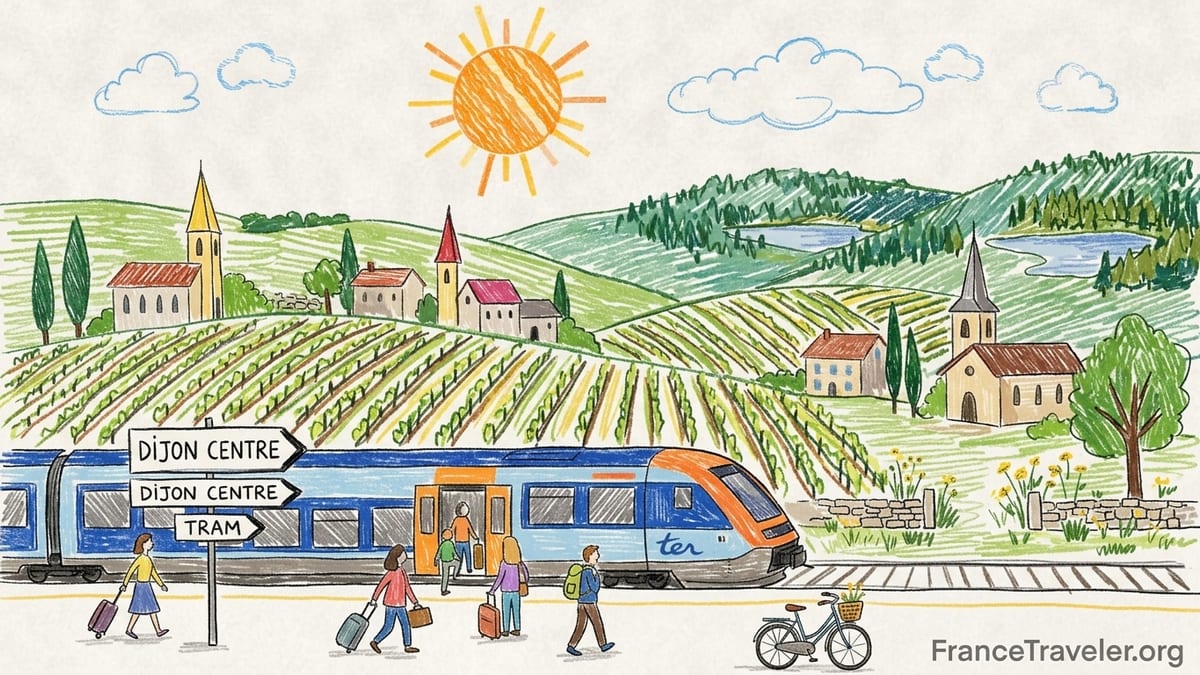
Like many first-timers, I thought Burgundy was essentially one long vineyard. On the train from Paris Gare de Lyon to Dijon, the landscape is gentle and green rather than dramatic, and you only start to glimpse regimented rows of vines in the last half hour. The ride takes around 1 hour 40 minutes on the TGV, with reserved seats and luggage racks that easily swallowed my carry-on and backpack. Stepping out in Dijon felt almost modest after Paris: one main station hall, clear signs to the tram and taxis, and a ten-minute walk into the historic center if you travel light.
I spent my first three nights in Dijon without a car, which in hindsight was the right way to ease into Burgundy. The city is compact, with frequent TER regional trains linking it to Beaune in about 18 to 20 minutes and to smaller wine towns like Nuits-Saint-Georges in roughly 15 minutes. I used Dijon as a base for a day trip into the Côte de Nuits by train and on foot, and another day on the Canal de Bourgogne towpath. Only on day four did I pick up a rental car from near Dijon station and drive south to Beaune, and then onward toward the Morvan. That sequence let me experience both the convenience of Burgundy’s rail spine and the reality that once you step off it, you are in real countryside where buses are scarce and you set your own pace.
My second base was Beaune, the small town that dominates most wine travelers’ plans. I stayed two nights inside the ring of old ramparts. It is an easy twenty-minute train ride from Dijon, but it feels like a different scale of life: narrower streets, a higher ratio of wine shops to bakeries, and a Saturday market that spills through the old town. From Beaune, I rented a basic city bike for a day to explore the Côte de Beaune villages, following quiet back roads through Pommard, Volnay and Meursault. Only for the last two nights did I leave the vineyards, driving about an hour and a half west into the fringes of the Parc naturel régional du Morvan, where mobile reception thinned out and the night sky turned properly dark.
This three-stop structure – Dijon, Beaune and the Morvan – mirrored the balance the regional tourism board now promotes: city, vineyard and nature. It also made clear that Burgundy is not a single, seamless experience. A glass of chilled Aligoté on a Dijon terrace, a bike leaning against a stone wall outside Meursault, and the silence of a lakeside track in the Morvan felt like different trips, loosely tied together by history and regional identity more than by wine alone.
How My Idea of Burgundy Changed on the Ground
I arrived expecting a wine playground, perhaps a rural version of a Napa Valley weekend. Instead, Burgundy revealed itself as a deliberately slow, sometimes almost reticent region. The vineyards of the Côte d’Or are narrow strips along gentle slopes rather than rolling seas of vines. Between even famous villages like Gevrey-Chambertin and Vosne-Romanée you walk on small departmental roads that pass stone crosses, vegetable patches and farmyards, not flashy winery gates. Some domaines still hide behind heavy wooden doors with only a small plaque and a doorbell.
In the cellars, the atmosphere is closer to a craftsman’s workshop than a polished visitor center. At several tastings, I found myself standing between oak barrels in spaces that stay around 12 to 14 degrees Celsius year-round. You feel the cold through your shoes and up your legs as you hold a glass by the stem so your hand does not warm the wine. One winemaker in the Côte de Nuits apologized for the concrete floor before he apologized for the weather. The etiquette was unhurried but precise: a short introduction to the domaine, then small pours in proper stems, a few minutes to taste in silence, and only then questions. In most places I visited, spitting was quietly expected after the first couple of wines, even if no one said it out loud.
Outside the cellar doors, Burgundy was gentler and greener than I had pictured. The limestone villages were small clusters of pale stone houses, pantile roofs and church spires rather than postcard showpieces. In May, the vines were only just leafing out, so the slopes were patterned with parallel lines of bare earth. Between vineyard belts, there were meadows, woods and fields of rapeseed in bright yellow bloom. I found as many walkers and cyclists along the Canal de Bourgogne or on hilltop paths near Châteauneuf-en-Auxois as I did in tasting rooms. This balance between agricultural work, quiet villages and outdoor space made Burgundy feel more like a living rural region than a wine park built for visitors.
By the time I reached the Morvan, my mental image of Burgundy had shifted again. Here, wine receded almost completely. The hills became steeper and forested, with lakes like Lac des Settons attracting hikers and kayakers rather than wine tourists. Signposts for long-distance trails crossed the road at regular intervals, and villages were smaller and further apart. The Morvan is officially positioned as an ecotourism destination, focused on nature sports and silence, and that rang true as I walked along soft forest tracks listening to woodpeckers instead of traffic. Burgundy, I realised, is as much about this quietness and space as it is about Pinot Noir.
Vineyard Roads, Village Rhythms and the Practicalities of Getting Around
Driving the Route des Grands Crus between Dijon and Beaune is romantic in theory, but in practice it is a patchwork of very ordinary local roads. Expect a mix of narrow lanes between low stone walls, short stretches through woodland, and occasional passes directly through villages where parked tractors and delivery vans set the pace. Speed limits drop frequently to 30 or 50 kilometres per hour, and during the working day you share the road with vineyard workers moving between parcels. It is not difficult driving, but it is not a scenic cruise at speed either. The beauty lies in the details: hand-painted signs pointing to individual climats, small roadside shrines, and the way each village’s church tower appears and disappears between vine rows.
Parking is straightforward in the cities if you know where to look. In Dijon, I followed local advice and left the car in a free car park just outside the very centre, then walked ten minutes into the pedestrian heart. In Beaune, several surface car parks sit just outside the old ramparts. I used a lot near Place Madeleine, paying for a few daytime hours but returning at night when spaces were free and the town had settled into evening calm. On market mornings or festival days, arrive before 9 a.m. or you may need to circle or park further out. In smaller villages, parking was often a matter of pulling onto a gravel verge near the church or using a few marked spaces on the main square.
Trains provided a very different rhythm. The TER between Dijon and Beaune ran roughly twice an hour during the day on my visit. Trains were clean and on time, with digital screens showing the next stops and plenty of space for luggage and the occasional bike. The convenience of stepping from Dijon’s café-lined streets and twenty minutes later walking under Beaune’s ramparts cannot be overstated. For vineyard visits, however, trains only take you so far. From Nuits-Saint-Georges, for example, the walk to the nearest grand cru slopes adds 30 to 40 minutes each way. I embraced that, treating the approaches on foot as part of the experience, but travellers with limited mobility or tight schedules may prefer a car or guided driver for at least one day.
Village life followed its own schedule that did not particularly bend toward visitors. Lunchtime in wine country still means roughly 12 to 2 p.m., and many small restaurants, bakeries and even tasting rooms close completely outside those hours. On several days I misjudged the timing and found myself cycling through villages with shutters closed and only the church bells for company. By 7:30 or 8 p.m., though, the same villages glowed with light behind courtyard gates as families gathered for dinner. The contrast with Dijon, where bistros and wine bars stayed lively until close to midnight, underlined the cultural gap between urban Burgundy and its rural heart.
Inside the Cellars: Temperatures, Tasting Etiquette and Commercial Surprises
Stepping into a Burgundy cellar is a tangible experience. Stone steps lead down into low, vaulted spaces where limestone walls weep a little moisture and electricity is rationed into small pools of warm light. My phone consistently reported temperatures between 11 and 14 degrees Celsius, even when the day outside edged above 20. It is worth packing a thin sweater specifically for tastings, regardless of the season. One afternoon in Beaune, I joined a group tasting in a 15th-century cave under a former merchant’s house. After twenty minutes, everyone was rubbing their hands for warmth while glasses of village-level Pinot Noir showed delicate red fruit and earthy notes made sharper by the chill.
Tasting etiquette had more in common with visiting a small workshop than a bar. In family domaines, the owner or a relative often poured the wines and described parcels in terms of grandparents and stone walls rather than brand names. It was considered polite to taste through most of what was offered, ask a few thoughtful questions, and buy at least one bottle if you had booked in advance. In the more structured cellars in Beaune, professionally trained staff led you through a set sequence of wines with printed tasting sheets. Here, reservations were strongly recommended, and time slots were kept so that groups flowed steadily.
What surprised me was how commercial some aspects of central Beaune felt compared to the countryside. Around the Hospices de Beaune, boutique shops sold branded aprons, corkscrews and premium-priced “Bourgogne” bottlings whose grapes may have come from much wider areas. Several major houses offered self-guided tours with audio guides and staged museum-style displays leading to large shops. There is nothing inherently wrong with this, and for many visitors these experiences offer accessible introductions. Yet after a few hours, I found myself craving the quieter cellars on the outskirts, where tastings were simpler and the conversation lingered on soils and vintages rather than loyalty programs.
On the flip side, some of the most prestigious villages felt less commercial than I expected. In Vosne-Romanée, where some of the world’s most sought-after Pinot Noir is grown, the streets were almost empty on a weekday morning. Large domaines were behind closed gates with no sign of a visitor reception. Only a small handful of producers were open by appointment, and there was little in the way of souvenir infrastructure. The wealth created by these vineyards was visible in the immaculate stonework and well-tended walls, but the village still felt like a place where people lived and worked rather than a showroom.
Food, Reservations and the Luxury of Long Lunches
Burgundy’s food culture is as compelling as its wine, but it moves at a different pace than many visitors may expect. Traditional dishes like oeufs en meurette, boeuf bourguignon and escargots à la bourguignonne remain fixtures on menus, joined by lighter, seasonal plates. In both Dijon and Beaune, lunch menus in mid-range bistros often hovered around 22 to 30 euros for two or three courses, with a glass of regional wine starting near 6 to 8 euros. In village restaurants along the Côte de Beaune, I found similar pricing but fewer options, and a stronger emphasis on set menus.
Reservations quickly became essential, particularly in and around Beaune. On my first evening there, a Tuesday, I tried to walk into three well-reviewed restaurants between 7:30 and 8 p.m. and was turned away from each; all were fully booked, some from the day before. The places with free tables tended to be more generic brasseries on the edge of town. From then on, I made a habit of booking dinner at least a day ahead, using either the restaurant’s online system or simply asking in person after lunch. In small villages like Volnay or Puligny-Montrachet, where there might only be one or two restaurants, booking at least 24 hours ahead felt prudent.
Once seated, meals stretched naturally into long lunches and unhurried dinners. In one village restaurant in Volnay, I sat for over two hours at a table next to local vineyard workers celebrating the end of a pruning period. Courses arrived at an unforced pace, and no one hinted at turnover times. This rhythm encouraged conversation and a level of attention to each glass that would feel rushed in a busier city. The downside is that you need to plan your day around these meals. A two-hour lunch means accepting that you will not also visit three domaines and cycle twenty kilometres. Burgundy rewards those who choose one or two key activities per day and live them fully.
In Dijon, the situation was more mixed. The city offered a wider spread of casual spots where reservations were not strictly necessary, as well as wine bars with small plates and longer opening hours. After a day of structured winery visits, I appreciated being able to drop into a bar à vin at 9 p.m. for a plate of charcuterie and a glass of Crémant de Bourgogne without a rigid booking. This underlined one of the core differences between Dijon or Beaune and rural Burgundy: choice. In the villages, you commit ahead of time. In the city, you can improvise a little.
Non-Wine Experiences: Canals, Abbeys, Markets and the Morvan
What ultimately rounded out my understanding of Burgundy were the experiences that had little or nothing to do with wine. One of the most memorable mornings was spent cycling a short stretch of the Canal de Bourgogne west of Dijon. The canal runs for over 240 kilometres, but from the city you can join a well-maintained towpath that doubles as a greenway. I rented a simple hybrid bike in Dijon, rode out through the suburbs and soon found myself on a flat, car-free path alongside still water, with plane trees and willows reflected on its surface. Every few kilometres, a lock-keeper’s house appeared, some converted into cafés or chambres d’hôtes. The pace here felt different again: slower than the vineyard roads, with the gentle ritual of locks filling and emptying providing the day’s drama.
Another day took me north from Beaune by car to the Abbaye de Fontenay, a former Cistercian monastery set in a sheltered valley. The drive took around an hour and a half along secondary roads. The abbey complex, with its Romanesque church, cloister and landscaped gardens, offered a cool, contemplative contrast to Beaune’s busy streets. Thick stone walls kept the interior pleasantly cool even as the afternoon warmed, and the modest museum displays explained how monastic life shaped the agricultural landscape long before wine became a global luxury product. Walking the cloister, I understood more clearly how Burgundy’s sense of time and continuity has been built over centuries.
Markets added yet another layer. Beaune’s Saturday market filled the squares with vegetable stalls, cheesemongers, poultry sellers and stands piled with morel mushrooms and fresh herbs in spring. Prices were not cheap, but the quality was unmistakable: goat cheeses from nearby farms, charcuterie from the Morvan, jars of mustard labelled with Dijon or Beaune addresses. On a Monday in Dijon, the covered market designed in the 19th century buzzed with locals shopping for the week. I bought cherries and a slice of terrine, then sat on a nearby bench to watch office workers and students pass by. These markets grounded Burgundy in everyday life rather than in the abstraction of grand crus.
The Morvan, finally, provided an escape valve from all talk of vintages and appellations. I stayed in a farmhouse guesthouse near the edge of the park, driving in from Beaune in roughly ninety minutes. From there, I spent a day walking forest loops around one of the lakes. The paths were soft underfoot, marked but not manicured. Waymarkers pointed to long-distance hiking and mountain biking routes, but I met only a handful of other walkers. In the evening, the countryside darkness was total: no streetlights, only a scatter of stars and the occasional distant dog. After the fairly dense tourism of Beaune, the silence felt almost exaggerated. It was here, more than anywhere, that Burgundy justified its reputation as a destination for nature and history rather than just wine.
What I Would Change: Surprises, Missteps and Extra Nights
Looking back, several aspects of the trip surprised me enough that I would plan differently next time. The first was just how quiet rural evenings could be once you left Dijon and Beaune. On my first night in the Morvan, I underestimated both the darkness and the early closing times. By 9:30 p.m., the local village was completely still, and my only entertainment was a book and the sound of rain on the roof. For some travellers this will be bliss; for others, too much of a retreat. I came to appreciate it by the second night, but I would warn anyone used to city life to pack their own distractions.
In terms of commercialisation, Beaune’s most central streets felt more packaged than I expected, particularly around the main tourist sites. Wine shops displayed price tags aimed at international visitors, and some restaurants seemed to lean on their location more than their cooking. It was not overwhelming, but it contrasted sharply with the villages. Next time, I would keep Beaune as a hub for its services and market but spend more of my tasting time in outlying communes or with guides who focus on smaller producers. I would also limit central Beaune shopping to one afternoon rather than drifting in and out of similar stores for two days.
As for the itinerary, one town clearly deserved another night: Dijon. I had assumed that Beaune would be the place to linger, but Dijon surprised me with its mix of museums, markets and nightlife. The fine arts museum, housed in the former ducal palace, offered a deep dive into regional history that put the vineyards into context. The city also felt more like a lived-in place than a wine stage. With hindsight, I would add a fourth night in Dijon, using it as a base for one more car-free day trip by train or canal path.
If I had to remove something, it would be one of the more formulaic cellar tours in Beaune. After the first, with its well-produced video and neat rows of barrels, the second and third offered diminishing returns. Burgundy’s wine culture reveals itself just as clearly in a smaller, family-run tasting or a simple café where local workers order glass pours with lunch. Rather than chasing a long list of big-name houses, I would choose one or two representative experiences and leave room for serendipitous stops in lesser-known villages or an extra hour on a canal towpath.
The Takeaway
By the end of the week, Burgundy had shifted in my mind from a narrow strip of famous vineyards to a region with several distinct personalities. There is the urban Burgundy of Dijon, with its ducal history, covered markets and tram lines; the vineyard Burgundy of the Côte d’Or, where small roads wind between climats and stone walls; the canal Burgundy of slow paths and lock-keeper’s houses; and the wild-leaning Burgundy of the Morvan, with forests, lakes and vast pockets of silence. Wine threads through all of these, but it is not the only narrative.
For travellers, this means two things. First, Burgundy rewards slowing down. Distances may look short on a map, but the pleasure lies in walking a single vineyard road, sitting through a long lunch, or spending an afternoon following a quiet section of canal rather than racing between famous names. Second, expectations matter. Those looking for nightlife, dense sightseeing and constant stimulation may find the region subdued after a couple of days, especially outside Dijon. Those who enjoy early nights, morning markets, gentle cycling and time to read will likely feel at home.
Ultimately, Burgundy is best suited to travellers who value depth over breadth: couples on a second or third trip to France, solo travellers comfortable with quiet evenings, and small groups interested in combining wine with walking, history and nature. It is ideal for anyone curious about how agriculture, monastic heritage and modern tourism intersect in a single landscape. On the other hand, visitors who thrive on big-city energy, spontaneous restaurant hopping without reservations, or late-night bars open every day of the week may be happier limiting their Burgundy stay to a brief visit and focusing their time on Paris, Lyon or the Riviera.
For me, the lasting memory is not a single grand cru, but a sequence of small moments: the chill of a cellar under a stone house, the soft crunch of gravel on a canal towpath, the smell of wet earth after a Morvan shower, and the way the last light catches the limestone of a village church. Burgundy’s power lies in that accumulation. You do not so much “do” it as you let it work on you, one quiet, concrete detail at a time.
FAQ
Q1. How many days do you need for a first trip to Burgundy?
For a balanced first visit that includes Dijon, the Côte d’Or vineyards and at least a taste of the Morvan or the canals, five to seven days works well. With less than four days, you can still enjoy Dijon and a focused day of wine touring, but you will need to skip the deeper countryside.
Q2. Is it possible to explore Burgundy without renting a car?
Yes, if you base yourself in Dijon or Beaune and rely on regional TER trains and local taxis or guided tours. You can reach many vineyard towns by train and explore on foot or by bicycle, and you can also access stretches of the Canal de Bourgogne from Dijon. For the Morvan and more remote villages, however, having a car or joining an organised excursion makes logistics much easier.
Q3. When is the best time of year to visit Burgundy?
Late spring and early autumn are particularly pleasant, with mild temperatures, active vineyard work and colourful landscapes. May and June bring fresh greens and long days, while September and early October offer harvest atmosphere and changing leaves. July and August are warmer and busier, and some small businesses may close for summer holidays, while winter is quiet but can be rewarding for those focused on cellar visits and hearty food.
Q4. Do you need to book wine tastings in advance?
In most cases, yes. Larger houses in Beaune often have online booking systems and set time slots, and many family domaines in the villages receive visitors only by prior arrangement. In shoulder seasons you might find a few places open to walk-ins, but planning at least a few days ahead gives you better choice and allows producers to prepare. Same-day visits are easiest with dedicated tasting rooms in towns rather than at small estates.
Q5. What should you wear for cellar visits and vineyard walks?
Comfortable layers are important. Cellars stay cool throughout the year, typically around 12 to 14 degrees Celsius, so bring a light sweater or jacket even in summer. For vineyard walks and canal paths, closed shoes with good grip are advisable, as tracks can be uneven or muddy after rain. Casual but neat clothing is normal in tasting rooms; there is no need for formal dress as long as you are tidy and respectful.
Q6. How expensive is Burgundy compared to other parts of France?
City prices in Dijon are similar to other mid-sized French cities, with café coffees, set lunches and public transport all within a reasonable range. Beaune and the famous vineyard belt can be more expensive, particularly for accommodation and high-end restaurants. Wine itself ranges widely in price, from affordable regional bottles to very costly premier and grand crus. Rural guesthouses and Morvan stays can feel better value, especially outside the peak summer and harvest periods.
Q7. Is Burgundy suitable for families with children?
It can be, especially if you balance adult-focused wine tastings with outdoor activities. Canal towpaths offer safe, flat cycling, and the Morvan has lakes, easy forest walks and space to run around. Many Burgundy towns also have parks and open squares. That said, long, formal tastings and multi-course dinners may test children’s patience, so families often do best choosing shorter cellar visits and more casual dining options.
Q8. How different are Dijon and Beaune as bases?
Dijon feels like a small city, with museums, a university atmosphere, varied restaurants and better public transport. It works well for car-free travellers and those who like some evening buzz. Beaune is smaller and more focused on wine tourism, with a strong Saturday market and quick access to the Côte de Beaune villages. It can feel more touristy and quieter at night. Many visitors enjoy splitting time between the two to experience both moods.
Q9. What non-wine activities should not be missed?
Consider at least one canal experience, whether walking or cycling a stretch of the Canal de Bourgogne, and one major historic site such as the Abbaye de Fontenay or the Hospices de Beaune. Markets in Dijon or Beaune give a vivid sense of local life, and a day or two in the Morvan offers hiking, lake views and deep quiet. Even within vineyard country, simple village walks or following a signed chapel trail can add variety beyond cellar doors.
Q10. Who might find Burgundy too quiet?
Travellers who prefer big-city nightlife, dense museum-hopping and spontaneous late-evening dining every day may find Burgundy, especially outside Dijon, a little subdued after a couple of nights. Those seeking constant entertainment or shopping opportunities might be happier limiting their stay to a short visit or combining Burgundy with livelier destinations such as Paris, Lyon or coastal resorts.