

I arrived in Burgundy with a bulging spreadsheet, a rental car reservation and the conviction that I was about to pull off the perfect wine trip. The region between Dijon and Beaune had lived in my imagination for years as a golden promised land of tiny cellar doors, leisurely lunches and slow evening strolls. Instead, I spent too many hours staring at the dashboard clock, gulping instead of tasting, and racing between hotel check-in times. Burgundy, as I discovered the hard way, quietly punishes rushed travel and rewards anyone willing to move at the pace of a canal boat or a cyclist on a country lane.
Booking Four Tastings a Day and Forgetting to Actually Taste
Before my trip, I treated winery visits like museum tickets in a big city. I assumed that the more domaines I could squeeze into a day, the better value I would get from the journey. On my first full day based in Beaune, I booked four tastings between 10 a.m. and 5 p.m., stretching from Marsannay in the north to Santenay in the south. On paper it looked brilliant: a neat progression along the Route des Grands Crus, the roughly 60 kilometer wine road that links Dijon to Santenay through villages like Gevrey-Chambertin, Vosne-Romanée and Puligny-Montrachet.
Reality felt very different. Each visit lasted 60 to 90 minutes, which is normal in Burgundy, especially when you are tasting several appellations at a family-run domaine. Add 30 minutes of driving between villages and I had essentially scheduled myself into a seven-hour workday. I spent most of the morning glancing at my phone to see whether we were overrunning the slot, and by the time we reached our third cellar, my notes had turned into half-legible scribbles. The nuanced differences between a village-level Pinot Noir and a premier cru that would have fascinated me in isolation blurred into a vague sense of “good red Burgundy.”
The financial cost was not huge but it stung. Tasting fees in Burgundy vary widely, but it is common to pay around 15 to 30 euros per person for a structured tasting at a known domaine, and some top addresses charge more. On that first day, we spent close to 180 euros for two people in tasting fees and bought several bottles that I barely remember choosing. More painful than the money was the realization that I had converted a place I loved on paper into something that felt like a box-ticking exercise. I had what I came to call palate fatigue long before dinner.
The corrected approach I would take now is to cap formal winery appointments at two per day, ideally one in the late morning and one mid-afternoon, with at least a three-hour gap between them. In Burgundy, there are many other ways to taste: cooperative cellars in town, wine bars in Beaune, and small wine shops in villages that offer flights by the glass. I would anchor the day with one or two meaningful visits and leave space to wander into a caveau in Nuits-Saint-Georges or sit with a single glass of village Gevrey at a bar in Dijon, actually paying attention instead of rushing to the next appointment.
Driving the Route des Grands Crus While Trying to Drink Normally
My second big mistake was assuming I could drive the whole Route des Grands Crus, taste freely and stay relaxed. The route itself is modest in distance at around 60 kilometers from Dijon to Santenay along the foot of the Côte d’Or escarpment, but those kilometers are dense with temptation. On my second day, we left Beaune after breakfast, planning to drive north to Dijon, stop in several villages, visit two domaines and end with a late-afternoon tasting back near Puligny-Montrachet. I was the only confident driver in our group, so I had also signed myself up as the permanent designated driver.
That decision turned the day into a frustrating compromise. At our stop in Vosne-Romanée, where grands crus like Romanée-Conti and La Tâche sit on the hill above the village, the tasting list included half a dozen wines poured generously. I spat some, sipped more than I should have, and then spent the next hour feeling guilty every time I turned the key in the ignition. Between villages, I drove under the speed limit, let faster locals pass, and skipped a spontaneous invitation to share a second glass in a cellar because I was already close to my personal line. Legally and ethically, Burgundy’s narrow roads are no place to mix more than a symbolic taste with driving.
The other cost was opportunity. We spent at least three hours that day inside the car inching through village traffic, hunting for parking and doubling back after missed turnings. By the time we reached Dijon, we had just 90 minutes before needing to start the return drive to Beaune to make our final tasting. I saw the palace of the Dukes of Burgundy only from the outside, and we skipped the Musée des Beaux-Arts altogether. I vividly remember standing in front of the church in Gevrey-Chambertin with my key in my hand, knowing that the road I had wanted to savor had turned into a conveyor belt.
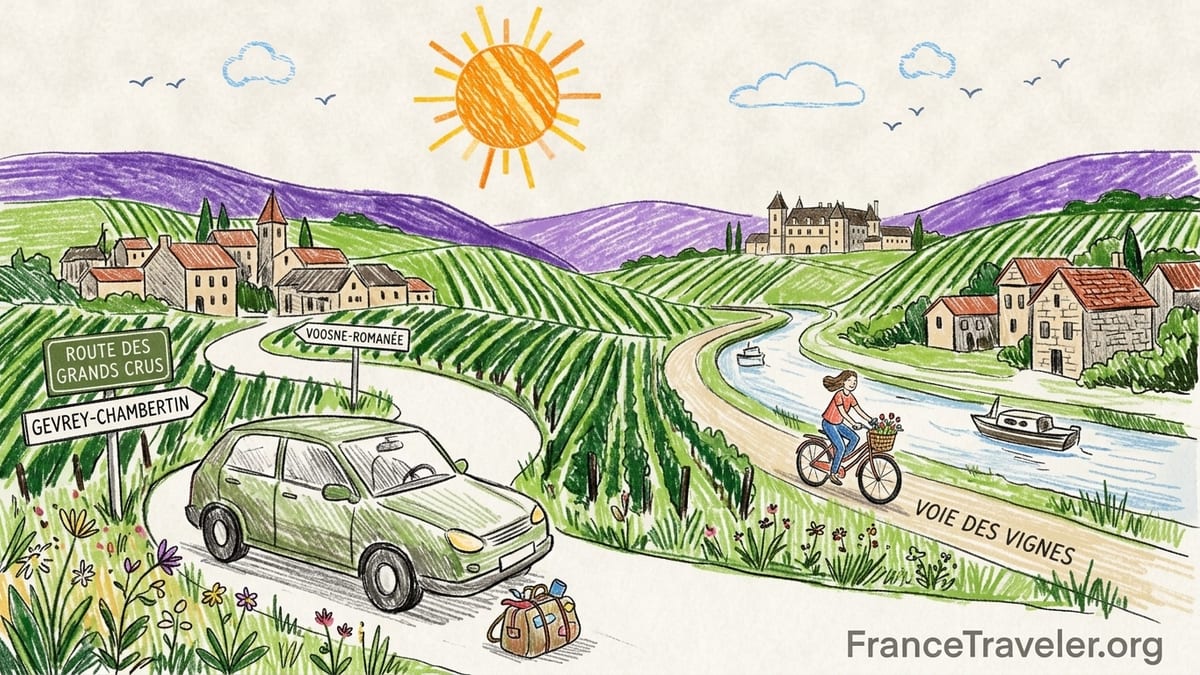
If I were planning the same route now, I would make an early decision about transport and alcohol. Either I would book a local driver or a small-group tour for one full day and give myself permission to taste as much as felt comfortable, or I would treat that driving day as a largely dry sightseeing loop, limiting myself to tiny pours and focusing on landscape, architecture and photos. There is also the option of breaking the route into cycling segments using the Voie des Vignes, a vineyard cycle path that parallels parts of the Route des Grands Crus, and reserving the car for days when no serious tasting is planned. What does not work, at least for me, is trying to combine a full driving day with the sort of relaxed, curious drinking that makes wine travel so appealing in the first place.
Changing Hotels Every Night and Losing Half a Day in Transit
The third trap I fell into is common among first-time visitors to Burgundy: over-slicing the map. Before I arrived, I decided that the “right” way to see the region was to spend one night in Dijon, two in Beaune, one in Chablis and one near the Morvan. It sounded romantic, as if I would be stringing together a chain of small, perfectly chosen bases and waking up somewhere new each morning. I underestimated how much time and energy each move between hotels would absorb.
On the ground, the numbers were sobering. Every hotel change involved a checkout routine, a drive of 60 to 90 minutes, finding parking, waiting until afternoon check-in and then figuring out dinner in a place I barely knew. Conservatively, I lost three to four hours each day to logistics. On the day we drove from Beaune to Chablis, it was closer to five hours by the time we factored in a supermarket stop and a detour around roadworks. That afternoon, I had planned to visit the cellar of a producer in Chablis town and then walk through the Grand Cru vineyards, but by the time we checked in and dropped our bags, the domaine had closed for the day and the light was already fading.
Emotionally, all this movement kept me skimming along the surface of places I wanted to know more deeply. Beaune in particular rewards lingering. It took me two days just to get my bearings in the old town and understand where the Saturday market set up, how the Hospices de Beaune timed its last entries, and which side streets held the most atmospheric wine bars. Moving repeatedly meant that I was still consulting apps to find a bakery for breakfast on my final morning instead of having a favorite café where the staff recognized my face.
If I could rebuild the itinerary, I would choose a maximum of two bases for a week-long trip, most likely Dijon and Beaune, or Beaune and a countryside stay along one of the canals. From Dijon, you can day-trip by train or car to places like Nuits-Saint-Georges, while Beaune sits in the middle of the Côte d’Or vineyards. With fewer hotel changes, I would recover at least a full day of usable time. That is the day I now imagine spending on a long lunch in a village square or cycling along the Canal de Bourgogne instead of queuing at a reception desk.
Packing Days With Sights and Long Lunches That Never Happened
In my imagination, Burgundy was a place of languid multi-course lunches that unfolded under plane trees, followed by gentle strolls through walled towns. In my spreadsheet, that translated into booking ambitious restaurant lunches in the middle of already full days. One Tuesday, I scheduled morning visits to a domaine in Meursault and the Château du Clos de Vougeot, the historic seat of the Confrérie des Chevaliers du Tastevin, with a 12:30 p.m. reservation at a well-regarded restaurant in Beaune’s center. On the map, the triangle looked tight but manageable.
The day unraveled in slow motion. The tasting in Meursault ran long, in a good way. Our host pulled an extra bottle and led us down a second flight of cellar stairs to show us older vintages slumbering in the cool. By the time we left, we were already 20 minutes behind schedule and I had a mental eye on the motorway. Morning traffic into Beaune added another 15 minutes, and we arrived at the restaurant 35 minutes late, apologetic and flushed. The staff were gracious but the rhythm was off, and what should have been a slow, memorable lunch turned into a compressed 75 minutes of watching the clock and making sure we still had time to drive north for the château visit.
We made it to Clos de Vougeot just before the mid-afternoon lull, but the combination of a big lunch and the residual wine from tasting had drained my energy. I drifted through the vast press rooms and the monk’s dormitory without reading half the panels I had flagged in my guidebook. I had technically “seen” one of Burgundy’s key sites, but I came away with only hazy impressions of stone arches and carved wooden presses. When I added up the day later, I realized we had spent around 90 euros on lunch and entry fees at the château for an experience that felt rushed on both fronts.
The change I would make is deceptively small: separate the big food experiences from the big sightseeing or tasting days. On a day when I book a special lunch at a one-star restaurant, or even a long bistro meal in Beaune or Dijon, I now try to limit other fixed commitments to a single light activity. That might be a gentle walk through the vineyards above Pommard or a quick stop at a nearby cellar-bar that does walk-in tastings. Conversely, on days when I want to focus on major sights like Clos de Vougeot, the Hospices de Beaune or Vézelay, I would keep meals flexible and simple, choosing from the many cafés and brasseries that are used to people coming and going on their own timetable.
Chasing Famous Village Names and Ignoring Burgundy’s Slow Side
Perhaps my most revealing mistake was treating Burgundy purely as a string of prestigiously named wine villages. Before the trip, I had highlighted names like Gevrey-Chambertin, Vosne-Romanée, Meursault and Puligny-Montrachet as if I were drawing stars on a map of constellations. In the process, I nearly ignored the canals, cycling routes and the wooded hills of the Morvan that the region’s tourism office puts forward just as prominently as wine. Burgundy has close to 1,200 kilometers of navigable rivers and canals, and the Tour de Bourgogne à Vélo, a long-distance cycling loop, covers several hundred kilometers along waterways and through the countryside.
During my week, I devoted exactly one afternoon to this slower side, renting bikes in Beaune and riding a short stretch of the Voie des Vignes towards Pommard. It was the most relaxed three hours of the entire trip. The dedicated path wound past low stone walls and through small plots of vines, and we stopped in a village square for coffee without any sense of a ticking clock. Yet when it came time to plan the next day, I abandoned the idea of continuing on two wheels or detouring towards the Canal de Bourgogne, which threads its way across the region and supports everything from hotel barges to self-drive boats and short sightseeing cruises. I convinced myself that “Burgundy is about wine” and that non-wine activities could wait for a later visit.
In hindsight, that afternoon cycle is the experience I remember most vividly, far more than the succession of similar tastings in anonymous cellar rooms. The existence of a structured route like the Tour de Bourgogne à Vélo, with multiple itineraries that follow canals such as the Canal du Nivernais and connect to areas near the Morvan hills, is a clear signal that the region is built for travelers who move slowly. Canal towns offer moored rental boats, small waterside restaurants and grassy towpaths where locals walk dogs at sunset. I drove past several of them at speed, catching only a glimpse of boats tied alongside and people unfolding deck chairs by the water.
If I were to rebalance the week, I would dedicate at least one full day to the canals and cycling. That might mean basing myself in a town with a small port, taking a short cruise on the Canal de Bourgogne or renting bikes to ride a section of the canal path between locks. It could also mean detouring into the Parc naturel régional du Morvan for a hike or a lake-side picnic. None of these activities appear on wine labels, but they anchor the trip emotionally in a way that another hurried tasting cannot. Burgundy’s official tourism offerings make it clear that the region is more than its most famous bottles; it took a mis-planned itinerary for me to absorb that lesson.
Visiting During Harvest Without Understanding How Busy Winemakers Are
I deliberately planned my trip for late September because I had read that harvest season was the most atmospheric time to visit. Many years, Pinot Noir and Chardonnay in Burgundy are picked between roughly mid-September and early October, although climate shifts mean the exact dates now vary and can begin earlier. What I failed to fully grasp was what harvest actually looks like for wine producers and how that would affect their availability. I imagined grape pickers working photogenically in the vineyards while I tasted in the cellar around the corner.
On arrival, I discovered that harvest is an all-hands-on-deck operation. Several small domaines I had emailed weeks earlier replied with polite notes saying that they were in the middle of bringing in fruit and could not host visits. One vigneron in the Hautes-Côtes offered us a slot at 8 p.m. after a day picking and sorting, and although I appreciated the gesture, I declined because it felt intrusive. Another estate warned that our booked tasting might be cancelled at short notice if the weather shifted and a parcel needed to be harvested. In one village, the main street was partially blocked by tractors towing trailers piled with crates of grapes, slowing traffic to a crawl and making parking more competitive.
The atmosphere was indeed electric, with teams of pickers singing in the rows and the smell of fermenting juice drifting from open cellar doors, but it was not a relaxed time to knock unannounced on doors or expect long, leisurely conversations with owners. Larger, more visitor-oriented producers continued to host tastings without interruption, and the cooperative cellars in towns like Beaune absorbed much of the visitor flow, but my fantasy of intimate harvest tastings at tiny family domaines collided with the reality of an industry working one of its most intense weeks of the year.
On a return visit, I would either approach harvest with a clearer strategy or pick a different season. If I wanted to be there during picking, I would concentrate appointments at larger estates with dedicated hospitality teams and rely more heavily on wine bars and merchant houses in Beaune, Nuits-Saint-Georges or Dijon that pour a range of producers. I would also keep at least one day completely free of bookings, leaving space to follow my nose toward a village fête, a food market or simply more time in the vineyards watching the work unfold. Alternatively, visiting in late October, when the leaves have turned and the cellars are calmer, might offer a better balance between atmosphere and access.
Assuming Rural Burgundy Stays Lively Late Into the Evening
My final mistake was importing big-city assumptions about evening life into small-town Burgundy. Coming from Paris a few days earlier, I expected that I could eat dinner at 9 p.m., wander around afterwards and perhaps drop into a wine bar for a final glass. In reality, outside Dijon and the busier corners of Beaune, many restaurants in villages along the Côte d’Or and in the countryside stop serving dinner relatively early. Kitchens may take their last orders around 8:30 or 9 p.m., and some places close entirely on Sunday or Monday evenings outside peak months.
More than once, we arrived back in a village after a late-afternoon tasting to find shuttered shopfronts and a single bar still open. In one small town near the Canal du Centre, we misjudged the timing completely. After lingering along the water to watch the lock-keeper guide a boat through, we strolled up to the only restaurant we had noticed earlier, only to discover that its kitchen had closed at 8:45 p.m. It was 9 p.m., we had not eaten since a light picnic at noon, and the next open option was a 25-minute drive away. In the end, we pieced together dinner from a petrol station’s sandwich refrigerator and a packet of local cheese we still had in the trunk.
These are small inconveniences in the grand scheme of travel, but they chipped away at the image I had of spontaneous, late-night Burgundy. The quiet streets that felt charming at dusk became slightly anxiety-inducing when we realized we had not planned ahead. It underscored for me how much Burgundy wants to be enjoyed at a human pace: shops in many villages close for a long lunch break, and evenings are oriented around early-ish dinners and time at home rather than nightlife.
Now, when I think about returning, I plan evenings first. I look up restaurant opening days and hours in advance, book tables for 7:30 or 8 p.m. on key nights, and keep some simple picnic supplies in the car for evenings when we are caught out by early closures. In towns like Dijon and central Beaune, where there is more choice and later hours, I still make reservations but feel less pressure. In small canal-side villages or wine hamlets, I accept that the day effectively ends after dinner and treat the quiet as part of the reason to be there: an invitation to sit with a glass of Aligoté on a terrace or read a book in the courtyard instead of chasing the next thing.
The Burgundy Trip I Would Plan Now
All of these missteps add up to a simple realization: Burgundy is structured for depth, not breadth. When I try to cram it into the model of a fast-paced, highlight-driven trip, everything that makes it special recedes into the background. The wines blur, the villages become interchangeable and the landscapes reduce to scenery glimpsed from a car window. The costs are counted not only in euros spent on tastings I rushed through or meals I could not fully enjoy, but also in hours lost to driving and logistics that could have been spent walking, cycling or simply sitting still.
If I were to design the same week again, I would start with two bases instead of four: three or four nights in Beaune and three nights near a canal or in the Morvan foothills. From Beaune, I would schedule no more than two winery appointments per day on two or three days total, focusing on a mix of one or two mid-sized domaines that welcome visitors and one or two tastings in town at merchant houses or cooperative cellars. That probably means paying for four to six structured visits in a week instead of the ten I attempted the first time, but it also means that each one has room to breathe. I would set aside one full day to cycle the Voie des Vignes between Beaune and Santenay and another to follow the canal towpaths near the Canal de Bourgogne or the Canal du Nivernais, possibly including a short cruise.
On the food front, I would choose two memorable, extended lunches or dinners and make them the centerpiece of their days, keeping everything else light and flexible. If lunch at a serious table in Beaune is the highlight of Tuesday, then Tuesday’s only other firm plan should be a gentle morning stroll through the market or an afternoon wander in the vines. Sightseeing would be spread out: perhaps a half day at the Hospices de Beaune, a morning in Dijon’s historic center reached by train instead of by car, and a day trip to Vézelay or a Morvan lake, where wine takes a back seat to landscape and history.
Practical details would reflect what I have learned. I would avoid driving long distances on heavy tasting days, choose one day with a hired driver if I really wanted to immerse myself in the wines along the Route des Grands Crus, and accept that some producers, especially during harvest, will not be available. Instead of chasing the most illustrious village names, I would pay attention to the feel of each place: a café terrace in Santenay, a canal-side bench in Pouilly-en-Auxois, a quiet churchyard in a Hautes-Côtes village. I would check restaurant hours, book earlier dinners in small towns, and embrace the quiet evenings as part of Burgundy’s charm.
Most of all, I would let Burgundy set the rhythm. The presence of long-distance cycling routes like the Tour de Bourgogne à Vélo and hundreds of kilometers of canals is not incidental. It reflects a region that reveals itself slowly, at walking pace, bike pace, boat pace. It took a week of over-scheduling, over-driving and over-tasting for me to understand that lesson. The next time I go back, I plan to bring fewer reservations, fewer big plans and a great deal more time to do very little indeed.
The Takeaway
Burgundy taught me more about how I travel than any other wine region I have visited. It exposed my tendency to equate quantity with quality, to count experiences instead of inhabiting them. By stacking tastings, racing along the Route des Grands Crus behind the wheel, changing hotels almost every night and chasing famous names at the expense of canals, bikes and forests, I built an itinerary that looked impressive on paper and felt strangely hollow in person.
The region itself offered a different template. Long, signed cycling routes along the canals, sleepy locks with moored boats, and vineyard paths linking one stone-built village to another all suggested a way of being that had nothing to do with spreadsheets. Winemakers, when they had the time to talk, reinforced the message: the best wines reflect patience, attention and respect for each season’s rhythm. It is no accident that the travelers who seemed happiest in Burgundy were those who had rented a houseboat for a week, or a small gîte for ten days, and were content to let their days be shaped by weather and appetite rather than by appointment times.
If there is one takeaway I hope other travelers can borrow from my mistakes, it is that Burgundy rewards subtraction. Subtract one tasting from each day, one hotel change from the itinerary, one big lunch from a packed schedule. In the space that opens up, you will find the experiences that stay with you: the quiet canal at dusk, the unexpected conversation at a village bar, the moment when a single glass of village wine tastes like a complete story because you finally have the time to listen.
FAQ
Q1. How many winery visits should I plan per day in Burgundy?
Most travelers find that one or two pre-booked winery visits per day is ideal. This leaves enough time to enjoy each tasting, handle driving safely and still explore villages, markets or canal paths without feeling rushed.
Q2. Do I need a car to explore the Route des Grands Crus?
A car is helpful, but not essential for every day. You can combine short drives with cycling sections on the Voie des Vignes, use local taxis or hire a driver for one focused wine day so you are free to taste without worrying about driving.
Q3. Is it a good idea to visit Burgundy during the grape harvest?
Harvest season can be magical, with pickers in the vines and fermentations starting in the cellars, but small producers are very busy and may offer fewer visits. If you go, book key tastings well ahead and be flexible about last-minute changes.
Q4. How many bases should I use for a one-week trip?
For a week, two bases are usually enough, for example Beaune plus Dijon, or Beaune plus a smaller town near a canal or the Morvan hills. Using fewer bases saves you several hours of packing and checking in and out.
Q5. Are there things to do in Burgundy besides wine tastings?
Yes. Burgundy is also known for its canals, cycling routes and natural areas. Travelers can ride parts of the Tour de Bourgogne à Vélo, walk canal towpaths, cruise sections of the Canal de Bourgogne or explore the forests and lakes of the Morvan.
Q6. How late do restaurants and wine bars stay open in smaller towns?
In villages and small towns, restaurant kitchens often stop serving around 8:30 or 9 p.m., with some places closed on certain evenings. It is wise to check hours in advance, make reservations and keep simple picnic supplies on hand just in case.
Q7. Is it safe to combine wine tastings and driving in Burgundy?
You should always treat drinking and driving very cautiously. Spitting during tastings, limiting the number of visits and planning some days with no driving or with a hired driver are all sensible ways to stay safe on Burgundy’s narrow country roads.
Q8. How can I experience Burgundy’s canals without renting a boat for a week?
Many canal towns offer short cruises, day boat rentals or easy walking and cycling paths along the towpaths. Even a half-day ride or a short cruise on the Canal de Bourgogne or the Canal du Nivernais gives a strong sense of the region’s slower side.
Q9. What is a realistic pace for cycling in Burgundy if I am not very sporty?
Much of the cycling infrastructure follows relatively gentle routes along canals or through rolling vineyard country. Planning 20 to 30 kilometers in a day, with plenty of time for café stops and photos, is realistic for many casual cyclists.
Q10. How far in advance should I book tastings and restaurants?
For popular domaines and well-known restaurants, it is sensible to book several weeks ahead, especially in September and October. For more casual wine bars and bistros, a few days’ notice or even same-day reservations are often enough outside the busiest weekends.