


I went to Burgundy for all the classic reasons. I had dreamed of cycling past stone-walled vineyards on the Route des Grands Crus, sipping pinot noir in centuries-old cellars and wandering medieval streets in Beaune at golden hour. On those fronts, Burgundy absolutely delivered: the light on the vineyards around Pommard really is as soft as the photos suggest, the Hospices de Beaune is as exquisite in person as in brochures, and the food in even simple bistros can be astonishingly good. But the trip was not as effortless as the romantic images had led me to believe, especially coming from wine regions where you just follow a road, pull into tasting rooms and let the day unfold. What follows is a reality check on what made my time in Burgundy harder than expected, and what I would do differently next time so that you can skip the frustrations and keep the magic.
Public Transport: Great Between Towns, Thin Between Vineyards
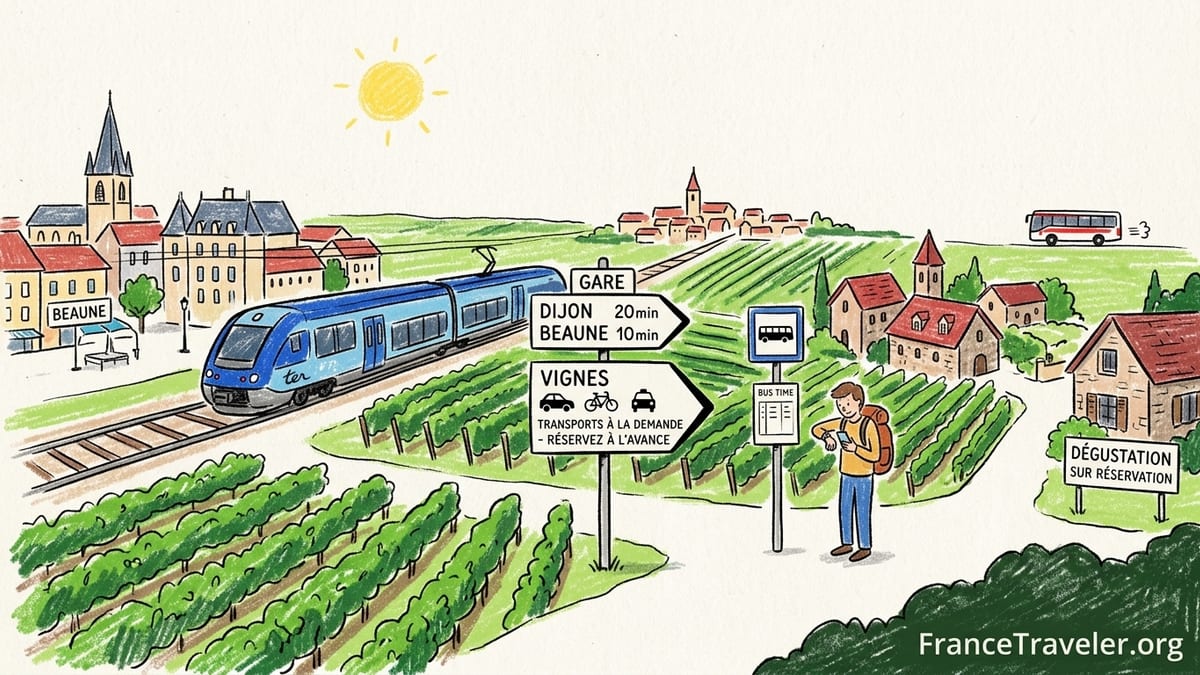
Before my trip, I checked that there were regular regional trains between Dijon and Beaune, and between Beaune and Chalon sur Saône. That part worked exactly as promised. TER Bourgogne Franche Comté trains shuttle frequently along this north south spine, with several services per day and advance fares often under 15 euros for journeys such as Dijon to Beaune. I used the train to move between my larger bases and it was reliable, clean and on time. The surprise came once I tried to translate that easy intercity movement into visiting actual wine villages and domaines.
On the map, the famous wine route looks compact. Nuits Saint Georges, Vosne Romanée, Gevrey Chambertin and Vougeot march down the Côte de Nuits; Pommard, Volnay, Meursault and Puligny Montrachet line the Côte de Beaune. In practice, bus services into these villages are limited, especially outside commuter times. I learned this the hard way when I tried to go from Beaune to Puligny Montrachet for a late morning walk and tasting. The only bus that fit was early, there was no return in the late afternoon, and the local on demand transport service required booking ahead on a French phone line I did not yet understand. I ended up paying for a taxi back to Beaune that cost almost as much as my lunch.
The lack of spontaneous connections also changed the mood of the trip. Instead of lazily hopping from village to village, I was constantly checking the clock, calculating if I had time to walk the 7 or 8 kilometers back along the Voie des Vignes cycle route, and worrying about being stranded in a village with one bar tabac and no evening bus. It drove home that Burgundy is designed for visitors with a car or a bike, not for those who arrive expecting dense rural transit like in Japan or Switzerland.
How to avoid this: treat the trains as a way to move between hubs such as Dijon, Beaune, Chalon sur Saône and Macon, then assume you will need either a rental car, e bikes or organized transfers in between. Beaune’s tourism office provides information about local bike rental and a transport on demand service; book those at least a day in advance. If you do not want to drive, concentrate your stay in a town like Beaune or Nuits Saint Georges and focus on wineries and wine bars you can reach on foot or by short taxi ride, rather than trying to crisscross the entire Côte in three days.
Short Evenings, Early Closures And Quiet Sundays
I knew France took Sundays seriously, but experiencing it as a hungry, slightly jet lagged traveler was a different story. On my first night in Beaune, a Sunday, I arrived around 7.30 in the evening assuming I could drop my bags and wander out to find a casual dinner. The streets around the Hospices were atmospheric, the light lovely, but the restaurant shutters told a colder truth. Several well known wine bars and bistros were closed for the day. The places that were open were already full or had stopped taking new tables. I ended up eating a serviceable but forgettable meal in one of the few spots that could squeeze me in at 9, mostly because I had not booked ahead.
The rhythm repeated through the week, especially in smaller villages. In Meursault and Volnay, bakeries often closed for several hours in the afternoon; small épiceries would shut by early evening. On a Monday in Nuits Saint Georges, many restaurants were still closed after their Sunday rest day, and some shops took Monday morning off as well. I walked through pretty streets past dark windows and found myself counting the open doors like a scavenger hunt. There is a practical impact to this beyond mild disappointment: it makes planning meals and grocery top ups much more important, and it limits the spontaneous cafe culture that some visitors associate with France.
On the flip side, when I did plan ahead, the region rewarded me. A Tuesday evening reservation at a wine focused bistro in Beaune turned into one of the best meals of the trip, and the calm of a quiet Sunday morning in Dijon, with most shops closed and only a few bakeries serving locals, had its own charm once I aligned with it. The issue was not that Burgundy was doing anything wrong. It was that I arrived with expectations shaped by more commercialized wine regions where every evening is a chance to sell another tasting flight.
How to avoid this: check the opening days and annual closures of specific restaurants, bars and attractions before you travel, especially if you visit in the shoulder seasons or around holidays. In Beaune and Dijon, reserve dinners for Friday through Monday nights if you care about particular restaurants, and keep a simple backup option in mind such as a wine bar that serves sharing plates. When you base yourself in a small village, treat your accommodation kitchen or picnic options as part of the plan. Buy bread, cheese, fruit and a bottle in the late morning so you are not caught out when shops close mid afternoon or early evening.
Wineries Are Not Casual Tasting Rooms
Perhaps the biggest shock for me, coming from regions like California and parts of Australia, was how structured wine tasting in Burgundy has become. I had pictured a day of meandering along the D974, pulling into domaines that caught my eye. In reality, the estates that I had actually heard of either did not accept casual visitors or were strictly by appointment, often scheduled weeks in advance. In Beaune, a historic house I wanted to visit made that clear online: tastings and cellar visits available only by reservation, typically lasting around 90 minutes with a set flight of wines and a fee per person.
I first ran into this when I tried to visit a mid tier négociant house in Beaune on a whim between lunch and an afternoon walk. At the reception desk, the staff explained politely that all tastings that afternoon were fully booked with groups and pre scheduled visitors. They could squeeze me into a shorter, more basic tasting two days later. I left with a brochure instead of a glass, frustrated that my only mistake was assuming I could pay and enter. Later in the week, in a small village south of Beaune, a family domaine that I had read about online had a hand painted sign outside, but when I rang the bell the owner gently explained they were in the middle of bottling and only saw visitors by appointment. I apologized in halting French and backed away, suddenly very aware that this was a working farm, not a shopfront designed for tourists.
There are tasting options without reservations, usually at more commercial cellars and wine boutiques that represent multiple producers, but they do not always focus on the specific tiny domaine you fell in love with from a restaurant wine list back home. In Beaune, I eventually booked a structured tasting at a cellar that poured wines from several appellations, including village and premier cru bottlings. It was informative and enjoyable, but it was not the romantic drop in at a single family domaine I had imagined.
How to avoid this: treat winery visits in Burgundy like restaurant bookings. Choose a realistic number of domaines you genuinely care about, research which ones welcome visitors, and contact them several weeks in advance through their official channels or through a specialized wine tour operator. Build your days around one or two substantial visits, each lasting an hour or more, rather than trying to cram in five or six drop ins. For spontaneous tasting, use wine bars and multi producer cellars in towns like Beaune and Dijon, where you can explore different producers without disrupting someone’s harvest schedule.
The Cost Of Prestige And The Reality Of Tasting Fatigue
Another misconception I brought to Burgundy was the idea that I could taste my way through famous labels at modest prices. The reality is that many of the most sought after vineyards produce tiny quantities, and their wines are allocated through long standing relationships. When I sat down in a wine bar in Beaune and asked about trying a grand cru from Vosne Romanée by the glass, the sommelier smiled and pointed instead to a list of village level and regional wines in the 10 to 20 euro range per glass. A single pour from a very prestigious vineyard, he explained, would cost several times that if available at all. In bottle form, some well known grand crus from producers with global demand were listed in the hundreds of euros, well beyond my casual tasting budget.
Even structured tastings reflect this scarcity and prestige. At one estate, the entry level visit included a mix of regional and village appellations at a reasonable fee per person, but stepping up to premier cru and grand cru flights nearly doubled the price. In another cellar, a “prestige” lineup featuring several premiers crus and at least one grand cru approached 90 euros per person. I do not regret the money I spent, but it was clear that Burgundy is not the place to chase famous labels without thinking about cost. On a practical level, it meant I tasted more carefully and took more notes, then spread the most expensive experiences across the trip instead of stacking them in one day.
There is also the simple human limit of tasting. Several of the visits I booked lasted well over an hour and included five or more wines. After walking vineyards in the sun and concentrating on the nuances of each pour, I found my palate and attention waning by late afternoon. One ambitious day, I scheduled two full cellar visits plus a glass at a wine bar before dinner. By the second tasting, I was struggling to appreciate the differences between crus, and by dessert that evening I honestly just wanted water. The trip taught me that quality in Burgundy depends as much on your physical and mental freshness as on what is in the glass.
How to avoid this: set an honest budget for tastings and bottles before you go, including a rough ceiling for what you are willing to spend on a special experience. Focus on village and premier cru wines from good producers rather than chasing grand crus at any price. Limit yourself to one serious visit per half day, and do not be shy about spitting or using the dump bucket, even when the wines are excellent. Finally, mix tasting days with slower, wine free activities so that when you do sit down in a cellar, you are engaged and able to appreciate what Burgundy does best.
Driving, Distances And Sleepy Rural Bases
On the map, the vineyards of the Côte d’Or form a neat vertical strip. In reality, distances between villages that look walkable can feel longer once you factor in hills, heat or rain. Early in the trip, I chose to base myself in a small village near Pommard, thinking it would be romantic to wake up among the vines rather than in a town. The mornings were indeed beautiful. The evenings were a different story. After sunset, the village streets were almost entirely silent. One restaurant in the village operated only on certain days and required advance reservations; when it was closed, I had to drive to Beaune or rely on a taxi that needed to be booked ahead. Walking back along unlit lanes after dinner did not feel entirely comfortable, especially during harvest when tractors and vans move late into the night.
Driving itself was not particularly difficult; the D974 and smaller local roads are well maintained and traffic is generally light outside peak commuting times. The challenge was combining driving with tasting. Even with careful spitting, a full day of cellar visits followed by a drive on narrow country roads was not something I wanted to repeat. I met other travelers in Beaune who had tried to stay in one village and drive each day to another part of the Côte, only to find themselves constantly shuttling back and forth and rarely able to relax over a full glass with lunch.
The other trade off with a rural base is atmosphere. During the day, villages like Puligny Montrachet, Chassagne Montrachet or Vosne Romanée can feel postcard perfect, especially when tour groups are in town. After about 7 or 8 in the evening, many of them become so quiet that you can hear your own footsteps echo. If you are seeking solitude, this can be bliss. If you imagine yourself strolling from your gîte to lively wine bars at night, you may be disappointed. In contrast, evenings in Beaune or Dijon offer a gentle but real buzz, with locals and visitors sharing terraces, even if it is far from a big city nightlife scene.
How to avoid this: be realistic about how you want to spend your evenings. If you value a choice of restaurants, a few lively bars and the ability to walk home without worrying about traffic or dark lanes, choose a base like Beaune, Dijon or possibly Nuits Saint Georges. Use the rural villages as daytime destinations reached by car, bike or organized tour. If you do stay in the countryside, clarify in advance which nights your nearest restaurant serves dinner, whether your accommodation offers meals, and how you will return safely if you choose to dine elsewhere.
Language Friction And Cultural Rhythm
Another subtle but real source of friction was language. In larger centers like Dijon and Beaune, many people in hotels, major attractions and some restaurants spoke excellent English. Once I moved into smaller villages and more traditional establishments, that shifted. At one family run domaine, the matriarch who welcomed me spoke only French. She was patient and kind, but my rusty high school vocabulary did not stretch to the nuances of vine training or cellar humidity. We laughed our way through, but I left aware that I had missed much of her deeper insight.
Similarly, making reservations by phone in French was stressful. Some domaines and restaurants offer online booking forms, but others still rely on emails or calls that may be answered in French. In one case, after two unanswered emails to a small producer whose wines I loved, I realized that they probably prioritized importers and long time customers over casual foreign visitors. It stung a little, but it was also a reminder that Burgundy is, first and foremost, a working agricultural region, not a theme park designed for anglophones.
There is also a different cultural rhythm around time. When a tasting is scheduled for 10 in the morning, it typically means a focused visit that may run 60 to 90 minutes, not a quick sip and go. Lunch at a good restaurant is rarely a 45 minute affair; it is a multi course experience that understandably cannot be rushed without prior agreement. On one occasion, my attempt to squeeze a restaurant lunch, a cellar visit and a drive across the Côte into a single afternoon left everyone slightly frazzled, including the staff who had to hurry my dessert so I could make my next booking.
How to avoid this: learn and use basic French phrases for greetings, gratitude and simple requests. Even a few words go a long way toward warmth and patience. When possible, choose domaines and restaurants that accept online reservations, and allow more time than you think you need between appointments. Accept that not every producer will be open to casual visitors, no matter how enthusiastic you are about their wines. The upside is that the places that do welcome you usually have the time and desire to share their world in depth.
When Postcard Images Do Not Match Reality
Travel marketing has made Burgundy look almost impossibly perfect. In photos, every village lane glows at sunset, each vineyard row is perfectly manicured, and every wine town bustles with happy cyclists. Reality is more mixed. On a grey day in late autumn, the vineyards can look stark, with bare vines and mud underfoot. During harvest, some lanes are lined with tractors, plastic harvest bins and parked vans. Outside peak season, certain squares in otherwise famous villages can feel surprisingly empty, with closed shutters and only a few locals going about their business.
I felt this disconnect most strongly in one village that had long lived in my imagination from glossy road trip features. The article had shown a lively square with cafe terraces and cyclists clinking glasses beneath plane trees. When I visited on a random weekday in shoulder season, the square was undeniably handsome but almost deserted. Two cyclists in rain jackets were gulping soup inside a bar, one cafe was closed for its weekly rest, and a small grocery store displayed a sign apologizing for reduced hours. It was perfectly pleasant to sit and watch the drizzle, but it was not the convivial scene I had expected.
The same applies to some high profile attractions. The exterior of the Hospices de Beaune really is a marvel, but the interior visit can feel busy at peak times, with guided groups moving through narrow spaces. Certain viewpoints along the Route des Grands Crus, promoted in brochures as serene lookouts, may have a line of parked cars or tour buses when you arrive. None of this erases the beauty of Burgundy, but it does remind you that there is a difference between a carefully framed image and a lived experience.
How to avoid this: calibrate your expectations by paying attention not just to photos but to season, time of day and context. If you want golden vineyard shots, plan for late September or early October and be prepared for company. For quieter, more contemplative visits, consider late spring or midweek days and embrace less dramatic weather. When looking at promotional images, remember that they often represent the best possible moment, not an everyday scene. If you arrive in a village and find it sleepier than expected, treat it as permission to slow down, walk a side street or duck into a simple bar rather than chasing the exact image you saw online.
The Takeaway
Despite the frustrations I have described, I left Burgundy already plotting my return. The region is not difficult because it is unfriendly; it is challenging because it runs on its own quiet, work focused schedule, and because its fame far exceeds its physical size. Once I slowed down, accepted that I would visit fewer domains, and treated each day as a balance between vineyards, villages and proper rest, Burgundy became much easier to love.
If I were to plan the trip again, I would choose two bases at most, probably Dijon and Beaune, and limit myself to a small handful of pre booked cellar visits with producers whose wines I genuinely want to understand. I would rent a bike for at least one day to ride between villages rather than racing by car, and I would block out entire afternoons with no appointments at all, just time to sit in a cafe, wander lanes and watch the light shift on the vines.
Most of all, I would treat Burgundy less like a checklist of famous names and more like a living countryside. The inconveniences rural transport, early closures, structured tastings and quiet evenings are, in many ways, the very things that have helped preserve its character. If you know about them before you go, you can plan around the rough edges and give the region the time and attention it quietly asks for. Do that, and Burgundy stops being a slightly stressful pilgrimage and becomes what it deserves to be: a place where slowing down, in every sense, is the greatest luxury.
FAQ
Q1. Do I need a car to visit wineries in Burgundy?
Not strictly, but having a car or hiring a driver makes visiting rural domaines far easier. Trains connect major towns like Dijon and Beaune, yet public transport into small villages and between vineyards is limited, especially outside commuter hours, so without a vehicle you will rely heavily on taxis, bikes or organized tours.
Q2. How far in advance should I book wine tastings?
For popular domaines and historic houses, aim to book several weeks ahead, particularly in harvest season, around major events or in peak summer. Smaller family producers may not have online booking systems and often prioritize existing customers, so contacting them early and being flexible with dates and times increases your chances of securing a visit.
Q3. Are there any wineries that accept walk in tastings?
Yes, but they are more likely to be larger négociant houses, cooperative cellars or multi producer tasting spaces in towns like Beaune, Dijon or Chablis. Many small, well known producers work by appointment only and do not run casual walk in tasting rooms, so plan to use wine bars and town based cellars for spontaneous sampling.
Q4. Is Burgundy very expensive for wine tasting?
The cost varies widely. Basic tastings of regional and village wines can be relatively affordable, while prestige flights including premier or grand cru wines and private visits can be significantly more expensive. Setting a daily tasting budget and focusing on well chosen experiences rather than chasing only big name labels helps keep costs under control.
Q5. What days are restaurants and shops most likely to be closed?
Many businesses close on Sundays, and in some cases on Monday as well, especially in smaller villages. Afternoon closures and weekly rest days are common, so you may find reduced options for meals or shopping at these times. Checking specific opening hours in advance and planning grocery or bakery visits earlier in the day can prevent last minute scrambles.
Q6. Which towns make the best bases for first time visitors?
Beaune is a classic choice thanks to its central location on the wine route, walkable centre and wide range of restaurants and tasting options. Dijon offers more of a small city atmosphere with strong rail connections, while Nuits Saint Georges provides a quieter base with access to the Côte de Nuits. Tiny villages are charming for a night or two but can feel very quiet in the evenings.
Q7. What is the best way to get between vineyards if I do not want to drive?
Consider renting a bike or e bike in Beaune or Dijon and using the dedicated vineyard cycle routes, which connect several villages at a relaxed pace. Alternatively, book a local guide or driver who specializes in wine tourism so that you can visit multiple domaines safely without worrying about alcohol limits or parking in small villages.
Q8. Will I manage if I do not speak French?
In hotels, major attractions and some restaurants, you will usually find staff who speak English, but in smaller villages and family run domaines French is more common. Learning a few key phrases and approaching interactions with patience and courtesy make a noticeable difference, and written confirmations for bookings help reduce misunderstandings.
Q9. When is the best time of year to visit Burgundy?
Late spring and early autumn are particularly attractive, offering pleasant temperatures and vineyards at either fresh green or golden stages. Harvest period can be exciting but also busy, with producers focused on work in the vines and cellar, while deep winter and mid summer bring more limited hours or heat, depending on the year, so your ideal timing depends on whether you prioritize scenery, quiet or event driven energy.
Q10. How many wineries should I visit in one day?
Two substantial visits in a day is usually enough in Burgundy. Cellar tours and structured tastings often run 60 to 90 minutes and involve careful attention, so trying to squeeze in more can lead to fatigue and rushed experiences. Combining one or two visits with time for a proper meal, some walking and simple village exploration creates a more enjoyable rhythm.