


I landed in Burgundy with the wide-eyed expectation of a pilgrim finally reaching a holy site. Legendary labels I had only read about, UNESCO-listed vineyards carved into 1,247 Climats, names like Vosne-Romanée and Gevrey-Chambertin that appear on auction sheets and sommelier exams. In my mind, great wine automatically translated into great wine tourism: open doors, welcoming domaines, and a glass of Pinot Noir waiting in every stone cellar. Within 48 hours, that illusion had cracked. Burgundy was unforgettable, but not at all in the simple, seamless way I had imagined.
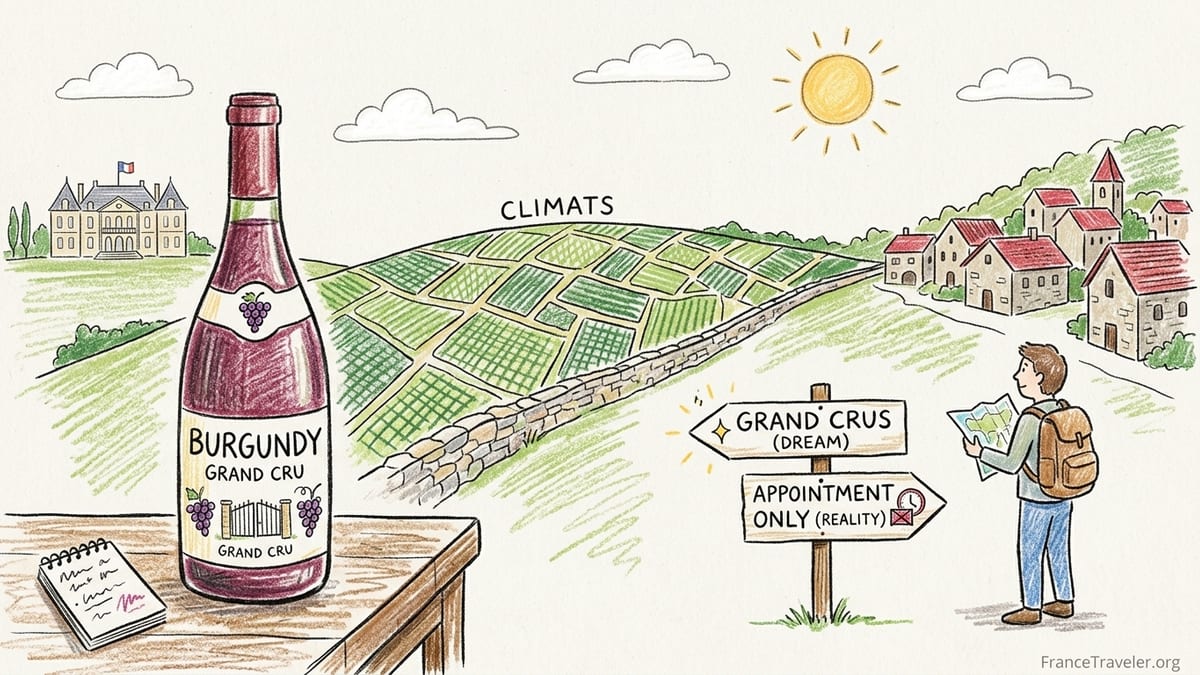
Dreaming in Grand Crus: Expectations Before Arrival
Before I set foot in Beaune, my mental picture of Burgundy borrowed heavily from glossy coffee-table books and romanticized travel features. I imagined the Route des Grands Crus as a kind of wine lover’s Main Street, where revered domaines would be ready for drop-in visitors who had finally made their pilgrimage. In my notebook I had underlined names like Romanée-Conti, Rousseau, Leroy, and Coche-Dury, almost as if I were building a tasting checklist rather than planning a realistic itinerary.
The UNESCO inscription of the “Climats, terroirs of Burgundy” had only amplified those expectations. I knew that between Dijon and Santenay there are roughly 1,247 precisely delimited vineyard parcels, each with its own name and historic reputation, now formally recognized on the World Heritage List since 2015. That sounded to me like an open-air museum of terroir, and I naively assumed that such global recognition would come with an equally well-oiled system for welcoming curious visitors.
In my head, I merged Burgundy with regions like Napa or parts of Rioja, where you can often hop between tasting rooms with little more than a rough plan and a designated driver. I pictured polished visitor centers at every famous estate, extensive by-the-glass lists, and staff accustomed to fielding questions from beginners and collectors alike. If anything, I worried more about crowds than about access.
What I found when I arrived in Beaune, rented a small car, and pointed myself toward the Route des Grands Crus was something different: a region whose wine culture is incredibly rich, but whose tourism model can feel opaque, exclusive, and occasionally indifferent to the casual enthusiast who shows up without advance arrangements.
The First Shock: The Biggest Names Do Not Need You
My first surprise was how invisible the most mythic domaines are from a tourist’s perspective. In Vosne-Romanée, the village that produces some of the most coveted Pinot Noir on the planet, you can park the car, stroll up to the famous Romanée-Conti vineyard wall, look at the neat rows of vines and the modest stone cross, and then realize that there is nowhere to actually taste those wines. Domaine de la Romanée-Conti does not operate a walk-in tasting room. Even industry professionals often struggle to secure a visit, and private buyers are usually allocated bottles through long-standing relationships rather than through any cellar-door charm offensive.
The same pattern repeats in other villages whose names have become shorthand for greatness. In Gevrey-Chambertin and Chambolle-Musigny, the signs for revered domaines are there, often attached to unassuming stone houses that look more like private homes than luxury brands. Yet a traveler without industry contacts will frequently find closed gates, no visitor information, and websites that either do not mention tourism or explicitly say “no public tastings” or “by appointment only.” Several respected guides to Burgundy wine travel now state this bluntly: Burgundy’s most famous domaines receive no holidaymakers and do not need wine tourism to sell their wines.
For someone raised on the idea that superb wine regions welcome and educate drinkers on-site, this can feel like a snub. It is not personal; it is economics and history. Production is tiny, demand is global, and bottles disappear into private cellars and restaurant lists long before any tourist could taste them at the source. Still, the emotional effect is real. Arriving in Vosne-Romanée, seeing the sign for La Tâche, and knowing that the nearest you may get is a photograph by a stone wall can be deflating.
That sense of distance is compounded by the practicalities of appointments. Many domaines that do accept visitors require advance booking, sometimes by email in French, often during limited weekday hours. Schedules fill weeks or months ahead, especially around busy periods like the Hospices de Beaune wine auction each November. The casual notion of “let’s drive and see where we stop” turns out to be a recipe for disappointment along much of the Côte d’Or.
Appointment-Only Reality and the Transactional Tasting
Once I adjusted my expectations and secured a few appointments, another aspect of Burgundy tourism emerged. Tastings at working domaines often feel closer to business meetings than to leisurely experiences. This is not universal, but it is common enough that travelers should be prepared. At one mid-sized Côte de Nuits estate I visited, the appointment lasted barely 45 minutes. We were poured through a flight of wines in quick succession, the technical details recited with efficiency. There was little time for conversation beyond perfunctory questions, and at the end there was an unmistakable expectation that we would buy multiple bottles. The fee was modest by global standards, but the atmosphere felt transactional rather than welcoming.
On another day in the Côte de Beaune, a domaine that had confirmed our visit months before asked us to share the tasting with a small group of importers. The wines were superb and the cellar impressive, but the focus was understandably on the professionals who might order pallets rather than on two individual travelers buying a handful of bottles. When the tasting fee edges above 30 or 40 euros per person, and the bottles you feel nudged toward start around 60 euros and climb steeply, the pressure for an “efficient” visit can undermine the romance that drew you there in the first place.
For comparison, some of the larger négociant houses in Beaune have adopted a more structured, visitor-friendly model. Patriarche, for instance, offers a self-guided tour of its extensive cellars under Beaune that ends with multiple wines available to taste with the help of an electronic card, at set prices for different packages. The experience feels more like a museum visit combined with a tasting bar. You lose some intimacy, but you gain clarity: prices, time slots, and expectations are clearly laid out before you descend into the tunnels.
This contrast between small, appointment-only domaines and bigger houses highlights one of Burgundy’s central tourism tensions. The region is built on tiny family holdings and micro-parcels of vines, but the traveler experience is smoother where operations are large enough to professionalize hospitality. Those haunting, hand-painted signs at the end of narrow village lanes often point to producers whose reality is closer to agricultural workshop than tasting lounge.
Sticker Shock and the Intimidation Factor
There is no way to avoid the subject of price. Burgundy has become one of the most expensive regions in the world for Pinot Noir and Chardonnay, and that reality filters down to the visitor. Even at village level, bottles at the cellar door often start around 25 to 35 euros and climb sharply for premier cru and grand cru wines. In a few Beaune shops that specialize in mature vintages or big names, it is not unusual to see grand cru bottles comfortably above 300 euros, with rarities stretching into four figures. For an ordinary traveler used to paying 20 or 30 dollars for a good bottle at home, it can be hard to know where a reasonable splurge ends and collector territory begins.
The pricing question is not just about the wines. Tasting experiences themselves have followed global trends upward. Structured workshops in Beaune, such as those offered by the Burgundy Wine School or wine schools like Sensation Vin, often charge in the region of 70 to 200 euros per person for half-day or full-day courses that include several wines, guided teaching, and sometimes a vineyard visit. Specialist tasting days organized by the Cité des Climats et vins de Bourgogne can run around 200 euros for a full day of instruction, tastings, and transport. These prices are not out of line with serious educational experiences elsewhere, but they can be a shock to visitors who expected casual bar-style tastings for a small fee.
Layered over price is an intimidating vocabulary that even intermediate wine lovers may find dense. Labels bristle with terms like climat, lieu-dit, premier cru, monopole, and a hierarchy of appellations that climbs from Bourgogne rouge to village to premier cru to grand cru. On the ground, the same village name can appear on bottles from dozens of different estates, each farming different parcels. In one Beaune tasting room, a staff member pulled out a map to show how a single premier cru vineyard is divided among many owners, each producing a wine labeled with the same vineyard name but the domaine’s own style and price. Without some prior study, it is easy to feel lost, and that insecurity can make already expensive choices feel riskier.
For beginners, this combination of complex terminology and significant cost can transform curiosity into anxiety. More than once I saw visitors quietly gravitate toward “safe” options like simple Bourgogne rouge because it felt less embarrassing to mispronounce than a tongue-twister like Chassagne-Montrachet Les Caillerets, and less financially terrifying if they guessed wrong.
Understated Vineyards and the UNESCO Paradox
Another surprise in Burgundy is visual. Many travelers arrive expecting dramatic vineyard scenery punctuated by grand château architecture. Instead, much of the Côte d’Or presents itself as a gently sloping patchwork of low stone walls, narrow dirt tracks, modest cabottes that once sheltered vignerons, and villages whose houses are more practical limestone than showpiece palace. There are stately properties, of course, but the most prestigious vineyards themselves can appear almost plain to untrained eyes.
Standing at the edge of a grand cru parcel, you may be looking at vines separated from their neighbors by nothing more than a small path or a slightly thicker stone wall. The UNESCO listing of the “Climats, terroirs of Burgundy” puts this in context. The outstanding value does not lie in monumental buildings, but in the centuries-long process of dividing and naming parcels based on minute differences in soil, slope, drainage, and exposure. The 1,247 Climats between Dijon and the southern end of the Côte de Beaune form a sort of three-dimensional archive of how local communities observed their land and codified quality long before modern marketing.
Understanding this makes the landscape far more compelling, but it does require a shift in expectation. If you are hoping for the kind of photogenic château-lined vistas you might find on certain roads in Bordeaux, Burgundy can initially feel visually understated. The heritage is primarily intellectual and agricultural rather than architectural. Even the key urban components of the UNESCO site, such as the historic cores of Dijon and Beaune, tell the story through urban form, trading houses, and archives more than through single showpiece buildings dedicated to wine.
This can be frustrating for travelers who equate “World Heritage” with spectacular visuals. A vineyard like Romanée-Conti is tiny, bordered by a low wall and a narrow road, its global status written in history and in bottle prices rather than in any obvious grandeur of design. If you arrive without any background, it is easy to ask, “Is that it?” The answer, of course, is that the drama is in the invisible details of geology and historical ownership, which you cannot absorb from a quick roadside stop.
Paradoxically, the more you learn about the Climats, the more Burgundy’s modest scenery makes sense. But this is not instant-gratification tourism. The region rewards curiosity and preparation far more than spontaneous drive-by appreciation.
When the Experience Suddenly Feels Personal
Lest this sound entirely negative, there were moments in Burgundy when the experience felt profoundly human and worth every logistical hurdle. One of the most memorable tastings of my trip did not involve a trophy domaine at all, but a lesser-known family estate outside Beaune. We had arranged the visit via email a month in advance. When we arrived, the vigneron himself met us in work boots still dusted with soil, apologized for his English, and then spent nearly two hours walking us through his barrels and bottles.
We tasted young village wines still in barrel, then older vintages from bottle, while he explained how the same parcel expressed itself differently from year to year. When he poured his modest Bourgogne rouge next to a premier cru from the same vintage, he admitted that he sometimes preferred the freshness of the simpler wine at table. There was no hard sell. We purchased several bottles because we wanted to, not because we felt obligated. The tasting fee was rolled into the purchase with a shrug. This felt like wine tourism at its best: grounded, educational, unhurried.
Similarly, structured tastings in Beaune itself can become personal if you choose carefully. At one session in a dedicated wine school close to the Hospices de Beaune, our small group spent several hours blind-tasting eight wines from across Burgundy, including two grand crus, under the guidance of a local expert. The room was simple, the focus was entirely on learning to taste and understand the appellation hierarchy, and questions from absolute beginners were treated as seriously as those from people who had studied wine for years. The fee, which was in the double digits rather than the triple digits, felt justified by the depth of the experience and the number of wines poured.
These encounters revealed another side of Burgundy, one that is often eclipsed by the mythology of impossible-to-visit estates. There is a network of independent guides, educators, and mid-sized domaines that genuinely enjoy sharing their region with curious travelers. The challenge is finding them, which often requires research, recommendations, and advance communication, rather than simply following the most famous names on the map.
When It Does Not Justify the Time or the Price
Not every experience met that standard. One afternoon along the Route des Grands Crus stands out as a warning. Tempted by a polished sign advertising tastings in a small village, we walked into a modern cellar run by a producer that had clearly invested in design and branding. The tasting menu offered several options, each with escalating prices depending on how many premier cru or grand cru wines were included. We chose a mid-level flight priced at around 30 euros per person, expecting a chance to compare village and premier cru wines.
The wines themselves were technically sound but unremarkable, and the pours were small. The staff member delivering them rotated between several groups, spending only a few sentences on each wine before moving on. When we tried to ask about the specific Climats we were tasting, we received generic answers delivered with the air of a script. After less than half an hour, we had finished our glasses and were presented with a price list. The same premier cru we had barely tasted was offered at prices well above what we later saw at independent wine shops in Beaune.
Walking back to the car, we realized that the visit had offered little we could not have obtained by buying a single bottle elsewhere and opening it slowly over dinner. The tasting fee had not bought context, conversation, or any significant insight into the producer’s philosophy. It felt like a roadside attraction arranged around Burgundy’s fame rather than around its substance.
Experiences like this are not unique to Burgundy. Any prestigious region risks attracting businesses that lean on the halo of the name while delivering a fairly generic product. However, they sting more in a place where so many doors remain closed. When you finally find one that is open, only to discover that your time and money might have been better spent in a Beaune classroom or a grocery store wine aisle, the question of whether Burgundy is overrated as a wine tourism destination starts to feel uncomfortably relevant.
The Car, the Glass, and the Challenge of Drinking Responsibly
A practical complication in Burgundy is transport. The Route des Grands Crus threads through villages that are often several kilometers apart, with limited public transport. For many visitors based in Beaune or Dijon, the default solution is to rent a car. On paper, this seems ideal: freedom to stop wherever you wish, vineyard views from the roadside, and the flexibility to adjust your day on the fly.
In reality, wine tasting and driving make uneasy companions. Even modest pours at three or four tastings can add up over the course of a day. Local limits on blood alcohol for drivers are strict, and rural roads are narrow. On one day when I tried to drive myself between villages, I found myself constantly calculating how much I could safely taste, spitting more wine than I swallowed, and sometimes declining glasses that I genuinely wanted to try. The nagging worry about the drive back to Beaune hung over every stop.
There are alternatives, but they come with trade-offs. Several companies based in Beaune offer small-group or private tours with a driver, often including multiple tastings over a full day. Some itineraries advertise upwards of a dozen samples across different domaines, which can be generous but also overwhelming. Prices for such tours commonly start in the low hundreds of euros per person, especially for full-day excursions that include transport, tastings, and sometimes lunch. For couples or small groups, that can be a worthwhile safety investment, but it pushes the overall cost of a Burgundy day well beyond what many travelers anticipate.
Another approach is to focus your tasting within Beaune or Dijon, where you can arrive by train, stay on foot, and confine your wine consumption to walking distance of your hotel. Beaune in particular has numerous négociant houses, wine bars, and dedicated tasting schools concentrated within a compact historic center. This does not replicate the romance of walking between vines in Vosne-Romanée, but it does allow you to taste more freely without worrying about rural driving or limited taxi availability in the evening.
Whichever route you choose, Burgundy quietly forces you to confront the logistics of wine tourism more explicitly than some other regions do. You cannot simply fill the trunk with bottles and spend the day floating from cellar to cellar. Spitting, scheduling, and saying no become as important as saying yes.
Beaune Classrooms vs. Chasing Grand Cru Villages
As my days in Burgundy accumulated, I began to suspect that many first-time visitors would be better served by flipping the typical itinerary on its head. Instead of dedicating most of their time to chasing famous village names along the Côte d’Or, beginners might gain more understanding and enjoyment from a structured introductory tasting in Beaune, followed by a more selective foray into the countryside.
In Beaune, wine schools and tasting centers offer sessions designed explicitly for non-experts. A workshop might present a flight of wines that spans the four main levels of Burgundy appellations, from simple regional Bourgogne to village, premier cru, and grand cru. With a map on the wall and a teacher at hand, you can taste how structure, aroma, and price escalate as you climb the hierarchy, all without needing to decode a dozen producer names or worry about how to ask for spit buckets in French.
Some programs go further, combining classroom tastings with short field excursions. For example, a day-long course may include both an introduction to tasting technique in Beaune and a guided walk in the nearby vineyards, where an instructor points out how slope and aspect change from parcel to parcel. These experiences are not cheap, but the cost is transparent, and the educational return per euro can be high. You leave with a framework that makes later encounters with wine lists and shop shelves less intimidating.
By contrast, an unstructured day of village-hopping along the Route des Grands Crus can easily dissolve into a series of hurried, disconnected tastings, especially if you have not booked ahead. You may drive through Morey-Saint-Denis or Puligny-Montrachet, see the names that appear on legendary labels, and yet only manage to squeeze in one or two impersonal flights at whichever cellar happens to be open. For beginners, the educational value of this may be lower than expected, and the frustration higher.
None of this is to say that visiting the villages is not worthwhile. Standing at the edge of a grand cru parcel, feeling the soil under your shoes and the wind on your face, can anchor your understanding of Burgundy in a way no classroom can replicate. The key is sequence and expectation. Learn the basics in Beaune first, then venture out with a more targeted plan and a sense of what questions you want to ask. Burgundy rewards informed curiosity far more than blind enthusiasm.
The Takeaway
So is Burgundy overrated for wine lovers? After several days of both enchantment and exasperation, my answer is no, but with important qualifications. The wines that made Burgundy famous deserve their reputation, and the UNESCO-recognized mosaic of 1,247 Climats is one of the most intellectually rich wine landscapes on earth. The problem is not the region itself, but the mythology that suggests it will welcome every visitor with open arms and bottomless grand cru pours.
If you arrive expecting a European version of a New World tasting trail, with easy drop-ins at marquee names and affordable flights of legendary wines, you are almost guaranteed to be disappointed. Famous domaines often do not accept casual visitors at all. Those that do may feel rushed or transactional, and the combination of high bottle prices, appointment requirements, and driving logistics can make the experience feel more stressful than celebratory.
Yet when you adjust your expectations and your strategy, Burgundy reveals a far more generous side. Booking ahead with thoughtful, mid-sized domaines, investing in at least one guided tasting or short course in Beaune, and using independent guides or driver-led tours for countryside days can transform the trip. So can balancing wine with other activities: wandering the medieval streets of Beaune and Dijon, visiting historic sites that are part of the same cultural fabric as the vineyards, or simply spending a quiet afternoon at a café with a single glass of village wine instead of sprinting toward another appointment.
Burgundy is not overrated, but it is often misunderstood. Its greatest treasures are not grand visitor centers or selfie-ready château facades, but a deeply layered history of site-specific agriculture, encoded in vineyard names and local knowledge. The more you learn before you go, and the more you plan around that reality, the more likely you are to leave with a sense of having tapped into something profound rather than having chased a mirage up and down the Route des Grands Crus.
FAQ
Q1. Can I visit famous domaines like Domaine de la Romanée-Conti as a regular tourist?
In practice, visits to the most famous domaines are extremely rare for casual tourists and usually reserved for trade professionals or long-standing clients with allocations.
Q2. Do I always need an appointment for tastings in Burgundy?
Many smaller domaines require advance appointments, especially in the Côte de Nuits and Côte de Beaune, though larger négociant houses and some Beaune-based venues accept walk-ins.
Q3. How much should I budget for tastings in Beaune and the surrounding area?
Simple cellar tastings may start around 10 to 20 euros, while structured workshops or classes in Beaune often range from roughly 60 to over 200 euros per person depending on length and content.
Q4. Is it better to rent a car or rely on tours and public transport?
A car offers flexibility but complicates responsible drinking; many visitors choose guided tours with a driver for rural tastings and rely on trains and walking for Beaune and Dijon.
Q5. Are Burgundy wines always very expensive at the cellar door?
Iconic names and grand crus are costly, but many domaines still offer regional and village-level wines in the 20 to 40 euro range, which can provide good value compared with top-tier labels.
Q6. What is the advantage of taking a wine class in Beaune before visiting vineyards?
A structured class clarifies Burgundy’s appellation system, terminology, and tasting basics, so that visits to villages and domaines later feel more meaningful and less intimidating.
Q7. Will I see impressive château-style wineries like in Bordeaux?
There are some notable estates, but Burgundy’s UNESCO value lies more in its network of small Climats and historic villages than in grand winery architecture.
Q8. Is Burgundy a good destination for complete wine beginners?
Yes, if beginners prioritize introductory tastings or courses in Beaune, plan modestly, and accept that they may not access the most famous domaines on a first trip.
Q9. How many tastings can I realistically do in one day?
For most travelers, two appointments plus perhaps one additional tasting in town is a comfortable maximum if you want to stay attentive and drink responsibly.
Q10. Besides wine, what else should I include in a Burgundy itinerary?
Consider time in Beaune and Dijon’s historic centers, visits to churches and local markets, walks in the vineyards, and meals that showcase regional dishes paired with more modest local wines.