


Before you book a hotel in Burgundy, decide first where you want to sleep. The region is large, trains and country roads can be slow, and the character of Dijon is very different from a farmhouse near the Canal du Nivernais or a lakeside cabin in the Morvan. Choosing the right base will shape your days, from how easily you can reach vineyards and Romanesque abbeys to whether you walk home from dinner or drive quiet country lanes after dark.
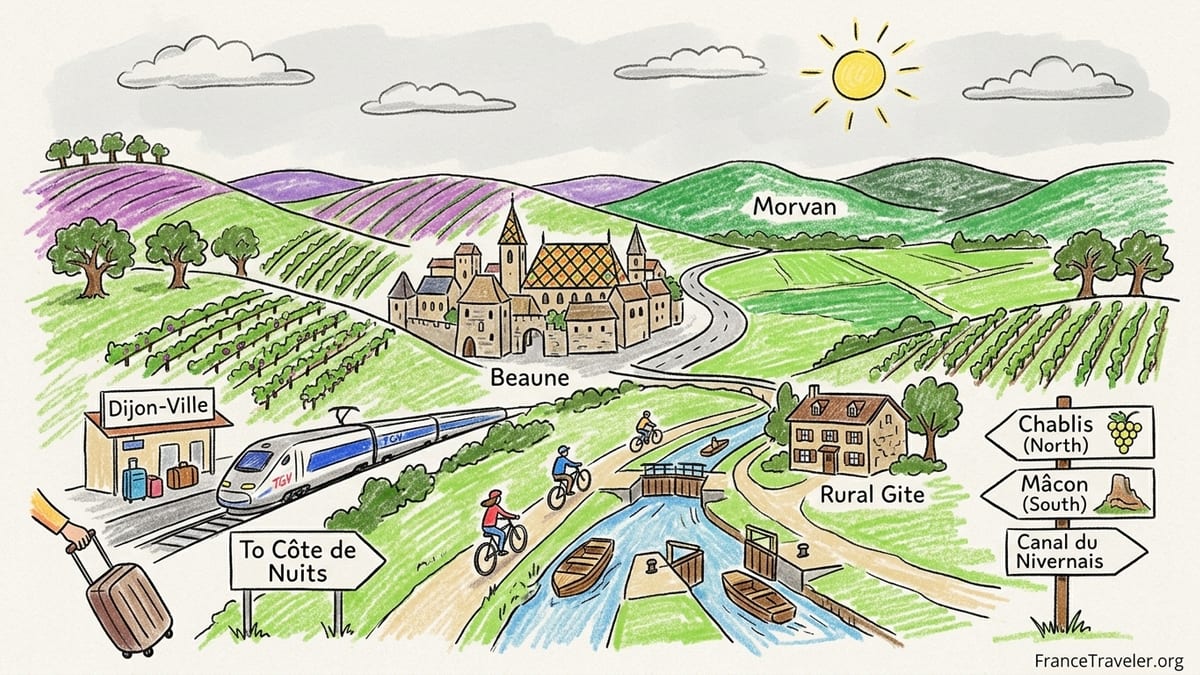
How to choose your Burgundy base
Burgundy’s wine country and countryside spread over a wide area, from Chablis in the north to the Mâconnais in the south, with the wild Morvan hills and a web of canals in between. Fast trains tie Dijon and Mâcon to Paris and Lyon, while rural buses in places like the Morvan or Nivernais canal area are limited. A visitor who arrives by TGV with a rolling suitcase will have a very different experience from one who picks up a rental car and heads into the hills.
France’s own tourism material presents Dijon and Beaune as the political and commercial anchors of Burgundy’s wine identity, then highlights Chablis, the Mâconnais, the Morvan and the canals as separate experiences. That is a helpful way to think about where to stay. Dijon and Beaune suit travellers who want easy rail access, structured tasting days and lively evenings. Chablis, Auxerre, the Morvan, canal-side villages and the southern Mâcon area are better for slow travel, scenery and smaller-scale wine or food exploration.
In practical terms, you should think about a few core questions. Will you rely on trains and organised tours, or will you rent a car. Do you prefer walkable historic streets with restaurants open every night, or are you happy with a small inn where dinner is available only on certain evenings. Are you planning short hops within one wine zone, or do you want to day trip across the region, potentially spending two hours each way on the road. The answers will point you toward a city base like Dijon, a compact wine town like Beaune or Chablis, or a rural stay by a lake or canal lock.
For many travellers, a mix of bases works best. You might start with a night or two in Dijon to recover from the journey and visit museums, then spend several nights in Beaune or Chablis for wine touring, and finally end with a rural retreat in the Morvan or along the Canal du Nivernais. Below, we compare the main options and spell out how long to stay in each, how easy they are without a car, and what types of accommodation and evening atmosphere to expect.
Dijon: urban base for rail arrivals and Côte de Nuits
Dijon works particularly well for travellers arriving by train. Direct high-speed and regional services connect Dijon with Paris in roughly 1 hour 40 minutes on TGV and just over 3 hours by slower TER, while regional trains run along the main axis to Beaune and further south. The city’s main station sits a short walk or tram ride from the historic centre, so it is easy to wheel luggage directly to a hotel without needing a taxi or car. This makes Dijon a strong choice for visitors who want to avoid driving after a long international flight.
The city is also an excellent launch point for excursions along the Côte de Nuits between Dijon and Nuits-Saint-Georges. Several wine tour operators base their full-day and half-day Grand Cru tours out of Dijon and pick up at major central hotels, then follow the Route des Grands Crus down through villages like Gevrey-Chambertin and Vosne-Romanée. Travellers who prefer not to drive between tastings often find that organised tours with hotel pick-up are easier to arrange from Dijon than from a remote village. By evening, you are back among urban restaurants, wine bars and bistros clustered around the Palace of the Dukes and the market halls.
In Dijon, a car is optional rather than essential. Within the city, trams and buses are frequent and most sights and restaurants are walkable. For day trips, frequent regional trains reach Beaune in about 20 minutes, and slower services continue to Chalon-sur-Saône. If you plan to explore the Côte de Nuits in depth on your own schedule, a rental car gives more freedom to reach outlying domaines and viewpoints, but many visitors simply book one or two guided tasting days and otherwise stay on foot. Parking is available in underground garages and some hotels offer private parking, but you should expect paid parking near the centre.
Hotel stock in Dijon runs from large business hotels near the station to characterful townhouses and design hotels in restored mansions. This variety suits different budgets and makes it easy to find rooms for one or two nights at short notice, especially outside peak harvest weeks. Dijon is therefore ideal as a short, flexible base at the start or end of a Burgundy itinerary. In two nights you can see the main sights, sample local cuisine and take at least one structured wine excursion into the Côte de Nuits without ever needing a car.
Beaune: classic hub for wine tourism and Côte de Beaune
Beaune is the heart of wine tourism in central Burgundy and the best single base if your focus is tasting and cellar visits. The compact historic centre surrounds the famous Hospices de Beaune and sits just a short walk from the train station. Regional trains link Beaune with Dijon in roughly 20 minutes and with Chalon-sur-Saône in under half an hour, so it remains accessible for travellers arriving by rail. Once in town, everything from wine bars and bistros to cavistes and bike rental shops are within a few minutes on foot.
Beaune’s advantage lies in its direct access to the Côte de Beaune vineyards in villages such as Meursault, Pommard and Puligny-Montrachet. Numerous local companies operate full-day and half-day tasting tours that pick up at hotels in Beaune and spend the day weaving through the vineyards and cellar doors of both the Côte de Beaune and, on some itineraries, the Côte de Nuits further north. Some chauffeur-driven services explicitly advertise hotel pick-up in Beaune followed by visits to estates and panoramic viewpoints before returning you to town in time for dinner. This makes Beaune particularly suitable for visitors who prefer not to drive between tastings.
That said, a car opens up more independent day-trip possibilities from Beaune. With your own vehicle, a realistic day-trip radius covers the full length of the Côte d’Or between Dijon and Santenay, along with side trips to villages such as Chagny, Nolay or Autun. Some travellers also manage longer forays into the Morvan or to abbey sites like Cluny as full days on the road, but those can involve two or more hours of driving each way. If you have a car, look for accommodation that offers courtyard or on-site parking, since street parking just outside the historic core is heavily used and central car parks can feel tight at busy times.
The hotel scene in Beaune is among the richest in Burgundy, with traditional townhouses converted into boutique hotels, mid-range chains around the ring road and a growing number of stylish properties in the nearby vineyards. For wine-focused travellers, three or four nights in or very near the old town works well: you have multiple evenings to try restaurants, join at least one guided Côte de Beaune or Côte de Nuits tour with hotel pickup, and leave one day for a slower walk or cycle through the vineyards. For a whirlwind visit, two nights is an absolute minimum, but wine enthusiasts often report that a longer stay allows tastings at a more relaxed pace.
Chablis and Auxerre: northern Burgundy and easy access from Paris
If you are coming from Paris and plan to see only northern Burgundy, a base in Chablis or nearby Auxerre can save journey time. Trains from Paris Bercy and Paris Gare de Lyon reach Auxerre in about 1 hour 45 minutes on regional services, and from there Chablis is reachable by local bus, taxi or rental car. The town of Chablis itself is compact, with wine shops, tasting rooms and small hotels clustered along the Serein river, surrounded by slopes of Chardonnay vines. This arrangement allows visitors to step out for tastings and walks with minimal car use once in town.
A car, however, becomes more useful if you want to explore the wider Chablis area and the Yonne valley. With a vehicle, a comfortable day-trip radius from Chablis or Auxerre includes the Premier Cru and Grand Cru vineyards around the town, villages along the Yonne, and canal-side sections of the Canal du Nivernais between Auxerre and Clamecy. Many domaines in the Chablis area request advance appointments, and reaching several in a day is easier with your own transport. Parking in Chablis and Auxerre is generally less pressured than in Beaune, with public car parks and street spaces available, although harvest periods in September and early October can feel busier.
In terms of accommodation style, Chablis offers small wine-focused hotels, guesthouses and a few properties with spas and on-site tasting rooms, while Auxerre has a broader mix of classic city hotels and riverside options. Evenings in Chablis are quieter, with a handful of restaurants that often close at least one night per week, so you should check opening days if you stay several nights. Auxerre, as a small city, provides a livelier restaurant scene and rail station access, which can matter if you rely entirely on public transport.
For many itineraries, two nights in Chablis or Auxerre is enough to explore the local vineyards and old town. Wine lovers might stretch that to three nights, using one full day for Chablis tastings and a second for a drive along the Yonne or a stroll beside the Canal du Nivernais. Travellers combining northern Burgundy with central or southern areas often treat Chablis or Auxerre as a separate segment, either at the start when arriving from Paris or at the end on the way back to the capital.
Vézelay, Avallon and the Morvan edge: scenery-first bases
Vézelay and Avallon sit on the northern flank of the Morvan Regional Natural Park, a protected upland area of woodlands, lakes and traditional farmland at the heart of Burgundy. The official park information emphasises outdoor activities such as hiking, cycling and lake sports, supported by a large network of rural paths and small roads. Public transport within the park is limited, a situation the park authorities themselves acknowledge as they work on more sustainable mobility solutions, so visitors staying near Vézelay or deeper in the Morvan should plan on having a car or bicycle if they want full freedom of movement.
Reaching this area by train is possible but slower than accessing Dijon or Beaune. Regional services from Paris to Avallon take roughly 2 hours 45 minutes, after which taxis or local buses connect to nearby villages and guesthouses. Once there, however, buses are infrequent and do not reach many hamlets, especially in the evenings. The trade-off is clear: you gain access to dramatic scenery, lakes and dark night skies, but you lose the convenience of frequent trains and easy restaurant hopping. If you arrive without a car, choosing a hotel or inn within walking distance of Vézelay’s basilica or Avallon’s centre will give you the best chance of having multiple eating options on foot.
Evening restaurant choice in Vézelay and Avallon is wider than in a remote lakeside hamlet but still limited compared with Dijon or Beaune. Several bistros and small restaurants line Vézelay’s steep main street and the lanes of Avallon’s historic centre, yet many close one or two days a week outside summer. Rural accommodation inside the Morvan itself can feel very isolated at night, with guests dining at the on-site restaurant or driving some distance for meals. Travellers who enjoy quiet evenings by a fireplace or lake, perhaps after a day of hiking or visiting small museums, often find this appealing, but it is not ideal if you want late-night bar life.
Accommodation styles around Vézelay, Avallon and within the Morvan range from simple country hotels and chambre d’hôtes to campsites and gites near lakes and rivers. Parking is rarely an issue, as most properties offer on-site spaces and village streets are less congested. A realistic day-trip radius by car includes Vézelay itself, Avallon, nearby sections of the Canal du Nivernais, small lakes and viewpoints, and on longer days perhaps a loop to Autun or back toward the Côte d’Or. For scenery-first travellers, two nights on the park’s edge can work, but three or four nights allow time for both walking and cultural visits without rushing.
Southern Burgundy: Mâcon, Cluny and Mâconnais vineyards
Southern Burgundy around Mâcon and Cluny suits travellers who want to combine wine, Romanesque architecture and easy access from the south. The area benefits from TGV services at Mâcon-Loché and Le Creusot TGV stations, with average travel times to Paris of around 1 hour 20 minutes on high-speed trains. This makes southern Burgundy convenient at the beginning or end of a broader trip involving Lyon, the Alps or the Mediterranean. From the TGV platforms, regional trains and local buses distribute passengers to Mâcon centre, Cluny and other small towns, although frequencies are sparser than in the Dijon–Beaune corridor.
The Mâconnais is primarily white wine country, with villages such as Fuissé, Solutré-Pouilly and Saint-Véran spread across rolling hills. A car is very useful here, as vineyards and village restaurants are scattered and public transport rarely reaches the smaller places. With your own vehicle, a comfortable day-trip radius from Mâcon or Cluny includes the wine villages, the dramatic Rock of Solutré, Romanesque churches, and greenway cycling routes created on former railway lines. Without a car, you can still enjoy Mâcon’s riverside setting and a selection of restaurants and wine bars in town, but your access to rural cellars and viewpoints will be limited.
Evenings in Mâcon are livelier than in many small Burgundy towns, with riverside terraces and a choice of brasseries and bistros. Cluny, by contrast, feels more intimate and historically focused, with the remains of its great abbey, a few central restaurants and a quieter night scene. Parking in both is manageable, though you may need to rely on public car parks around the edges of the historic cores. For wine or food trips that focus on the Mâconnais and nearby Beaujolais, three nights in Mâcon or Cluny works well, giving time for vineyard drives, abbey visits and unhurried meals in rural inns.
Accommodation in southern Burgundy ranges from city hotels in Mâcon to charming guesthouses in the countryside and small hotels in Cluny itself. Rural isolation becomes a factor as soon as you leave the towns: many farm stays and vineyard lodgings sit on single-track lanes and offer great views and quiet nights but require driving to the nearest restaurant. Some properties provide on-site table d’hôtes dinners on set evenings. If you choose one of these, plan to stay at least two nights, so you can enjoy one dinner at the property and use another evening to discover a local restaurant in a nearby village.
Canal-side and rural bases: Nivernais, Burgundy Canal and beyond
Staying by a canal presents a different slice of Burgundy, one centred on water, cycling and slow travel rather than intensive vineyard hopping. The Canal de Bourgogne runs between the Yonne and the Saône, touching towns such as Montbard and approaching Dijon along the Ouche valley, while the Canal du Nivernais stretches between Auxerre and Decize through rolling meadows, hillside vineyards and forests. Official canal information and boat-hire companies describe the Nivernais as one of France’s prettiest waterways, dotted with hire bases in towns like Joigny, Migennes, Tannay and Decize, as well as smaller villages and lock hamlets.
For many travellers, the key decision is whether to stay in fixed accommodation beside the canal or to rent a self-drive boat and use that as both transport and lodging. Fixed canal-side hotels, chambres d’hôtes and gites generally assume you will arrive by car or bicycle, since local train and bus services can be limited and may not stop close to your chosen lock or hamlet. Even where rail stations exist, such as in Auxerre or Migennes, the final stretch to a rural property often requires a taxi. The trade-off is rural quiet, direct access to towpaths for walking or cycling, and the pleasure of watching boats and birdlife on the water.
Evening restaurant options in canal-side villages are often restricted to one or two establishments, some of which may close on particular days, especially outside high season. Many properties offer either on-site dining or provide kitchen facilities so you can self-cater with ingredients from nearby markets. Parking is usually straightforward, with guests leaving cars in small lots or directly on the property. If you choose a canal base within reach of a larger town like Auxerre, Clamecy or Montbard, you can use that town as a shopping and dining hub while spending your nights in a quieter spot.
A realistic day-trip radius from a Nivernais or Burgundy Canal base depends heavily on whether you have a car. With one, you can combine mornings on the towpath or short cruises with afternoon visits to small towns, Romanesque churches or viewpoints in the surrounding countryside. Without one, most of your exploration will be along the canal itself, either on foot or by rented bicycle. For many visitors, two or three nights beside the canal is enough to enjoy the slow atmosphere before moving either to a wine town or to a more connected city base.
Car or no car: matching base to transport style
Because Burgundy’s experiences are so varied, it is worth matching your base to your transport style from the start. Travellers relying fully on rail and occasional organised tours are usually happiest in Dijon, Beaune, Auxerre or Mâcon. These towns combine station access, a spread of evening restaurants and tour companies that offer hotel pick-up for vineyard days. Dijon and Beaune, in particular, see a steady flow of wine tours that connect city hotels with Côte d’Or vineyards, leaving guests free to taste without worrying about driving back.
Once you move into rural Burgundy, the equation changes. In Chablis, Vézelay, Avallon, Cluny, canal-side hamlets and the interior of the Morvan, a car or at least a bicycle becomes much more important. Accommodation is more dispersed, public transport thins out and restaurants may be spaced several kilometres apart. Visitors who arrive without a vehicle and book remote lodgings sometimes discover they are effectively limited to the property itself in the evenings. To avoid this, those travelling by train alone should either choose a base in a town centre or be sure that their rural hotel offers regular on-site dinners and can arrange transfers.
As a rule of thumb, plan to manage without a car in Dijon and Beaune, and to have one available for longer stays in Chablis, the Morvan, southern Burgundy and canal regions. For mixed itineraries, some travellers pick up a rental car partway through, for example staying car-free in Dijon for two nights, then collecting a vehicle to explore the Côte de Beaune and Morvan over several days before returning it near a TGV station. This approach allows you to enjoy both walkable cities and remote landscapes without paying for a car you do not use in the first days.
In terms of how many nights to spend where, think of Dijon and Auxerre as 1 to 3 night city bases, Beaune, Chablis and Mâcon as 3 to 4 night wine and food hubs, and Vézelay, Avallon, Cluny, Morvan villages or canal-side hamlets as 2 to 4 night slow-travel retreats. Blending these segments can create an itinerary that balances tastings, culture and outdoor time without feeling rushed.
Sample base combinations for 3, 5, 7 and 10 days
For a 3-day trip focused on wine and easy logistics, one simple option is to base entirely in Beaune. Arrive by train from Dijon or Paris on day one, spend your first afternoon exploring the old town and Hospices, then dedicate a full day to a guided Côte de Beaune or combined Côte de Beaune and Côte de Nuits tour with hotel pick-up. On your final day, you might rent a bicycle for a short vineyard ride if the weather is good, then depart by train in the late afternoon. Without changing hotels, you enjoy both structured tastings and relaxed evenings on foot.
With 5 days, you can comfortably combine two bases. One pattern is to start with two nights in Dijon to take advantage of the direct rail connection and urban dining, including perhaps a half-day Grand Cru route tour into the Côte de Nuits. Then travel by short regional train hop to Beaune for three nights, using one day for Côte de Beaune tastings and another for a slower outing to nearby villages or a bike ride among the vines. This combination gives you a taste of Burgundian city life and a deeper immersion in the wine country without needing a car.
A 7-day itinerary allows you to add either northern Burgundy or a scenery-focused segment. You might spend two nights in Dijon, three nights in Beaune and two nights in Chablis or Auxerre, concentrating on wine across different zones. Alternatively, you could allocate three nights to Beaune, two to a Morvan-edge base such as Vézelay or Avallon for hiking and small-town evenings, and two to a canal-side inn near the Nivernais or Burgundy Canal. In both versions, you keep transfer days short while experiencing distinct sides of Burgundy: urban, wine village and rural water or mountain landscape.
With 10 days, you can string together a broad cross-section of the region. One realistic sequence might be 2 nights in Dijon, 3 in Beaune, 2 in the Morvan or along the Canal du Nivernais, and 3 in southern Burgundy around Mâcon or Cluny. This arc connects political and cultural capital, wine hub, protected natural landscape and Mâconnais vineyards in one trip. Another option is a north–south wine focus, for example 2 nights in Auxerre or Chablis, 3 in Beaune, 2 in a rural Côte d’Or village and 3 in Mâcon, using a rental car from the moment you leave Auxerre. In each case, think in clusters: two or three nights per base keeps packing to a minimum while giving enough time for day trips.
The Takeaway
Where you sleep in Burgundy matters as much as which cellars you visit. Dijon and Beaune are the region’s anchors, offering rail access, dense restaurant districts and easy booking of tasting tours, while Chablis, the Morvan, canal-side villages and the southern Mâconnais provide more specialised experiences. Deciding between them means weighing scenery against convenience, quiet village nights against lively streets, and the freedom of a car against the simplicity of trains and guided excursions.
If you value walkability and do not want to drive, start with Dijon or Beaune and consider adding Auxerre or Mâcon. If your priority is landscape and slower days, look to Vézelay, Avallon, Morvan villages or the towpaths of the Canal du Nivernais. For many travellers, the best approach is to mix at least one city or major wine town base with one rural or canal-side stay, allowing both structured tastings and time simply to sit under a linden tree, watch clouds move over the vineyards and listen to church bells in the distance.
Above all, keep distances realistic and resist the temptation to cover the whole of Burgundy from a single hotel. Choosing two or three contrasting bases, each with its own rhythm and landscape, will turn a good trip into a memorable one, whether you come for grand cru labels, Romanesque stonework, forest trails or the simple pleasure of a glass of wine beside the water at sunset.
FAQ
Q1. Is Dijon or Beaune a better base without a car?
Dijon is stronger for pure rail convenience and city sights, while Beaune is better if most of your activities are wine tours with hotel pick-up in the Côte d’Or.
Q2. How many nights should I spend in Beaune for wine touring?
Plan at least two nights, and ideally three or four, so you can join one or two guided tasting days and still have time to explore the town at an easy pace.
Q3. Do I need a car to enjoy Chablis and northern Burgundy?
You can visit Chablis from Auxerre by bus or taxi, but a car makes it much easier to reach multiple domaines, nearby villages and stretches of the Canal du Nivernais in one day.
Q4. Is the Morvan a good base if I rely on trains and buses?
The Morvan is best with a car, as public transport inside the park is limited and many villages and lakes are not served frequently, especially in the evenings.
Q5. Where should I stay for easy access to both Côte de Nuits and Côte de Beaune?
Beaune and Dijon both work; Beaune gives immediate access to Côte de Beaune and many tours that also cover Côte de Nuits, while Dijon is ideal for Côte de Nuits-focused excursions by tour or car.
Q6. Is southern Burgundy around Mâcon and Cluny worth adding to a short trip?
If you have at least a week and enjoy white wines, Romanesque sites and quieter countryside, two or three nights in Mâcon or Cluny add welcome variety to a Côte d’Or-focused itinerary.
Q7. What is the advantage of staying by a canal instead of in a wine town?
Canal-side bases offer direct access to towpaths for walking and cycling, very quiet nights and views of passing boats, but usually fewer restaurants and limited public transport.
Q8. Can I base in one town and day trip across all of Burgundy?
It is technically possible from a central base like Beaune with a car, but driving times can be long; most travellers are happier with two or three bases to keep day trips under about 90 minutes each way.
Q9. When is parking most difficult in Dijon and Beaune?
Parking tightens during summer weekends, major festivals and the autumn harvest weeks, so it is wise to choose accommodation with on-site or reserved parking during those periods.
Q10. How far in advance should I book accommodation in Burgundy?
For peak months from May to October and during harvest, booking several months ahead is sensible, especially for small guesthouses, canal-side inns and sought-after wine town hotels.