


France might be the easiest country in Europe to cross by high-speed rail. The TGV network links Paris with almost every major city in a matter of hours, while slower regional TER trains fill in the gaps. For many trips a fast train will beat a car on time, comfort, and often cost. In others, especially in rural regions, a rental car becomes your best tool. This guide walks you through core TGV routes from Paris, the difference between TGV and TER services, how to book and handle luggage, and where it is worth switching from rail to four wheels.
Understanding TGV vs TER in France
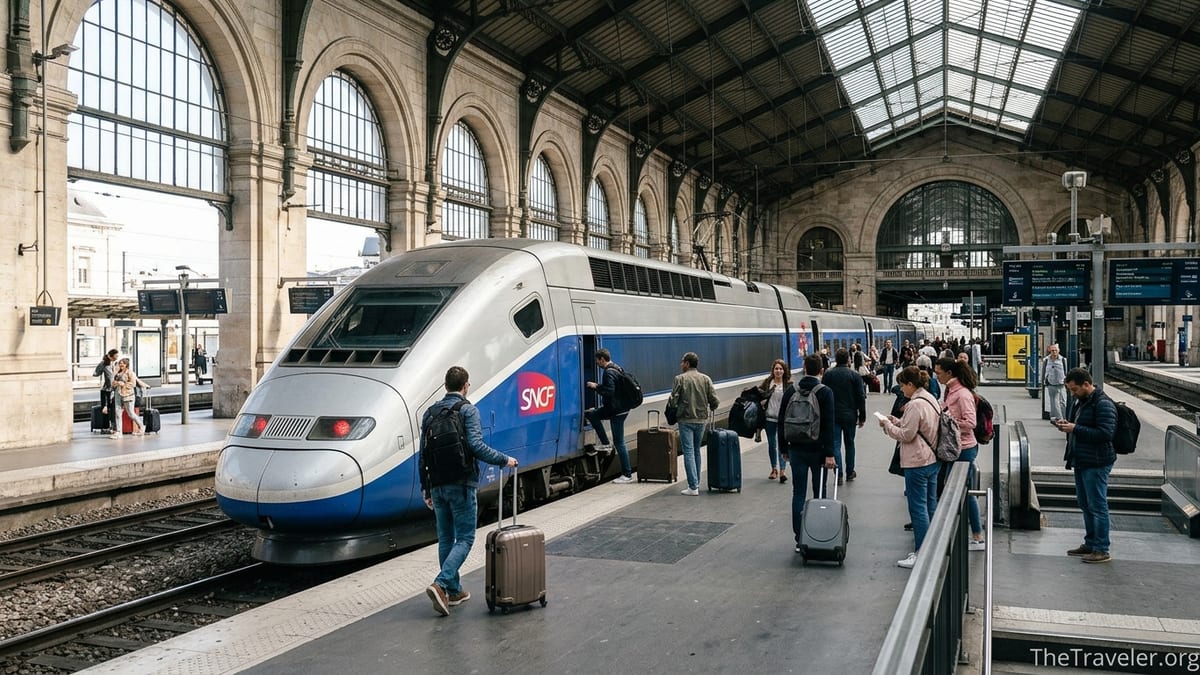
Two acronyms define most intercity rail travel in France: TGV and TER. TGV, short for Train à Grande Vitesse, is the national high-speed train network that connects major hubs such as Paris, Lyon, Marseille, Bordeaux, Strasbourg, Lille and Nice on dedicated high-speed lines for much of the journey. Typical top operating speeds reach around 300 km/h, which is how you can leave Paris mid-morning and be eating lunch in Lyon in roughly 2 hours or on the Mediterranean in about 3 hours on many services.
TER stands for Transport Express Régional and refers to the slower regional trains managed by each French region. These trains run on conventional tracks, stop more frequently, and are designed to link small and medium-sized towns with the larger TGV stations. For example, you might take a TGV from Paris to Avignon TGV station, then connect to a TER for 15 to 30 minutes to reach Avignon Centre or smaller Provence towns.
As a traveler, think of TGV as the long-distance backbone and TER as the local feeder. A first-timer might ride TGV from Paris to Bordeaux, then use TER trains to reach St-Émilion or Arcachon. Similarly, a TGV from Paris to Strasbourg can be paired with short TER hops along the Alsace Wine Route to towns like Colmar and Obernai. Many tickets are sold as a through journey so your TGV and connecting TER appear on a single booking, which simplifies transfers.
Comfort levels differ slightly. Modern TGV InOui trains have reserved seating, air-conditioning, power outlets and usually a café-bar car. TER trains are simpler, typically without seat reservations and with more basic seating, but they are perfectly fine for 1 to 2 hour hops. If you picture TGV as intercity airline-style travel on rails, TER is more like a commuter or regional bus in train form.
Key TGV Routes from Paris: Lyon, Bordeaux, Strasbourg, Avignon, Marseille, Nice
The TGV network is centered on Paris, with high-speed lines radiating out like spokes. For many trips you will start or change trains in the capital. Some of the most useful routes for visitors are Paris to Lyon, Bordeaux, Strasbourg, Avignon, Marseille and Nice. These routes shift what would be half- or full-day drives into manageable train journeys.
The classic high-speed corridor is Paris to Lyon. Typical non-stop services between Paris Gare de Lyon and Lyon Part-Dieu often take about 2 hours, sometimes a little less. Advance fares can vary widely, but it is common to see second-class tickets booked weeks ahead starting from a few dozen euros on off-peak departures, rising to much more for last-minute peak-hour trains. From Lyon you can connect by TGV or TER further south to Avignon, Marseille, Montpellier or the Alps.
On the Atlantic side, the Paris to Bordeaux line is another flagship route. Non-stop trains from Paris Montparnasse to Bordeaux St-Jean usually cover the distance in around 2 hours to just over 2 hours. In practice that means you can leave Paris after breakfast and be tasting wine in Bordeaux by lunchtime. Many travelers then connect onto regional TER trains toward the Dordogne, the Atlantic coast or the Basque Country.
Toward the east, Paris to Strasbourg by TGV generally takes around 1 hour 45 minutes to 2 hours from Paris Gare de l’Est to Strasbourg’s central station. This makes Strasbourg a realistic day trip from Paris, although most travelers stay longer to explore Alsace villages using short TER rides. To reach the Mediterranean, TGV services from Paris to Avignon TGV or Marseille St-Charles commonly take about 3 to just over 3 hours. Some trains continue along the coast to Toulon, Cannes, Antibes and Nice. Paris to Nice is usually around 5.5 to 6 hours by direct TGV, still competitive with flying once airport transfers and security are factored in.
Booking Tickets: SNCF Connect, Ouigo, Passes and Timing
For point-to-point tickets on French trains, the main digital gateway is the official SNCF Connect platform, which sells TGV InOui, low-cost Ouigo, Intercités and TER tickets. Third-party resellers exist and can be helpful for foreign cards or multi-country itineraries, but usually add booking fees. For most straightforward domestic trips such as Paris to Lyon or Paris to Bordeaux, booking directly through the national operator simplifies after-sales changes and customer service.
French TGV tickets are dynamic priced. Buying early almost always lowers the cost. On busy routes, booking roughly 2 to 3 months in advance for popular dates often yields the best choice of fares and times. For instance, a Paris to Marseille TGV on a summer Saturday booked the week of travel can be significantly more expensive than the same train reserved eight weeks earlier. If you know you will be in France during a school vacation period or public holiday, treat your long-distance TGVs like airline tickets and secure them early.
Budget-conscious travelers should also look at Ouigo, the low-cost high-speed brand. Ouigo trains use the same high-speed lines as TGV InOui but operate with stricter luggage rules, mostly all-standard class seating and less flexibility on changes. Fares can be very low on selected routes, such as Paris area stations to Lyon, Marseille, Montpellier or Bordeaux, especially on midweek or off-peak departures. The trade-off is that Ouigo sometimes uses secondary stations, such as Marne-la-Vallée or Massy near Paris, and often has surcharges for extras that are included or cheaper on standard TGVs.
Rail passes for France, such as country or multi-country passes sold through international distributors, can work for intensive rail itineraries with many high-speed segments in a compressed timeframe. However, they require seat reservations on TGVs at a per-train cost and may not always beat well-planned advance point-to-point tickets. For a typical 10-day itinerary that includes perhaps three or four TGV legs and several TER rides, many travelers now find that buying individual tickets gives more control and sometimes a lower total bill, especially if travel dates are mostly fixed.
Luggage, Seat Reservations and Stations: How It Works in Practice
Luggage on French trains is straightforward compared with airline rules, but there are differences between operators. On standard TGV InOui services, there is no formal checked baggage system for most passengers. You simply bring your suitcases on board and place them in overhead racks, at the ends of the coach, or in mid-car luggage areas. As a rule of thumb, if you can comfortably lift your case onto a low platform or up a few steps, you can handle it on the train. There is no weight check, though bringing more than two large suitcases per person will quickly become impractical in crowded coaches.
Low-cost Ouigo tickets include a specific luggage allowance that is more restrictive. Typically you are allowed one piece of small hand baggage and one cabin-size case in the base fare, with additional or larger items charged as extras. Luggage is not weighed in a formal airline sense, but staff may measure or visually check bags that clearly exceed size limits. If you know you will be carrying large checked-style cases or sports equipment, comparing the cost of Ouigo add-ons with an equivalent TGV InOui fare is worth doing.
Seat reservations on TGV and Ouigo are compulsory and automatically assigned when you book. Your coach and seat number appear on your ticket, and on the platform electronic boards will list the train composition so you can wait roughly where your coach will stop. TER trains, by contrast, are mostly open-seating with no reservations. On a route like Bordeaux to Sarlat or Lyon to Annecy, you can simply board with your TER ticket and find any free seat, which takes the pressure off missing a specific train when sightseeing runs late.
Major stations in cities like Paris, Lyon, Bordeaux, Marseille and Strasbourg feel closer to airports in scale, with multiple halls, food outlets and services. Paris alone has several different stations, each serving a region of the country. For example, Paris Gare de Lyon handles most trains to Lyon, Avignon, Marseille and the Riviera, while Montparnasse serves Bordeaux and much of western France, and Gare de l’Est covers Strasbourg and parts of Germany. Allow time on your first day in France to get used to finding your departure boards, validating tickets where required, and locating your platform. Within a couple of journeys the process becomes as automatic as scanning a boarding pass.
Planning Classic Itineraries by Train: Real-World Examples
To see how the system works in practice, it helps to sketch a few realistic itineraries anchored around TGV routes. One common first-time trip is Paris, Lyon and Provence. A traveler might spend four nights in Paris, then take a mid-morning TGV from Paris Gare de Lyon to Lyon Part-Dieu in about 2 hours. After two or three nights exploring Lyon’s old town and food scene, they could board another TGV south to Avignon TGV or Aix-en-Provence TGV, a ride of roughly 1 to 1.5 hours. From there, regional buses or a short-term car rental can open up hill towns like Gordes or the Luberon.
Another popular combination is Paris, Bordeaux and the Dordogne. You could depart Paris Montparnasse for Bordeaux St-Jean in a bit over 2 hours by TGV, then connect to a TER service toward Périgueux or Sarlat. This last leg is slower, roughly 2 to 3 hours depending on the route, and is where some travelers decide to switch to a car in Bordeaux to reach rural cottages, farm stays or historic villages that lie well beyond the nearest station. The train still does the heavy lifting of crossing the country, while the car is used only for the more local segment.
On the eastern side of France, consider pairing Paris with Strasbourg and the Alsace region. From Paris Gare de l’Est a TGV runs to Strasbourg in under 2 hours. After exploring Strasbourg’s cathedral and canals, short TER hops connect to Colmar and smaller wine villages. Some visitors base in Colmar and use buses or bike rentals to reach vineyards, while others pick up a car for a day or two to access trailheads and remote hamlets at their own pace.
For a coastal journey, a reasonable route is Paris, Avignon and Nice. Take a Paris to Avignon TGV in about 2 hours 40 minutes to 3 hours, spend several nights between Avignon and nearby Provence towns, then board a direct TGV from Avignon or Marseille to Nice in roughly 3 to 4 hours. The scenery along the Mediterranean stretch between Toulon and Nice, passing through or near resorts like Cannes and Antibes, is a highlight in its own right, and many travelers are happy not to be navigating traffic while enjoying those views.
When a Rental Car Becomes More Practical
Despite the strength of the French rail network, there are clear moments when renting a car becomes the more practical choice. The first is when your main goal is to explore rural or dispersed regions with limited public transport, such as the Dordogne Valley, much of Provence outside its main cities, the Loire Valley’s smaller châteaux, or coastal drives in Brittany and Normandy. In these areas, trains usually deliver you to a larger town, but reaching country inns, farm stays or viewpoints without a car can involve patchy buses or expensive taxis.
A second factor is the cumulative time and cost of transfers. As an example, traveling from the Loire Valley to the Dordogne almost always involves returning toward a major hub like Bordeaux or even back toward Paris to change trains. While rail connections are possible, by the time you add one or two changes and waiting time, a direct 4 to 5 hour drive in a rental car can sometimes be more efficient, especially for families or groups sharing the cost. On the other hand, motorway tolls in France add up quickly on such long drives, so it is worth comparing a day’s car rental plus tolls and fuel with advance TGV fares.
Third, think about the style of trip you prefer. In cities such as Paris, Lyon, Bordeaux, Marseille or Nice, driving is more hassle than help because of traffic, parking costs and unfamiliar rules. A common hybrid solution is to rely on trains for the long-distance links between major cities, then rent a car only for the 3 to 5 day segment where you are based in the countryside. For example, you could take a TGV from Paris to Avignon, rent a car at the station for four days to tour Luberon villages and lavender fields, then return it before catching a TGV onward to Nice.
Season also matters. In high summer, parking spaces in historic centers and coastal resorts are scarce, and roads into spots like Cassis or small Riviera bays can be slow. In shoulder seasons like May or October, a car offers more flexibility for spontaneous stops at vineyards or viewpoints without the same congestion. In winter, some mountainous or rural districts may require snow-ready vehicles, which adds cost but also opens up landscapes that are quiet and atmospheric.
Comparing Costs, Time and Comfort: Train vs Car
Cost comparisons between train and car in France depend heavily on how many people you are traveling with and how early you book. For a solo traveler or couple on popular TGV routes such as Paris to Lyon, Bordeaux or Marseille, booking several weeks out often makes high-speed rail appealing both on price and comfort. A mid-range advance second-class TGV fare between Paris and Marseille, for example, can compare favorably with the combined cost of one day’s car rental, several hundred kilometers of motorway tolls and fuel, plus city-center parking on arrival.
For families or small groups, a rental car can sometimes even out the equation, especially on segments where the train would require multiple changes. Sharing the daily rental fee and fuel between four people may work out cheaper than four individual TGV tickets, particularly closer to departure when rail fares have risen. That said, you also need to factor in non-monetary costs: one person has to drive, navigate and stay alert, while everyone on a train can read, nap or look out the window.
Time is another dimension. On the high-speed spine from Paris to major cities, trains generally win. The TGV from Paris to Bordeaux or Lyon is roughly 2 hours, city center to city center, while driving can be 5 to 6 hours including stops. Once you move into cross-country travel between secondary regions, cars gain ground. Going from Provence to the Dordogne, for instance, might mean a series of trains through Marseille and Bordeaux or via Toulouse, consuming most of a day. A direct drive, though long, may be more straightforward.
Finally, consider your tolerance for logistics. Train travel requires you to match your sightseeing to departure times, navigate large stations and occasionally deal with delays or strikes. Car travel asks you to tackle unfamiliar road signs, parking rules and toll booths. Many repeat visitors settle on a blend: trains for the inevitable Paris to south or Atlantic crossings, limited car rentals for rural interludes, and city stays designed around walking and public transport.
The Takeaway
Planning France by train is largely an exercise in matching the strengths of TGV and TER services with the realities of your itinerary. High-speed TGVs excel at whisking you between Paris and major cities like Lyon, Bordeaux, Strasbourg, Avignon, Marseille and Nice in a few hours, turning what used to be full-day drives into comfortable half-days. TER regional trains then help you reach nearby towns and smaller hubs without the stress of driving.
At the same time, rural regions rich in small villages, backroads and scattered sights often reward travelers who are willing to rent a car for part of their trip. Instead of choosing train or car for the entire journey, think of them as complementary tools. Use TGVs to cross the country quickly, and reserve car rentals for the slices of your itinerary where public transport thins out.
As you plan, sketch your route around a few key TGV corridors radiating from Paris, then test alternative segments to see whether connecting TER trains or a short car rental would best serve your plans. Factor in not only ticket prices or rental fees but also tolls, fuel, parking and your own energy levels. With that balanced approach, France becomes remarkably easy to traverse, whether you are gliding into a grand station on a high-speed train or taking the scenic route through vineyards behind the wheel.
FAQ
Q1. Do I need to book TGV tickets in advance in France?
It is strongly recommended, especially for popular routes like Paris to Lyon, Bordeaux or Marseille. Advance booking often means lower prices and better choice of departure times, while last-minute tickets on busy days can be limited or significantly more expensive.
Q2. What is the main difference between TGV and TER trains?
TGV trains are high-speed, long-distance services with compulsory seat reservations that link major cities quickly. TER trains are slower regional services without seat reservations that stop more frequently and connect smaller towns to the main rail hubs.
Q3. Can I use the same ticket for a TGV and a connecting TER train?
Yes, many journeys are sold as through tickets, with both the TGV and any connecting TER segments included on a single booking. In that case, if the first train is delayed, staff can usually help rebook your onward connection according to current policies.
Q4. How much luggage can I bring on French trains?
On standard TGV InOui services luggage limits are generous, with no strict weight checks, though you must be able to handle your bags yourself. On low-cost Ouigo services the included allowance is more restricted, and larger or additional bags may require paid options, so checking the conditions before travel is important.
Q5. Which Paris stations serve Lyon, Bordeaux, Strasbourg and the south?
Paris Gare de Lyon handles most trains to Lyon, Avignon, Marseille and the Riviera. Paris Montparnasse serves Bordeaux and much of western France, while Paris Gare de l’Est is the main departure station for Strasbourg and parts of eastern France.
Q6. When is it better to rent a car instead of taking trains?
A rental car is usually more practical when your itinerary focuses on rural or dispersed regions such as the Dordogne, many parts of Provence, the Loire’s smaller château areas or coastal villages in Brittany and Normandy. In these places public transport can be infrequent and time-consuming.
Q7. Are French motorways really that expensive compared with trains?
French motorway tolls can add up quickly on long drives, especially when crossing large parts of the country. For solo travelers or couples on major routes, advance TGV tickets often compete well with the combined cost of daily car rental, tolls, fuel and city parking.
Q8. Is driving in French cities like Paris or Marseille recommended?
Generally no. Traffic, narrow streets, one-way systems and high parking costs make driving in big French cities stressful and often slower than using trains, metros and trams. Most visitors pick up or drop off rental cars outside the densest urban areas.
Q9. How early should I arrive at the station before my TGV?
Arriving 30 to 45 minutes before departure is usually enough for domestic TGV trips. This gives you time to find your platform, locate your coach and board calmly, even in large stations you do not yet know well.
Q10. Are strikes a serious risk for train travel in France?
Rail strikes do occur, sometimes with several weeks’ notice and sometimes with less warning. They rarely shut down the entire network but can reduce frequencies or cancel certain trains. Keeping some flexibility in your schedule and monitoring news in the days before key travel dates helps you adapt if needed.