


Choosing between the French Alps and the Swiss Alps is one of the most enjoyable dilemmas in travel planning. Both regions deliver classic peaks, glacier‑capped horizons and old stone villages framed by cowbells and church spires. Yet the experience on the ground can feel very different, from how you move around the mountains to what you pay for a ski pass or a plate of fondue. This guide compares the two in practical detail so you can decide which Alps are better for your trip.
Overall Feel: Two Takes on the Classic Alpine Dream
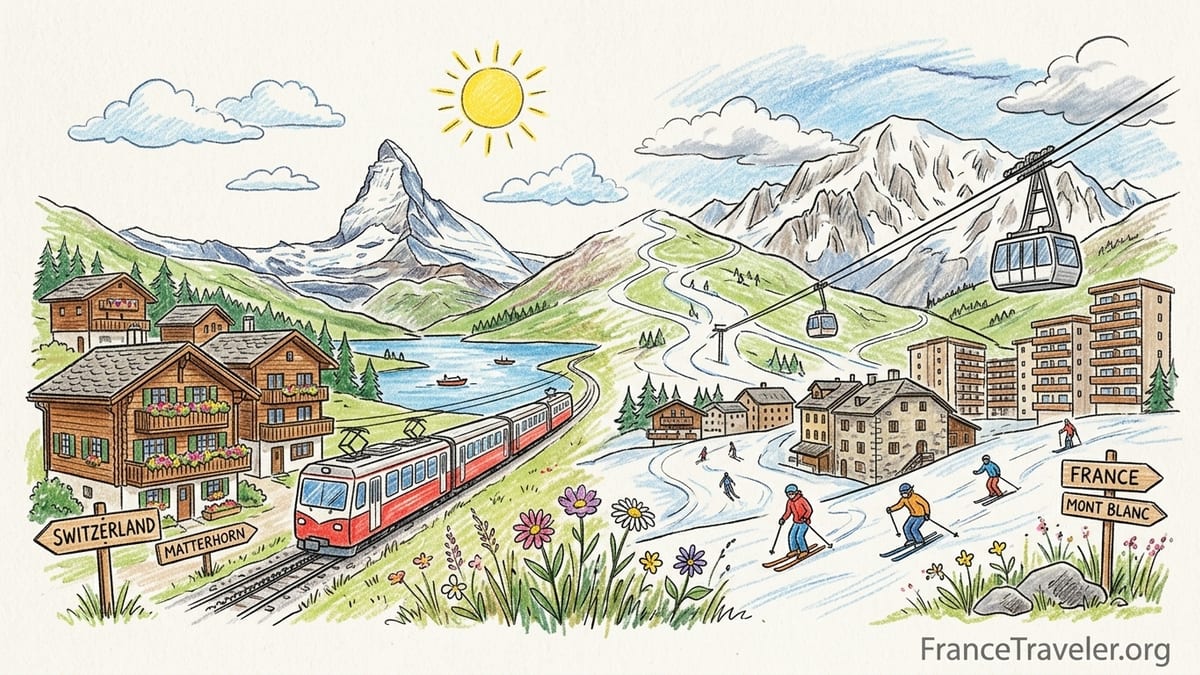
If you picture the Alps as a storybook of chalets, flower-filled balconies and precise trains gliding past lakes, you are probably imagining Switzerland. Destinations like Zermatt, Wengen and Grindelwald lean into that postcard aesthetic, with strict building codes, mostly wooden chalets and uncluttered village cores. Many Swiss resorts are compact, pedestrian friendly and feel carefully curated, which some travelers experience as charmingly orderly and others as a bit polished.
The French Alps feel more varied and often more relaxed. You still find pretty old villages such as Samoëns, Megève or Saint-Martin-de-Belleville, but also large purpose-built resorts like Tignes, Val Thorens and Flaine that were designed in the 1960s and 70s for efficient ski access. That can mean taller apartment blocks and a more functional look, but also ski-in/ski-out convenience and a wide choice of self-catering apartments at different price points.
Culture also differs subtly. In France, you are firmly in French food and wine country, with boulangeries in most resort towns and long, convivial lunches on sunny terraces. In Switzerland, you feel the influence of multiple languages and cantons: German-speaking Valais around Zermatt and Saas-Fee, French-speaking Vaud and Valais around Villars and Verbier, and Italian-speaking Ticino further south. Menus shift from rösti and raclette to polenta and risotto as you cross linguistic borders, often within the same trip.
Cost is one of the biggest contrasts. Broadly, Switzerland is more expensive day-to-day, especially for accommodation, eating out and train travel, while France tends to offer better value, particularly on ski packages and apartment rentals. For many travelers, that single factor pushes them toward the French side once they start pricing a week on the slopes or a multi-stop summer hiking itinerary.
Iconic Scenery: Mont Blanc vs Matterhorn and Beyond
Both countries share the same mountain chain, but the way you experience the scenery differs. In France, the headline act is Mont Blanc, Western Europe’s highest peak at about 4,810 meters, looming above Chamonix and the Vallée Blanche. The Aiguille du Midi cable car lifts visitors from Chamonix town to over 3,800 meters in just 20 minutes, with views into Italy and Switzerland on a clear day. The surrounding range has a jagged, high-mountain feel, with glaciers spilling into the valley and a sense of drama that appeals to climbers and photographers alike.
Switzerland’s iconography is more diffuse but just as powerful. The Matterhorn above Zermatt might be the single most recognizable mountain silhouette in the world, while the Eiger, Mönch and Jungfrau, seen from villages like Wengen and Mürren, form a vertical wall of rock and ice that defines classic Swiss postcards. The Engadine around St. Moritz offers a different look again, with broad valleys, frozen lakes in winter and golden larch trees in autumn.
Visually, the Swiss Alps often feel tidier and more manicured. Lakes such as Thun, Brienz, Lucerne and Geneva sit at the foot of high peaks, and railways and cable cars bring you to viewpoints like Jungfraujoch, Gornergrat and Pilatus with very little effort. In France, the landscape is wilder in places and infrastructure can be more concentrated in big resort valleys, especially in the Tarentaise (home to Les 3 Vallées, Paradiski and Espace Killy). You might spend part of your holiday in a busy ski hub like Val Thorens, then drive 45 minutes to find quieter, more traditional villages.
For a first-time visitor seeking that archetypal “Alps as seen on chocolate boxes” view, towns like Zermatt, Wengen, Grindelwald and Mürren in Switzerland are hard to beat. For big horizons of interconnected ski slopes, balconies over deep valleys and glacier views that feel more rugged and less domesticated, the Mont Blanc region and the high French Tarentaise valleys fit the bill.
Skiing and Winter Sports: Size vs Refinement
On pure ski area size, the French Alps have the clear advantage. Les 3 Vallées, which links Courchevel, Méribel, Les Menuires, Val Thorens and several smaller villages, markets around 600 kilometers of groomed pistes on one lift pass, all fully interconnected on skis. Paradiski, combining Les Arcs and La Plagne via the Vanoise Express double-decker cable car, adds another roughly 400-plus kilometers. Portes du Soleil, straddling France and Switzerland between Morzine, Avoriaz, Châtel and Champéry, claims an extensive cross-border network with several hundred kilometers of marked runs. For a skier who wants to roam for days without repeating the same route, these French mega-domains are exceptionally hard to match.
Swiss ski areas tend to be smaller on paper but richer in character and views. Zermatt’s Matterhorn Ski Paradise, linked with Cervinia in Italy, offers over 300 kilometers of pistes and lifts rising to around 3,800 meters, with glacier runs under the Klein Matterhorn. The Jungfrau Ski Region around Grindelwald and Wengen is more modest in size but unforgettable for its scenery, with trains and gondolas running beneath the north face of the Eiger. Resorts like Verbier, part of the wider 4 Vallées area, combine challenging off-piste terrain and a strong freeride culture with good snow reliability.
When it comes to snow conditions and season length, both regions have high-altitude options. In France, Val Thorens, Tignes and parts of Les Arcs keep lifts running into late April and often early May. In Switzerland, Zermatt and Saas-Fee maintain glacier skiing into late spring and often beyond. Average snowfall and quality can vary from valley to valley, so for mid-winter trips you are usually safe in either country if you choose higher bases and north-facing slopes.
For beginners and casual skiers, France often wins on budget and convenience. A six-day lift pass in a major French area such as Les 3 Vallées or Paradiski typically costs noticeably less than in leading Swiss resorts, and packages bundling accommodation, ski hire and passes can be significantly cheaper, especially outside school holidays. Switzerland, while more expensive, can feel smoother for non-skiers within the group thanks to excellent winter walking paths, scenic trains and easy access to viewpoints without needing to clip into skis.
Summer Hiking, Lakes and Outdoor Adventures
Both the French and Swiss Alps have transformed into serious summer destinations, with trail networks, mountain biking, via ferrata and lake activities. In France, classic multi-day hikes such as the Tour du Mont Blanc loop between France, Italy and Switzerland are major draws, as are national parks like the Vanoise and Écrins, where you can base yourself in towns such as Pralognan-la-Vanoise or Vallouise. Resorts like Chamonix, Morzine and Bourg-Saint-Maurice reinvent themselves in summer as hubs for hiking, paragliding and road cycling, with many ski lifts running to give hikers an easier start.
Switzerland has perhaps the most accessible mountain hiking in Europe thanks to its integrated rail and cable car system. In the Jungfrau region, you can take a train from Interlaken to Lauterbrunnen, switch to cog railways and gondolas up to Wengen, Mürren or Kleine Scheidegg, then start walks that feel properly alpine without a long, steep approach. Around Lucerne and central Switzerland, boats, funiculars and chairlifts combine so that a single day might include a lake cruise, a ride up a historic cog railway and a ridge walk above grazing cows.
Lakes are a Swiss strong suit. Lake Geneva, Lake Lucerne, Lake Thun and Lake Brienz give easy options to blend city and mountain time, for example pairing Geneva with day trips to Montreux and the Vaud Alps, or basing in Lucerne to mix old town sightseeing with excursions to Mount Pilatus and Mount Rigi. The French side has major lakes too, notably Annecy and Lac du Bourget, but the combination of lake steamers, punctual trains and mountain railways makes Switzerland particularly attractive for non-drivers.
If your group includes serious hikers who want longer, wilder routes as well as families who prefer short scenic strolls, both regions can work. Switzerland has the edge for easily combining multiple short hikes and viewpoints in one day without a car, while France offers a greater sense of “big landscape” adventure for those happy to drive or use regional buses between valleys.
Trains, Car-Free Travel and Moving Around
Switzerland is the clear winner for car-free travel. The country has built its tourism identity on rail, with mountain lines such as the Glacier Express between Zermatt and St. Moritz, the Bernina Express linking the Engadine to Italy, and the Jungfrau Railway climbing from Kleine Scheidegg to Jungfraujoch, the “Top of Europe.” Panoramic carriages, frequent services and tight connections make it realistic to plan an entire multi-week itinerary without ever renting a car, including luggage forwarding between hotels.
Many Swiss resorts are car-free at their core or severely limit traffic. Zermatt bans private cars, requiring visitors to leave vehicles in Täsch and arrive by shuttle train, while Wengen and Mürren are reached only by cog railway, cable car or funicular. Bettmeralp, Saas-Fee and Riederalp follow similar patterns. That creates quiet village centers where children can play safely in the snow and people stroll between hotels, restaurants and lifts without worrying about traffic.
The French Alps rely more on a network of regional trains, coaches and private transfers feeding into valleys, with local buses and ski lifts handling the last section. It is absolutely possible to do a car-free trip to Chamonix, Les Arcs, Les 3 Vallées or Alpe d’Huez, particularly from Geneva or Lyon airports, but the experience often involves more bus changes and less of the seamless “train to gondola” feel that Switzerland offers.
For travelers who enjoy the journey as much as the destination, Switzerland’s scenic railways are a major part of the appeal. You might spend one day gliding past vineyards and viaducts on the Glacier Express, another weaving through mountain villages on the GoldenPass line between Montreux and Interlaken, and a third combining lake ferries and funiculars. In France, the standout exception is the little red Montenvers cog railway from Chamonix up to the Mer de Glace, but overall the rail experience is more about practical access than a highlight in itself.
Accommodation, Food and Resort Atmosphere
In terms of lodging, the French Alps excel at mid-range and budget-friendly self-catering. Purpose-built resorts such as Les Menuires, La Plagne, Flaine and Avoriaz are filled with apartment residences, ranging from simple studios to upscale serviced apartments with pools and spas. Package operators frequently bundle flights, transfers and accommodation at per-person prices that compare favorably with most Swiss options, especially outside peak dates.
Switzerland, by contrast, tends to offer a higher proportion of traditional hotels and chalets, many of them family-run. Villages like Wengen, Mürren and Bettmeralp have long-established hotels right on the slopes, often including half-board dining with multi-course dinners. There are apartments too, but self-catering stock can be more limited and nightly rates higher. Upscale properties, such as five-star hotels with spas in Zermatt, St. Moritz or Gstaad, can be exceptionally luxurious but also priced accordingly.
Food is a draw in both countries, though the focus differs. In France, expect hearty Savoyard staples such as tartiflette, raclette and fondue alongside classic French dishes, pastries and cheeses. Mountain restaurants in areas like Les 3 Vallées or Espace Killy often offer multi-course lunches, good wine lists and terraces where people linger for hours on sunny days. In Switzerland, fondue and raclette are just as present, but you are also likely to encounter rösti, air-dried meats, mountain cheeses and regional desserts, with menus varying noticeably between German- and French-speaking regions.
Atmosphere-wise, many French resorts have a livelier après-ski scene, particularly hubs like Val d’Isère, Méribel, Chamonix and Morzine, where British and other international visitors mix with Parisians on winter weekends. Swiss resorts can feel more restrained in the evening, although Zermatt, Verbier and St. Moritz each have a well-established bar and nightlife scene. If your image of the Alps includes dancing in ski boots at 4 pm on a sun deck, France generally offers more options at lower prices for drinks and snacks.
Family Travel, Beginners and Non-Skiers
For families, both regions can work beautifully, but the priorities are slightly different. In France, large ski areas such as Portes du Soleil and Grand Massif have earned national “family” labels for facilities and programming, with beginner zones, childcare options and family lift pass deals. Many purpose-built resorts are designed so that most accommodation is close to the slopes, which simplifies logistics with children. Self-catering apartments also help families manage food costs and picky eating.
In Switzerland, car-free villages are a major asset for families with young children. Places like Wengen, Mürren, Bettmeralp and Saas-Fee allow kids to sledge, build snowmen and wander between hotel and lift without crossing busy roads. Train travel itself becomes part of the adventure; a trip up to Gornergrat above Zermatt or to Jungfraujoch from Wengen is a memorable day out for non-skiers of all ages. Many Swiss resorts also maintain winter hiking paths and toboggan runs that let non-skiing grandparents or parents join in the fun.
For absolute beginners, both France and Switzerland offer English-speaking ski schools, magic carpet lifts and gentle slopes near village level. In practice, you will often find more competitively priced group lessons and rental packages on the French side, especially in larger resorts with multiple ski school providers competing for business. Swiss instruction quality is typically high, but group sizes are sometimes smaller and costs higher.
If your group mixes keen skiers with people who do not intend to ski at all, Switzerland may have a slight edge. The ability to ride trains and cable cars to spectacular viewpoints, browse traffic-free village centers and take easy winter walks without needing to put on ski boots is a strong selling point, particularly for older travelers.
Costs and Value: Where Your Budget Goes Further
Overall, the French Alps offer better value for most visitors, especially on a week-long ski trip. Package deals that include flights, transfers, accommodation and lift passes are commonplace and often significantly cheaper than assembling a similar itinerary in Switzerland. As a ballpark example, travelers regularly report mid-range French packages in major areas like Les 3 Vallées for less than what a comparable week in Zermatt or Verbier might cost just for accommodation and passes, before adding meals and train travel.
Lift passes themselves are typically cheaper in France. Industry comparisons show that average daily revenue per skier day, a proxy for ticket pricing, is substantially higher in Switzerland than in France, reflecting both higher list prices and fewer deep-discount packages. Even allowing for seasonal offers and advance-purchase deals, it is common to see flagship Swiss areas charge noticeably more for a six-day pass than major French competitors.
Day-to-day spending also tends to be lower in France. Eating out, buying groceries, ordering drinks at après-ski bars and renting ski equipment generally cost less than in Switzerland, where restaurant prices, in particular, can surprise North American visitors used to European bargains. Accommodation is where the difference often becomes most obvious: a simple apartment or two-star hotel on the French side can undercut equivalent Swiss options by a wide margin, especially during busy school holiday weeks.
There are exceptions. Some French prestige resorts such as Courchevel 1850 or Megève can match or exceed Swiss prices at the top end, and savvy travelers can soften Swiss costs by choosing smaller, lesser-known villages or self-catering apartments. Still, if you are planning a family trip or traveling in a group and budget is a major factor, France is usually the more forgiving choice.
The Takeaway
Both the French and Swiss Alps deliver spectacular mountains, excellent skiing and memorable summer adventures. The decision often comes down to what you value most. If your dream trip involves skiing for miles on interconnected pistes, staying in a slope-side apartment, enjoying long lunches and keeping a closer eye on costs, the French Alps are likely to fit better. Areas like Les 3 Vallées, Paradiski, Espace Killy and Portes du Soleil were built around that model and serve it superbly.
If, instead, you picture yourself gliding into car-free villages on cog railways, riding panoramic trains such as the Glacier Express or Bernina Express, and waking up to the Matterhorn or the Jungfrau trio outside your window, Switzerland will speak your language. The trade-off is higher daily costs in exchange for extremely polished infrastructure and some of the most iconic mountain views on earth.
For many travelers, the most satisfying solution is to experience both over time. Start with a value-focused ski week in a large French domain, then return another year for a shorter, rail-based journey through Switzerland, linking Zermatt, the Jungfrau region and perhaps the Engadine. Whichever side of the border you choose first, you will still be in the Alps, which means high peaks, crisp air and a strong chance you will be planning your return before you have even left.
FAQ
Q1. Which is better for a first ski trip, the French Alps or the Swiss Alps?
For a first ski trip, many travelers find the French Alps more approachable because packages, ski passes and rentals are usually cheaper, and large resorts like Les 3 Vallées or La Plagne offer extensive beginner areas alongside huge intermediate terrain. Switzerland works very well too, especially places like Wengen or Grindelwald, but overall costs are typically higher.
Q2. Where will I find the biggest interconnected ski areas?
The largest fully lift-linked ski domains are in France, notably Les 3 Vallées with its network of resorts including Courchevel, Méribel and Val Thorens, as well as Paradiski and Espace Killy. Switzerland has sizable areas such as Zermatt–Cervinia and the 4 Vallées around Verbier, but in terms of sheer continuous piste mileage, France has the edge.
Q3. Is car-free travel easier in the French or Swiss Alps?
Car-free travel is easier in the Swiss Alps. Switzerland’s rail and cable car system is exceptionally well integrated, with scenic trains like the Glacier Express and Jungfrau Railway linking directly to mountain villages. Several key resorts, including Zermatt, Wengen, Mürren and Saas-Fee, are car-free or largely traffic-free, which makes moving around without a car very straightforward.
Q4. Which side is cheaper for accommodation and food?
In general, the French Alps are cheaper for accommodation and everyday expenses such as groceries, restaurant meals and après-ski drinks. Self-catering apartments are common and help keep costs down. In Switzerland, hotels and dining are often significantly more expensive, especially in flagship resorts like Zermatt, Verbier and St. Moritz.
Q5. Where are the best views, Mont Blanc or the Matterhorn areas?
Mont Blanc above Chamonix and the Matterhorn above Zermatt offer very different but equally impressive views. Mont Blanc feels higher and more glaciated, with sheer icefalls and sharp spires around the Aiguille du Midi, while the Matterhorn’s distinctive pyramid shape dominates the skyline in a more sculptural way. Many travelers find each area unforgettable in its own right.
Q6. Are the Swiss Alps worth the higher price?
For many travelers, the Swiss Alps are worth the extra cost because of the seamless public transport, car-free villages, iconic rail journeys and polished service. If you value ease of movement, scenic trains and picture-perfect villages as much as skiing or hiking itself, Switzerland can feel like good value despite higher prices.
Q7. Which region is better for families with young children?
Both regions work well, but in different ways. French mega-resorts like Les 3 Vallées, Grand Massif and Portes du Soleil offer family-focused facilities, apartment-style lodging and relatively affordable ski school options. Switzerland counters with very safe, car-free villages such as Wengen, Mürren and Bettmeralp, where children can roam more freely and train rides become part of the fun.
Q8. Do I need a car to enjoy the French or Swiss Alps?
You do not need a car in either region, but the experience differs. In Switzerland, it is easy to rely entirely on trains, boats and cable cars. In France, trains and buses reach many key resorts, especially from Geneva or Lyon, but you may find a car more convenient if you want to hop between valleys or smaller villages.
Q9. Which is better outside the ski season?
Outside winter, both regions are excellent for hiking, biking and lake activities. Switzerland has the advantage if you want an itinerary built around scenic trains, lake cruises and short hikes, while the French Alps often appeal to those seeking big mountain trekking routes, road cycling climbs and a slightly wilder feel in high valleys.
Q10. If I have 7 days, can I visit both the French and Swiss Alps?
Yes, it is possible to visit both in a week, especially if you focus on areas close to the border such as Chamonix in France and the nearby Swiss Valais. However, you will spend more time in transit. For a first visit, many travelers prefer to base entirely on one side, then plan a second trip later to explore the other at a more relaxed pace.