


The French Pyrenees are built for road trips. Valleys run parallel, ski resorts and spa towns sit at the end of twisting roads, and some trailheads are simply unreachable by bus. At the same time, key towns are linked by solid rail and bus networks, so not every itinerary needs a car. This guide explains where and how to rent in Toulouse, Tarbes-Lourdes, Pau and Perpignan, how to handle deposits, insurance and mountain roads, and when you genuinely need a car versus when shuttles, trains and transfers will do the job.
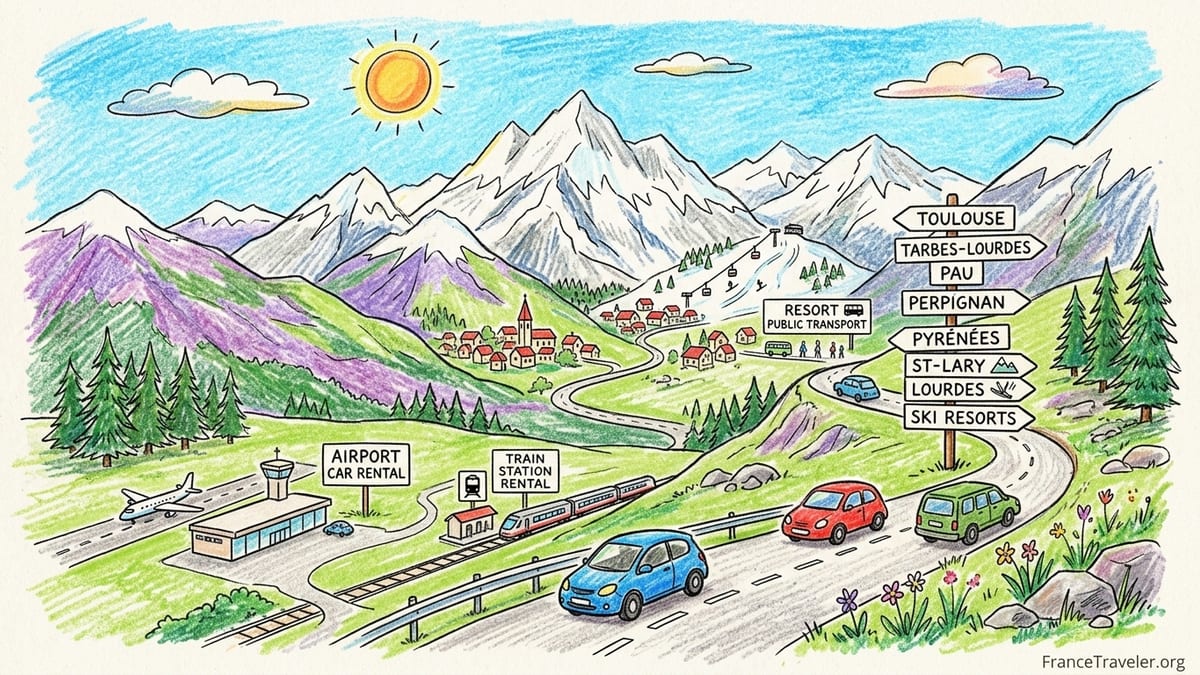
Where to Rent: Toulouse, Tarbes-Lourdes, Pau, Perpignan and Stations
Toulouse-Blagnac Airport is the main gateway for the central French Pyrenees and has the broadest choice of vehicles. Major brands such as Avis, Hertz, Sixt, Europcar, Enterprise, Budget and Thrifty all maintain desks in the terminal with parking directly opposite arrivals. This is usually the most convenient pickup point if you are driving straight to resorts like Saint-Lary, Luchon, Peyragudes or the Ariege valleys, because you avoid a transfer into the city with luggage and can reach the A64 or A61 motorways within minutes.
Tarbes-Lourdes-Pyrénées Airport is much smaller but strategically placed for the Hautes-Pyrénées, including Lourdes, Cauterets, Luz-Saint-Sauveur, Gavarnie and Grand Tourmalet. The airport confirms that Avis, Enterprise, Europcar, Hertz and Sixt maintain desks either in arrivals or directly in the adjacent rental car park, and cars can usually be collected as soon as you exit baggage claim. Opening hours can track flight times, so late-evening summer charters and pilgrimage flights often have corresponding desk hours; in winter shoulder seasons, midday closures are common, so always check your chosen company’s schedule before committing to a flight.
Pau-Pyrénées Airport is a useful alternative for the western Pyrenees and Béarn. The airport notes that several car-hire companies maintain around a few hundred vehicles in a dedicated rental car park, with desks located on the ground floor near shops and restaurants. In practice that means a very short walk from arrivals to the cars and quick access to the A64 toward Oloron-Sainte-Marie, the Vallée d’Aspe and ski areas like Gourette or La Pierre Saint-Martin.
Perpignan-Rivesaltes Airport is the most practical car pickup for the eastern Pyrenees, the Catalan coast and access into Andorra via the N116 and N20. The airport lists multiple brands on site, including Avis, Europcar, Hertz, Enterprise and local operators, with a car park reserved for rental vehicles next to the terminal. One real-world consideration is that some counters close by early evening, as travelers on August flights arriving around 17:30 have discovered, so if your flight is late in the day you should verify that your chosen rental office will still be open and consider pre-authorizing out-of-hours pickup if offered.
Railway stations can also be efficient pickup points, especially if you prefer to cover the bulk of the highway distance by train and only drive in the mountains. Toulouse-Matabiau, Pau, Tarbes and Perpignan stations typically host several car-hire brands either inside or within a short walk. A common strategy is to take a TGV or Intercités train from Paris or Bordeaux to Toulouse or Tarbes, then rent a car for three to five days to explore a cluster of valleys. This reduces fuel and toll costs and can lower your rental bill by avoiding weekend airport surcharges.
When a Car Is Essential and When You Can Rely on Public Transport
Public transport in the French Pyrenees is improving, but it is still built around commuting patterns and main valleys. If your plan is a classic multi-valley road trip, a car quickly becomes essential. For example, linking Cauterets, Gavarnie, the Tourmalet area and the Vallée d’Aure in a single week involves crossing passes such as the Col du Tourmalet or detouring far down to Lourdes or Tarbes to change buses. Services are infrequent outside peak summer and ski periods, and they rarely align neatly for same-day cross-valley travel. In contrast, with a car from Tarbes-Lourdes airport you can drive from Lourdes to Cauterets in around 45 minutes, continue to Luz-Saint-Sauveur and the Cirque de Gavarnie, then loop back via the Col du Tourmalet in one or two days, stopping at viewpoints and trailheads as you wish.
Road-trippers using Toulouse as a base will also find a car vital for exploring side valleys like the Vallée d’Oueil, the Hospice de France above Luchon, or the remote approaches to the Spanish border at the Port de Vénasque or Port de Boucharo. Buses typically only serve the main towns, and hiking starting points may be 10 to 20 kilometres beyond the last stop. If you want to string together mountain lakes, viewpoints and small Romanesque churches over several valleys, door-to-door flexibility is hard to beat.
On the other hand, if you plan to stay in a single resort or spa town, public transport and transfers can be perfectly adequate. Lourdes is a good example: you can land at Tarbes-Lourdes-Pyrénées, take a shuttle or taxi into town, then rely on seasonal buses to reach Cauterets or Barèges for skiing or hiking. Similarly, visitors based purely in Saint-Lary, Ax-les-Thermes, Font-Romeu or Les Angles can often book shared transfers from the nearest airport or station and then move around locally on foot, by ski bus or by hotel shuttle. In these scenarios, renting a car only for a single day trip to a neighboring valley might be enough.
Culturally focused itineraries along the foothills may also work without a car. The Toulouse to Pau and Bayonne railway lines serve pretty bastide towns and market centres, and local buses connect to some villages. For example, you could stay in Pau and use regional trains and buses for day trips to Oloron-Sainte-Marie, Orthez or Lourdes, renting a car only if you later decide to venture into higher passes like the Col d’Aubisque.
Choosing a Vehicle: Automatic vs Manual, Size and Power
In France, compact manual cars still dominate rental fleets, but automatics are increasingly common, especially at major airports such as Toulouse-Blagnac. If you can comfortably drive a manual on steep, winding roads, you will usually find it cheaper and easier to secure. However, many visitors from North America and other regions prefer automatics, and in the Pyrenees this preference has a practical side: managing gear changes on hairpin bends, steep descents and narrow village streets can be stressful if you are not fully confident with a clutch.
When booking, look explicitly for “automatic” or the abbreviation “auto” next to the vehicle category, and avoid assuming that a “compact SUV” will be automatic by default. Platforms that aggregate major brands at Toulouse, Pau, Tarbes-Lourdes and Perpignan often show that automatics can cost a noticeable premium, especially in July and August or during February school holidays when demand for easy-to-drive cars spikes. If an automatic is important to you, book as early as possible and choose a rental class where “automatic guaranteed” is clearly stated, even if that is one category higher than you initially planned.
Vehicle size is another key decision. For mountain roads and small village car parks, a compact or intermediate model is almost always more practical than a large SUV or people carrier. Cars such as a Renault Clio, Peugeot 308 or similar class provide enough space for two or three travelers plus luggage but remain nimble on single-track sections and easier to park in resort centres like Cauterets or Luz-Saint-Sauveur. Larger groups might consider a 7-seat MPV, but they should be ready to navigate tight bends slowly and plan their parking in advance, particularly in older town centres where spaces are short and streets are narrow.
Power matters more than outright size. The steep access roads to ski areas above Ax-les-Thermes, Saint-Lary or Font-Romeu put a strain on small petrol engines when fully loaded. If you are traveling with four adults and ski gear, a slightly more powerful diesel or turbo petrol in the “compact or intermediate” category will offer more relaxed performance on climbs, especially when combined with an automatic gearbox. Four-wheel drive is helpful in snow but not strictly necessary if roads are cleared; more important is good winter equipment, which is usually offered as an optional extra in season.
Insurance, Deposits and Rental Costs in Mountain Regions
French rental companies at these airports broadly follow the same pattern on insurance and deposits. Standard rates include basic third-party liability and usually a collision damage waiver and theft protection with an excess that can run to several hundred or even a couple of thousand euros, depending on the vehicle category. At the desk you will be offered to reduce or eliminate this excess under names like “super cover” or “zero franchise.” In the Pyrenees, where narrow roads and stone walls are common, many travelers opt for at least a mid-level reduction to avoid large bills for minor bodywork scratches or a damaged tire.
Deposits are typically blocked on a credit card and can range roughly from a few hundred euros for a small car with full cover to more than a thousand euros for larger vehicles when you keep the standard excess. Debit cards can be more difficult to use, especially for foreign drivers. If you do not have a traditional credit card, check the rental conditions for each brand at your chosen pickup point; some operators at Toulouse and other busy airports accept certain debit cards under strict conditions, while smaller airport branches may insist on a credit card in the lead driver’s name.
To manage costs, many experienced travelers reserve a standard package with a reasonable excess and then use a separate stand-alone excess insurance policy bought before the trip. This avoids the relatively high daily rates often quoted at the counter while still giving peace of mind if you scrape a bumper in a tight village car park. If you take this route, you will still need to leave the full deposit with the rental company, then claim back any charges from your policy later, so make sure your credit limit can comfortably absorb that temporary block.
In the Pyrenees context, scrutinize terms relating to glass, tires and underbody damage. Mountain driving increases the chance of stone chips, punctures and sump impacts on rough access roads. Some premium covers specifically include these elements, which can otherwise fall outside standard waivers. If you know that your itinerary includes rougher sections to trailheads or remote gites, adding protection for these areas of the car can be a sensible investment.
Driving Mountain Roads: Cols, Weather and Practical Safety
Mountain passes in the French Pyrenees are generally well-engineered and maintained, but they demand respect. Roads like the Col du Tourmalet, Col d’Aubisque, Col du Soulor and the approach to Gavarnie feature tight hairpins, steep gradients and sections without guardrails. In summer, you can expect a mix of local drivers, motorhomes, cyclists and sometimes livestock on the tarmac. The safest approach is unhurried driving: select a lower gear before bends, brake gently, and leave plenty of space for oncoming vehicles. On narrow sections, be ready to reverse a few metres to let a bus or truck through.
Weather can change quickly, even in July and August. A sunny morning departure from Pau or Lourdes can turn into mist or thunderstorms at altitude by afternoon. Check local forecasts in the morning and build extra time into your schedule so you do not feel pressured to rush a descent in poor visibility. In spring and autumn, some higher passes may temporarily close after heavy snowfall or rockfall. Tourist offices in Lourdes, Tarbes, Pau and Perpignan, as well as regional road information services, provide up-to-date details on closures and alternative routes.
The same principles apply on the eastern side near Perpignan, where roads climb from sea level to resorts like Font-Romeu, Les Angles and Porté-Puymorens. The N116 and adjacent departmental roads can be subject to winter chain requirements and occasional closures after snow or landslides. Drivers should pay close attention to signage at the base of the climbs, which may indicate that chains are mandatory above certain points or that only equipped vehicles may proceed.
Practical habits make a big difference on these roads. Fill your tank before heading into remote valleys, since smaller villages may have only one pump or none at all. In summer, keep water and snacks in the car in case a herd of sheep or a cycling event delays you for an hour. In winter, carry warm clothing separate from your main luggage so that if you need to step out to fit snow chains or wait for a snowplough, you do not have to unpack suitcases at the roadside.
Fuel, Parking and Winter Equipment
Fuel stations are easy to find on the motorways around Toulouse, Pau, Tarbes and Perpignan and in larger towns such as Lourdes, Lannemezan, Foix and Prades. Once you head into side valleys, distances between pumps lengthen, and some village stations operate only during daytime or rely on automatic payment terminals that can occasionally be fussy with foreign cards. A simple rule is to refill when your gauge drops below half a tank before leaving a main road, particularly in the evening.
Parking conditions vary widely between resort towns. Lourdes, Pau and Perpignan offer a mix of paid underground car parks and surface lots, often with time limits or higher tariffs near historic centres. Smaller mountain villages may provide free or low-cost parking at the entrance to the village and limit vehicle access in the centre. In winter, ski areas such as Grand Tourmalet, Saint-Lary or Ax 3 Domaines have large open-air car parks that fill quickly on weekends and French school holiday periods. Arriving early not only helps you secure a space but also makes it easier to leave at the end of the day before traffic builds on the single access road.
Winter equipment is now a structured requirement in much of the French Pyrenees. Many mountain departments enforce seasonal rules that oblige vehicles to carry snow chains or be fitted with winter tyres between roughly November and March on specified roads. Rental agencies in Toulouse, Tarbes-Lourdes, Pau and Perpignan often offer chains or snow socks as an optional extra and may maintain fleets with all-season or winter tyres in peak ski season. When booking a winter trip, specifically request winter equipment and verify whether it is included or charged per day; declining it might be cheaper in the short term but can leave you stuck if police checkpoints enforce chain requirements on the way to your resort.
Fitting chains on the roadside is easier if you have practiced once in a safe place. As soon as you reach a designated chain-fitting area or a safe lay-by below the snow line, pull over early, rather than waiting until traction is already compromised. If conditions look poor and you are not confident, consider parking in the valley and taking a resort shuttle or gondola if available, as some ski towns offer combined parking and lift deals for this purpose.
Driving into Spain or Andorra from the French Pyrenees
Many French Pyrenees itineraries include a cross-border day trip or longer loop into Spain or Andorra. Examples include driving from Saint-Lary or Bagnères-de-Luchon over to the Aran Valley and Vielha, or from the Cerdagne plateau and Font-Romeu area into Andorra la Vella for shopping and spa visits. Before planning such excursions, confirm that your rental agreement allows cross-border travel to Spain and Andorra. Most major providers at Toulouse, Tarbes-Lourdes, Pau and Perpignan permit it as standard within Western Europe, but some budget brands require prior authorization or charge an additional fee.
Border crossings are typically straightforward, with only occasional spot checks. In Andorra, fuel and some goods are cheaper, which is why many French residents drive over to refuel and shop. However, customs officers sometimes conduct searches when vehicles re-enter the European Union, so make sure you respect allowances for alcohol and tobacco and keep receipts handy. Also remember that Andorra and Spain have their own rules on winter equipment and speed limits; signage changes quickly after the border, so adjust your speed and driving style accordingly.
From a practical standpoint, tunnels and high passes linking France with Spain and Andorra can be subject to weather-related closures or controls. Winter snowfalls may shut higher mountain roads or require chains, while heavy traffic can cause delays at key bottlenecks, particularly at the entrance to popular Andorran shopping zones. Build flexibility into your schedule if you plan a same-day return to a French resort or an evening flight from Toulouse or Perpignan after a cross-border trip.
One small but important detail is breakdown and recovery coverage across borders. Check whether your rental’s roadside assistance applies in Spain and Andorra and what procedure you should follow if you experience a problem abroad. Keeping the emergency number and your rental agreement accessible, rather than buried under luggage, will save time in a stressful situation.
The Takeaway
Renting a car in the French Pyrenees is often the difference between a linear trip and a true exploration of multiple valleys, passes and viewpoints. Toulouse-Blagnac offers the broadest choice of vehicles and the best supply of automatics, while Tarbes-Lourdes, Pau and Perpignan airports provide convenient regional access points linked directly to major mountain corridors. Railway station pickups add flexibility for those who prefer to keep long-distance driving to a minimum.
A car is close to essential if you want to link valleys such as Cauterets, Gavarnie and the Aure in a single itinerary, reach dispersed trailheads or improvise around weather windows. For travellers staying put in a single resort like Saint-Lary, Ax-les-Thermes or Font-Romeu, airport shuttles, transfers and local buses can suffice, with perhaps a one-day rental for specific side trips. Choosing the right vehicle, understanding insurance and deposits, and respecting mountain road conditions will make the difference between a stressful drive and a memorable road trip.
With thoughtful planning, realistic driving days and proper winter equipment, the French Pyrenees reward motorists with high passes, quiet valleys and the freedom to chase clear skies or fresh snow. Use rental hubs at Toulouse, Tarbes-Lourdes, Pau and Perpignan as springboards, then let the mountain roads knit together your own personal circuit of peaks, lakes and villages on both sides of the border.
FAQ
Q1. Is it better to rent a car in Toulouse city or at Toulouse-Blagnac Airport for a Pyrenees trip? It is usually more convenient to rent at Toulouse-Blagnac Airport because you avoid an extra transfer with luggage and join the motorways toward the Pyrenees within minutes, though city branches can sometimes offer slightly lower rates if you are already in town.
Q2. Do I really need an automatic car for driving in the French Pyrenees? No, many locals use manuals, but if you are not fully comfortable with frequent gear changes on steep, winding roads, paying extra for an automatic can make driving far less tiring and safer, especially on long descents.
Q3. How much deposit should I expect when renting a car at Tarbes-Lourdes or Pau airports? Deposits commonly range from a few hundred to over a thousand euros depending on vehicle class and insurance excess; the exact amount is blocked on your credit card at pickup and released after the car is returned without new damage or unpaid charges.
Q4. Are snow chains or winter tyres mandatory for driving to Pyrenees ski resorts? In many mountain areas, seasonal regulations require vehicles to carry chains or have winter tyres between roughly November and March on designated roads, so you should either reserve a car already equipped or add chains as an extra and be prepared to use them when signposted.
Q5. Can I drive a French rental car into Spain or Andorra without special permission? Most large rental companies allow travel into Spain and Andorra, but you should always check your contract, as some brands require prior notification or charge a fee, and you must still comply with local road rules and any customs limits on goods when returning to France.
Q6. Is a car necessary if I plan to stay only in one resort such as Saint-Lary or Font-Romeu? Not necessarily; if you arrange an airport or station transfer and are happy to use local buses, ski shuttles and walking, you can manage without a car and perhaps rent one just for a single day trip to nearby valleys.
Q7. How reliable is parking availability in Pyrenees ski resorts during peak season? Resorts generally provide large open car parks, but they can fill quickly on weekends and school holidays, so arriving early in the morning gives you the best chance of finding a space close to the lifts and avoiding long queues when leaving.
Q8. What is the best way to handle fuel on mountain drives where stations are sparse? A simple habit is to refill when your tank drops below half before you leave a main town or motorway, particularly in the late afternoon, because smaller village stations can close early or rely on automatic pumps that may not accept every foreign card.
Q9. Are mountain roads like the Col du Tourmalet suitable for nervous drivers? These roads are well-built but narrow and steep in places, so nervous drivers should allow extra time, drive slowly in lower gears, avoid peak traffic times and, if necessary, skip certain high passes in favour of gentler valley routes or public transport alternatives.
Q10. Can I rely on trains and buses alone to explore several different valleys in one week? Trains and buses are fine for moving along main corridors and reaching larger towns, but schedules and connections make it difficult to combine multiple side valleys in a short period, so for a multi-valley hiking or skiing itinerary a rental car remains the most practical option.