


The French Pyrenees stretch nearly 400 kilometers from the Atlantic to the Mediterranean, yet many first-time visitors struggle to decide where to start. This guide walks you along the French side of the range from the western valleys through the Hautes-Pyrénées and Ariège to the Catalan Pyrenees, highlighting Lourdes, Cauterets, Gavarnie, Pic du Midi, Saint-Lary, Luchon, Ax-les-Thermes, Font-Romeu and Canigó. It explains how the regions differ, what each does best and how to match them with your interests, season and budget.
Understanding the French Side of the Pyrenees
The French Pyrenees are less densely developed than the Alps, which gives them a quieter, more rural feel, but it also means distances matter. The mountains are divided informally into several zones. In the west, the Béarn and Basque foothills around Pau and Oloron are green and gentle. The central Hautes-Pyrénées host some of the most classic high-mountain scenery around Lourdes, Cauterets, Gavarnie, the Pic du Midi and Saint-Lary. Further east, the Ariège is wilder and less visited, with deep valleys and medieval villages. Near the Mediterranean, the Catalan Pyrenees around Font-Romeu and Canigó blend mountain landscapes with a distinctly Catalan culture.
For a first trip of five to seven days, you are unlikely to cover more than one or two of these areas without feeling rushed. Driving from Lourdes in the central Pyrenees to Font-Romeu near the Mediterranean takes around four hours in good conditions, and mountain roads are often slow. Many travelers therefore pick a single base, such as Cauterets or Saint-Lary in the Hautes-Pyrénées or Ax-les-Thermes in Ariège, and add a night or two elsewhere as an extension.
Two other factors shape a first visit. First, the Pyrenees National Park protects much of the central range between Cauterets, Gavarnie and the Néouvielle area, with strict rules on development that keep these valleys relatively unspoiled. Second, altitude is generally lower than in the Alps, so even the highest resorts like Grand Tourmalet or Font-Romeu rarely exceed about 2,500 meters at their top lifts. That can mean more mixed snow conditions in warm spells, but it also reduces the risk of altitude sickness for visitors who are not used to high mountains.
Lourdes, Cauterets and Gavarnie: Heart of the Hautes-Pyrénées
Many visitors first arrive in the Pyrenees at Lourdes, the sanctuary town that doubles as a practical gateway to the mountains. The town’s Tarbes–Lourdes–Pyrénées airport offers seasonal flights from cities such as Paris and London, and there are direct trains from Paris, Toulouse and Bordeaux. From Lourdes, regional liO buses connect to key mountain hubs including Cauterets, Gavarnie, Luz-Saint-Sauveur and the cable car for the Pic du Midi, so it is one of the easiest places in the Pyrenees to explore without a car.
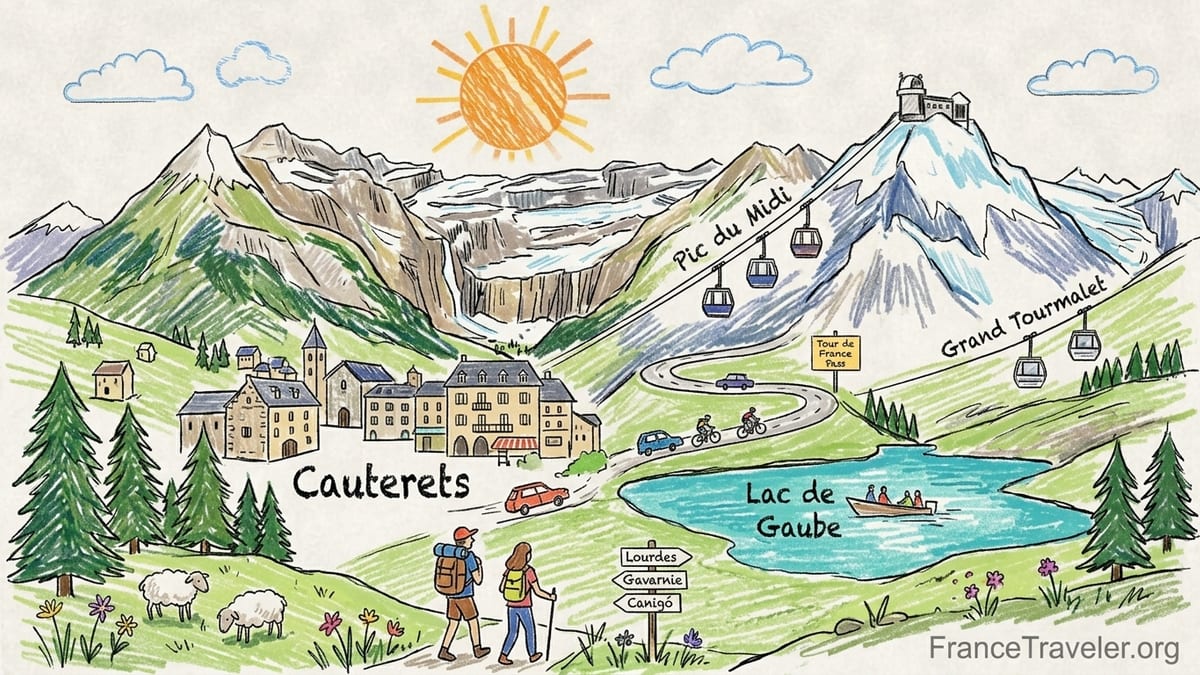
Cauterets, about 30 kilometers south of Lourdes by road, sits at the entrance to the Pyrenees National Park. It combines a Belle Époque spa town with a small but high-altitude ski area and quick access to famed beauty spots like Pont d’Espagne and Lac de Gaube. In winter, a typical day for a first-time visitor might mean taking the gondola from the village to the Cirque du Lys ski slopes for a few hours of relaxed runs, then soaking in the Bains du Rocher thermal baths. In summer, many travelers ride the cable car and chairlift from Pont d’Espagne to Lac de Gaube and walk back down, which offers big-mountain views without committing to a full-day hike.
Further up the valley system, the village of Gavarnie is the jumping-off point for the Cirque de Gavarnie, a UNESCO-listed amphitheater of cliffs and waterfalls that many people regard as the single must-see sight of the French Pyrenees. In July and August, families follow the wide track from the village to the Hôtel du Cirque, a gentle walk of around two hours each way. More experienced hikers can climb to the plateau d’Espuguettes or link Gavarnie with neighboring valleys. In winter, the Gavarnie-Gèdre ski area offers a compact, family-oriented set of runs with impressive scenery rather than a vast lift network.
Pic du Midi, Saint-Lary and Luchon: Classic Mountain Bases
The Pic du Midi de Bigorre is one of the most recognizable peaks in the French Pyrenees, crowned by an astronomical observatory that can be reached by cable car from La Mongie, part of the Grand Tourmalet ski area. First-time visitors often combine a half-day on the slopes with a ride up to the summit. On clear days, the panorama stretches across much of the range and deep into Spain. In summer, the cable car still runs, and short walks around the terraces give a taste of high altitude without a demanding ascent.
South-east of Lourdes, the Aure valley and the resort village of Saint-Lary-Soulan offer one of the most complete year-round bases in the Pyrenees. The ski area above Saint-Lary is among the largest in the French part of the range, with long intermediate runs and snowparks that appeal to mixed-ability groups. In practical terms, Saint-Lary works well for visitors who want a single base with ski rental shops, several supermarkets and a cluster of mid-range hotels and apartments. In summer, the focus shifts to hiking, canyoning and road cycling over nearby passes such as the Col d’Azet and the Col de Peyresourde, both regular features in the Tour de France.
On the border of Haute-Garonne and the Hautes-Pyrénées, Bagnères-de-Luchon, usually shortened to Luchon, feels more like a small town than a village. Its 19th-century boulevards, thermal baths and the cable car to Superbagnères make it appealing to travelers who like a developed resort atmosphere. Skiers can stay in Luchon and ride the gondola up to the Superbagnères slopes in winter, while hikers in summer benefit from a dense local trail network. The town also serves as a practical base for drivers who want to explore several valleys by car, including day trips to the Spanish side through the nearby passes where conditions allow.
Ariège and Ax-les-Thermes: Quieter, Wilder Pyrenees
East of the Hautes-Pyrénées, the department of Ariège is often overlooked by first-time visitors, which is part of its charm. The landscape here is steep and forested, dotted with medieval villages and Cathar castle ruins. For many travelers, the most convenient base is Ax-les-Thermes, a spa town with a compact center, public hot-water basins and easy access by train from Toulouse. From Ax, a cable car climbs to the Ax 3 Domaines ski area, while regional buses link to nearby valleys.
Ax-les-Thermes works particularly well for visitors who do not plan to rent a car. A common pattern for a winter trip is to take the train from Toulouse in about two hours, check into a small hotel or rental studio near the river and then use the gondola and local shuttles to reach the slopes. After skiing, people gather around the hot-spring pools in the town center or visit the thermes complex for more formal spa treatments. In summer, Ax becomes a hub for hiking and mountain biking, with well-marked trails starting near the town and guide offices offering canyoning and caving excursions.
Elsewhere in Ariège, villages such as Aulus-les-Bains and Ustou combine small ski stations with thermal facilities and simple guesthouses. These are not destinations for large groups expecting extensive nightlife or shopping, but they suit travelers looking for quiet, good value and an authentic rural atmosphere. Prices for basic hotel rooms and set menus in local restaurants here are often noticeably lower than in the more famous Hautes-Pyrénées resorts, which can matter if you are planning a longer stay.
Catalan Pyrenees, Font-Romeu and Canigó
As the mountains approach the Mediterranean, they take on a different character. The eastern Pyrenees lie mostly in the Pyrénées-Orientales department and form part of historic Catalonia, so you will hear Catalan as well as French in many villages. The landscape is more open and sunny, with wide plateaus broken by the granite massifs of Carlit and the sacred Catalan mountain of Canigó. Snow cover is more variable than in the central Pyrenees, but the proximity to the sea and the cultural distinctiveness make this a compelling region for a first or second trip.
Font-Romeu is one of the best-known bases in the Catalan Pyrenees. The resort sits on a high plateau above the Cerdagne valley, with a large solar research facility nearby that has become a local landmark. In winter, the Font-Romeu Pyrénées 2000 ski area spreads across gentle ridges that suit beginners and intermediates, backed up by significant snowmaking, while cross-country skiers use an extensive network of trails in the forest. In summer and early autumn, the focus shifts to hiking and road cycling, and many visitors ride the historic Yellow Train that links small mountain villages across the Cerdagne.
Closer to the plains, the Canigó massif rises steeply above the Roussillon plain and is often visible from the beaches near Perpignan on clear days. While there are no major ski resorts here, the mountain is threaded with hiking trails and refuges, and several small spa centers sit in the surrounding valleys, including traditional hot pools such as the Bains de Saint-Thomas. For first-time visitors who plan a combined sea-and-mountains itinerary, it is realistic to spend mornings walking on Canigó’s lower slopes and afternoons on the Mediterranean beaches in late spring or early autumn, when temperatures are mild in both places.
Skiing, Hiking, Thermal Spas and Cycling: What Each Area Does Best
For downhill skiing, the largest and most versatile areas on the French side of the Pyrenees include Grand Tourmalet near La Mongie and Barèges, Saint-Lary-Soulan and Font-Romeu Pyrénées 2000. Grand Tourmalet is known for its long pistes under the Pic du Midi and challenging routes off the Col du Tourmalet, while Saint-Lary balances family-friendly slopes with more sporting runs from higher lifts. Font-Romeu offers a gentler profile and strong snowmaking, which is reassuring in variable early- or late-season conditions. Smaller areas like Cauterets, Ax 3 Domaines and Gavarnie-Gèdre can be excellent for a few days, as long as you adjust expectations about the size of the lift network.
Hiking is arguably the strongest single reason to come to the French Pyrenees outside winter. The Pyrenees National Park around Cauterets and Gavarnie offers classic day routes such as the loop around the lakes above Pont d’Espagne or the ascent to the Espuguettes refuge. In the Néouvielle reserve near Saint-Lary, granite peaks rise above chains of turquoise lakes, accessible on waymarked paths that range from family-friendly walks to demanding high-level circuits. In Ariège, routes are typically quieter and sometimes less formally waymarked, rewarding more experienced hikers who are comfortable with map and compass or GPS. The Canigó area has a well-known summit route, usually done from late June to early October, and numerous balcony paths with coastal views.
Thermal spas are another thread that ties the Pyrenees together. Historic baths exist in towns such as Cauterets, Luchon, Ax-les-Thermes and Saint-Lary, many of which now combine medical treatments with modern spa facilities. A typical two-hour session in a public spa pool complex, such as the Bains du Rocher in Cauterets or one of the main thermes in Ax-les-Thermes, generally costs a moderate fee compared with big-city spas, and many visitors schedule a spa afternoon at the end of a hiking or skiing day. In the eastern Pyrenees, open-air pools like the Bains de Saint-Thomas provide a more rustic experience, especially in winter when snow lies around the steaming basins.
Cyclists know the French Pyrenees for their iconic passes featured in the Tour de France, including the Col du Tourmalet near Bagnères-de-Bigorre, the Col d’Aspin, the Col de Peyresourde and the Port de Balès. In practice, road cycling season for these high passes runs roughly from June to October, although exact dates depend on snow clearance and weather. Many visitors base themselves in the valleys around Arreau, Saint-Lary or Bagnères-de-Luchon and tackle a different pass each day, renting performance road bikes locally if they do not bring their own. For a gentler introduction, long-distance cycle routes in the foothills, including sections near Lourdes, offer flatter terrain and more regular services.
Transport, Seasons and Practical Planning
Access patterns across the French Pyrenees shape how easy it is for first-time visitors to move around. Lourdes, Tarbes, Pau, Toulouse and Perpignan all have railway stations linked to regional towns by TER trains and liO or other regional buses. For example, regular bus services in season connect Lourdes to Cauterets, Gavarnie and the Pic du Midi cable car area, which allows car-free travelers to reach some of the most famous sites at relatively low cost. Ax-les-Thermes benefits from a direct rail line from Toulouse, making it one of the simplest choices for visitors relying solely on public transport. In contrast, many smaller valleys are only accessible by car, and services may be limited on Sundays or outside school holidays.
For those renting a vehicle, it is worth understanding that many mountain roads are narrow and winding, with frequent hairpins and occasional closures during heavy snow or rockfall risk. Driving times on navigation apps can underestimate how long it takes in winter conditions or behind slow-moving traffic. First-time visitors often choose a single valley as their base to reduce daily driving, then add one or two longer day trips to major sites such as the Pic du Midi or Gavarnie when forecasts are favorable. Fuel and toll costs add up over longer distances, so concentrating activities in one area can also help control budgets.
Seasonality matters throughout the range. Ski resorts typically aim to open from early or mid-December to late March or early April, but actual dates vary each year according to snowfall. July and August are peak months for hiking, with the most reliable conditions on high trails but also the busiest car parks and higher accommodation prices. Late June and September often provide a good balance of milder temperatures, open huts and fewer crowds, though some lifts and mountain restaurants may run on reduced schedules. In May and October, lower routes in the foothills and around spa towns can be delightful, but snow can still block high passes and summit routes.
Accommodation options range from simple gîtes and small family-run hotels to modern spa hotels and self-catering apartments in the main resorts. In central hubs like Cauterets, Saint-Lary, Luchon, Ax-les-Thermes and Font-Romeu, you can usually find studios and one-bedroom apartments suitable for couples or small families, as well as campsites that open in the warmer months. Booking ahead is strongly recommended for August, for school holiday weeks in February and for major events like Tour de France stages that pass through the mountains, when entire valleys can sell out.
How to Choose Your First Pyrenees Base
When deciding where to focus a first trip, start with your priorities. If you want the broadest mix of famous scenery, accessible day hikes, thermal spas and non-ski activities, the Hautes-Pyrénées around Lourdes, Cauterets, Gavarnie, Pic du Midi and Saint-Lary is the strongest all-round choice. You could arrive by train or plane in Lourdes, spend a couple of nights there for the sanctuary and nearby foothill walks, then move on to Cauterets or Saint-Lary for hiking or skiing. This corridor also suits mixed groups where some members prefer easy valley walks and spa visits while others chase bigger hikes or bike passes.
If your priority is a car-free winter or summer break with straightforward public transport, Ax-les-Thermes and Luchon stand out. Ax combines direct train access from Toulouse with a linked ski area and hot springs, so a long weekend can be planned almost entirely around rail timetables. Luchon, although its rail line has seen changes in recent years, still offers a town-like setting with services, thermal baths and road access to Superbagnères and other valleys, making it appealing for travelers who prefer not to isolate themselves in a small village.
Travelers seeking quieter trails, more traditional villages and lower prices might look closely at Ariège or the smaller resorts in the eastern Pyrenees. Bases such as Aulus-les-Bains or the villages near Canigó offer access to wild-feeling terrain with fewer people on the paths, especially outside high summer. These areas work best if you are comfortable with a bit more logistical complexity, such as limited shop opening hours or less frequent buses, and if you value solitude over a wide choice of restaurants or nightlife.
For a combined sea-and-mountain experience, the Catalan Pyrenees around Font-Romeu and Canigó are hard to beat. You can spend several nights in Font-Romeu for hiking, biking and spa visits, then continue to the Mediterranean coast near Collioure or Argelès-sur-Mer. This combination is particularly attractive in late May, June or September, when beach towns are active but not yet at their busiest and high trails around Canigó are mostly clear of snow.
The Takeaway
The French Pyrenees reward visitors who slow down and choose their base carefully. Instead of trying to dash from the Atlantic to the Mediterranean in a single itinerary, most first-time travelers will enjoy the region more by focusing on one or two valleys. Whether you settle in Cauterets to explore the Pyrenees National Park, base yourself in Saint-Lary for skiing and cycling, soak in the hot springs of Ax-les-Thermes or look out over the plains from the slopes of Canigó, you will find that the French Pyrenees offer a more intimate, less commercial version of the European mountains.
By understanding the differences between the Hautes-Pyrénées, Ariège and the Catalan Pyrenees, and by aligning your plans with the seasons and your preferred transport, you can build a trip that feels balanced rather than rushed. The mix of high-mountain scenery, spiritual sites like Lourdes, thermal spas, small ski areas and legendary cycling passes means there is no single right way to experience this range. Instead, the French Pyrenees invite you to come back in different seasons and discover new corners each time.
FAQ
Q1. Is it better to visit the French Pyrenees with or without a car?
For a first visit, having a car gives you far more flexibility to reach smaller valleys and trailheads, but it is not essential. Areas like Lourdes, Cauterets, Ax-les-Thermes and Font-Romeu can be reached with trains and regional buses, and many classic hikes and ski areas are accessible from these hubs without driving.
Q2. When is the best time of year to hike in the French Pyrenees?
The main hiking season runs from late June to late September, when most high trails are free of snow and mountain huts and refuges are open. July and August offer the most reliable conditions but are also the busiest, so many walkers prefer late June or September for quieter paths and cooler temperatures.
Q3. How many days should a first-time visitor spend in the French Pyrenees?
A minimum of four to five days allows you to explore one valley properly and include a mix of activities such as a cable-car ride, a full-day hike and a spa visit. With a week or more, you can either slow the pace in one area or split your time between two bases, for example combining Cauterets and Gavarnie or Ax-les-Thermes and the Canigó area.
Q4. Are the French Pyrenees suitable for beginners at skiing or hiking?
Yes, many resorts such as Font-Romeu, Saint-Lary and Cauterets offer gentle ski slopes, English-speaking instructors and equipment rental tailored to beginners. For hiking, there are numerous short, waymarked routes to lakes and viewpoints starting from cable-car stations and valley villages, so even first-time walkers can enjoy mountain scenery without technical terrain.
Q5. How expensive are thermal spas in the French Pyrenees?
Prices vary by resort, but a typical two-hour access to public spa pools in towns like Cauterets, Luchon or Ax-les-Thermes usually costs a moderate fee compared with large urban spas. Treatments such as massages or medical-oriented cures are extra. It is common for visitors to budget for one or two spa sessions during a week-long stay, especially after strenuous hikes or ski days.
Q6. Can I rely on public transport to reach places like Gavarnie and Pic du Midi?
In season, regional bus networks make it possible to reach Gavarnie, Cauterets and the base stations for the Pic du Midi cable car from hubs like Lourdes, but services are often limited outside school holidays. Timetables can change each year, so it is important to check current schedules when planning a car-free trip and to allow extra time for connections.
Q7. What is the main difference between the French Pyrenees and the Alps for travelers?
The Pyrenees are generally quieter and less built-up than major Alpine resorts, with smaller ski areas and a stronger emphasis on spa towns, rural villages and mixed-activity holidays. Altitudes are slightly lower, but the scenery is still dramatic, and prices for accommodation and meals are often a bit lower than in the best-known Alpine destinations.
Q8. Is it realistic to combine the French and Spanish Pyrenees in one trip?
It is possible to cross between France and Spain via several mountain passes and tunnels, and some itineraries link towns such as Saint-Lary with Spanish valleys in Aragon. However, road journeys can be slow and weather dependent. For a first visit of one week or less, most travelers find it more comfortable to focus on one side of the range and leave cross-border circuits for a later trip.
Q9. Do I need special equipment to hike in the Pyrenees?
For standard summer day hikes, good walking shoes or light boots, layered clothing, a waterproof jacket, sun protection, water and snacks are usually sufficient. For higher or longer routes, especially early or late in the season when snow patches may linger, you may need trekking poles, warmer layers and sometimes professional guidance. Winter and spring ascents of high peaks require full alpine gear and experience.
Q10. Are the French Pyrenees family friendly?
Yes, many resorts and towns cater specifically to families, with gentle ski areas, beginner zones, playgrounds and easy lake or forest walks. Places like Cauterets, Font-Romeu, Saint-Lary and Ax-les-Thermes offer a mix of child-friendly accommodation, swimming or spa facilities and non-ski activities such as sledging, adventure parks and historic train rides, making them well suited to multi-generational trips.