


The French Pyrenees stretch from the Atlantic to the Mediterranean, but most travelers only have a few days to sample this mountain world. Instead of trying to see everything, the smartest strategy is to pick one or two bases that match your priorities, whether that means dramatic scenery, easy walks, ski slopes, hot springs, or a quick cultural detour from cities like Toulouse or Bordeaux. This guide compares the main destinations in the central and eastern French Pyrenees and shows where each one truly shines.
How to Choose Your Base in the French Pyrenees
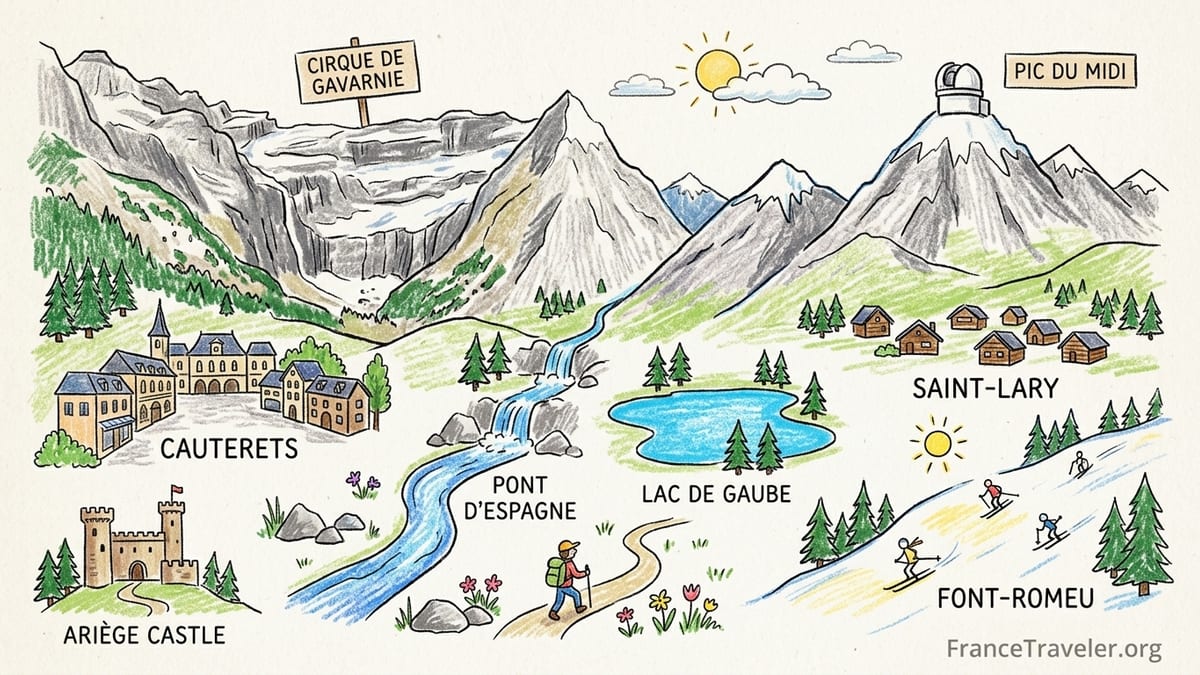
The central French Pyrenees cluster around a series of valleys, each with a distinct personality. Cirque de Gavarnie feels wild and vertical, Cauterets and Pont d’Espagne are all about waterfalls and lakes, Pic du Midi brings big-summit drama without a major hike, while Font-Romeu and the Catalan Pyrenees lean toward sunshine, ski slopes, and family infrastructure. A bit further east and south, Saint-Lary, Néouvielle, Ax-les-Thermes, Ariège, Luchon, and Lourdes each bring their own mix of spas, villages, and culture.
Practical details matter. In peak summer, a mid-range hotel or guesthouse in a busy hub like Cauterets or Saint-Lary often runs around 90 to 140 euros per night for a double room, while smaller villages like Gavarnie may offer simpler rooms or gites in the 70 to 110 euro range. Winter ski weeks in places such as Font-Romeu or Ax-les-Thermes can climb higher, especially during French school holidays, but self-catering apartments help keep costs in check.
Before booking, decide your main focus. If you want one knock-out view in a single day from Toulouse, Pic du Midi or Cauterets with Pont d’Espagne works well. If you are planning a week of varied hiking, Saint-Lary with easy access to Néouvielle’s lakes is ideal. If you are driving with children and want short strolls, animals, and a cable car or two, Font-Romeu and Cauterets are better bets. The following sections break down each area and help you match them to your style.
Gavarnie and the High Drama of Cirque de Gavarnie
Cirque de Gavarnie is the French Pyrenees classic for sheer drama. From the village of Gavarnie, a mostly gentle track follows the river toward a monumental limestone amphitheater with cliffs that rise around 1,500 meters above the valley floor and a towering waterfall visible from far away. The approach from the village is usually two hours or less round trip for a reasonably fit walker, with options to continue to the hot-chocolate terrace of the Hôtel du Cirque for an up-close view of the falls.
This is one of the best places in the Pyrenees if you crave scenery but not necessarily hard hiking. Families with school-age children often manage the main track with plenty of pauses, and the wide path makes it straightforward in summer weather. In July and August expect mule rentals on the main track, souvenir stalls in the village, and parking charges at the entrance to Gavarnie. A typical real-world pattern is to arrive from Lourdes late morning, park in the main lot, walk in normal sneakers with a daypack, and enjoy a picnic at the meadow in front of the cirque.
For more serious hikers, Gavarnie is also a gateway to tougher routes that feel much wilder. Ascents to the Plateau de Bellevue, the Refuge des Espuguettes, or the Hourquette d’Alans saddle involve steeper trails, full hiking gear, and often 800 to 1,000 meters of elevation gain. These routes move you quickly from busy valley floors to high ridges with views not just over Gavarnie but toward neighboring Spanish canyons in the Ordesa area. If you are planning a multi-day trek like part of the GR10, Gavarnie can be one of your most scenic overnight stops.
Travelers with limited time should note that Gavarnie is slightly more remote and road access can feel slow. From Lourdes you will usually allow around 1 hour 15 minutes by car, and public transport options can be seasonal and involve changes. That makes Gavarnie perfect for a dedicated day or overnight, but less ideal as a base if you want to explore several valleys in three or four days.
Cauterets, Pont d’Espagne and Lac de Gaube for Lakes and Easy Walks
Cauterets is one of the most versatile bases in the French Pyrenees. It combines a compact spa town with Belle Époque architecture, thermal baths, and direct access to both gentle valley walks and higher alpine scenery. Just 7 kilometers above town, Pont d’Espagne is a historic mule route that now serves as a visitor gateway to waterfalls, forests, and the famous Lac de Gaube, often promoted locally as one of the most beautiful lakes in the Pyrenees.
For travelers who want scenic but accessible walks, Pont d’Espagne and Lac de Gaube are hard to beat. In summer, a practical option is to drive or take a shuttle up from Cauterets, park at the Pont d’Espagne lot, walk a few minutes to the stone bridge over the roaring river, then continue either on foot up a well-graded forest path to Lac de Gaube or take the combination of gondola and chairlift that drops you near the lake shore. Many visitors, including families and older travelers, choose the lift and then stroll the remaining distance along the lakeside trail, spending an hour or two at the small café or simply sitting with picnic supplies looking across to the Vignemale massif.
Compared with Gavarnie, Cauterets offers much more infrastructure: several hotels, self-catering apartments, supermarkets, and a thermal spa complex that sells evening passes. If you are looking to mix easy nature outings with a relaxed town atmosphere, Cauterets is one of the best choices. Everyday prices reflect that convenience. In high summer it is common to find simple two-star hotel rooms around 90 to 110 euros, while three-star spa hotels cluster higher. Restaurant options range from crêperies and pizza to mountain cuisine like garbure soup and duck confit.
Cauterets is also a springboard to more demanding hiking. From the Pont d’Espagne side, routes lead into the Marcadau valley and toward high passes. The hiking season can extend from late June into early October in average conditions, though snowfields may linger above 2,000 meters early in the summer. For a mixed group with some hikers and some less active travelers, Cauterets works especially well. One day the whole group can ride up to Lac de Gaube together; the next, stronger hikers can head deeper into the valleys while others enjoy a spa afternoon or café-hopping in town.
Pic du Midi, Néouvielle and Saint-Lary for Big Views and Serious Hiking
If you want instant high-mountain drama without a long climb, Pic du Midi de Bigorre is the obvious candidate. A cable car from the ski village of La Mongie brings you to a 2,800-meter observatory terrace with far-reaching views across the Pyrenees. Many visitors treat it as a half-day excursion from Lourdes or Bagnères-de-Bigorre. In practice you might drive to La Mongie late morning, buy a return ticket, ride the two-stage lift, and spend an hour or two strolling the panoramic walkways and learning about the astronomy and weather research carried out on the summit.
Pic du Midi is not a hiking base in itself but works very well paired with nearby valleys. One logical combination is to stay in Saint-Lary-Soulan, a lively mountain town around the Aure valley that doubles as a ski resort in winter and hiking hub in summer. Saint-Lary offers a wide range of accommodation from campsites and chalets to modern apartments, along with restaurants, bars, supermarkets, and family facilities such as a small adventure park and bike rentals. It also has a modern thermal spa complex with family-friendly leisure pools and quieter wellness areas, making it a good choice for travelers who want to end big hiking days in hot water.
Just above Saint-Lary lies the Néouvielle massif, an area of granite peaks and an exceptional concentration of glacial lakes. Access roads and shuttles lead to trailheads near dams such as Orédon and Cap-de-Long, from which classic lake circuits begin. Hikers often spend a full day linking lakes like Aumar and Aubert on well-marked paths, with elevation gains that are manageable for reasonably fit adults. Unlike the gentle walks at Pont d’Espagne, these circuits feel like full mountain days, so carrying proper boots, layers, food, and emergency gear is strongly recommended.
For travelers focused on serious hiking, Saint-Lary and Néouvielle arguably make a better base than Cauterets or Gavarnie because of the density of routes of all levels within short driving distance. A week-long stay might include two big lake circuits, a summit attempt on a nearby 3,000-meter peak with a guide, and a rest day in the spa or exploring small villages in the Aure valley. Public transport is more limited than in some Alpine regions, so a rental car from Toulouse or Pau helps you make the most of the area.
Lourdes and Luchon for Culture, Spas and Mixed Itineraries
Lourdes is primarily known as a major pilgrimage center, with its sanctuary complex, nightly candlelight processions in season, and large hotels geared to pilgrims. For purely scenic travelers it may not be an obvious Pyrenees base, but for some itineraries it makes sense. Trains from Paris, Bordeaux, and Toulouse run directly to Lourdes, and from there you can reach places like Gavarnie, Cauterets, and the Col du Tourmalet region by car within 60 to 90 minutes. That makes Lourdes a practical starting or ending point if you want to mix spiritual tourism, comfortable city-style lodging, and mountain day trips.
In a real-world week, one couple might spend two nights in Lourdes visiting the sanctuary and historic sites in the evenings, then pick up a rental car for three or four nights split between Cauterets and Gavarnie before returning to Lourdes or Toulouse to fly home. Because Lourdes has a large accommodation stock, you can often find reasonably priced three-star hotels outside peak pilgrimage dates, sometimes under 100 euros, which helps offset the cost of a car.
Further east, Bagnères-de-Luchon, usually known simply as Luchon, blends thermal spa tradition with high mountain access. The town has leafy boulevards, a historic spa building, and a base area that used to be linked by cable car to Superbagneres ski station. While lift infrastructure can evolve over time, the pattern remains similar: Luchon focuses on spa culture, restaurants, and services, while the surrounding mountains offer hiking, biking, and winter sports. It is a good option if you want a town with a bit of evening life rather than a tiny village.
Compared with Saint-Lary or Cauterets, Luchon feels a touch quieter in international tourism terms, which can be an advantage if you prefer a less polished atmosphere. It also provides easier road access into neighboring valleys and even across into Spain for day trips. For travelers with limited time who want a blend of spa relaxation, light hiking, and mountain scenery without the crowds of top pilgrimage or ski resorts, two or three nights in Luchon can be rewarding.
Ariège and Ax-les-Thermes for Quieter Mountains and Thermal Spas
South of Toulouse, the Ariège department offers a different side of the French Pyrenees. Valleys feel less developed and more rural, with stone villages, Romanesque churches, and a scattering of medieval castles. For many travelers this is the best place to come if you value quiet, under-the-radar landscapes over grand gestures. Hiking trails often start directly from small villages, and even in high season it is common to walk for hours and see only a handful of other people.
Ax-les-Thermes is the main hub in this part of the range. It is a compact town with steaming thermal fountains on the main square, a public spa complex, and easy access by train from Toulouse. Above town, the Ax 3 Domaines ski area caters to winter sports, while in summer the lift opening schedule can allow walkers and mountain bikers to gain altitude quickly. At street level, you can soak your feet in the hot-water basins for free or book a full spa session in a modern thermal center, making Ax particularly attractive for travelers who like hydrotherapy as much as hiking.
Pricing and atmosphere in Ax-les-Thermes are generally a bit more modest than in big-name ski resorts further west. Simple hotels, chambres d’hôtes, and rental apartments make it relatively easy to travel on a mid-range budget. A realistic pattern for a long weekend might be to arrive by train from Toulouse on Friday evening, enjoy a spa session, then spend Saturday and Sunday on nearby hikes or short drives to lakes and passes, returning for one last soak before catching an evening train back.
Ariège overall suits travelers who prioritize culture and gentle exploration over headline summit ticks. Combined itineraries can include visits to prehistoric caves, hilltop castles, and Romanesque churches alongside day hikes. If your mental image of the Pyrenees is quieter valleys and old stone villages rather than big cable cars, Ariège and Ax-les-Thermes deserve serious consideration.
Font-Romeu and the Catalan Pyrenees for Families and Skiing
Near the Spanish border in the eastern Pyrenees, Font-Romeu and the wider Catalan Pyrenees offer a sunny, family-friendly take on mountain travel. Font-Romeu Pyrénées 2000 is a resort spread across open plateaus, with a reputation for abundant sunshine and both downhill and Nordic ski terrain. The ski area offers several dozen kilometers of pistes along with over 100 kilometers of cross-country trails in a typical season, plus fun zones and beginner areas that cater well to children and first-time skiers.
In winter, Font-Romeu is one of the best choices in the French Pyrenees for families learning to ski. Ski schools run group lessons, and dedicated children’s areas with conveyor-belt lifts and gentle slopes make the learning curve less intimidating. Many French families rent small apartments or residences for a week, cook simple meals, and enroll kids in morning lessons while adults either ski nearby or enjoy snowshoe outings. Rental shops in the village center and at the main base areas package skis, boots, and helmets together, which simplifies logistics if you arrive by train and local bus from Perpignan or Toulouse.
Summer at Font-Romeu is quieter but still appealing. Trails lead through pine forests and open meadows, mountain-biking routes crisscross the hills, and lake outings in the wider Cerdagne and Capcir areas round out the picture. The Catalan identity is visible in bilingual signage, local cuisine, and the proximity of Spanish and Andorran borders, making this an attractive base for travelers who like to combine French and Catalan cultures in one trip.
For travelers with limited time, Font-Romeu works best as a focused skiing or family base rather than a hub for exploring the entire Pyrenean chain. Distances to western sights like Gavarnie or Cauterets are long, and without a car it is hard to combine the Catalan Pyrenees with the high valleys around Pic du Midi in a single short stay. If you are arriving via Barcelona, however, this eastern cluster of resorts offers one of the simplest ways to dip into the French mountains for a few days.
Matching Destinations to Different Types of Travelers
Seen together, these destinations form a menu rather than a checklist. For the most dramatic scenery accessible in a single easy outing, Cirque de Gavarnie, Pic du Midi, and the Lac de Gaube viewpoint each offer different flavors. Gavarnie surrounds you with a vertical stone amphitheater, Pic du Midi gives you a bird’s-eye panorama from a scientific observatory, and Lac de Gaube frames a turquoise lake under glaciated peaks. Choosing between them depends on whether you prefer to look up from a meadow, look out from a terrace, or sit beside water.
If easy walks are the priority, Cauterets with Pont d’Espagne and Lac de Gaube probably wins, followed by Ariège valley walks and lower trails around Ax-les-Thermes and Luchon. For more serious hikers who want long days and multiple itineraries in a week, Saint-Lary with Néouvielle stands out, with Gavarnie a close second if you are comfortable stringing together steeper routes around the cirque and nearby passes. In practice many hiking-focused travelers build a loop that includes a few nights in Saint-Lary for lake circuits and a night or two in Gavarnie for cirque views.
For skiing, Font-Romeu and Ax-les-Thermes offer the broadest range for recreational skiers, with Saint-Lary and Cauterets also strong winter options. Families tend to favor Font-Romeu for its sunny reputation and structured children’s areas, or Cauterets where you can combine time in the snow with spa sessions down in town. Thermal spa enthusiasts, on the other hand, may gravitate to Cauterets, Saint-Lary, Ax-les-Thermes, or Luchon, where modern spa complexes sit beside historic bath buildings and you can buy half-day or evening passes.
Culture-focused travelers and those with limited time should consider Lourdes, Luchon, and Ariège. Lourdes works particularly well if you want a mix of pilgrimage and mountain day trips and plan to arrive by train. Ariège, including Ax-les-Thermes, brings together medieval castles, prehistoric cave sites, and Romanesque churches with relatively quiet mountain valleys. Luchon provides a small-town French atmosphere with a spa tradition and access to both French and Spanish valleys.
If your schedule is tight, you can still get a meaningful Pyrenees taste. From Toulouse, a long day trip by car to Cauterets and Pont d’Espagne or to Ax-les-Thermes and a nearby valley is realistic. From Lourdes, a one-day loop to Pic du Midi or Gavarnie gives you a signature landscape without overnighting in the mountains. The key is to resist trying to cover too much ground between distant valleys and instead invest your limited hours in one or two well-chosen spots.
The Takeaway
The French Pyrenees reward travelers who choose depth over breadth. Cirque de Gavarnie, Cauterets and Pont d’Espagne, Lac de Gaube, Pic du Midi, Néouvielle and Saint-Lary, Lourdes and Luchon, Ariège and Ax-les-Thermes, and Font-Romeu in the Catalan Pyrenees each answer a different travel question. Do you want a single unforgettable view, a week of serious lake hiking, a sunny ski base for children, a pilgrimage plus mountains, or quiet valleys with hot springs and old stone villages.
Building your trip as a destination-selection exercise rather than a checklist makes the planning easier and the experience richer. Start by deciding whether your priority is dramatic scenery, easy walks, strenuous hiking, skiing, family comfort, thermal spas, culture, or a quick hit of mountains in a packed itinerary. Then match that priority to the valley or town that fits it best, accepting that you will not see everything in one go.
Whichever base you choose, the French side of the Pyrenees remains compact enough that with a rental car and a few extra days you can link several of these areas into a satisfying loop. Many travelers find themselves returning, perhaps swapping a first trip of easy walks in Cauterets for a second visit built around Néouvielle ridge hikes or a Font-Romeu ski week. The range is varied enough to reward repeat visits, and choosing carefully the first time simply ensures that your opening chapter in the Pyrenees matches the way you like to travel.
FAQ
Q1. If I have only one full day, should I choose Gavarnie, Cauterets with Pont d’Espagne, or Pic du Midi
For a first visit, Cauterets with Pont d’Espagne and Lac de Gaube offers the best balance of easy access, short scenic walks, waterfalls, and lake views, while Pic du Midi is ideal if you prefer a cable car to a very high summit terrace and Gavarnie is best if you want to spend most of your day walking toward one iconic cirque view.
Q2. Which area in the French Pyrenees is best for families with young children
Font-Romeu in the Catalan Pyrenees and Cauterets are particularly family friendly, thanks to gentle ski slopes and ski schools in winter, easy lift-assisted walks in summer, and town centers with playgrounds, casual restaurants, and accommodation options such as self-catering apartments that suit families.
Q3. Where should serious hikers base themselves for a week of challenging routes
Saint-Lary with access to the Néouvielle lakes and nearby 3,000-meter peaks is an excellent hiking base, with a wide range of demanding circuits and summit routes, while combining a few nights in Saint-Lary with two or three nights in Gavarnie gives very strong hikers access to some of the most spectacular multi-hour trails in the French Pyrenees.
Q4. What is the best destination for thermal spas combined with light walking
Ax-les-Thermes, Cauterets, Saint-Lary, and Luchon all work well, but Ax-les-Thermes and Cauterets stand out if you want to arrive by train from Toulouse and then spend your days on gentle valley or forest walks and your evenings soaking in modern spa complexes or even free outdoor footbaths fed by hot springs.
Q5. Is Font-Romeu a good base if I am not skiing
Yes, but it works best in summer and shoulder seasons for people who enjoy forest walks, mountain biking, and sunny plateau scenery, or in winter if you want to accompany skiers and use lifts for snowshoeing and viewpoints rather than skiing yourself, though if you do not plan to use the resort infrastructure at all you might prefer a traditional valley town such as Cauterets or Saint-Lary.
Q6. How do I choose between Ariège and the central Pyrenees if I like quiet and culture
If you want quieter valleys, small stone villages, and a strong focus on castles, churches, and caves alongside moderate hiking, Ariège and Ax-les-Thermes are very appealing, while the central Pyrenees around Cauterets, Gavarnie, and Saint-Lary offer bigger mountain architecture, more visitors, and slightly more polished tourism infrastructure.
Q7. Can I visit Lourdes and still see high mountain scenery without a car
It is easier with a car, but you can sometimes combine Lourdes with organized excursions or seasonal bus links to Cauterets or nearby valleys, so if you are willing to join a tour or adapt to limited bus timetables it is possible to experience at least one high-mountain area while basing in Lourdes, especially in the main summer season.
Q8. Which destination works best if I am traveling in winter but do not ski
Cauterets, Ax-les-Thermes, and Saint-Lary are strong choices because you can enjoy spa facilities, short walks in valley bottoms, and sometimes lift-assisted pedestrian tickets for viewpoints or restaurant terraces, while still being in lively towns where ski culture creates a winter atmosphere without requiring you to ski.
Q9. What is a sensible first-time one-week itinerary in the French Pyrenees
A realistic one-week plan might include two nights in Lourdes for arrival and cultural visits, three nights in Cauterets for Pont d’Espagne and Lac de Gaube plus a spa evening, and two nights in Saint-Lary or Gavarnie for higher-level hiking, giving you a mix of culture, easy walks, and more dramatic mountain days without rushing between distant valleys.
Q10. Do I need a car to make the most of the French Pyrenees
You can reach hubs like Lourdes, Cauterets, and Ax-les-Thermes by train or bus, but having a rental car makes it far easier to connect multiple valleys such as Gavarnie, Néouvielle, and Saint-Lary in a single trip, to start hikes at less accessible trailheads, and to adjust plans quickly for weather changes, especially outside the peak summer season.