


Choosing where to base yourself in the French Pyrenees will shape your entire trip. Valleys are deep, distances are slow, and each town has a very different feel. Pick well and you will step from your front door straight onto classic hiking trails, family-friendly ski slopes or steaming thermal baths. Pick poorly and you may spend hours in the car chasing good weather or dinner options. This guide compares the main bases that English-speaking travelers usually consider Cauterets, Saint-Lary-Soulan, Luz-Saint-Sauveur, Bagnères-de-Luchon, Ax-les-Thermes, Font-Romeu, Lourdes, Argelès-Gazost and quieter Ariège villages so you can book accommodation in the valley that actually fits your priorities.
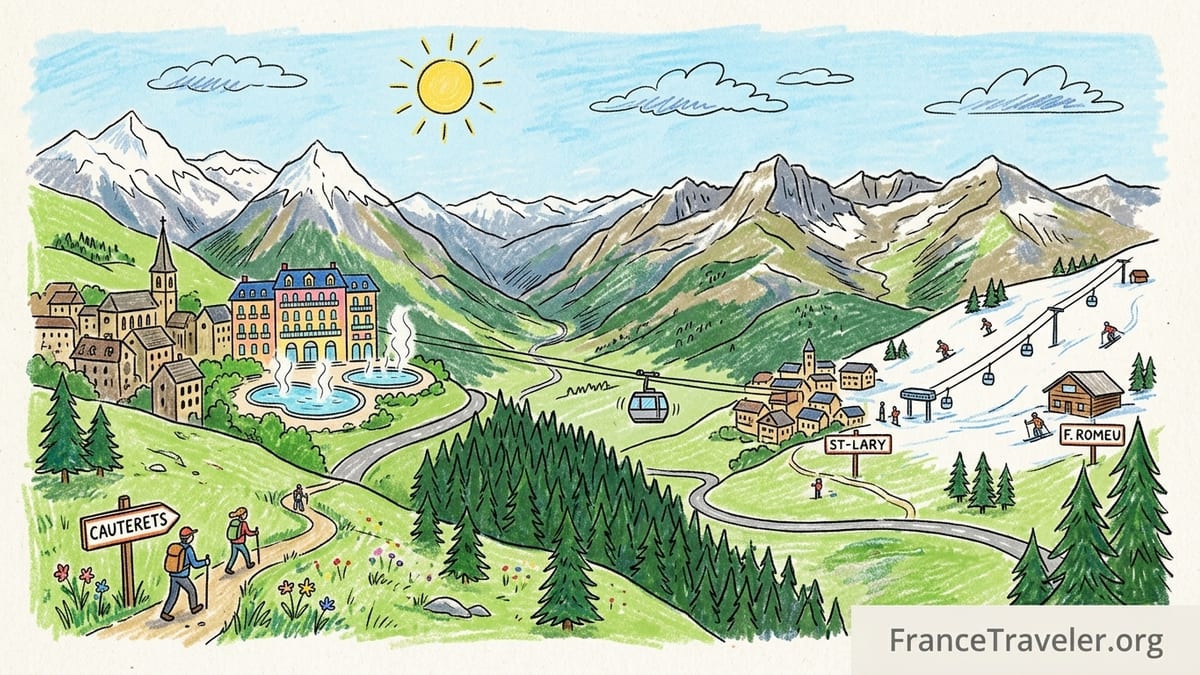
How to Choose Your Base in the French Pyrenees
The French Pyrenees are not like the Alps, where you can hop between resorts in under an hour. Here, valleys run north to south and are often dead ends, separated by high passes. That means your base largely determines which hikes, ski areas and spa towns you can realistically reach in a week. Before you book, be clear on whether your priority is high-mountain hiking, family skiing, spa downtime, restaurant choice or a quieter nature retreat.
As a rule of thumb, Cauterets, Luz-Saint-Sauveur and Saint-Lary-Soulan work best for classic high-mountain scenery and hiking. Bagnères-de-Luchon and Ax-les-Thermes combine ski access with serious spa culture. Font-Romeu and Argelès-Gazost are mellow, sunny bases with easier driving and plenty of day trips. Lourdes is a transport hub with the widest accommodation range but a more urban, pilgrim-focused feel than a typical mountain village. Smaller Ariège villages suit travelers who want quiet trails and can accept limited services.
Car dependence is a crucial factor. In summer, some shuttle buses run to key trailheads like Pont d’Espagne above Cauterets or the Néouvielle lakes, and from Lourdes up several valleys, but departure times are limited and often seasonal. If you want maximum flexibility, especially in shoulder seasons like late September or early June, plan on renting a car and choosing a base with easy parking and grocery access.
Prices vary less by town than by trip timing and accommodation style. In peak August or over New Year, a self-catering apartment in popular hubs like Cauterets or Saint-Lary can run from roughly 110 to 200 euros per night for a small family place, while similar units in quieter Ariège valleys may cost closer to 80 to 130 euros. In May or October shoulder seasons, it is often possible to find simple hotel rooms in most of these towns from around 70 to 110 euros if you book in advance.
Cauterets: Gateway to Lakes, Waterfalls and Family Skiing
Cauterets is one of the strongest all-round bases in the central Pyrenees, especially if you want to combine serious hiking with a classic spa town atmosphere. The village sits at around 950 meters in a narrow valley and offers direct access to Pont d’Espagne, Lac de Gaube, the Marcadau valley and multiple GR10 segments. In practice, that means you can start some of the region’s most photographed day hikes with a short drive or bus ride rather than a long transfer from another valley.
In winter, the Cauterets ski area is reached by a gondola from the village, with a compact but snow-sure domain that is popular with families and intermediate skiers. Snowfall here is often generous compared with some nearby resorts, and the beginner-focused Yéti Park area near the ski school makes it an approachable choice for children. Experienced skiers who want huge linked domains might find it limited, but for a week mixing skiing, spa sessions and snowshoeing it works well.
The spa experience is a major part of Cauterets’ appeal. Les Bains du Rocher offers outdoor thermal pools with mountain views, whirlpools and relaxation areas, and you can realistically finish a long hike to Lac de Gaube, drive 20 minutes back down, and be soaking in warm water by early evening. In terms of restaurants and hotels, Cauterets has a compact but lively center with brasseries, creperies and mountain-style bistros, plus a mix of traditional hotels, small residences and plenty of self-catering apartments. Prices in summer and winter high season are mid-range rather than budget, and in August it pays to book several months ahead.
Car dependence in Cauterets is moderate. You can reach the village from Lourdes by bus in around an hour in season, and local shuttles connect to Pont d’Espagne. For a car-free traveler whose focus is a week of hiking in the same valley and soaking in the spa, it can work. For those wanting to day-trip to Gavarnie or the Néouvielle reserve, having a car still makes life much easier.
Saint-Lary-Soulan & Argelès-Gazost: Lively Bases for Active Families
Saint-Lary-Soulan in the Aure valley is one of the most complete resorts in the French Pyrenees for travelers who want a classic mountain village with a big ski area, thermal baths and plenty of restaurants. The village has direct access by gondola and cable car to the Saint-Lary ski domain, which offers a wide mix of pistes, snowparks and beginner zones. In winter, families appreciate that many accommodations sit within walking distance of lifts and ski schools, and there are both upscale spa hotels and more modest guesthouses.
Hiking access from Saint-Lary-Soulan is especially strong for those interested in the Néouvielle lakes, the high Pyrenean passes on the GR10 and day walks toward the Spanish border. You can drive in under an hour to the Orédon and Aubert lakes trailheads, or up the road to the Portet pass for high-altitude walks with large panoramas. The village itself has a proper year-round community, so restaurants, bars and bakeries do not close completely outside of peak months. Expect mid-range accommodation prices that can spike in August and during school ski holidays, especially for chalets and spa hotels with pool access.
Argelès-Gazost, lower in the valley toward Lourdes, is another solid choice for active travelers who want to radiate out in different directions. From a base here, you can drive to Cauterets, Luz-Saint-Sauveur, the Val d’Azun or Hautacam in under an hour in normal traffic, which gives you access to a wide range of moderate-level hikes, smaller ski areas and cross-country skiing locations. The town has a pleasant thermal park, a weekly market, and enough restaurants and supermarkets to make self-catering easy. It suits families who prefer a slightly gentler, sunny valley setting rather than the enclosed feel of high mountain villages.
Both Saint-Lary-Soulan and Argelès-Gazost are easier for travelers who prefer to use a car. Public transport exists but is limited and often does not reach key high-altitude trailheads outside peak summer. If you are comfortable driving mountain roads and want to explore multiple valleys in one trip, these two bases strike a good balance between amenities and access.
Luz-Saint-Sauveur & Lourdes: Central Hubs for Multiple Valleys
Luz-Saint-Sauveur occupies a strategic spot where roads branch toward the Col du Tourmalet and the Pic du Midi, the Gavarnie valley and Barèges. That makes it an appealing base for people who want to see several classic Pyrenean highlights in a week without changing hotels. The town itself is a small spa resort with historic buildings, a compact center and a riverside setting. Compared with Cauterets, it sits more centrally relative to major sites like Gavarnie, the Cirque de Troumouse and the Néouvielle reserve, though certain day trips still involve hour-long drives.
In winter, Luz-Saint-Sauveur gives access by short drives or shuttle buses to three ski areas: Luz Ardiden, the larger Grand Tourmalet domain via Barèges, and the small family-friendly Gavarnie-Gèdre station. That variety appeals to mixed-ability groups. In summer, hikers can access routes in the Gavarnie valleys, ascents toward the Brèche de Roland, and balcony paths above Barèges. Restaurant choice is decent for the town’s size, with pizzerias, bistros and a few more creative kitchen teams, plus small hotels, self-catering apartments and nearby campsites.
Lourdes, about 30 minutes down the valley by car, plays a very different role. It is a major pilgrimage destination with a dense hotel stock, particularly two and three star properties catering to groups. For travelers, this translates into a wide range of prices and last-minute availability, especially outside major religious events. Lourdes is also the main public transport hub for this part of the Pyrenees, with trains connecting to Toulouse and Pau and seasonal buses running up to Cauterets, Barèges and occasionally Gavarnie.
The trade-off is atmosphere. If your dream of the Pyrenees is a quiet stone village with cows on the hillside, Lourdes’ urban sprawl and souvenir shops may feel jarring. If, however, you want to keep costs low, travel mostly by bus and string together day hikes across several valleys, basing in Lourdes and using local buses and occasional taxis can make sense. Families who value easy supermarket access, playgrounds and simple restaurants may also find it practical, especially in shoulder seasons when smaller resort villages are sleepy.
Bagnères-de-Luchon & Font-Romeu: Sun, Spas and Wide-Ranging Day Trips
Bagnères-de-Luchon, usually shortened to Luchon, is one of the grand old spa towns of the Pyrenees, with tree-lined avenues and Belle Époque buildings. It sits in the far east of the central range, close to the Spanish border. Luchon is a strong base if you value spa treatments, moderate but beautiful hiking, and restaurant choice over extreme Alpine-style peaks. The local Superbagnères ski slopes are reached by a gondola from town in winter, and in summer the same lift helps walkers reach high meadows and ridge walks without a long climb.
Hiking around Luchon tends to focus on accessible valleys such as the Vallée du Lys and lakes like Lac d’Oô, which can be reached in under an hour by car. There are also options to cross into Spain for day trips, especially if you are comfortable driving mountain passes. Restaurants range from simple crêperies and pizza places to a handful of more ambitious establishments, and accommodation includes mid-range hotels, spa-focused properties and apartments. Prices are generally similar to Saint-Lary or Cauterets in high season but can be softer in spring and autumn, especially midweek.
Font-Romeu, further east in the Pyrénées-Orientales, is among the sunniest resorts in France and has long marketed itself as a training base for athletes. At around 1800 meters, the town sits on a plateau with wide views toward the high peaks on the Spanish and Andorran borders. Skiing here suits families and intermediates, with a good spread of blue and red runs and snowparks, while cross-country skiing is particularly strong in the wider Cerdagne area.
In summer, Font-Romeu is a base for moderate hiking rather than extremely rugged mountaineering. Trails wind through pine forests, meadows and small lakes, and nearby attractions include the historic walled town of Villefranche-de-Conflent, hot springs in the surrounding valley and the famous yellow tourist train that trundles through spectacular scenery. Accommodation leans toward apartments and chalet-style residences, with prices that can be competitive outside the main French school holidays. A car is very useful here to explore surrounding valleys, although some local buses run between nearby villages.
Ax-les-Thermes & Quieter Ariège Villages: Low-Key Nature and Thermal Waters
Ax-les-Thermes sits in the Ariège department and is best known for its thermal baths and the Ax 3 Domaines ski area, which is reached by gondola in around seven minutes from town. The village itself has a friendly atmosphere, with steaming public foot baths in the main square, a small market and a clutch of restaurants and bars serving hearty mountain food. It suits travelers who like the idea of skiing in the morning and soaking in thermal pools in the afternoon without needing to drive between locations.
Hiking around Ax-les-Thermes is varied and often quieter than in the more famous Hautes-Pyrénées valleys. You can reach lakes such as Étang de Laurenti or Étang du Comte, or tackle steeper routes like the Dent d’Orlu. The scenery features dense forests, craggy peaks and deep valleys, with plenty of scope for day hikes between three and six hours. Accommodation choice includes small hotels, spa-focused properties, self-catering apartments and nearby campsites, and prices are often a touch lower than in headline destinations like Cauterets.
Beyond Ax, the Ariège Pyrenees are dotted with small villages that can work as peaceful bases for hikers with a car. Places in the Vicdessos valley or near Auzat and Val-de-Sos give access to wild routes around Montcalm and the high border ridges, while villages closer to Foix and Tarascon-sur-Ariège offer a mix of medieval towns, caves and more gentle walking. The trade-off is limited restaurant choice, fewer hotels and little in the way of nightlife. These bases are best suited to couples or solo travelers seeking quiet, who are happy to cook in their accommodation and drive to most trailheads.
For families, Ax-les-Thermes is usually the better Ariège base, because it combines a ski area, thermal spa facilities, simple playgrounds and a compact, walkable center. For budget-conscious hikers or road-trippers seeking an uncrowded corner of the range, a rental house in a smaller Ariège village can be excellent value, especially outside peak French school holidays.
Comparing Hiking, Skiing, Spas, Food and Practicalities
When you line these bases up side by side, their strengths become clearer. For top-tier hiking access without constantly driving, Cauterets, Luz-Saint-Sauveur and Saint-Lary-Soulan rank highest, with direct routes into high valleys, lakes and GR10 stages. Ax-les-Thermes and Luchon offer excellent walking too, but the scenery is more spread across several valleys and may require more driving. Font-Romeu and Argelès-Gazost lean toward moderate-level walks and scenic rambles, while Lourdes and smaller Ariège villages serve as central or quiet bases rather than doorstep hiking hubs.
In winter, Saint-Lary-Soulan, Font-Romeu, Ax-les-Thermes, Cauterets and the Luz-Saint-Sauveur area all give access to significant downhill ski domains, with Saint-Lary and Grand Tourmalet near Luz being the largest. Families learning to ski often appreciate compact, beginner-friendly areas like Cauterets or Ax 3 Domaines, where moving between nursery slopes and cafés is straightforward. Non-skiers in the group will value towns with spas and promenades, such as Cauterets, Luchon, Ax-les-Thermes and Lourdes.
If spas are important, prioritize Cauterets, Ax-les-Thermes, Luchon, Saint-Lary-Soulan and Argelès-Gazost, all of which have established thermal facilities and sometimes hotels with direct spa access. For restaurant choice, Lourdes, Luchon and Saint-Lary-Soulan generally offer the widest variety across budgets, while Cauterets and Luz have enough options for a week but can be quieter outside school holidays. Smaller Ariège bases have much more limited dining, so self-catering is often the default.
Car dependence is lowest in Cauterets, Ax-les-Thermes and Luchon if you are content to focus on local hikes and ski areas, and in Lourdes if you plan to rely on regional buses to move between valleys. It is highest in small Ariège villages, around Font-Romeu if you want to explore widely, and in Argelès-Gazost if you intend to reach multiple remote trailheads. For families, the most convenient bases usually combine walkable centers, easy access to lifts or shuttle buses, short walks to bakeries and supermarkets, and a playground or riverside path. On those criteria, Cauterets, Saint-Lary-Soulan, Ax-les-Thermes, Luchon and Luz-Saint-Sauveur score well.
The Takeaway
Choosing the right base in the French Pyrenees is less about chasing the single “best” resort and more about matching a town’s character to your own travel style. If your priorities are big scenery, classic lakes and a strong spa culture, Cauterets or Luz-Saint-Sauveur make excellent anchors. For a lively ski and hiking resort with plenty of services, Saint-Lary-Soulan and Luchon are hard to beat. If you value sunshine, moderate walks and cross-country skiing, Font-Romeu and Argelès-Gazost shine. Those seeking quieter nature, lower prices and authentic villages will find a lot to love in Ax-les-Thermes and the wider Ariège valleys.
Before you reserve accommodation, sketch out a few must-do hikes or ski days and see how they line up on the map. Check how long it actually takes to drive between valleys, how often local buses run in your season, and whether your chosen town has the restaurants, supermarkets and spa facilities you want. With a little planning at the base-selection stage, your French Pyrenees trip can feel effortless once you arrive, with mountains, hot springs and good food all within easy reach of your front door.
FAQ
Q1. Which town is best if I want to hike without using a car every day?
Cauterets is one of the best choices, because several classic hikes such as the Pont d’Espagne area and Lac de Gaube are reachable by short shuttle or a relatively quick drive, and the GR10 passes close by. Luz-Saint-Sauveur and Saint-Lary-Soulan also offer good hiking options from or near the village, but you will likely use a car more often.
Q2. Where should I stay for the most family-friendly skiing?
Saint-Lary-Soulan, Cauterets, Ax-les-Thermes and Font-Romeu are all strong for families. They combine beginner areas, ski schools and varied pistes with village facilities like bakeries, casual restaurants and, in some cases, indoor pools or spas that keep children entertained after skiing.
Q3. If I do not want to rent a car, which base makes the most sense?
Lourdes can work as a car-free hub, thanks to train connections and seasonal buses up surrounding valleys, though it has a more urban, pilgrim-oriented feel. Cauterets, Ax-les-Thermes and Luchon are also viable if you are happy to focus mainly on local hikes and the nearest ski domain, since each has gondola access and walks that start near town, plus at least some public transport connections.
Q4. Which place offers the best combination of spa facilities and outdoor activities?
Cauterets and Ax-les-Thermes are particularly strong, with modern thermal complexes and easy access to hiking trails and ski lifts. Luchon and Saint-Lary-Soulan also balance spa culture, mountains and village life, giving you several options for a soak after a day outside.
Q5. Is Lourdes a good base for a classic mountain holiday?
Lourdes works well if you want wide hotel choice, lower prices and public transport links, and you plan to day-trip by bus or car to nearby valleys. It does not feel like a small mountain village, and you will not step directly from town into high-mountain scenery, but it is practical for travelers prioritizing logistics and budget.
Q6. Where are prices generally lowest for accommodation?
Prices depend strongly on season, but quieter Ariège villages and some accommodations in Ax-les-Thermes often undercut headline resorts in peak weeks. Outside school holidays, you can also find relatively good value in Font-Romeu, Luchon and Argelès-Gazost, especially if you choose simple apartments over full-service hotels.
Q7. Which base is best for a couple seeking quiet and nature rather than nightlife?
Smaller Ariège villages, as well as Ax-les-Thermes outside the busiest weeks, are excellent for couples who want quiet evenings, local markets and uncrowded trails. Parts of Argelès-Gazost and the valleys above it can also feel peaceful, especially if you stay in a rural guesthouse rather than in the town center.
Q8. How should I choose between Cauterets and Saint-Lary-Soulan?
Cauterets is ideal if you prioritize proximity to famous lakes and waterfalls, a compact spa town atmosphere and a smaller but snow-sure ski area. Saint-Lary-Soulan suits travelers wanting a larger ski domain, a slightly bigger village with more restaurants and bars, and easier access to the Néouvielle lakes and the Spanish border.
Q9. Are these towns suitable for visiting outside summer and winter high seasons?
Yes, but expect a quieter atmosphere. In May, June, September and October, many hiking trails are open and accommodation prices soften, though some restaurants and shops may operate reduced hours in smaller villages. Larger bases like Lourdes, Saint-Lary-Soulan, Luchon and Ax-les-Thermes usually retain enough services year-round.
Q10. How far in advance should I book accommodation in the French Pyrenees?
For peak August weeks and French school holiday periods in winter, it is wise to book several months ahead, especially in popular towns like Cauterets and Saint-Lary-Soulan or if you need a family apartment. In shoulder seasons, you can often find rooms a few weeks before arrival, although the best located and best value options still tend to go first.