

The French Pyrenees offer some of Europe’s most rewarding walking holidays, from gentle valley rambles to tough multi-day crossings on the GR10. The challenge for many travelers is not whether to go, but how: guided group, self-guided inn-to-inn, centre-based from one village, or a full section of the GR10 with luggage transfers. This guide compares the main trip styles and bases that specialist operators currently use, with concrete examples to help you book the holiday that matches your experience, budget and appetite for adventure.
How French Pyrenees walking holidays are typically organised
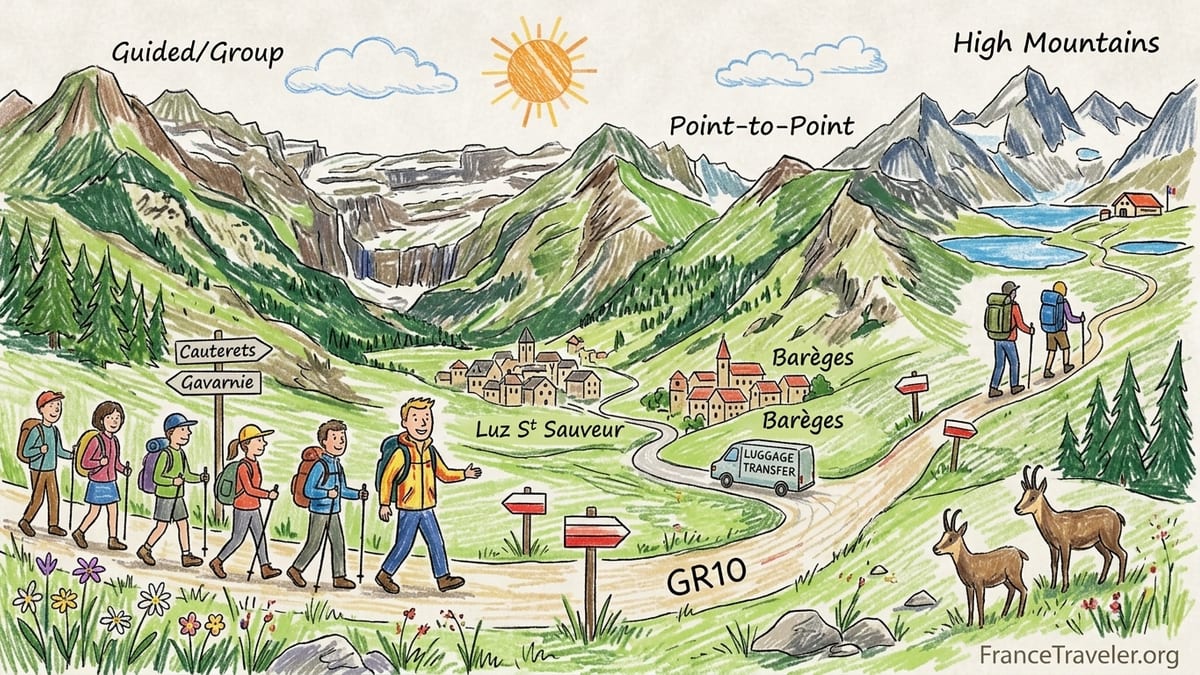
Most commercial walking holidays in the French Pyrenees follow a handful of proven formulas. Operators based in the region use the same core ingredients again and again: classic bases such as Luz Saint Sauveur and Barèges, iconic sites like Gavarnie, Cauterets and Pont d’Espagne, and high mountain areas like the Néouvielle Nature Reserve. Trips are then packaged either as centre-based stays, point-to-point sections of the GR10, or short hut-to-hut circuits with luggage transfers where roads allow.
For example, companies such as Respyrénées and GR10 Liberté sell self-guided sections of the GR10 that include accommodation, breakfasts and dinners, route notes, maps or GPS tracks, and daily luggage transport so you carry only a daypack between villages like Cauterets, Luz Saint Sauveur and Barèges. In parallel, smaller outfits such as Pyrenean Odysseys and local guesthouses around Barèges offer centre-based weeks with day walks to Gavarnie, Pont d’Espagne and the Néouvielle lakes, often backed by their own taxi service for flexible A to B hikes.
Prices vary by comfort level and whether guiding is included. A typical week-long self-guided GR10 package in high season, based on two people sharing, often starts around 750 to 900 euros per person including luggage transfers and half-board in simple hotels and gîtes. Fully guided small-group weeks with a qualified international mountain leader can run from roughly 1,000 euros upwards, depending on group size and hotel standard, but remove almost all of the logistical burden from the hiker.
Understanding these building blocks is the key to choosing the right format. The same landscapes can be experienced very differently: as a relaxed week from a cosy base, as a committed GR10 section where you change village every night, or as a more serious hut-to-hut trek in the high mountains. Your fitness, navigation confidence and tolerance for planning will largely determine which model suits you best.
Guided vs self-guided: who benefits from each format
Guided trips in the French Pyrenees are typically led by French or international mountain leaders who know the GR10 variants, unmarked shortcuts and weather patterns intimately. On a guided GR10 section between Cauterets and Luchon, for instance, the guide may decide on the day whether to follow the main line via Luz Saint Sauveur and Barèges or take an alternative balcony path depending on thunderstorms, snow patches or group fatigue. This level of real-time decision making is reassuring if you have limited alpine experience.
Guided groups tend to be small, often 6 to 12 walkers, and prices roll in the guide’s fees, logistics and most meals. That partly explains why a guided week can cost several hundred euros more than an equivalent self-guided itinerary. For many, though, the value is in safety and insight. A guide can explain local pastoralism as you cross the summer pastures above Luz, point out marmots and izards on the climb into Néouvielle, or quietly adjust the pace for slower walkers without disrupting the day.
Self-guided packages remove the leader but keep the logistics. Companies like Respyrénées publish detailed technical sheets for each itinerary, grading difficulty on a five-point scale and specifying daily ascent, descent and walking time. Their self-guided GR10 section from Cauterets eastward, for example, is marketed as level 3 out of 5, with luggage transported each day except hut nights where you carry only an overnight kit. You receive roadbooks, GPX files and emergency contact numbers, but you set your own pace and start times.
Independent hikers who are comfortable with basic map reading and following waymarks often find self-guided packages a good compromise. The GR10 is generally well signposted with red and white flashes, and the main valleys around Barèges and Cauterets also have clear local signage. The organized package saves hours of work booking small inns, aligning shuttle transfers and coordinating luggage transport, while preserving a sense of autonomy on the trail.
Centre-based vs point-to-point: understanding the trade-offs
Centre-based walking holidays anchor you in one village or valley for the week. Luz Saint Sauveur and neighbouring Barèges are classic examples, as they sit on the GR10 and at the gateway to several side valleys leading to Gavarnie, the Néouvielle lakes and the Tourmalet pass. Operators like Borderline Holidays build week-long self-guided stays here that combine local walks from the door with taxi-assisted day trips to hotspots such as Pont d’Espagne or the Cirque de Gavarnie.
The main advantage of a centre-based week is simplicity. You unpack once, get to know the village bakery and market, and can easily take a rest day if the weather closes in. A typical package might include airport or station transfer, seven nights in a small hotel or chalet, breakfasts, some dinners and a bundle of detailed route notes. You head out on signed paths each morning with only a daypack, sometimes taking a local bus up the valley and walking back down on the GR10, then return to the same bed each night.
Point-to-point holidays, by contrast, follow a continuous line. The most famous is of course the GR10, which runs roughly 900 kilometres from Hendaye on the Atlantic to Banyuls-sur-Mer on the Mediterranean, crossing the French Pyrenees from end to end. Packed trips rarely cover the full trail in one go. Instead, operators carve it into one-week chunks such as Hendaye to Saint-Jean-Pied-de-Port, Cauterets to Luchon, or Luz to Néouvielle and beyond, linking villages by a mix of main route and variants.
On a point-to-point section between Cauterets, Luz and Barèges, for example, you might sleep in a spa town hotel one night, a simple village inn the next and then a high mountain refuge near Néouvielle on day three. Luggage transfers usually connect the valley accommodations, while on hut nights you carry what you need. This format suits walkers who enjoy a sense of journey, but it is less forgiving if you want spontaneous rest days or if bad weather interrupts the schedule.
Key bases: Gavarnie, Cauterets, Néouvielle and Barèges / Luz
Gavarnie is the most iconic single site in the central French Pyrenees. The Cirque de Gavarnie, a vast natural amphitheatre of cliffs and waterfalls just south of the village, is part of a UNESCO World Heritage area shared with Spain. Many centre-based holidays in Luz or Barèges include a day trip here, either by local bus or private transfer, followed by a half-day walk up to the cirque and beyond to the Hôtel du Cirque or the base of the Grande Cascade. For experienced walkers, longer circuits from Gavarnie towards the border passes or the Ossoue valley are easily woven into hut-to-hut itineraries.
Cauterets and the nearby Pont d’Espagne plateau form another classic hub. Self-guided GR10 itineraries often begin or end in Cauterets, taking advantage of its thermal baths and plentiful accommodation before or after tougher days in the high mountains. Pont d’Espagne itself, accessible by road and short cable car, offers a network of waymarked paths to lakes such as Lac de Gaube and to high refuges that can be linked into two or three day mini-treks.
The Néouvielle massif, a protected nature reserve east of Barèges, is known for its chain of glacial lakes and granite peaks. Commercial itineraries frequently describe days that traverse from Barèges or the Tourmalet area into Néouvielle, then descend towards Saint-Lary or other eastern valleys. One typical self-guided GR10 variant climbs from Luz to Barèges, continues past high summer pastures, and then crosses into Néouvielle via passes above 2,000 metres, with overnight stays in staffed refuges beside lakes like Orédon or Oule.
Barèges and Luz Saint Sauveur themselves function as practical and atmospheric bases. They sit in the “Pays Toy” valley, linked by the GR10 and by regular buses in summer, and retain a lived-in feel outside the main ski season. Small hotels, gîtes and apartments here serve both centre-based weeks and one-night stays on point-to-point trips. A centre-based package might, for example, use a family-run hotel in Luz, combine a GR10 stage over to Barèges one day, a vehicle-supported outing to Pont d’Espagne the next, and a higher level Néouvielle walk later in the week.
Luggage transfers, accommodation types and realistic costs
The availability of luggage transfer is one of the biggest practical questions for GR10 and hut-to-hut walkers. Established operators in the region have built up networks of local taxi companies and small carriers who move bags between inns and hotels while clients walk. Technical sheets for self-guided GR10 sections usually spell out exactly which nights include luggage transfer and which nights are in refuges where you must carry an overnight pack. Weight limits are common, often requesting that main bags remain in the 10 to 15 kilogram range, with surcharges if luggage is too heavy or too numerous.
Accommodation on these walking holidays ranges from simple gîtes d’étape and mountain refuges to comfortable two or three star hotels and a few boutique guesthouses. A typical self-guided GR10 week might combine three or four nights in small hotels in villages like Cauterets, Luz and Barèges with one or two nights in staffed refuges in the high mountains. Half-board is standard in both, meaning breakfast and dinner included, and you either buy picnic supplies in village shops or pre-order packed lunches through the operator.
In concrete terms, a seven-night self-guided package on an easier GR10 section, including luggage transfers and half-board, might start around the high 700s of euros per person in a group of four, rising for smaller groups, single rooms or higher hotel standards. Adding a private guide for the week can easily add several hundred euros per person once guide fees, their accommodation and local insurance obligations are factored in. Centre-based weeks in family hotels, with no luggage transfers but including some local transport to trailheads, are often priced in a similar or slightly lower range, particularly outside the peak school holiday weeks in late July and August.
Travel to the starting point is usually not included. Operators often recommend arrival by train to nearby towns such as Lourdes or Pau, then onward bus or taxi to villages like Luz, Cauterets or Barèges. This approach avoids the need to backtrack to pick up a car at the end of a point-to-point hike, and fits well with GR10 sections where you finish in a different valley. Return transfers at the end of a week, for example from Saint-Lary back to Cauterets after crossing Néouvielle, are commonly offered as optional extras and may cost a few hundred euros per vehicle depending on distance and whether the trip falls on a weekend or public holiday.
Difficulty, seasonality and who really needs an organized package
Difficulty grading on commercial Pyrenees walks usually reflects a mix of daily ascent and descent, total walking time and technical terrain. A level 2 or 3 out of 5 itinerary might involve 5 to 7 hours of walking a day, with 600 to 900 metres of climb on well-marked paths and no scrambling, suitable for fit hillwalkers with some previous experience. Harder level 4 or 5 trips may include longer days, steeper and rougher ground, snow patches early in the season and occasional exposure where confident footwork is required.
The central French Pyrenees have a relatively short true summer season. Mid June to late September is the main window when higher passes and approaches to Néouvielle are most reliably snow free, although conditions can vary from year to year. July and August bring the most stable weather but also the biggest crowds around Gavarnie and Pont d’Espagne, and the highest prices for accommodation. Early season hikers on the GR10 may encounter snow on north facing slopes and should either accept guided support, choose a lower section, or be prepared to adapt their route.
Whether independent hikers need an organized package depends on their appetite for admin and their comfort with mountain logistics. Confident walkers who already have experience booking alpine refuges, reading French topographic maps and adjusting itineraries for weather could, in theory, piece together their own multi day route through Cauterets, Gavarnie, Luz and Barèges. The GR10 is a public waymarked trail, and accommodation in villages can be booked directly. Luggage transfer services can sometimes also be booked à la carte by contacting local carriers, although this takes effort and French language helps.
In practice, many travelers opt for a package because it significantly reduces friction. The operator blocks out rooms in tiny inns that may have only a handful of beds, organizes luggage and people transfers so that days link neatly, and provides a single point of contact if storms or injuries force rerouting. For those with limited time, or those travelling in peak season when beds around Cauterets and Gavarnie sell out, an organized self-guided trip is often a pragmatic choice even for otherwise independent hikers.
Choosing between Gavarnie, Cauterets, Néouvielle and GR10 sections
Travelers with only one week need to be selective. A Gavarnie focused holiday, usually based in Luz or Gavarnie village itself, is best for those who want big scenery in a compact area. You can combine three or four substantial day hikes around the cirque and neighbouring valleys with easier rest days in Luz, and you will still feel you have seen the “postcard” Pyrenees. This suits mixed-ability groups or families who need flexible options.
A Cauterets and Pont d’Espagne centred week works well for those who appreciate lakes and classic valley walks. The infrastructure here, including cable access to high plateaus, means that strong walkers can quickly reach refuges and high passes, while others can enjoy shorter circuits around waterfalls and lakes. Many itineraries cross briefly into Spain or link back towards Gavarnie via GR10 variants, offering a hint of multi day trekking without committing to a full through hike.
Walkers drawn to wilder terrain may prefer a Néouvielle based itinerary or a GR10 section that traverses the reserve. Expect longer days, higher passes and more nights in mountain huts, with superb lake and peak scenery in return. These trips are more weather dependent and require greater fitness, but are often cited by GR10 veterans as some of the most memorable days of the entire trail.
If your priority is the satisfaction of a journey, then booking a defined GR10 stage between two towns, such as Cauterets to Bagnères de Luchon or Luz to Saint-Lary, provides a clear narrative. Each day you move east, ticking off passes and valleys, and you finish the week at a different trailhead with the sense of having “crossed” a chunk of the range. For first timers, choosing a mid range difficulty section that includes both villages and at least one night in a refuge offers a balanced introduction.
The Takeaway
The French Pyrenees are exceptionally well set up for both independent and packaged walking holidays. Classic bases like Luz Saint Sauveur, Barèges, Cauterets and Gavarnie, along with high areas such as Néouvielle, give operators and experienced hikers alike a versatile toolkit of routes. The choice between guided, self-guided, centre-based and point-to-point formats comes down to how much responsibility you wish to carry, both literally in your pack and figuratively in your planning.
For many travelers, a self-guided package on a GR10 section or a centre-based week in the Luz Barèges valley offers the best blend of freedom and support, combining luggage transfers and pre-booked beds with the flexibility to walk at your own pace. Strong, experienced hikers with time and language skills can always go fully independent, particularly on well waymarked stretches of the GR10, while those anxious about navigation or early season snow may appreciate the reassurance of a guide.
What matters most is aligning the trip style with your expectations. If you want one village, spa evenings and the occasional big day such as Gavarnie, look for centre-based holidays around Luz or Cauterets. If you crave movement and the rhythm of a long trail, opt for a point-to-point GR10 stage. Whichever model you choose, the combination of pastoral valleys, high lakes and welcoming villages makes the central French Pyrenees one of Europe’s most rewarding walking playgrounds.
FAQ
Q1. Do I need a guide to walk the GR10 in the French Pyrenees?
Many reasonably fit and experienced hikers walk well marked GR10 sections self-guided, using commercial packages or their own bookings, but a guide is recommended if you are unsure about navigation, early season snow or route finding on variants.
Q2. How difficult are centre-based walking holidays around Luz and Barèges?
Most centre-based weeks in the Luz and Barèges area offer a range of day walks from easy valley routes of 3 to 4 hours to more demanding 7 hour days with 800 to 1,000 metres of ascent, allowing mixed groups to choose their level.
Q3. Can I get luggage transfers on hut-to-hut routes near Néouvielle?
Luggage transfers usually operate only between road accessible hotels and gîtes in the valleys, so on nights in high mountain refuges near Néouvielle you normally carry your own overnight kit while your main bag moves to the next valley stop.
Q4. When is the best time of year for walking holidays in the French Pyrenees?
The main season runs from mid June to late September, with July and August offering the most stable weather but also the busiest trails and highest accommodation prices around hubs like Gavarnie and Cauterets.
Q5. Are French Pyrenees walking holidays suitable for beginners?
Yes, provided you choose lower graded itineraries, often centre based, with daily walks of 3 to 5 hours on good paths, and avoid committing high mountain or long GR10 stages on your first trip.
Q6. What kind of accommodation will I stay in on a GR10 package?
Typical GR10 packages combine small village hotels and gîtes d’étape with one or two nights in staffed mountain refuges, usually on a half-board basis with shared facilities and simple, hearty food.
Q7. How much should I budget for a week-long self-guided walking holiday?
A seven-night self-guided holiday with half-board and luggage transfers in the central French Pyrenees often starts in the high hundreds of euros per person, with costs rising for smaller groups, private rooms or higher hotel standards.
Q8. Can I reach Luz, Cauterets or Barèges without renting a car?
Yes, many travelers take trains to regional hubs such as Lourdes or Pau and then use local buses or pre-booked taxis to reach villages like Luz Saint Sauveur, Cauterets and Barèges, which works well for point-to-point GR10 stages.
Q9. What equipment do I need for a summer walking holiday in the French Pyrenees?
Sturdy hiking boots, waterproofs, warm layers, sun protection, trekking poles, a comfortable daypack and, for hut nights, a lightweight sleeping bag liner and basic toiletries are typically sufficient for summer itineraries.
Q10. How far in advance should I book a French Pyrenees walking holiday?
For trips in July and August, especially those involving small inns in Gavarnie, Cauterets or Barèges, it is wise to book several months in advance, while June and September can sometimes be arranged on a shorter timeline.