


The French Pyrenees have quietly become one of Europe’s best value regions for ski holidays, especially for travelers willing to compare ready-made packages with building a trip independently. With characterful villages, modern lifts and natural hot springs, resorts like Grand Tourmalet, Cauterets, Saint-Lary and Peyragudes offer a compelling alternative to the big-name Alps at often lower prices and with softer crowds.
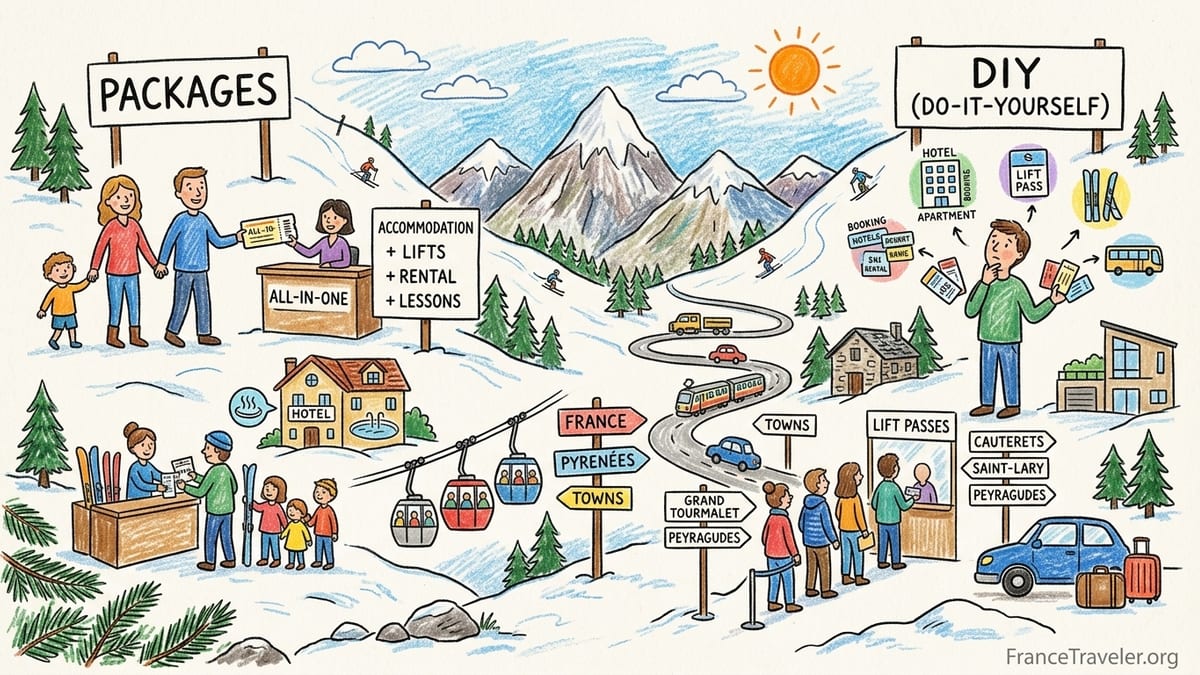
Packages vs DIY: How French Pyrenees Ski Trips Are Sold
When you search for French Pyrenees ski holidays today you will usually see two clear options. The first are packaged breaks sold by official resort booking centers and regional tourism boards, typically bundling accommodation with ski passes and sometimes equipment, lessons or spa access. The second is the DIY route: booking a hotel or apartment directly, then adding lift passes, rental and transfers yourself. Both approaches can work well in the Pyrenees because the main resorts are compact and well organized, and many have their own central reservation platforms.
In Saint-Lary, for example, the official reservation site regularly promotes winter deals that combine discounted lift passes with lessons and rental when booked with accommodation, with reductions that can reach around 40 percent on some components during promotional periods. These “wow” style offers are designed so that you arrive and collect everything through a single contact point in the village, avoiding time in ticket queues. In practice, that can mean a family of four saving a meaningful amount on passes and ski school compared with buying everything separately on arrival.
DIY travelers often benefit when they are flexible on dates and property type. An apartment in a lesser-known hamlet near Grand Tourmalet or Peyragudes, for instance, can be booked through general hotel or rental platforms, while passes are bought online from the lift company. Resorts such as Cauterets, Grand Tourmalet and Saint-Lary now emphasize online pass sales, with price tables for the 2025/26 winter and small discounts for advance purchase on multi-day products. DIY suits skiers who want to mix several resorts in one trip or are confident comparing pass types across websites.
For most visitors, the decision comes down to simplicity versus maximum flexibility. Packages excel if you are traveling as a family in school holidays or want ski-and-spa combinations without spending hours comparing options. Independently bundling accommodation, passes, rentals and transfers can work out similar or slightly cheaper in low and mid-season, especially if you are outside peak dates and willing to adjust your arrival day to match cheaper flights into Toulouse or Tarbes-Lourdes.
Key Resorts: Grand Tourmalet, Cauterets, Saint-Lary and Peyragudes
The largest linked ski area in the French Pyrenees is Grand Tourmalet, which joins the villages of Barèges and La Mongie beneath the Pic du Midi. The area offers over 100 kilometers of pistes with a mix of tree runs, wide blue cruisers and more exposed high-altitude terrain. Grand Tourmalet’s 2025/26 lift pass grid highlights a range of season, week and short-stay products, including a “Saison Basic” giving unlimited skiing in the area and strong reductions at the Pic du Midi cable car. This scale makes it a solid choice if you want a longer stay with varied terrain while still enjoying Pyrenean pricing.
Cauterets is smaller in terms of lift-served area but punches above its weight on snow reliability and atmosphere. The village sits at around 950 meters but the ski area of Cirque du Lys rises much higher, and the resort is known domestically for solid snow cover well into spring seasons. The official resort information promotes a selection of passes tailored to short breaks and families, and even a “ski pass plus restaurant” formula where a day ticket, main course, dessert and drink in the 3600 panoramic restaurant are combined for a set price, underlining the resort’s emphasis on packaged value on and off the snow.
Saint-Lary-Soulan is the flagship all-rounder of the central Pyrenees with around 100 kilometers of runs across three main sectors, all linked by modern lifts above a lively spa village close to the Spanish border. The lift company and local tourism office highlight a wide variety of pass types, from beginner and pedestrian passes to group and family tickets, often with special conditions for families booking two or more consecutive days. The village’s cable car and gondola lift connect the old stone-built center with the slopes, so you can stay in a traditional setting without compromising ski access.
Peyragudes offers a more contemporary, purpose-built experience, straddling two departments and overlooking the Louron and Larboust valleys. It has gained a reputation for ski-and-spa stays thanks to its proximity to Balnea, the largest thermal spa complex in the French Pyrenees, located by the lake in the valley. Marketing materials for Peyragudes and Balnea emphasize that winter guests can combine downhill skiing at Peyragudes or nearby Val Louron with time in the thermal baths, and some reservation centers explicitly sell “ski plus Balnea” formulas. This makes Peyragudes a strong candidate for couples or groups looking to balance active days with relaxed evenings in warm outdoor pools.
Comparing Real-World Costs: Packages vs Independent Booking
To understand the real value of packaging versus DIY in the French Pyrenees, it helps to look at specific examples rather than theoretical savings. Consider a family of two adults and two children planning a six-day trip to Saint-Lary in January, staying in a mid-range apartment in the village. Using the official reservation site, they might find a family offer that bundles a six-day “Alti Famille” ski pass for the whole family at a reduced rate when purchased with accommodation, with the passes collected at check-in. While exact figures change from season to season, the structure typically allows one or two adults plus several young skiers to access the full domain on a single family product rather than four separate day passes.
If the same family booked an apartment independently through a general rental platform, they would then purchase lift passes directly from the Saint-Lary pass office online. Passes can be reserved for multiple days, and prices tend to be comparable, but they would lose the extra percentage savings integrated into some accommodation-plus-pass packages and potentially pay a little more overall. However, if they were traveling outside of French school holidays or could ski only four days within a six-night stay, cherry-picking day passes and perhaps a beginner or pedestrian product for a less experienced family member might balance the equation in favor of DIY.
At Cauterets, a three-night short break in late March illustrates another pattern. Booking via the local tourist office or official site, you may see offers that wrap two days of skiing at Cirque du Lys with a half-day access to the Bains du Rocher spa and sometimes equipment rental at partner shops. This format is particularly appealing for couples or friends who do not want a full week of intense skiing and appreciate having spa time pre-planned. Recreating that mix independently is entirely possible but will involve booking the hotel, then choosing lift passes, then separately reserving spa access, usually at roughly the same or slightly higher price once you add transaction fees or peak-time spa slots.
Value is also influenced by how you travel. For visitors flying into Toulouse on low-cost carriers, local rail and regional buses into the mountains are relatively affordable but can be less convenient with bulky equipment. Some regional tourism offers from earlier seasons combined train, shuttle and ski passes into a single price to Ax or other resorts; while products change year to year, the concept demonstrates how packaging transport plus passes can simplify logistics. By contrast, independently renting a car at Toulouse or Tarbes-Lourdes airport and booking passes online will provide greater flexibility to ski more than one resort in a week, with fuel and tolls offsetting some of the savings.
Family Packages, Ski Schools and Child-Friendly Options
Families are a core audience for French Pyrenees resorts, and many current offers reflect that. Saint-Lary’s family ski pass products are a good example, allowing one or two adults plus multiple children between roughly five and seventeen years to ski together under a dedicated pass for two or six days. The practical advantage is not only financial: passes are distributed through a single booking, often via the accommodation provider, and everyone starts the week with compatible lift cards. This reduces the administrative load on parents on the first morning of the holiday.
Regional tourism agencies for the Hautes-Pyrénées also promote “ski fiesta” or “ski or not ski” style stays featuring six-day family passes to resorts like Saint-Lary, sometimes bundled with non-ski activities for non-skiing family members. A typical configuration might include six days of skiing for the skiers in the family, snowshoeing or thermal spa access for others, and accommodation in a village with restaurants and shops. These offers are aimed at mixed-ability or multi-generation groups who want to share a base without everyone being obliged to ski every day.
On the ground, the Pyrenean resorts have the right scale for family logistics. In Cauterets, beginner zones, sledging areas and cafés like Yeti Croq sit close together at the bottom of the slopes, so a parent can supervise small children in the snow while another takes laps on nearby pistes. Cauterets also combines ski pass products with restaurant meals at altitude, which can help families control on-mountain spending and avoid surprise bills at lunch. At Peyragudes, the link between slopes and spa means that one parent can ski a half-day while another enjoys Balnea with very young children, then swap in the afternoon.
For lessons, major resorts such as Grand Tourmalet, Saint-Lary and Peyragudes each have French Ski School branches and independent schools offering group and private tuition. Packages that integrate ski school with passes and accommodation are common in the Alps, and the Pyrenees are moving in the same direction, with regional promotions indicating combined discounts on lessons and equipment when booked with accommodation. In practice, families should still confirm lesson times and meeting points directly with the school, as those details can be more critical than marginal savings, especially when organizing multiple children at different levels.
Ski-and-Spa Stays: Thermal Waters and Balnea
Ski-and-spa holidays are a signature of the French Pyrenees, thanks to historic thermal towns and modern wellness centers close to the slopes. Peyragudes and the Louron valley are at the heart of this trend. Just below the resort, Balnea sits beside the lake, offering indoor and outdoor pools, themed thermal circuits and mountain views. Recent experience brochures emphasize dedicated “Balnea formulas” for the 2024/25 season and beyond, including options to pair time in the baths with access to the Skyvall gondola linking the valley village of Génos-Loudenvielle to the Peyragudes ski area. Some packages explicitly market “ski plus Balnea” days where a lift pass and spa access are sold together.
Cauterets has its own take on ski-and-spa breaks through the Bains du Rocher, a thermal complex with steam rooms and outdoor pools overlooked by snowy peaks. Earlier sales material from Pyrenees regional tourism showcased sample itineraries such as three nights in a three-star hotel with two days of alpine skiing at Cauterets, one day of Nordic skiing at Pont d’Espagne, equipment rental and a two-hour spa session included. Though exact pricing evolves, the structure shows how tightly the spa and ski industries are integrated locally, allowing visitors to experience classic Pyrenean thermal culture without complicated planning.
Saint-Lary adds another dimension with its well-developed village spa infrastructure and events that blend snow and water. The resort has hosted spring festivals where skiing in the morning is followed by surfing or swimming in partner aquatic centers later in the day, under slogans that frame the end of the ski season as a bridge into warmer-weather water sports. While these specific festivals are seasonal, the broader message is that a Saint-Lary ski trip can easily extend into a wider wellness or watersports holiday, particularly in late March and early April when valley temperatures rise.
From a booking perspective, ski-and-spa packages usually make sense if spa access is a central reason for your trip. Bought separately, a two-hour spa session in a premium complex may add a noticeable cost for a family across several days. When spa entry is wrapped into accommodation and pass bundles, the incremental cost per person can drop and you benefit from reserved timing. Travelers who only want a single spa visit during a week might prefer to book that one-off independently to avoid being locked into a particular time slot each day.
Getting There: Airport Transfers from Toulouse and Tarbes-Lourdes
Most international visitors to the French Pyrenees arrive via Toulouse-Blagnac or Tarbes-Lourdes-Pyrénées airports. Toulouse, a major regional hub, offers a wide range of flights from across Europe and good onward rail connections, while Tarbes-Lourdes sits closer to the mountains and reduces transfer times to western resorts such as Cauterets and Grand Tourmalet. The choice between the two often depends on flight availability and whether you intend to rent a car or rely on public transport.
From Toulouse, train services run from Toulouse-Matabiau station towards Tarbes, Lourdes and the central Pyrenees, with regional buses providing onward links to mountain towns. Travelers discuss using combined train and ski offers for some resorts, where a round-trip rail ticket, shuttle bus to the gondola and day pass are sold together. Even where such explicit “train plus ski” packages are not advertised, it is worth checking regional ticketing platforms for through-fares that include bus segments to resort bases. For those renting a car, driving times from Toulouse are typically around two and a half hours to Saint-Lary or Peyragudes, depending on traffic and winter road conditions.
Tarbes-Lourdes airport is the closest gateway to Cauterets and Grand Tourmalet, with road transfers of roughly one hour to one and a half hours under normal conditions. Public transport from Lourdes to Cauterets, for instance, currently involves a regional bus operating several times a day, connecting the pilgrimage town with the ski village via the valley. This setup makes it feasible to stay in Lourdes and day-trip to Cauterets, though for a focused ski holiday most visitors prefer to base themselves in resort to avoid daily commuting.
Organized transfers in the Pyrenees are generally more limited than in the big Alpine hubs, so independently minded travelers often opt for car rental to retain flexibility, especially if planning to ski more than one resort. The trade-off is the need to drive mountain roads and to budget for tolls and parking. Some ski package providers and regional tourist offices do sell holidays that include coach transfers from Toulouse or Tarbes-Lourdes into the mountains, particularly for groups and school trips, but these are less visible on the open market than in Alpine destinations. If transfer logistics feel complex, booking a full package that includes transport, at least from the nearest rail station, can remove a significant layer of stress.
When to Go: Balancing Snow, Price and Crowds
The French Pyrenees are particularly sensitive to timing in terms of both snow reliability and value. In general, mid-January and early February are strong bets for good coverage at all but the lowest elevations, while late March can still deliver enjoyable conditions in higher areas like Cauterets and Grand Tourmalet, especially when night temperatures stay low. Resorts publish season calendars and pass price tables that indicate their planned operating dates, often from around late December to mid-April, though the exact opening and closing days vary by year and snow conditions.
For price-conscious travelers, avoiding French school holiday periods is the single most effective lever. Package promotions on the Saint-Lary reservation site, for example, tend to highlight early-season and late-season stays, with reduced-rate passes, ski lessons and rentals grouped together under campaign names and marketing banners. Regional operations also push end-of-season promotions up to early April, using events and discounts to keep the slopes busy after the main domestic peak. Those windows can offer noticeably lower accommodation prices and quieter slopes, at the cost of slightly less predictable snow at lower altitudes.
Crowd levels in the Pyrenees are typically lower than in headline Alpine mega-resorts, but weekends can still be busy with domestic visitors, especially in February. DIY travelers with flexible dates should aim for weekday skiing in January or March to combine short lift queues with competitive prices. In family-focused resorts, ski schools and child-friendly zones are most crowded at key lesson times, so consider booking afternoon lessons or off-peak slots if your children cope well with later starts.
If you are particularly snow-focused, research historic snow patterns for each resort rather than relying only on headline altitude figures. Cauterets has a long-standing reputation for strong natural snowfall and a favorable microclimate, which has often allowed it to remain open later in spring than some neighboring areas. On the other hand, some lower sectors in the Pyrenees are more exposed to mild episodes. Resorts are investing in snowmaking and adapting operations, but for trips planned months in advance it is still wise to choose dates and resorts with a record of stability, especially if skiing is the central reason for your visit.
The Takeaway
French Pyrenees ski holidays reward travelers who are willing to look beyond the most publicized Alpine names and compare both package and independent options systematically. Resorts like Grand Tourmalet, Cauterets, Saint-Lary and Peyragudes combine authentic mountain villages, modern lifts and, increasingly, sophisticated product bundles ranging from accommodation-plus-pass deals to ski-and-spa and family-focused stays. Many of these packages are sold directly by resort booking centers and regional tourism boards, confirming strong purchase intent and making it easy for first-time visitors to buy everything in one transaction.
At the same time, the scale and pricing of the Pyrenees mean that DIY itineraries can be just as attractive, especially outside peak weeks. Booking apartments or small hotels directly, then adding online lift passes, rental and selected spa visits, allows you to fine-tune costs and experiences, perhaps skiing multiple resorts in one trip or mixing downhill days with thermal baths and cultural excursions. Transfers from Toulouse and Tarbes-Lourdes are slightly more complex than in tightly organized Alpine valleys, but with a mix of rail, regional buses and car rental the main ski areas remain accessible for long weekends as well as full weeks.
Ultimately, the best value solution depends on your profile. Families who prioritize simplicity and ski school logistics often benefit from resort-backed packages bundling passes, lessons and occasionally spa access. Couples and experienced skiers with flexible calendars may find better deals by assembling their own combination of accommodation, passes and off-slope activities, especially in January and March. Whichever approach you choose, the French Pyrenees offer a distinctive blend of mountain character, warm hospitality and relatively gentle price levels that can make a winter holiday here feel like a discovery even for seasoned skiers.
FAQ
Q1. Is it cheaper to book a French Pyrenees ski holiday as a package or independently?
In many cases, packages from resort booking centers in places like Saint-Lary or Cauterets offer better value for families and beginners, because they combine accommodation with discounted lift passes and sometimes lessons or rentals. Independent booking can be similar or slightly cheaper if you travel off-peak, choose modest accommodation and are flexible with skiing days.
Q2. Which French Pyrenees resort is best for a first-time family ski trip?
Saint-Lary and Cauterets are strong choices for first-time family trips. Saint-Lary combines an atmospheric village with extensive beginner and intermediate terrain plus family pass products, while Cauterets offers a compact ski area, good snow reliability and convenient beginner zones close to services.
Q3. How do ski-and-spa packages work in the French Pyrenees?
Ski-and-spa packages typically bundle a lift pass for a resort such as Peyragudes or Cauterets with timed access to a nearby thermal spa like Balnea or Bains du Rocher. You book through the resort’s reservation center or regional tourism office and receive vouchers or electronic confirmations covering both skiing and spa sessions in a single purchase.
Q4. Do I need a car to reach French Pyrenees ski resorts from Toulouse?
You do not strictly need a car, as trains and regional buses connect Toulouse with mountain towns and some resorts offer shuttles, but a rental car makes life easier if you have a lot of equipment or plan to ski more than one resort. For visitors who prefer not to drive, check for combined train and bus tickets and consider basing yourself in a resort with straightforward public transport links.
Q5. When is the best time to visit for reliable snow and good prices?
Mid-January to early February is often a good compromise between snow reliability and crowd levels, while March can provide softer prices and quieter slopes, particularly in higher resorts like Cauterets and Grand Tourmalet. Avoiding French school holiday weeks usually brings the best deals on both packages and independent stays.
Q6. Are French Pyrenees resorts suitable for advanced skiers?
Yes, resorts such as Grand Tourmalet and Saint-Lary have enough red and black runs to keep advanced skiers interested for several days, and there is accessible off-piste when conditions permit. However, the overall scale is smaller than the biggest Alpine domains, so serious experts might prefer to combine two or more resorts in one trip.
Q7. How do family ski passes work in places like Saint-Lary?
Family ski passes in Saint-Lary are structured so that one or two adults plus several children within certain age ranges share a single discounted product for two or more days. The passes typically cover the full ski area and are issued together, which simplifies administration and can work out cheaper than buying separate passes for each family member.
Q8. What is special about ski holidays in the French Pyrenees compared with the Alps?
The French Pyrenees generally offer lower prices, fewer crowds and a more traditional, village-based atmosphere than many large Alpine resorts. You also have easy access to thermal spas and authentic small towns, and it is common to combine skiing with spa visits or short trips into Spain from resorts like Saint-Lary.
Q9. Can I combine multiple resorts in one French Pyrenees trip?
Yes, combining more than one resort is relatively easy with a rental car. For example, you might spend three days in Cauterets and then move to Grand Tourmalet, or base yourself in the Louron valley and ski both Peyragudes and Val Louron. DIY booking offers the most flexibility for this style of trip.
Q10. How far in advance should I book a French Pyrenees ski holiday?
For peak weeks such as February school holidays and New Year, it is wise to book accommodation and any package offers several months in advance to secure availability and early booking promotions. For January and March, you can often wait longer, but it is still sensible to reserve key elements like apartments and ski school once your flights are confirmed.