


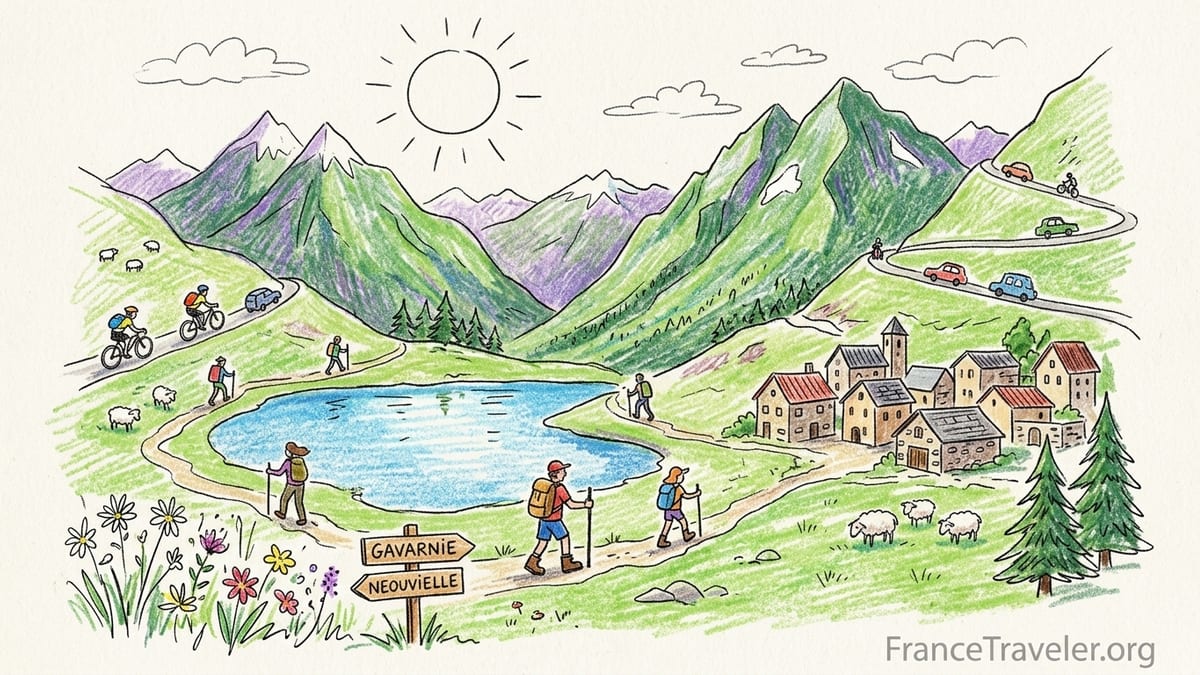
The French Pyrenees in summer feel wild and intimate at the same time. Granite peaks rise above deep green valleys, villages steam with thermal waters, and waymarked trails lead to turquoise lakes that stay cool even in August. This guide focuses on the classic high valleys around Gavarnie, Cauterets, Néouvielle and the Pyrenees National Park, with practical advice on hiking, cycling the legendary Tour de France cols, water sports, lifts and passes, and where to base yourself between June and September.
Understanding the French Pyrenees Summer Season
Summer in the French Pyrenees is shorter and more alpine in character than on the Mediterranean coast. Low valleys feel properly summery from early June, but high passes and lakes can keep snow patches into late June or even early July depending on the year. Mountain weather is highly changeable: you can wake up to blue skies in Cauterets, see clouds build by midday over the Cirque de Gavarnie and get a brief thunderstorm by late afternoon. Daytime highs in the main valleys such as Luz Saint Sauveur or Saint Lary often sit around the low to mid 20s Celsius in July and August, but it can drop close to freezing overnight above 2,000 meters.
Practically, that means June and September are quieter, cooler and often ideal for hikers who do not mind the possibility of lingering snow on the highest paths in early June, or cooler evenings later in September. July and August are high season in the French Pyrenees, with French school holidays, busier trails, more frequent shuttle buses, and all cable cars, chairlifts and activity providers operating their full summer schedules. Prices for accommodation in hotspots like Cauterets, Gavarnie Gedre, Argeles Gazost and Saint Lary generally peak from mid July to around the third week of August.
Mountain passes typically open between late May and late June, again depending on snowfall and spring storms. For example, the road over Col du Portet above Saint Lary often opens in early June and stays open until the first significant snowfalls in autumn. In contrast, very high roads or balcony tracks in Néouvielle and around the Tourmalet can open a little later in a heavy snow year. Always check local tourist office or departmental road information a few days before travel and build some flexibility into your itinerary.
June and September feel more relaxed in the villages, with easier parking at trailheads and more last minute room availability. July and August offer lively markets, village festivals and long evenings on café terraces, but you need to prebook the most popular refuges, canyoning guides and spa sessions if your dates fall in that peak window.
Key Hiking Areas: Gavarnie, Cauterets, Néouvielle and the National Park
Hiking is the defining summer experience in the French Pyrenees and the classic areas are close enough that you can combine two or three bases in a week. Around Gavarnie, the star attraction is the Cirque de Gavarnie inside the Pyrenees National Park, with its enormous amphitheatre of cliffs and waterfalls. A popular family hike starts directly from the village at about 1,360 meters and follows a wide track to the Hôtel du Cirque below the main waterfall. It is around 2 hours return for fast walkers or 3 to 4 hours at an easy pace, with only moderate ascent, making it ideal for mixed-ability groups.
Stronger hikers can continue higher towards the Plateau de Bellevue or link circuits that look down into Gavarnie and the neighbouring cirques of Estaubé and Troumouse. These require more ascent and sure-footedness, with some paths involving steeper, rockier sections. Marked routes are well signed, but conditions depend heavily on recent weather: early summer can mean snow patches on north facing traverses above 2,200 meters, while late season can bring loose scree after storms.
Cauterets offers a different side to the Pyrenees National Park. The Pont d Espagne area, accessed either by road and parking or via a regular shuttle bus from Cauterets village between roughly late May and late September, is famous for its stone bridge over rushing waterfalls and a dense network of signed trails. From Pont d Espagne, a gondola and a chairlift operate during the main summer season, typically throughout July and August and on a slightly reduced schedule in June and September, taking you quickly to Lac de Gaube at around 1,725 meters. From here, day hikes continue deeper into the Vignemale basin or to smaller hanging lakes.
East of these valleys, the Néouvielle massif is one of the jewels managed by the Pyrenees National Park, with more than 70 lakes and a high plateau feel. Access is typically via the Aure valley from Saint Lary or via Barèges and the Tourmalet side, with vehicle access to certain lakes regulated in peak season. Well known day walks include the classic loop taking in Lac d Orédon, the Laquettes and the twin lakes of Aubert and Aumar, or routes towards the Bastan lakes from the Col du Portet. Paths here often begin around 1,850 to 2,000 meters, so even modest distances can feel strenuous for new arrivals unaccustomed to altitude.
Mountain Lakes: Where to Find Turquoise Water and Manage Crowds
The mountain lakes of the French Pyrenees are a recurring theme in traveler searches, and for good reason. In summer, they offer photogenic rest spots, clear reflections and, for the hardy, a chance to dip feet in icy water after a hot ascent. Near Cauterets, Lac de Gaube is a textbook example: reached either by a one hour trail from Pont d Espagne or by combining lift and a short walk, it offers café terraces, boat rentals in peak season and a straightforward shoreline path with views to the Vignemale glaciers. Because of this easy access, summer weekends in July and August can feel busy by late morning.
To escape the crowds without tackling a full day of mountaineering, consider the lakes in the lower Néouvielle reserve such as the Laquettes, reachable on foot from Lac d Orédon in under an hour for most walkers on a well graded trail. The more energetic can climb further to Lac d Aubert and Lac d Aumar, where granite islands and twisted pine trees appear in many tourism posters for the region. Starting early, around 8:00 or 8:30 in the morning, usually allows you to walk in relative quiet and enjoy softer light on the water.
In the Gavarnie valleys, gentler lake options include the walk to Lac des Gloriettes above the Estaubé valley, often accessible by car to a high parking area once the seasonal road opens. Another family friendly option is the short hike to Lac d Isaby from the Hautacam road above Argeles Gazost, where a rounded grassy basin encourages picnics and children running around barefoot. For more serious walkers, multi lake traverses above Barèges or routes around the lakes of Bastan combine altitude, long days and frequent changes in terrain, so should be attempted only with proper boots, weather awareness and a realistic sense of your fitness.
Swimming is rarely officially encouraged in the core zones of the Pyrenees National Park or in protected reserves like Néouvielle, and the water temperatures stay low even in high summer. Most visitors limit themselves to paddling or brief plunges near refuges where it is clearly tolerated. Always check local signage and avoid using soaps or sun creams directly in the water to help protect these fragile ecosystems.
Cycling the Tour de France Cols and Other Summer Activities
The French Pyrenees are dream territory for road cyclists. Legendary passes like the Col du Tourmalet, Col d Aubisque, Col du Soulor and Col du Portet appear regularly in the Tour de France, and on a clear day in July you will see a steady flow of cyclists grinding upward from Luz Saint Sauveur, Argeles Gazost or Saint Lary. Rental road bikes and e bikes are widely available in these bases, with typical prices sitting in the region of what you would expect in other French mountain areas for a quality road or gravel bike for a day, and e bikes slightly more.
Road access to the highest passes usually begins sometime between late May and late June, depending on winter snowfall. On the Tourmalet, for example, it is not unusual for the pass to remain closed to cars into June after a very snowy winter, while lower cols may open earlier. Even after official opening, snow walls can line the upper hairpins for a few weeks. Cyclists should bring proper layers and windproof gloves even in July, since the windchill on a 20 kilometer descent can be sharp after sweating up from the valley.
Beyond cycling, rivers in the foothills offer rafting, hydrospeed and canyoning from around late May to September. Bases around Luz, Argeles Gazost and Saint Lary run guided canyon trips in side valleys with natural slides and pool jumps, typically half day or full day outings with all equipment provided. Booking at least a day or two ahead is wise in July and August, especially for family slots and English speaking groups. Age and weight limits vary by provider, so families with younger children should ask detailed questions when reserving.
In the high valleys, summer sled runs, zip lines and adventure parks operate near several ski stations, giving mixed groups alternatives to long hikes. For instance, resort bases near Gavarnie and the Grand Tourmalet sector open dry luge tracks and simple adventure courses once the snow has gone. These are not the main reason to visit the Pyrenees, but they can provide a welcome half day for children or to rest tired legs between bigger outings.
Lifts, Passes and How to Choose Your Base
In summer, many of the ski lifts in the French Pyrenees shift to sightseeing and hiking access. Around Cauterets, the Pont d Espagne gondola and Lac de Gaube chairlift typically run daily through July and August, with hours roughly from mid morning to late afternoon. Outside peak dates, operations may be limited to weekends or to specific holiday periods, so always check the latest timetable the week before visiting. Using these lifts can save 400 to 600 meters of ascent and make higher terrain accessible to families or to anyone adjusting to altitude.
Elsewhere, the Pic du Midi cable car from La Mongie usually runs through the summer providing access to the observatory summit above the Tourmalet, while smaller chairlifts in resorts like Saint Lary or Peyragudes may open to serve downhill biking and walkers. Remember that weather can close lifts at short notice; strong winds and thunderstorms are treated seriously, and staff will often shut operations early on days with unstable conditions.
For bases, think about your priorities. Gavarnie works well if your main aim is to hike the cirques and you do not mind a compact village atmosphere with a strong focus on walkers and riders. Cauterets offers more restaurants, shops and classic Belle Epoque spa architecture, with quick access to both the Pont d Espagne and lower valley walks. Saint Lary in the Aure valley makes a strong base if you want to combine Néouvielle lakes, the Col du Portet and road rides towards the Spanish border. Argeles Gazost sits lower and feels more like a small town, with easy driving access to multiple valleys including Luz, Cauterets and the Aubisque area.
Accommodation options span classic two star hotels in the 80 to 120 euros per night range in smaller villages in mid season, family run guesthouses, basic gites and self catering apartments. In July and August, expect minimum stays of several nights in many rentals, and book early for weekends that coincide with Tour de France stages or major local festivals. If you plan hut to hut hikes in the national park or a night in popular refuges near Néouvielle lakes, reserve as far ahead as possible for mid July to mid August and still call a day or two in advance outside these dates to confirm opening and meal availability.
Weather, Trail Difficulty and Staying Safe
Weather patterns in the Pyrenees differ from those in the Alps and can be surprisingly humid. Morning blue skies can build into cumulus clouds by lunchtime and short, intense thunderstorms by mid afternoon, especially in July and August. It is common practice among local hikers to start earlier than you might at home, aiming to reach the high point of a walk by midday and to be descending or already in the valley by the time storms are most likely. In June and September, storms are still possible but often less regular, and nights tend to be cooler and clearer.
Trail difficulty ranges from wide, almost road like tracks such as the main Gavarnie valley path or the Chemin des Cascades near Cauterets, up to steep, rocky ascents with occasional hands on sections. Signage is usually solid around major sites and follows French colour coding for difficulty, but the presence of paint marks and signposts does not remove the need for proper footwear, layers and basic map awareness. As a rule of thumb, any route climbing more than about 700 to 800 meters of vertical, or spending long stretches above 2,200 meters, should be treated as a full mountain outing rather than a stroll.
Even on popular loops in Néouvielle, fog or afternoon storms can quickly reduce visibility and make path finding harder around lake shores or boulder fields. Carry a waterproof jacket even on seemingly stable mornings, plus water, snacks and at least one warm layer. Mobile phone coverage is patchy in many basins and cirques, particularly once you move away from main villages and roads, so do not rely on a smartphone alone for navigation or emergency calls. Local tourist offices and park information centres provide free or low cost paper maps and updates on current trail conditions such as snow patches, path works or temporary wildlife related closures.
Wildlife encounters are generally limited to marmots, isards and birds of prey, but livestock is common and you will cross herds of sheep, cows and semi wild horses in summer pastures. Give guard dogs plenty of space, avoid cutting through the middle of flocks and keep food well packed away. Respecting simple rules like closing gates, keeping voices low near huts at night and packing out all rubbish helps maintain the delicate balance between tourism and traditional pastoral life in these valleys.
Thermal Spas and Mountain Villages
One of the enjoyable contrasts in the French Pyrenees is finishing a dusty hike or long bike climb and soaking in naturally hot thermal waters beneath slate roofs and stone balconies. Historic spa towns such as Cauterets, Luz Saint Sauveur, Argeles Gazost and Saint Lary have modern thermal complexes that operate throughout the main summer months. Facilities typically include indoor and outdoor pools with water around 32 to 38 degrees Celsius, jets for tired calves and backs, and quieter relaxation areas with mountain views.
Prices are broadly in line with other French spa towns for basic two hour entries, with supplements if you want sauna access, massages or more elaborate wellness treatments. Booking ahead online or by phone is highly recommended in July and August evenings, when many hikers and cyclists converge for a post activity soak. Families should check age policies, since some thermal baths restrict access to children or have dedicated time slots for quieter adult sessions.
The villages themselves reward slow wandering. In Cauterets you will find Belle Epoque façades, covered galleries and old patisseries still selling traditional violet or blueberry sweets. Gavarnie feels more rustic, with stone houses clustered around the church and a string of cafés and small hotels lining the main street. Saint Lary mixes traditional architecture with a resort feel, especially near the gondola base, and its weekly outdoor market is a chance to buy local cheeses, cured meats and mountain honey.
Staying in these villages rather than larger cities gives you early access to the trails and a better sense of local rhythm. Bakery doors open early for hikers picking up sandwiches and pastries before driving to Pont d Espagne or the Néouvielle lakes. In return, arriving back from the mountains by mid to late afternoon lets you enjoy a drink on a terrace, a thermal session or simply the long light of a summer evening against the skyline of peaks.
How July and August Differ from June and September
July and August bring the most reliable access but also the biggest crowds. All key lifts such as the Pont d Espagne gondola and Gaube chairlift, the Pic du Midi cable car and most bike friendly chairlifts in Saint Lary, Peyragudes and the Grand Tourmalet sector run daily. Shuttle buses to key trailheads, like the service between Cauterets and Pont d Espagne, operate on intensive schedules with departures roughly every one to two hours, and village tourist offices open seven days a week with extended hours.
In return, you will share classic hikes and lakes with many other visitors, especially anywhere accessible within one to two hours of walking. Parking at trailheads such as Pont d Espagne, Lac d Orédon or popular starts near Gavarnie often fills by mid morning on sunny days, and some valleys introduce parking quotas or shuttle systems to limit traffic. Restaurant reservations become important, particularly for Friday and Saturday evenings in the busiest weeks of late July and early August, and room prices track that same peak.
June and September feel more relaxed and are often ideal for those who prioritize hiking rather than family attractions and festivals. In June, valley meadows are green, rivers run high with snowmelt and temperatures remain comfortable for long climbs. The trade off is that some high routes and passes may still carry snowfields or be officially closed, especially in a heavy winter year, and lift operations can be limited to weekends or only begin in late June. By September, high lakes have mostly thawed, crowds thin out and the first touches of autumn colour appear in higher forests.
If your main aim is to string together day hikes around Gavarnie, Cauterets and Néouvielle, or to ride several big cols in a week, consider late June, early July or the first half of September. If you are travelling with school aged children and want the full range of activities, shorter family walks, lift access and village events, then a July or early August visit will deliver that, provided you book and plan around the busier times of day.
FAQ
Q1. When is the best time in summer to hike in the French Pyrenees?
The most balanced period for hiking is usually from late June to mid July and again in early to mid September, when most higher trails are snow free but crowds are thinner and temperatures moderate.
Q2. Where should I base myself for hiking around Gavarnie and Cauterets?
For Gavarnie, staying in Gavarnie Gedre or nearby villages around Luz Saint Sauveur works well. For Cauterets and Pont d Espagne, base yourself in Cauterets itself or in the lower valley near Argeles Gazost if you want easier access to multiple valleys.
Q3. Do I need a car to explore the French Pyrenees in summer?
A car gives far more flexibility for reaching trailheads, passes and lakes, especially outside July and August. There are summer shuttles to some hotspots like Pont d Espagne and certain high valleys, but public transport alone can feel limiting if you want varied hikes.
Q4. How difficult are the classic hikes like Cirque de Gavarnie and Lac de Gaube?
The walk to the Cirque de Gavarnie viewpoint follows a wide track with moderate ascent and suits most reasonably fit walkers. The path to Lac de Gaube from Pont d Espagne is steeper and rockier in places but still accessible to many families, especially if you use the lifts one way.
Q5. Can I cycle the Tourmalet and other big cols as an amateur rider?
Yes, many amateur cyclists ride the Tourmalet, Aubisque and other passes each summer, but they demand steady fitness and low gears. Plan early starts, carry layers for descents and consider renting an e bike if you are unsure about the full climb.
Q6. Are mountain lakes warm enough for swimming in summer?
Most high lakes stay very cold even in August, and swimming is sometimes discouraged or restricted in protected areas. Short dips or paddling are common, but expect water that feels closer to glacial melt than to a coastal beach.
Q7. How do summer lift operations work in the French Pyrenees?
Key gondolas and chairlifts in areas like Pont d Espagne, Pic du Midi and certain ski resorts open daily in July and August, often with reduced schedules in June and September. They mainly serve walkers and sightseers, with tickets sold at valley stations and some online.
Q8. What should I pack for day hikes in July and August?
Even in high summer, pack sturdy shoes, a waterproof jacket, a warm layer, sun protection, water and snacks. Weather can change quickly from hot sun to sudden showers or storms, especially in the afternoon.
Q9. Are thermal spas suitable for families with children?
Many Pyrenean thermal spas welcome families and have specific pools and hours for children, but some areas or entire complexes may be reserved for adults. Check age rules, required swimwear and opening hours before you go.
Q10. How far in advance should I book accommodation and refuges?
For visits in July and early August, book hotels, apartments and popular refuges several months ahead if possible, especially around Tour de France dates. In June and September you can often book weeks rather than months in advance, but refuges near famous lakes still warrant early reservations.