


The Pyrenees stretch for more than 400 kilometers between the Atlantic and the Mediterranean, forming a natural border between France and Spain. On paper it is one mountain range, but for travelers the French and Spanish sides can feel like two very different trips. Lush green valleys and historic spa towns on one side, sun-baked canyons and high, dry plateaus on the other. If you are choosing where to base yourself for hiking, skiing or a summer road trip, it pays to understand the contrasts before you book.
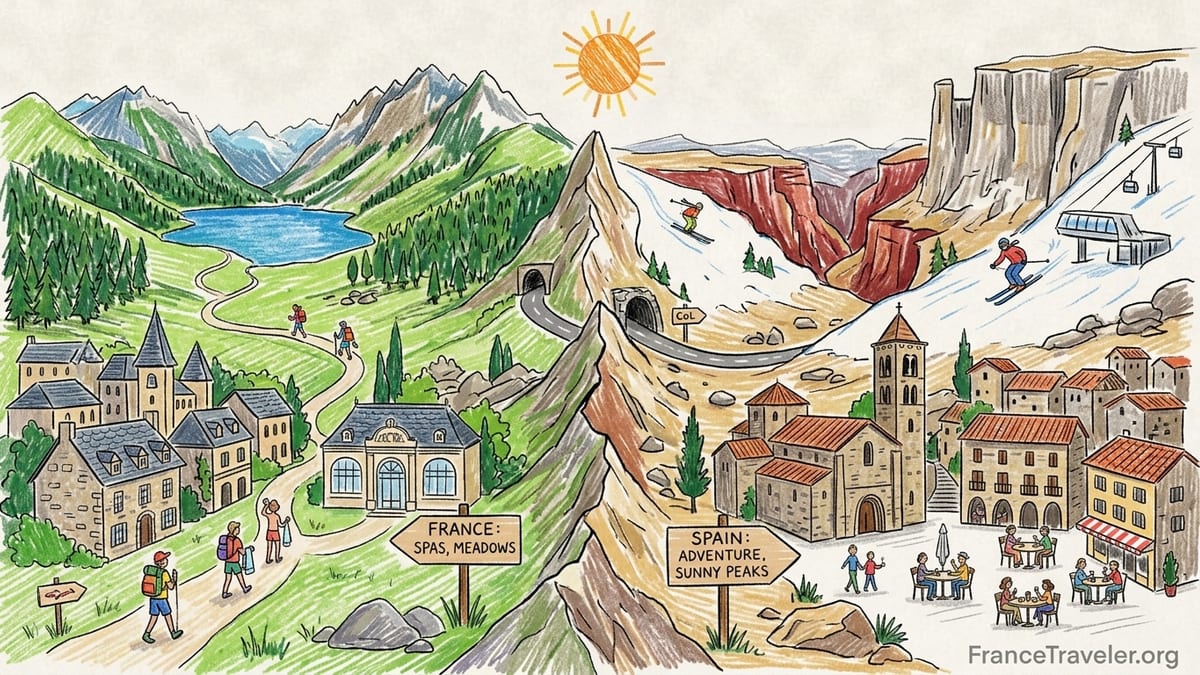
Overall feel: two characters, one mountain range
Stand in the Cirque de Gavarnie on the French side and you are surrounded by steep limestone walls, waterfalls and meadows that look almost Alpine. Cross south through the tunnels into Aragón or Catalonia and the landscape often becomes drier, with red rock canyons and bigger skies. The French Pyrenees feel softer and greener overall, with more forests and pastoral valleys, while the Spanish slopes are typically rockier, sunnier and a little wilder in appearance.
The French side has a long history as a therapeutic escape. Towns such as Cauterets, Luz Saint Sauveur, Argelès Gazost and Bagnères de Bigorre grew up around sulfur-rich hot springs and elegant 19th century bathhouses. Many visitors still come primarily to soak in thermal waters and take gentle walks rather than to chase big summit days. In contrast, the Spanish side has focused strongly on adventure tourism and modern ski infrastructure, especially in Aragón’s Tena and Benasque valleys and in the Catalan Pyrenees.
Culturally the experience also differs. In France, small mountain towns often feel unmistakably French, with boulangeries, weekly markets and brasseries lining compact squares. On the Spanish side, you feel closer to rural Aragónese or Catalan life: stone-built villages like Aínsa or Benasque where late dinners, tapas bars and lively plazas set the rhythm. Both are still far quieter than the Alps, but the day-to-day atmosphere has a different cadence that many travelers notice within a few hours of arriving.
For first-time visitors, a simple way to picture the split is this: choose the French Pyrenees if you like spa culture, classic green valleys and slower-paced holidays, and the Spanish Pyrenees if you want sunnier weather, lively ski areas and dramatic canyons and ridges. The rest of this guide looks at how that plays out in practice for hiking, skiing, budgets and family trips.
Scenery and outdoor activities: Gavarnie vs Ordesa and beyond
On the French side, the textbook introduction to Pyrenean scenery is the area around Gavarnie and Cauterets in the Hautes Pyrénées. The Cirque de Gavarnie, a giant natural amphitheater of cliffs crowned with waterfalls, and the Pont d’Espagne above Cauterets, with its stone bridge, pine forest and cascades, both sit at the edge of the Pyrenees National Park. From Cauterets you can walk up to Lac de Gaube, a turquoise lake below the Vignemale, the highest peak in the French Pyrenees, along a path that is busy but accessible to most reasonably fit travelers.
The French valleys here feel quintessentially green. Lower down you pass cows and sheep grazing on meadows; higher up, spruce and beech forests lead to granite peaks and hanging lakes. Classic bases include Lourdes for broader services, Cauterets and Luz Saint Sauveur for mountain access plus spas, and small villages such as Gavarnie itself for a quieter, almost end-of-the-road feel. Hiking ranges from gentle half-day rambles to multi-day sections of the GR10, the long-distance trail that runs along the French flank of the range.
On the Spanish side, many hikers gravitate first to Ordesa y Monte Perdido National Park in Aragón. The Ordesa Valley has immense vertical cliffs, stepped terraces of grassy ledges and famous day hikes such as the Faja de Pelay balcony path or the climb to Refugio de Góriz. Further east in Aragón, the Benasque Valley near Cerler gives access to some of the highest summits in the Pyrenees, including Aneto, while the Sierra de Guara, south of the main crest, has carved canyons and is one of Europe’s leading canyoning areas.
In Catalonia, the Aigüestortes i Estany de Sant Maurici National Park is a tangle of granite peaks and over 200 lakes, with stone refuges linked by well-marked trails. Travelers often base in villages such as Espot or Boí and spend several days hiking to high lakes and passes. Compared with much of the French side, these Spanish valleys feel more open and stark, with more exposed rock and fewer roadside meadows. If your idea of mountain beauty is dry air, big skies and dramatic cliffs, the Spanish Pyrenees may feel more compelling overall.
Ski resorts and winter: where to ski for different styles
Both sides of the Pyrenees have dozens of ski areas, but they are not equal in size or character. On the Spanish side, Aragón’s Formigal Panticosa is one of the largest ski domains in Spain, spread across several valleys near Sallent de Gállego. Cerler, also in Aragón, is known among experienced skiers for its vertical drop and long red runs above the Benasque Valley. Further east, Catalonia’s Baqueira Beret in the Val d’Aran is a flagship resort with extensive intermediate terrain and a reputation within Spain as a high-end winter destination.
The French Pyrenees, by comparison, tend to offer smaller, slightly lower-altitude ski areas with a more local atmosphere. Resorts such as Cauterets, Saint Lary, Peyragudes, Grand Tourmalet and Les Angles attract mainly French and Spanish families who drive in for weekends. Slopes are often gentler on average, with plenty of blue and red runs rather than endless steep black pistes, which can suit mixed-ability groups. Snow reliability varies year to year, but many French resorts invest heavily in snowmaking to compensate for milder spells.
In terms of cost, lift passes in both French and Spanish Pyrenees are generally cheaper than in the Alps, though exact prices change each season. As a broad guide, a day pass at a mid-sized Pyrenean resort often comes in noticeably below what you would pay at major Alpine names, and package deals that include accommodation and passes can represent good value, especially outside peak school holiday weeks. The Spanish side can sometimes work out a little cheaper overall, particularly if you book self-catering apartments and eat in local bars rather than at slope-side restaurants.
If your priority is varied terrain and the feel of a full-scale ski destination, the big Spanish areas like Baqueira Beret, Formigal Panticosa and Cerler generally edge ahead. If you are more interested in mixing a bit of skiing with spa time, village markets and slower days, basing in a French valley such as Cauterets, Luz Saint Sauveur or Saint Lary Soulan works very well, especially for families and intermediate skiers.
Thermal spas, wellness and mountain villages
One of the French Pyrenees’ signature experiences is their network of thermal spa towns. Cauterets, Argelès Gazost, Luz Saint Sauveur, Barèges, Bagnères de Bigorre and Ax les Thermes are all built around naturally hot, mineral-rich springs. Many have 19th century grand hotels, Belle Époque facades and covered promenades that speak to a past when Europe’s elite came for hydrotherapy cures. Today the atmosphere is more down-to-earth, but you can still spend an afternoon soaking in outdoor pools while watching peaks turn pink at sunset.
Facilities vary from simple municipal-style baths to full wellness complexes with saunas, hammams and treatment rooms. In Cauterets, for example, travelers combine winter skiing or summer hiking with evening sessions at a modern spa that uses the local sulfur waters. In Luz Saint Sauveur, the thermal center sits just above the village, surrounded by steep forested slopes. For travelers who want a restorative element to their trip, this spa tradition, which exists at smaller scale on the Spanish side, is a convincing reason to favor the French valleys.
Village character also differs slightly. French mountain towns typically have compact historic centers with stone houses, slate roofs and small weekly markets. A place like Saint Lary Soulan mixes old stone barns in the lower village with purpose-built chalets near the lifts. On the Spanish side, especially in Aragón and Catalonia, villages such as Aínsa, Benasque, Vielha or Boí have Romanesque churches, broad plazas and terrace bars where evenings run late. In some Spanish valleys you may find a higher concentration of modern apartment blocks close to ski bases, but older quarters often remain intact and atmospheric.
If your holiday vision involves wandering between cafés, bakeries and covered markets in a robe over your swimsuit, the French side is clearly stronger. If instead you see yourself finishing a hike with tapas, wine and a lively plaza scene at 10 p.m., you will probably feel more at home in Aragón or Catalonia.
Food, hotels, prices and overall value
Food is a major factor for many travelers choosing between France and Spain. On the French Pyrenees side you can expect regional dishes that feel broadly French with mountain twists: garbure (a hearty soup with cabbage, beans and duck confit), local sheep cheeses from the Ossau and Barèges valleys, blueberry tarts and generous use of duck and pork. Even modest village restaurants often serve fixed-price menus with starter, main and dessert, and boulangeries in towns like Argelès Gazost or Bagnères de Bigorre make breakfast a highlight in itself.
On the Spanish side, regional difference is strong. In Aragónese valleys you might find migas (fried breadcrumbs with chorizo), slow-cooked lamb and hearty stews, while in Catalonia mountain restaurants serve grilled meats, botifarra sausage and dishes like escudella, a robust broth with meat and vegetables. Tapas culture is more visible on the Spanish side, especially in larger bases like Jaca, Vielha or Sort, and many travelers appreciate the informality of sharing plates with a drink for a relatively modest total bill.
When it comes to budgets, both sides of the Pyrenees are generally better value than major Alpine resorts, but Spain often has a slight edge on day-to-day costs. Simple hotel rooms or guesthouses in Spanish mountain towns can come in a bit cheaper on average than their French equivalents, and bar prices for coffee, wine and casual tapas are often lower. On the French side, food quality is typically high even in basic places, but you should be ready for restaurant prices that are closer to the national French average.
For mid-range travelers, a realistic scenario might be a comfortable two or three star hotel or apartment in a French spa town with dinners at brasseries and one or two spa sessions, versus a similar standard apartment or guesthouse in a Spanish mountain village where you eat most evenings in tapas bars or family-run restaurants. In many situations the Spanish option will slightly undercut the French one, especially for longer stays and for groups who self-cater breakfasts and some dinners.
Road access, weather and planning a road trip
Road access to the Pyrenees is generally straightforward on both sides, but the experience differs. On the French side, main approach routes run south from cities like Toulouse, Pau and Perpignan, then branch into narrower valley roads that climb to spa towns and ski areas. Famous passes such as the Col du Tourmalet and Col d’Aubisque, often used in the Tour de France, connect valleys in summer and make for memorable driving days, but are typically closed or restricted in winter, which can lengthen some journeys between valleys.
On the Spanish side, access tends to rely more on the national highway network running up from Zaragoza, Lleida and Barcelona before turning into mountain roads. Many Spanish ski resorts are at the end of long dead-end valleys, such as the road from Benasque up to Cerler or the climb from Vielha towards Baqueira Beret. These routes are well maintained but can feel more isolated than some French passes, so it is worth planning fuel, food and timing carefully, especially in shoulder seasons when daylight is shorter and some services close midweek.
Weather is one of the clearest differences between the two sides. The French Pyrenees receive moist air masses from the Atlantic that drop significant precipitation on the northern slopes, leading to greener valleys and, in winter, more frequent snowfall but also more cloud and rain at low levels. Cross the watershed and the Spanish side is typically drier and sunnier, with more days of clear blue skies in both summer and winter, but also slightly higher risk of dry spells affecting snow cover in some years.
For a summer road trip focused on scenic driving and photography, a good compromise is to cross the range at least once. You might, for example, start in Pau or Lourdes, visit Gavarnie and Cauterets, then head over to Aragón to explore the Ordesa Valley and the medieval town of Aínsa, before looping towards Catalonia and finishing near the Val d’Aran. This gives you a sense of how the light and landforms change from one side to the other, and helps you judge which side you would like to spend more time in on a future trip.
Family travel: which side works better with kids
For families, both sides of the Pyrenees can work very well, but they suit slightly different styles. On the French side, towns like Cauterets, Saint Lary Soulan, Ax les Thermes and Les Angles offer walkable centers, clear signposted family hikes and plenty of non-ski activities in winter, such as small toboggan areas, ice rinks and thermal pools with child-friendly sections. The atmosphere tends to be relaxed and early-evening oriented, which can make life easier with younger children.
Accommodation in French valleys often includes family-run hotels and simple apartments close to lifts or spa centers. Many restaurants serve kids’ menus or are happy to adapt dishes such as roast chicken, steak haché or pasta. In summer, shorter walks to waterfalls, lakes and animal parks, plus activities like small adventure parks and farm visits, can fill several days even if your children are not keen on long hikes.
On the Spanish side, older children and teenagers may appreciate the livelier evening atmosphere and broader choice of informal eating options. Ski resorts like Formigal Panticosa and Baqueira Beret usually have dedicated beginner zones and ski schools, and many Spanish families build their winter around repeat trips to these areas. In summer, activities such as canyoning in the Sierra de Guara, rafting on Pyrenean rivers and via ferrata routes appeal to active teens, though these are guided activities and come with minimum age and fitness requirements.
In terms of language, basic English is spoken in many tourist businesses on both sides, but you will go further with a few phrases of French in spa towns or Spanish in smaller Aragónese villages. For families who are nervous about language barriers, the largest resorts and towns such as Saint Lary, Cauterets, Vielha or Jaca generally have the most multilingual staff and signage.
Which side is better for skiing, hiking, road trips and value?
For skiing, the Spanish Pyrenees usually come out ahead if you want big, continuous ski areas and a clear resort feel. The combination of Formigal Panticosa and Cerler in Aragón and Baqueira Beret in Catalonia offers enough terrain and infrastructure to keep confident intermediates and above busy for a week or more. The snowiest choice will vary year by year, but overall you can expect plenty of sunny days and a distinctly Spanish après-ski culture in the villages.
For hiking, it becomes more a question of taste. The French side shines if you like lush valleys and the ability to mix gentle walks with thermal baths and village markets, particularly around Gavarnie, Cauterets, the Néouvielle area and the Ariège valleys. The Spanish side takes the lead if you are drawn to dramatic canyons and big-mountain terrain, with Ordesa y Monte Perdido, the high Benasque Valley and Aigüestortes i Estany de Sant Maurici all offering multi-day potential for strong hikers.
For road trips, doing both sides is ideal if you have at least a week and are comfortable on winding mountain roads. The French passes give you classic Tour de France scenery and access to spa towns, while the Spanish side offers some long, quiet valleys with big skies and atmospheric medieval towns like Aínsa or Vielha. If you must choose one, France is better if you value frequent small villages and short hops between sights, Spain if you prefer longer driving days with more contrast between landscapes.
For pure value, Spain normally wins by a small margin, especially for travelers who eat out most nights or are planning multi-day ski passes. Accommodation and restaurant prices in Catalan or Aragónese valleys often undercut equivalent French options, and informal eating in bars makes it easier to keep costs predictable. That said, if you are traveling in shoulder seasons or book self-catering apartments on the French side, the gap can narrow considerably.
The Takeaway
The choice between the French and Spanish Pyrenees is less about which side is objectively better and more about what kind of mountain trip you want. The French valleys around Gavarnie, Cauterets, Saint Lary and Ax les Thermes suit travelers who picture green slopes, spa sessions, markets and a slower rhythm, with hiking and skiing woven into a broader holiday. The Spanish valleys of Aragón and Catalonia appeal to those who crave drier air, stronger sun, dramatic canyons and big, modern ski areas anchored in lively mountain towns.
If you are planning a winter trip focused on skiing, look seriously at Spanish bases such as Formigal Panticosa, Cerler or Baqueira Beret, especially if you want extensive terrain and a social après scene. If you imagine a summer break centered around lakes, waterfalls and thermal pools, a French base in Cauterets, Luz Saint Sauveur or Argelès Gazost will likely deliver exactly that mood. For many travelers, the best solution is to treat the Pyrenees as a region rather than a border and spend time on both flanks over several trips.
Whichever side you pick first, the practical message is reassuring: both French and Spanish Pyrenees remain less crowded and often better value than Europe’s major Alpine hotspots, while still offering serious landscapes, real mountain culture and plenty of comfort. Once you have experienced one side and fallen for it, crossing the watershed to see how the light and villages change on the other quickly becomes an obvious next journey.
FAQ
Q1. Are the French Pyrenees or Spanish Pyrenees better for first-time visitors?
For a first visit, many travelers find the French side more intuitive, with spa towns like Cauterets or Saint Lary Soulan offering an easy mix of walks, thermal baths and village life, while Spain suits those already comfortable with mountain driving who want bigger ski areas or more dramatic canyons.
Q2. Which side of the Pyrenees is cheaper overall?
Prices vary, but the Spanish side is often slightly cheaper day to day, especially for eating out and simple hotels or apartments, while the French side can feel a bit more expensive yet still good value compared with many Alpine regions.
Q3. Where is the best place in the Pyrenees for classic postcard scenery?
On the French side, the Cirque de Gavarnie and the Pont d’Espagne above Cauterets are iconic, while on the Spanish side Ordesa y Monte Perdido National Park and the lakes of Aigüestortes i Estany de Sant Maurici offer equally striking landscapes.
Q4. Is the snow more reliable in the French or Spanish Pyrenees?
Snowfall patterns change year to year, but the French north-facing slopes often see more frequent precipitation, while the Spanish side tends to have more sunny days; both invest in snowmaking, so snow reliability depends more on the specific resort and season than the passport side alone.
Q5. Do I need a car to enjoy the Pyrenees properly?
You can visit some valleys by public transport, especially from cities like Toulouse, Barcelona or Zaragoza, but having a car greatly increases your options for trailheads, small villages and crossing between French and Spanish sides on a single trip.
Q6. Which side is better for families with young children?
Families with younger children often find French spa towns and family-oriented ski areas very convenient, thanks to walkable centers and thermal pools, while active teenagers may prefer the Spanish side for its adventure sports and livelier village evenings.
Q7. Are the thermal baths only on the French side?
No, there are hot springs on both sides, but the French Pyrenees have a denser network of historic spa resorts, so if soaking in thermal waters is a priority, France offers more choice of classic spa towns in a compact area.
Q8. Is hiking signage better in France or Spain?
Both countries maintain major long-distance routes and local trails, but many travelers find waymarking and topographic maps slightly more standardized on the French side, while in Spain the main national parks and classic routes are very well signposted but smaller paths can vary.
Q9. Can I easily combine French and Spanish Pyrenees in one trip?
Yes, in good weather it is straightforward to cross the range at a few key passes or tunnels, so a one or two week itinerary can realistically include French spa towns, a Spanish national park and perhaps a loop through the Val d’Aran.
Q10. If I only have one week in winter, which side should I choose?
If your priority is skiing as much varied terrain as possible, base on the Spanish side at a large resort like Formigal Panticosa or Baqueira Beret; if you want a mix of modest skiing, spas and village life, a French base such as Cauterets, Saint Lary or Ax les Thermes is likely to suit better.