


The French Pyrenees have quietly become one of Europe’s most compelling ski regions, offering big-mountain terrain, authentic villages and generally softer prices than many Alpine resorts. Yet the area is far from uniform. Grand Tourmalet skis very differently from compact Cauterets, just as high-altitude Piau-Engaly feels a world apart from family-friendly Font-Romeu. For travelers weighing up where to ski, the details matter: altitude, snow reliability, terrain balance, village character, prices and how easy it is to get there from airports such as Toulouse or Pau.
Understanding the French Pyrenees Ski Landscape
Compared with the French Alps, the Pyrenees are lower in overall altitude but often wilder in feel, with deep valleys, steep faces and a more intimate, less industrial style of resort development. You still find sizeable ski domains such as Grand Tourmalet and Saint-Lary with around 100 kilometers of pistes each, but they are interspersed with smaller areas like Luz Ardiden or La Pierre Saint-Martin that offer concentrated, characterful terrain rather than endless motorway cruising.
Snow reliability is a key question for any mid-altitude range. Here, the Pyrenees offer some strong cards. High, north-facing bowls such as Piau-Engaly and Cauterets’ Cirque du Lys tend to hold snow well, while major areas like Grand Tourmalet and Saint-Lary have invested heavily in snowmaking on main return routes. Travelers who can visit between mid-January and early March typically find the best balance of coverage and daylight, though early-season or Easter skiing can work in higher spots like Piau-Engaly and Cauterets in a good year.
On the ground, the experience is distinctly French and often more local than in headline Alpine names. Instead of purpose-built concrete towns, you are more likely to stay in real villages such as Barèges, Saint-Lary village or Cauterets, where weekly markets sit alongside ski shops and fromageries. Prices are usually lower, too: it is common in winter 2025–26 to see adult day passes in the 40 to 55 euro range, where similar-sized Alpine areas can push significantly higher.
Most international visitors will arrive via Toulouse-Blagnac, Pau-Pyrénées or, for the eastern resorts, Perpignan or even Barcelona. Drive times of two to three hours from Toulouse open up Grand Tourmalet, Saint-Lary, Peyragudes and Piau-Engaly, while Perpignan and Barcelona are natural gateways for Font-Romeu and Les Angles in the eastern Pyrenees. With that context in mind, it becomes easier to compare the key resorts side by side.
Big-Hitters: Grand Tourmalet and Saint-Lary
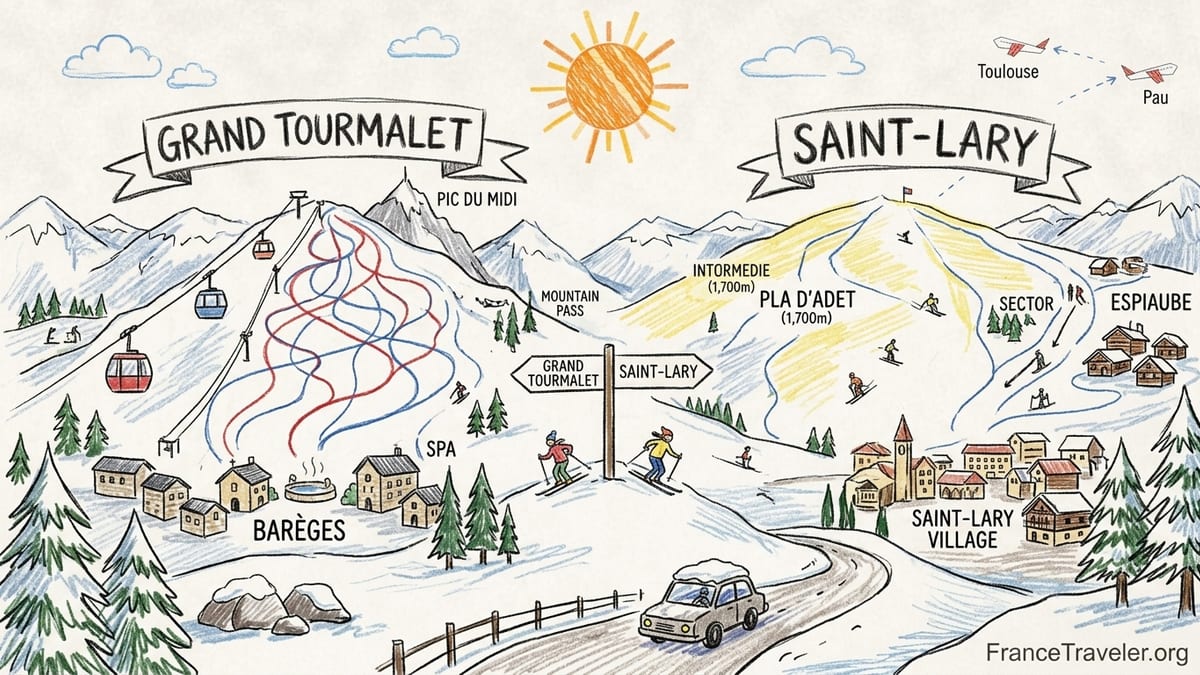
Grand Tourmalet and Saint-Lary are the two heavyweight ski areas of the French Pyrenees, each offering roughly 100 kilometers of pistes and a similar vertical range from about 1,400 to over 2,400 meters. Grand Tourmalet stretches between La Mongie and Barèges at the foot of the Pic du Midi, with more than 100 kilometers of marked runs and around 30 lifts, making it the largest continuous ski domain in the French Pyrenees. Saint-Lary’s ski area covers some 700 hectares with approximately 100 kilometers of pistes, spread across sectors at 1,700, 1,900 and 2,400 meters.
For intermediates, both resorts are rewarding. At Grand Tourmalet, long blue and red runs wind through open slopes above La Mongie and down through more sheltered terrain towards Barèges. A typical day might start on a cruising blue off the Tourmalet pass before dropping into tree-lined reds for the afternoon. At Saint-Lary, classic runs such as La Mirabelle or the long reds from the Vallon du Portet deliver sustained descents of around 800 meters of vertical, ideal for confident skiers who want a sense of journey rather than lapping the same short hill.
Expert skiers will find more obvious challenges at Grand Tourmalet, especially when you factor in freeride options off the Pic du Midi cable car where, with a guide, you can ski high-alpine itineraries back towards La Mongie. Saint-Lary also offers some serious terrain, particularly in the Espiaube and 2400 sectors, with steeper reds, a few blacks and interesting off-piste lines towards the Néouvielle nature reserve in good conditions. For mileage-hungry skiers who want to spend a week in one resort without repeating runs too often, these two are the most complete choices in the French Pyrenees.
Village atmosphere is where they diverge. Barèges is a traditional spa village with stone houses and a quieter evening scene, while La Mongie is a more functional base at the foot of the slopes. Saint-Lary village at 830 meters feels more like a mountain town, with thermal baths, a proper high street and a broader choice of restaurants and bars. Families who like to stroll after skiing, browse shops and perhaps visit a spa often prefer Saint-Lary, while those who want quick access to the Pic du Midi and do not mind a more utilitarian base may lean toward La Mongie.
Snow-Sure Choices: Cauterets and Piau-Engaly
If your priority is snow reliability within the French Pyrenees, Cauterets and Piau-Engaly should be high on the list. Cauterets’ main downhill area, the Cirque du Lys, is a high, bowl-shaped sector reached by gondola from the spa town. The pistes sit mainly above 1,700 meters and face broadly north, which helps preserve snow quality. Cauterets is known locally for keeping its ski season going into April in a good year, aided by its altitude and orientation, and the resort publishes detailed daily snow-height and open-piste information throughout the winter.
Piau-Engaly, meanwhile, is the highest ski resort in the French Pyrenees, with lifts running from around 1,420 up to about 2,600 meters. The compact, purpose-built village sits at roughly 1,860 meters, right on the snowline, which often means you can ski back to your door well into spring. On stormy days, Piau’s high, treeless bowl can feel stark, but the payoff is excellent snow preservation and usually the deepest base in the region during mid-winter.
Both resorts are medium-sized by Alpine standards but offer enough to keep most skiers happy for a long weekend. Cauterets has around 20 to 25 kilometers of marked runs focused on intermediates, with several confident blue and red pistes that funnel back into the Cirque du Lys bowl. Piau-Engaly offers closer to 60 kilometers of pistes, with a mix of gentle greens for beginners near the base and progressively steeper blues, reds and a few blacks higher up. For example, a family might spend the morning in Piau’s sheltered beginner zone before parents head off after lunch to explore steeper runs while grandparents enjoy the on-site spa.
Village character is very different. Down in the valley, Cauterets is a charming Belle Époque spa town, with covered walkways, patisseries and the Bains du Rocher thermal complex, popular for evening soaks under the snow. Piau-Engaly’s architecture is unapologetically modernist, built in sweeping concrete arcs that hug the mountainside. Some travelers find it stark; others appreciate the ski-in ski-out convenience and the way the buildings shelter the central square from the wind. If you prioritize atmosphere and restaurants, Cauterets wins; if you care more about snow depth and doorstep skiing, Piau-Engaly has the edge.
Family-Friendly All-Rounders: Peyragudes, Font-Romeu and Les Angles
Peyragudes, Font-Romeu and Les Angles occupy a sweet spot for many families and mixed-ability groups: enough terrain to stay varied across a week, strong beginner and intermediate offerings, and villages that balance convenience with atmosphere. Peyragudes sits atop a high col between two valleys, with pistes on both the Peyresourde and Agudes sides and a reputation for well-groomed, sunlit runs. The resort gained a touch of fame as a filming location for a James Bond ski-chase, and today a long blue piste recalls that link.
In practical terms, Peyragudes typically offers around 60 to 65 kilometers of pistes, with plenty of blue runs and several scenic reds running from nearly 2,000 meters down to about 1,600 meters. It tends to appeal to intermediate skiers who enjoy wide, confidence-building slopes. The recent addition of modern lifts and improved snowmaking makes it a solid bet for families arriving from Toulouse, roughly a two-hour drive away in good conditions. Accommodation is mostly in small purpose-built complexes at the foot of the slopes, with self-catered apartments dominant and a handful of hotels and residences.
Farther east in the Cerdagne and Capcir area, Font-Romeu and neighboring Les Angles share a high plateau that benefits from extensive sunshine. Font-Romeu is known across France as a training base for endurance athletes thanks to its altitude and sports facilities. Its ski area, linked with Pyrénées 2000, offers around 40 to 45 kilometers of pistes, skewed toward beginners and intermediates, with many tree-lined runs and several snow parks. This is an excellent choice for first-timers and families who value gentle progression and sunny nursery areas more than extreme vertical.
Les Angles, a short drive from Font-Romeu, has slightly more vertical and a village that sits right on the slopes, allowing you to ski down into the old streets in good snow years. The resort offers a broadly similar piste mileage, with long blues and reds running from about 2,300 meters down to the lake at Matemale. Both Font-Romeu and Les Angles are conveniently reached from Perpignan or even Barcelona, making them attractive to travelers combining a city break with a few days on snow. Apres-ski tends to focus on family-friendly bars, casual restaurants and local Catalan-influenced cuisine rather than late-night clubbing.
Smaller Character Resorts: Luz Ardiden, Gourette and La Pierre Saint-Martin
Luz Ardiden, Gourette and La Pierre Saint-Martin are smaller than the big names but punch above their weight for day-trippers, short breaks and those who value a particular type of terrain. Luz Ardiden sits above the spa village of Luz-Saint-Sauveur and offers a compact but varied ski area with around 25 to 30 kilometers of pistes. The slopes are laid out across two main sectors, with plenty of blues and reds that suit intermediates, plus beginner zones near the base. Skiers often combine a stay in Luz with day trips to nearby Grand Tourmalet or Cauterets, using Luz Ardiden as a quieter alternative when the big domains are busy.
Gourette, in the western Pyrenees near the Col d’Aubisque, has a long skiing history and a dramatic cirque setting. The lift-served area is mid-sized, often quoted in the 30 to 35 kilometer range, but the terrain is unexpectedly steep in places. Above the main front de neige, a series of bowls and couloirs offer challenging red and black runs that appeal to strong skiers, while reworked beginner zones and modern lifts in recent seasons have made it more accessible to families than its reputation might suggest. Snow reliability here is helped by the north-facing high cirque, though lower runs can be more variable late in the season.
La Pierre Saint-Martin sits close to the Spanish border and is known for its unusual karst landscape on the high plateau, dotted with limestone formations. The ski area is modest, usually around 25 kilometers of pistes, but offers a friendly, relaxed atmosphere and excellent options for beginners and cautious intermediates, with wide greens and blues rolling across the plateau. It is a good choice for long weekends or for families who want an uncrowded environment where children can explore without the intensity of a giant ski factory.
All three of these resorts tend to have quieter slopes outside French school holidays, limited but cozy apres-ski, and mostly apartment-style accommodation with a few hotels and family-run lodgings. Prices for lift passes are often at the lower end for the region, which can make them attractive if you are traveling with a larger family or group and do not need vast mileage every day. They also pair well with the N’PY and regional pass systems, allowing you to mix and match several ski areas in one trip.
Terrain, Skill Levels and Snow: How the Resorts Compare
When choosing between these French Pyrenees resorts, matching terrain to ability level is crucial. Beginners are particularly well catered for in Saint-Lary’s Pla d’Adet sector at 1,700 meters, with dedicated nursery slopes, magic carpets and an enclosed kids’ area right next to apartment residences. Font-Romeu’s gentle, sunny greens through the forest and La Pierre Saint-Martin’s plateau runs are similarly well suited for first-timers and nervous skiers. Peyragudes and Les Angles also offer extensive blue terrain, making them natural progression resorts for those who have already mastered the basics.
Intermediates arguably get the best overall deal in the French Pyrenees. Grand Tourmalet, Saint-Lary, Peyragudes, Piau-Engaly, Font-Romeu and Les Angles all feature abundant blue and red pistes between roughly 1,600 and 2,300 meters. A typical intermediate skier could spend a week at Grand Tourmalet or Saint-Lary exploring new runs each day, enjoying long top-to-bottom descents and scenic traverses between sectors. For example, a confident cruiser might lap the flowing blues above Barèges in the morning, then tackle steeper reds towards La Mongie in the afternoon, finishing with a drink on a sun terrace overlooking the Pic du Midi.
Experts will gravitate toward Grand Tourmalet, Saint-Lary, Gourette, Piau-Engaly and, in the right conditions, Cauterets. Grand Tourmalet’s black runs and freeride off the Pic du Midi offer the most extensive challenge. Saint-Lary’s steeper Espiaube sector, combined with off-piste options in the higher Vallon du Portet, can keep strong skiers busy for days. Gourette has a compact but intense selection of steeper slopes, while Piau-Engaly’s upper bowl often forms large natural snow features that advanced riders enjoy. Cauterets, while not steep everywhere, often has some of the best snow in the region, making its reds and off-piste trees appealing when lower resorts are suffering spring conditions.
Snow reliability tracks closely with altitude and aspect. Piau-Engaly and Cauterets stand out for altitude and snow preservation, especially from January to March. Grand Tourmalet and Saint-Lary back this up with significant snowmaking on key return runs and high sectors above 2,000 meters that hold snow well. Eastern plateau resorts such as Font-Romeu and Les Angles benefit from cold, dry air but can see thinner cover on lower south-facing slopes late in the season. If you are planning an Easter trip, targeting Piau-Engaly, Cauterets or the highest sectors of Grand Tourmalet and Saint-Lary typically provides the best odds of good skiing.
Village Atmosphere, Apres-Ski and Practicalities
The emotional feel of a ski trip is often defined as much by the village as by the slopes. Saint-Lary village and Cauterets are the strongest options for those who want a proper town atmosphere with restaurants, shops, thermal baths and evening strolls. In Saint-Lary, you can finish skiing, ride the gondola back to the village, and be in a lively bar within minutes, or head to the thermal spa for a soak. Cauterets offers a similar pattern, with Belle Époque architecture, covered walkways and the Bains du Rocher spa that stay busy even when the lifts are closed for the night.
Grand Tourmalet splits its personality between La Mongie and Barèges. La Mongie is a classic French purpose-built base at altitude, with apartment blocks clustered around the lifts, a supermarket, rental shops and a handful of bars and restaurants. It is practical more than pretty but ideal for keen skiers who want to be on the first lift. Barèges, lower down, feels more like a traditional Pyrenean village, with stone houses, a church and small hotels and guesthouses. Apres-ski is low-key in both; expect relaxed bars and a few live-music nights rather than full-on nightclub scenes.
At family-focused resorts like Peyragudes, Font-Romeu, Les Angles, Luz Ardiden, Gourette and La Pierre Saint-Martin, evenings tend to center on early dinners, bowling alleys, small bars and occasional events organized by the tourist office. In Les Angles, you can walk from the slopes into the village for crepes or tapas-style plates, while Font-Romeu’s sports complex and ice rink offer alternatives to bar-hopping. Piau-Engaly has a compact, functional center with a few bars and cafes, but the emphasis remains on daytime skiing and spa visits rather than late nights.
Accommodation across the French Pyrenees is dominated by self-catered apartments and residences, though you will find traditional hotels and chambres d’hôtes in villages like Saint-Lary, Cauterets, Barèges, Luz-Saint-Sauveur and Gourette. Price-wise, you can often rent a simple two-bedroom apartment for a week in January for less than the cost of a similar unit in a major Alpine resort, particularly if you avoid peak French school-holiday weeks in February. Many visitors book packages that bundle accommodation, lift passes and rentals, but it is equally feasible to build your own trip, especially when combining several resorts over a week.
Lift Passes, N’PY and Getting There
Lift-pass pricing in the French Pyrenees is generally more accessible than in the Alps, though exact rates shift each winter. As a broad indication for the 2025–26 season, adult day passes at large domains such as Grand Tourmalet and Saint-Lary commonly sit in the mid-40 to low-50 euro range, with discounts for multi-day passes, families and early-booking offers. Smaller areas like Luz Ardiden, La Pierre Saint-Martin or some days at Gourette can be a little cheaper. Passes typically include access to modern chairlifts, gondolas and beginner-friendly carpets, with separate tickets sometimes available for non-skiing pedestrians who just want to ride up for lunch or scenery.
N’PY, a regional operator, links several of the major French Pyrenees ski areas under one umbrella, including Grand Tourmalet, Saint-Lary, Peyragudes, Piau-Engaly, Cauterets, Luz Ardiden and others. For travelers, this can mean convenient online purchase, shared loyalty schemes and, at times, passes that allow skiing different resorts on different days of a trip. A realistic example might be a week based in Saint-Lary village where you ski Saint-Lary for three days, take a day trip over the Col d’Aspin to Grand Tourmalet, and finish with a day at Piau-Engaly, all managed via a single N’PY account and a rechargeable pass.
Airport access is a decisive factor for many international visitors. Toulouse-Blagnac is the primary gateway for the central French Pyrenees, with winter drive times of roughly two hours to Saint-Lary and Peyragudes, around two and a half hours to Grand Tourmalet and Piau-Engaly, and a little over two hours to Cauterets and Luz-Saint-Sauveur, traffic and conditions permitting. Pau-Pyrénées is closer to western resorts like Gourette and La Pierre Saint-Martin, usually around one and a half to two hours by road. For Font-Romeu and Les Angles in the eastern Pyrenees, Perpignan and Barcelona are common starting points, with transfer times typically between two and three hours.
Public transport is possible but requires more planning. Regional trains and buses connect Toulouse to towns such as Lannemezan or Lourdes, with onward buses to Saint-Lary, Cauterets and Luz. However, relying solely on public transport can limit flexibility, particularly if you want to sample multiple ski areas in one week. Renting a car remains the most practical option for most visitors who intend to explore several resorts, and it allows spontaneous decisions, such as switching from a low resort to high, snow-sure Piau-Engaly or Cauterets after a warm spell.
The Takeaway
The French Pyrenees offer a rich collection of ski resorts, each with its own strengths. Grand Tourmalet and Saint-Lary stand out for size and variety, giving intermediates and experts enough terrain for a full week. Cauterets and Piau-Engaly provide some of the most reliable snow, which is particularly reassuring for late-season trips or those booking far in advance. Peyragudes, Font-Romeu and Les Angles shine as family-friendly all-rounders with plenty of gentle terrain and accessible accommodation, while Luz Ardiden, Gourette and La Pierre Saint-Martin deliver quieter slopes, distinctive landscapes and excellent value.
Choosing the “best” resort in the French Pyrenees depends on what you are seeking. If you prioritize big mileage and varied terrain, lean toward Grand Tourmalet or Saint-Lary. If reliable snow and high-altitude skiing matter more, Cauterets and Piau-Engaly are compelling. Families and cautious skiers often feel most comfortable in Font-Romeu, Les Angles, Peyragudes or La Pierre Saint-Martin, while experts in search of steeps and freeride will find more challenge in Grand Tourmalet, Saint-Lary, Gourette and Piau-Engaly. With regional passes like N’PY and relatively short driving distances between many of these resorts, you do not have to choose just one; it is entirely feasible to build a week-long road trip that samples several of the French Pyrenees’ finest ski areas.
FAQ
Q1. Which French Pyrenees ski resort is best for beginners?
Saint-Lary’s Pla d’Adet sector, Font-Romeu, La Pierre Saint-Martin and Les Angles are among the best for beginners, thanks to wide, gentle greens, dedicated learning zones and good ski-school options.
Q2. Where is snow most reliable in the French Pyrenees?
Piau-Engaly and Cauterets usually offer the best snow reliability because of their high altitude and generally north-facing slopes, while high sectors at Grand Tourmalet and Saint-Lary also hold snow well.
Q3. Which resort has the largest ski area in the French Pyrenees?
Grand Tourmalet is widely regarded as the largest continuous ski area in the French Pyrenees, with more than 100 kilometers of pistes linking La Mongie and Barèges under a single lift system.
Q4. Are French Pyrenees ski resorts cheaper than the Alps?
In general, yes. Lift passes and accommodation in the French Pyrenees are often noticeably cheaper than in major Alpine resorts, especially outside peak French school-holiday weeks in February.
Q5. Can I ski multiple French Pyrenees resorts in one trip?
Yes. With a rental car and regional systems like N’PY, it is practical to ski several resorts in one week, for example combining Saint-Lary, Grand Tourmalet, Piau-Engaly and Cauterets.
Q6. Which resort is best for advanced and expert skiers?
Grand Tourmalet and Saint-Lary offer the most sustained expert terrain, especially when you include off-piste with a guide, while Gourette and Piau-Engaly also provide challenging slopes and natural features.
Q7. What is the easiest French Pyrenees resort to reach from Toulouse?
Saint-Lary and Peyragudes are among the easiest from Toulouse, with typical winter drive times of around two hours in normal conditions, provided mountain passes are open and clear.
Q8. Is there good apres-ski in the French Pyrenees?
Apres-ski is generally more relaxed than in some Alpine hotspots. Saint-Lary village and Cauterets have the liveliest scenes, with bars, restaurants and thermal spas popular after skiing.
Q9. Are the French Pyrenees a good choice for families?
Yes. Resorts such as Saint-Lary, Peyragudes, Font-Romeu, Les Angles and La Pierre Saint-Martin cater strongly to families, with beginner zones, kids’ clubs, activities and comparatively gentle pricing.
Q10. When is the best time to ski the French Pyrenees?
Mid-January to early March usually offers the best combination of snow coverage and daylight, while late March and early April can still be excellent in higher, snow-sure resorts like Piau-Engaly and Cauterets.