


Every summer, Provence turns shades of violet as lavender and lavandin come into bloom across the plateaus of Valensole, Sault, the Luberon and beyond. The difference between a magical trip and a frustrating one is timing and location. Fields only peak for a few short weeks, harvest can start while some visitors are still arriving, and each area follows its own calendar. This guide focuses on how and when to plan, not just where to take pretty photos, so you can build a realistic itinerary around bloom periods, festivals and places to stay.
Understanding Lavender Seasons, Bloom vs Harvest
In Provence, lavender is a crop, not a backdrop. Farmers plant, irrigate and harvest on a schedule that depends on altitude, variety and the weather each year. As a rule of thumb, the lower and warmer the fields, the earlier they flower. Around the Valensole plateau, regional tourism offices state that lavender typically blooms from mid June to around mid July, with a visible peak in the first half of July. Further north and higher up, on the Albion plateau and around Sault, flowering starts later and can stretch into early August in a normal year, so visitors who miss the early bloom around Valensole often still find color there.
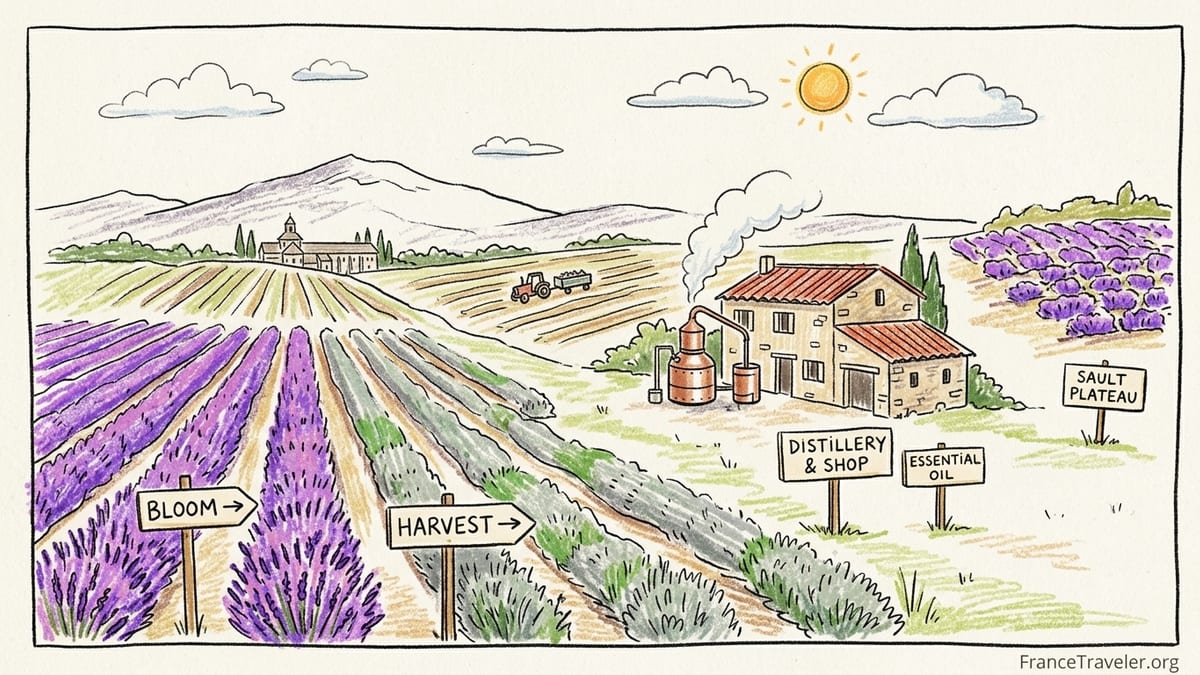
It helps to distinguish three phases: first flowers, full bloom and harvest. In early to mid June, you might see scattered purple rows, but green still dominates and photos can look patchy. By late June and early July on the lower plateaus, the fields are dense and vibrantly purple. Harvest usually begins shortly after the local lavender festivals, often in mid to late July in Valensole and late July into August in the higher Sault and Albion areas. Once a field is harvested, the plants turn a gray green and the iconic waves of color are gone for that year, even if nearby plots are still in bloom.
Because the exact dates shift with spring rains, heat waves and wind, treat online calendars as guidelines, not guarantees. If your trip is already fixed, you can adapt your expectations: in late June you are likely chasing early bloom at lower altitudes and have a chance of full bloom at sites like Sénanque Abbey in the Luberon, while in late July you may focus more on Sault, Ferrassières and the higher Drôme Provençale. A few days before you arrive, call or email the local tourism offices in Valensole, Sault or Gordes and ask directly how much of the surrounding plateau is still uncut.
The harvest itself can be worth planning for. In August, when the showiest purple has often disappeared, you may still see tractors cutting rows and traditional or modern mobile distilleries producing essential oil near Sault or on the Albion plateau. For some travelers, photographing clouds of steam and copper stills at work, then buying fresh oil from the same farm shop, is as memorable as the color of peak bloom.
Lavender vs Lavandin: What You Are Really Seeing
Most postcard images of endless purple stripes in Provence are not strictly true lavender, known locally as lavande fine, but lavandin, a hardy hybrid. True lavender grows at higher altitude, generally between about 600 and 1,400 meters. It produces a finer essential oil that is widely used in perfumery and can command higher prices. You are more likely to encounter true lavender around Sault, Ferrassières and the Albion plateau, where many farms display the term lavande fine or AOP (protected designation) signage on their roadside shops.
Lavandin, which is a natural cross between true lavender and spike lavender, is more common on the vast rolling plateaus such as Valensole and parts of the Luberon. It has bushier flowers, thicker stems and tends to produce wider, more uniform rows, which is why photographs from Valensole look so dramatic. For farmers, lavandin yields more oil per hectare and is more resistant to disease. For visitors, the distinction mostly matters if you plan to buy essential oils. True lavender oil is valued for a softer, more complex aroma and is often slightly more expensive in farm boutiques than lavandin oil, which is frequently used in soaps, detergents and inexpensive sachets.
On the ground, you can often recognize the difference by looking closely at the spikes. True lavender usually has a single flower head at the top of each stem, while lavandin often has several small “ears” branching near the top, forming a trident-like shape. Guides at local distilleries, such as those around Valensole and on the Sault plateau, often demonstrate this side by side in their shop gardens. Even if you cannot identify every field from the roadside, understanding that much of the neon purple sea you are photographing is lavandin, while the more modest high plateau fields may be true lavender, puts the landscape in context.
For planning purposes, lavandin in lower areas tends to flower a little earlier than high-altitude true lavender and may be harvested slightly sooner, which is why Valensole often peaks in late June and early July while Sault and Albion can still be colorful in early August. If your goal is to see the archetypal sweeping purple fields, Valensole’s lavandin is ideal. If you are more interested in traditional essential-oil production and slower-paced countryside, Sault and Ferrassières, with their emphasis on true lavender, may suit you better.
Valensole Plateau: Peak Color and Classic Road Loops
The Valensole plateau, east of Manosque and north of Aix en Provence, is the most photographed lavender landscape in Provence. Official tourism information from the Verdon and Alpes de Haute Provence regions describes its bloom period as typically between mid June and mid July, although in some recent hot summers the fields closest to the roads have started to be cut around the second or third week of July. If you hope for the strongest chance of unbroken purple, target the last week of June through about the second week of July, but remain flexible a few days on either side.
Most visitors explore Valensole by car. A popular driving loop starts from the village of Valensole itself, then follows the D6 and D8 roads across the plateau, passing large fields near well known farms that sell their own honey and essential oils. While the exact names of farms change over time, you will see several signposted distilleries and boutiques along this route. Another option is to approach from Moustiers Sainte Marie or the Verdon Gorges, driving up onto the plateau in the late afternoon when the low sun side lights the rows and temperatures are slightly cooler. Parking is usually informal: small gravel pull outs or wider shoulders where you can safely get off the road before stepping into a field edge.
Photographers should plan around light as much as bloom. In Valensole, morning and late afternoon often work best. Midday sun flattens the texture of the plants and makes walking the exposed fields uncomfortably hot, with temperatures frequently above 27 degrees Celsius in July. Sunrise and sunset can be dramatic, especially when sunflowers are planted in alternating blocks, but be aware that many guided tours time their visits the same way, so the most famous spots can feel crowded at golden hour. To escape the worst of the traffic, consider turning onto smaller side roads between the main departmental routes, where you will still find extensive fields but with far fewer parked cars.
For accommodation near Valensole, many travelers base themselves in Manosque, Gréoux les Bains or Moustiers Sainte Marie rather than in the small village of Valensole itself. Midrange hotels in these towns often price double rooms from roughly the low to mid three figures per night in high season, depending on facilities and views. Staying in a nearby village allows you to drive up to the plateau for sunrise or sunset and then return to somewhere with more restaurant choices. If you prefer a rural stay, look for chambres d’hôtes or gîtes on the outskirts of Valensole or along the D6, where working farms offer a few guest rooms amid the fields.
Sault, Ferrassières and the Albion Plateau: Late-Season Lavender
The Sault area, northeast of the Luberon and below Mont Ventoux, is often called the lavender capital of high Provence. At around 700 to 1,000 meters in altitude, its fields of true lavender and lavandin come into bloom later than Valensole. Regional tourism calendars and recent reports suggest that typical full color usually arrives in the second half of July and can last into early August, especially on the higher Albion plateau toward Ferrassières and the Drôme Provençale. This makes Sault an excellent choice for visitors who cannot travel until late July or the first days of August and still hope to see flowering fields rather than stubble.
A classic experience here is to follow the signed lavender discovery route around the Sault plateau. The loop takes in viewpoints above patchwork fields and offers parking areas where you can stop and walk alongside the rows. Compared with Valensole, the traffic is thinner and the landscape feels more open and mountainous, with Mont Ventoux often in the background. Around Ferrassières, a small village at roughly 1,000 meters, the fields are particularly known for fine lavender, and the local festival on the first Sunday of July marks the beginning of the high plateau season. In mid August, Sault hosts a major lavender festival with traditional sickle cutting competitions, parades and a large producers market, timed to coincide with the harvest.
Driving in this area is slower and more winding than on the wide Valensole plateau roads, but rewards those who like quieter country lanes. If you are staying in the Luberon, it is feasible to do a long day trip via Apt and then up toward Sault, but allow generous driving time and remember that rural roads have limited lighting after dark. Fuel up and carry water; in high summer, heat can still be strong even at altitude. For a more relaxed pace, spend a night or two in Sault itself or in one of the surrounding hamlets. Modest hotels and guesthouses are scattered through the village and nearby countryside, and you may find slightly lower rates than in the more famous Luberon villages at the same time of year.
Staying locally also gives you easy access to early morning walks among the fields before day trippers arrive and lets you experience the area beyond lavender. The region is known for hiking, cycling routes, truffle oak woods and local goat cheeses. Weekly markets in Sault and nearby villages sell lavender honey, soaps and essential oils direct from producers, sometimes at lower prices than in more touristed towns farther south.
Sénanque Abbey, Luberon Fields and Other Lavender Areas
Sénanque Abbey, near Gordes in the Luberon, is one of the most iconic lavender locations in France: a small Cistercian monastery set in a narrow valley, with rows of lavender in front of the stone buildings. Because the abbey sits in a sheltered spot and at moderate altitude, its flowering pattern can differ slightly from the wide plateaus. In some recent seasons, visitors have reported substantial bloom from mid June, with the field often cut earlier than the peak in Valensole. The monks grow lavender and lavandin as part of their livelihood, selling essential oils and honey in the on site shop. Entry to the site is controlled and visitors are expected to follow the abbey’s rules, including staying behind barriers around the fields.
The wider Luberon region offers many smaller fields scattered between vineyards, orchards and hilltop villages such as Bonnieux, Roussillon and Goult. The bloom here typically starts toward the end of June and can extend into July, though the timing is less uniform than on the big plateaus. You may find one field in full flower while a neighboring one is still green, depending on the exact variety and orientation. Exploring by car along roads such as the D900 and smaller local lanes between Apt, Bonnieux and Saignon often reveals photogenic but less crowded fields than those at Valensole. These are working plots, usually belonging to nearby farms and distilleries, so approach them with the same respect you would any agricultural land.
Beyond these main areas, lavender routes cross into the Drôme Provençale, around villages such as Grignan, Nyons and the upper reaches of the Rhône valley. Here, high altitude and cooler nights can support later blooming fields, often combined with vines and olive groves. Some regional tourism bodies publish themed driving itineraries called lavender routes, linking distilleries, farms and small museums. If you have a week or more, it is possible to design a trip that begins in the Luberon and Sénanque in late June, continues through Valensole around early July, and finishes on the Sault or Albion plateau and in the Drôme in late July or early August, following the wave of color north and upward.
For accommodation in the Luberon and around Sénanque, expect higher prices and more competition, especially in hilltop villages such as Gordes that feature in international media. Boutique hotels and stylish guesthouses often book out months in advance for late June and early July. To keep costs manageable, consider basing yourself in less famous but well located villages like Apt, Saint Saturnin lès Apt or Coustellet, from which you can drive to multiple lavender sites, markets and walking trails.
Driving Routes, Etiquette and Practical Tips
Most Provence lavender visitors rely on a rental car to move between plateaus and catch the best light. When planning routes, remember that distances are not large but roads are often narrow and slow. As a rough guide, driving from Aix en Provence to Valensole takes about 1.5 to 2 hours in normal traffic, from Valensole to Gordes around 2 to 2.5 hours, and from the Luberon up to Sault roughly 1 to 1.5 hours depending on your base village. Build in extra time in peak season for slow moving sightseeing traffic and tour buses near the most popular viewpoints.
Parking deserves special attention. You will see cars pulled over beside famous fields and around viewpoints, but not every dirt track or field edge is suitable or legal. Whenever possible, use designated lay-bys, small car parks or the widened verges clearly intended for stopping. Avoid blocking field entrances, which farmers need for tractors, and do not drive into the rows. In wet conditions, what looks like firm earth can quickly become muddy and soft. Local tow services do good business every summer pulling rental cars out of ditches because drivers tried to edge a little closer to the lavender.
Photography etiquette is equally important. It is generally accepted to walk a short distance into the gap between two rows to take pictures, but you should do this gently, avoid stepping on plants and keep to obvious paths. Many farmers are now posting signs asking visitors not to trample crops, pick flowers or lie down across the rows, a trend driven by social media behavior. As a visitor, assume that the field is a workplace first and a backdrop second. If you see a farmer at work or a sign indicating private property, ask permission or choose another spot. Drones are increasingly restricted; in many areas they are either banned outright or require permits, and flying them near abbeys like Sénanque is not acceptable.
Practical comfort matters as much as etiquette. Summer temperatures in Provence can be high, often above 30 degrees Celsius in July afternoons, with little shade in the fields. Bring water, a hat, sunscreen and comfortable footwear that can cope with uneven ground and sharp stones. Bee activity around flowering lavender is intense, though the insects are usually uninterested in people who move calmly. If you are allergic to stings, carry appropriate medication. For those prone to hay fever, be aware that a full day among the fields can trigger symptoms, particularly on windy days when pollen and dust lift easily.
Festivals, Distilleries and Where to Stay
Lavender is celebrated across Provence with a series of festivals tied to local bloom and harvest calendars. Valensole hosts one of the region’s largest lavender festivals around the third Sunday of July, coinciding with the start of harvest on the plateau. The day usually brings producers’ markets, farm open days and demonstrations of traditional distillation. Up in the high country, Ferrassières opens the lavender festival season with its event on the first Sunday of July, focusing on fine lavender and high plateau products. Sault’s major 15 August festival, set around its racecourse area, combines a French lavender cutting championship, floral floats, folk groups and a big artisan market, and often marks the close of the flowering period as harvest finishes.
Even outside festival days, many distilleries welcome visitors in July and August. Around Valensole, Verdon and the Albion plateau, you will find small family run stills and larger operations, some offering guided tours explaining how freshly cut lavender and lavandin are steam distilled into essential oils. These visits are not just tourist shows; in some cases you may be watching that day’s harvest transformed, with strong scents of oil and vapor in the air. Shops attached to distilleries sell oils, hydrolats, soaps, honey and culinary products, often at more transparent prices than urban souvenir boutiques.
When choosing where to stay, think beyond a single plateau. Many travelers design a two or three base trip, for example combining a few nights in the Luberon (for Sénanque, village life and mixed agriculture), a stay near Valensole or Moustiers Sainte Marie (for the classic rolling fields and access to the Verdon gorges), and then a final stop around Sault or in the Drôme Provençale (for late season lavender, hiking and quieter roads). This spreads driving time and allows you to adapt to local conditions; if you arrive to find Valensole already partly harvested, you can shift focus to higher altitude fields without losing your whole trip.
Budget wise, expect July to be high season pricing in most lavender areas, with coastal destinations and renowned villages like Gordes charging premium rates. Inland towns such as Manosque, Apt or Carpentras, and smaller villages on the margins of the main tourist circuit, often offer better value while still being within an hour’s drive of multiple lavender sites. Booking several months ahead is strongly recommended if you plan to travel between late June and mid August, especially if your dates overlap with the main festivals or with French school holidays.
The Takeaway
Seeing Provence’s lavender at its best is less about chasing a specific date and more about matching your travel window to the right plateau. Lower, warmer Valensole usually comes into bloom from mid June, with a peak toward the end of the month and into early July, while higher Sault, Ferrassières and the Albion plateau tend to flower later and can offer color into early August. The Luberon and Sénanque Abbey fit in between, with earlier blooming in some sheltered spots and a patchwork of smaller fields.
Plan your route to follow altitude and bloom, respect that every field is someone’s livelihood, and allow for the possibility that weather may shift harvest a week earlier or later than expected. Whether you come for the sweeping lavandin seas of Valensole, the true lavender of the high plateaus, or the iconic lines in front of Sénanque, a little advance planning on timing, driving and accommodation will turn a brief flowering season into a richly layered trip.
FAQ
Q1. When is the best time to see lavender in Valensole?
The most reliable period is usually from the last week of June to around the second week of July, with some fields starting earlier or being harvested slightly sooner in very hot years.
Q2. If I visit in late July, where in Provence am I most likely to still see lavender in bloom?
By late July, your best chances are around Sault, Ferrassières and the Albion plateau, where higher altitude delays both flowering and harvest and can keep fields purple into early August.
Q3. Is early June too early to see lavender in Provence?
In early June you may see the first flowers on some lower altitude fields, especially near Valensole and parts of the Luberon, but most landscapes will still be more green than purple until mid June.
Q4. What is the difference between lavender and lavandin for visitors?
Visually, lavandin creates many of the huge, dense purple fields on lower plateaus like Valensole, while true lavender is more common at higher altitudes. For most travelers, the main difference is in the products sold, with true lavender oil usually positioned as finer and lavandin oil used more for everyday soaps and detergents.
Q5. Do I need a car to visit the lavender fields?
You can join organized day tours from cities like Aix en Provence or Avignon, but having a rental car gives you much greater flexibility to chase good light, explore quieter roads and reach higher plateaus such as Sault or Ferrassières.
Q6. Can I walk into the lavender fields to take photos?
It is generally acceptable to walk carefully along the gaps between rows near the field edges, as long as you avoid trampling plants, do not pick flowers and respect any signs or barriers indicating private access, especially at places like Sénanque Abbey.
Q7. Are the lavender festivals worth planning around?
Yes, if you enjoy local culture. Events in Valensole, Ferrassières and Sault combine markets, demonstrations and traditional activities, and give you a chance to see both blooming fields and aspects of the harvest and distillation process.
Q8. Where should I stay if I want to visit several lavender areas?
Many visitors split their trip, for example staying a few nights in the Luberon for Sénanque and nearby fields, a base near Valensole or Moustiers Sainte Marie for the classic plateau, and then a night or two around Sault for later season bloom.
Q9. What should I pack for a day among the lavender fields in summer?
Bring water, sun protection, comfortable closed shoes, and, if you are sensitive, any medication for allergies or bee stings. Temperatures are high, shade is scarce and bees are active, especially around midday.
Q10. Will I still enjoy a Provence trip if I miss peak lavender bloom?
Yes. Outside the short peak, the region offers hilltop villages, markets, vineyards, gorges and festivals. In August and September, you may see harvest activity, wine grapes turning color and far fewer crowds, even if the lavender fields themselves have already been cut.