


Provence rewards first-time visitors who slow down. This is a region of markets and medieval streets, hilltop villages and vineyards, lavender fields and limestone gorges. Rather than rushing between every postcard view, you will enjoy Provence most by choosing a couple of bases and exploring in easy day trips. This guide introduces the main inland hubs for a classic Provençal stay, explains how city, village and rural bases differ, and offers practical advice on lavender, markets, wine, Roman heritage, transport, seasons and how to divide your time.
Understanding Provence’s Main Regions and Bases
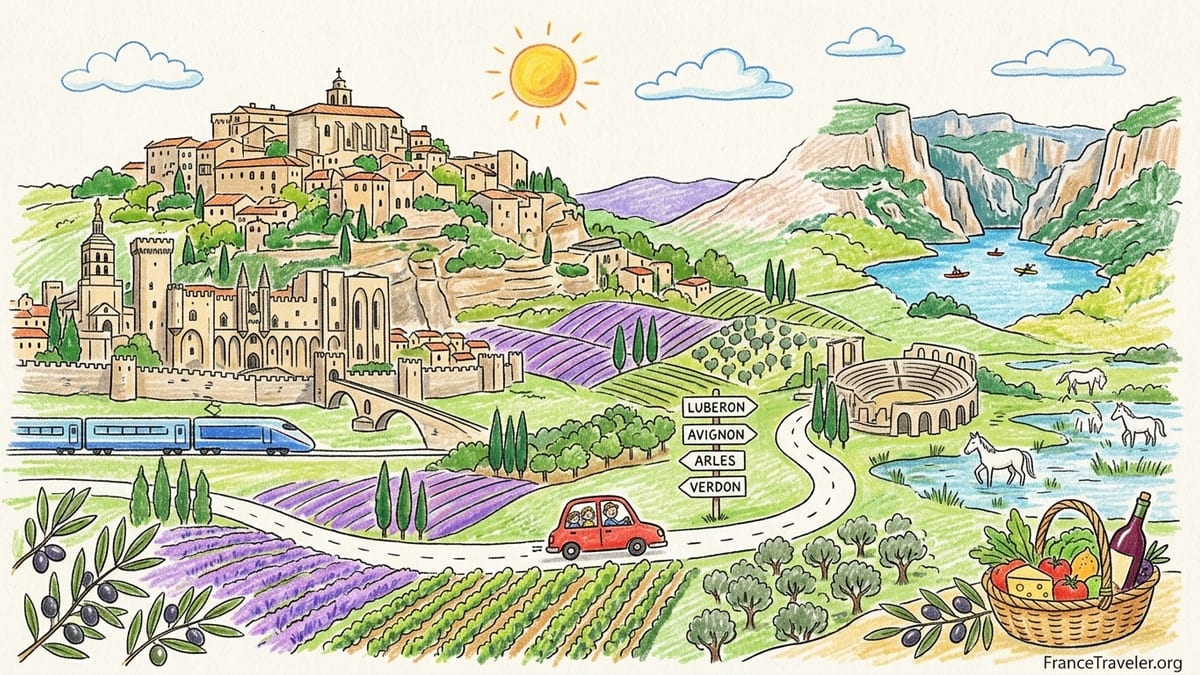
Most first-time visitors picture Provence as stone villages wrapped in vineyards and lavender. That exists, but the region is larger and more varied than many realize. Inland Provence is anchored by mid-size cities such as Aix-en-Provence, Avignon and Arles, with surrounding countryside split between the Luberon hills, the Alpilles, the Valensole plateau and the Verdon area. These areas are within two hours of each other by car, but each offers a different atmosphere, from university city buzz to quiet farm tracks and deep river gorges.
Aix-en-Provence works well as a refined, walkable city base with fountains, 17th-century mansions and a dense calendar of markets and cultural events. Avignon feels more medieval and compact, circled by stone ramparts and dominated by the Palais des Papes. Arles is smaller again and leans into its Roman ruins and Van Gogh associations, with easy access to the wild Camargue wetlands. For a village experience, the Luberon offers hill towns like Gordes and Roussillon, while the Alpilles cluster around Saint-Rémy-de-Provence and Les Baux-de-Provence. Valensole and the Verdon area are more rural still, with scattered hamlets, vast agricultural plateaus and the dramatic Verdon Gorge.
Because distances are short, you can combine a city base with one countryside base in a week. Travelers arriving by train often start in Aix or Avignon, then rent a car once, for example spending three nights in Avignon without a car and four nights in a Luberon village with one. Others fly into Marseille Provence Airport, pick up a car immediately and drive straight to a rural gîte or small hotel, using a city like Aix for the final night before departure. There is no single “right” approach, but understanding how each area feels will help you choose a base that matches your style and pace.
This guide focuses on inland Provence. The French Riviera and coastal hubs such as Nice, Antibes and Cassis merit a separate trip or at least a separate planning conversation. If you do combine coast and countryside in one itinerary, avoid letting beach days eat into the time you need to actually slow down and enjoy Provence’s inland rhythm.
Cities, Villages and Rural Stays: What to Expect
City stays in Provence suit travelers who like to walk out the door to restaurants, cafes and nightlife. In Aix-en-Provence, for example, many visitors choose a small hotel or apartment within a few minutes’ walk of the Cours Mirabeau, the broad, plane-tree-lined avenue that forms the city’s social spine. Here you can have a morning coffee in a classic café, browse the textile stalls of the open-air market along the lower Cours, then wander to the daily produce market on Place Richelme, all without needing a car. Avignon offers a similar density of amenities in a smaller, more medieval-feeling package, with the added benefit of a major TGV station just outside the walls.
Countryside villages such as Gordes, Roussillon, Bonnieux or Saint-Rémy-de-Provence appeal to visitors who want Provençal scenery at their doorstep but still appreciate a choice of restaurants and a weekly market. In Gordes, for instance, you might stay in a stone guesthouse just below the main square and walk up for a morning croissant, then drive 15 minutes to the Abbey of Sénanque in lavender season. Saint-Rémy’s Wednesday market fills the town with stalls selling olives, cheeses and linen clothing, yet by late evening the streets are quiet apart from terrace diners and the odd scooter.
Rural bases are typically standalone farmhouses, vineyard stays or small hamlets outside major villages. Around Valensole, mas-style farmhouses are surrounded by fields of lavender, wheat and almonds. In the Verdon area, simple guesthouses near Moustiers-Sainte-Marie or Aiguines might be several kilometers from the nearest bakery but offer direct access to hiking trails and lake swimming. These stays are often self-catering and require a car for even basic errands, but reward you with big skies, dark nights filled with stars, and the sound of cicadas instead of passing traffic.
Costs vary accordingly. A central three-star hotel in Aix in summer might start around a mid-range nightly rate, with breakfast extra, while a simple but atmospheric gîte in the Luberon sleeping two or three people can often be found for a comparable nightly cost if booked by the week, especially outside peak dates. Rural stays may be cheaper per night but require a car and fuel, so the savings are not always as large as they appear. City bases let you avoid a car for a few days, which is attractive for travelers wary of narrow lanes and paid parking.
Key Destinations: Aix, Avignon, Arles, Luberon, Alpilles, Valensole and Verdon
Aix-en-Provence is a lively university city with a strong cultural calendar, including an opera festival in July and frequent art exhibitions. Its handsome architecture, shaded squares and fountains give it a distinctly Italianate feel. Visitors typically spend their time strolling the old town, shopping for local ceramics and linens, visiting Cézanne’s studio on the northern edge of town and enjoying long lunches in places where two-course fixed-price menus at midday can still be reasonable by French city standards. Markets take place daily somewhere in the center, from the flower market outside the town hall to large general markets on the Cours Mirabeau on certain mornings.
Avignon is synonymous with the Palais des Papes, one of the largest Gothic palaces in Europe, and the truncated Pont Saint-Bénézet. Inside the 14th-century walls, streets wind between stone facades, churches and small squares filled with café terraces. The annual Festival d’Avignon in July transforms the city into an open-air stage, but even outside festival time there are guided tours of the palace, riverfront walks and easy day trips by regional train to places like Orange or Nîmes. Avignon is also a practical rail gateway: high-speed trains from Paris arrive in about three hours, so many travelers start or end their trip here.
Arles feels more intimate and sun-baked, its Roman amphitheatre and theater still used for events and performances. The amphitheatre’s oval form dominates the old town and gives a sense of continuity between the Roman colony and today’s café-lined squares. Arles is also associated with Vincent van Gogh, who painted dozens of works in and around the city. It makes a good base if you want to combine Roman heritage with forays into the Camargue to see rice fields, white horses and flamingos. The weekly markets, especially on Saturday along the Boulevard des Lices, are regarded as among the most atmospheric in Provence.
The Luberon is the landscape of stone farmhouses, cypress-lined lanes and perched villages that many people picture when they imagine Provence. Gordes appears like a stone cascade on its rocky outcrop, while nearby Roussillon glows in warm ochre tones above a former quarry. Villages such as Bonnieux, Ménerbes, Lacoste and Lourmarin each have their own character, but all offer cobbled lanes, shaded squares and easy access to vineyards, olive groves and country walks. The Alpilles, west of the Luberon, are lower, limestone hills centered on Saint-Rémy-de-Provence and Les Baux-de-Provence. This area feels slightly drier and rockier, with olive groves stretching toward the horizon and Roman sites such as Glanum just outside Saint-Rémy.
Valensole and the Verdon area sit to the northeast. The Valensole plateau is given over to fields of lavender, cereals and almond trees, and in early summer its gridded purple rows stretch for kilometers. The Verdon Gorge, further east, cuts a dramatic canyon between high limestone cliffs, with the blue-green waters of the Verdon River flowing into the artificial Lac de Sainte-Croix. Villages like Moustiers-Sainte-Marie cling to cliff sides and are popular bases for hiking, kayaking, swimming and scenic drives. These regions feel wilder and less built up than the core Luberon or Alpilles, and distances are greater, so they work best for travelers comfortable with longer drives and who want hikes and water activities alongside more traditional Provençal experiences.
Lavender, Markets, Wine and Roman Heritage
Lavender is one of Provence’s main visual draws. Bloom timing varies with altitude and weather, but low-lying areas such as Valensole typically reach peak color from late June to mid July, while higher fields closer to Sault and the Mont Ventoux area may bloom slightly later. In a normal year, planning for the last week of June or the first half of July gives you the best chance of seeing fields at their fullest. Most fields are privately owned working farms, so visitors are expected to stick to paths between rows rather than trampling plants, and to avoid blocking farm tracks with cars when pulling over for photos.
Markets are part of daily life rather than a special event laid on for tourists. In Aix-en-Provence you can find at least a small produce market most mornings, with larger markets rotating between squares and the Cours Mirabeau on set days. Saint-Rémy-de-Provence’s Wednesday market expands through much of the old town and is especially busy in summer, while Arles’ Saturday market stretches for nearly a kilometer, combining food, textiles and household goods. Prices for basics such as seasonal fruit and vegetables are typically comparable to or slightly higher than large supermarkets, but the quality and range are often better, and shopping here becomes one of the main pleasures of the trip.
Provence has several important wine appellations, and wine-tasting can be woven into a wider day of exploring rather than becoming the sole focus. The Côtes du Rhône vineyards lie just north of Avignon, around villages such as Châteauneuf-du-Pape and Gigondas, where family-run domaines offer tastings of red blends built on grenache and syrah. South of Aix-en-Provence, the Coteaux d’Aix-en-Provence and Palette appellations produce rosés and structured reds, while the Lubéron and Ventoux appellations offer fresh, often good-value whites and rosés alongside reds. Many estates welcome casual visitors for tastings without elaborate booking procedures, though calling ahead remains wise in high season and on Sundays. Bottles at cellar doors typically start at a modest price point, rising for cuvées aged in oak or made from old vines.
Roman heritage threads through this part of France. Arles preserves a large amphitheatre and theater, as well as extensive remains in its museum. Nearby Nîmes, just outside the core area covered by this guide but reachable as a day trip, boasts one of the best-preserved amphitheatres and a Roman temple. In Orange, the Roman theater’s towering stage wall still stands. Around the Alpilles, the ancient site of Glanum and the Roman monuments of Saint-Rémy illustrate how dense this heritage can be. For travelers with a strong interest in antiquity, basing in Arles or Avignon gives the easiest access to multiple Roman sites by train or car.
Practicalities: Hotels, Driving, Trains and Seasons
Accommodation ranges from city hotels and serviced apartments through to owner-run chambres d’hôtes, farm stays and rental houses. In cities, three-star hotels in central Aix or Avignon often provide compact rooms with air conditioning, breakfast buffets and front-desk staff who can help with restaurant reservations and taxi bookings. In villages, small hotels might have only a dozen rooms, but compensate with garden pools and on-site bistros. Rural gîtes and villas are more likely to require a minimum stay of several nights, often Saturday to Saturday in peak season, which suits those planning a full week in one base.
Driving in Provence is manageable for most visitors but does require some adjustment. Major routes between cities are on well-maintained motorways and main roads, while the final stretches into Luberon or Alpilles villages involve narrower lanes, blind curves and occasional stone walls close to the road edge. Renting a smaller car rather than a large SUV makes parking and maneuvering easier. Distances on the map can be deceptive: while Avignon to Gordes looks like a short drive, in practice you should allow for extra time to negotiate village traffic, find parking and walk from car parks located just outside historic centers. Many villages use pay-and-display machines, so carrying coins or a bank card is useful.
Trains and regional buses work well between major towns but do not penetrate deeply into the hills. High-speed TGVs link Paris to Avignon and Aix-en-Provence TGV stations in roughly three hours, and there are frequent regional trains between Avignon, Arles, Nîmes and Marseille. You can, for example, spend three nights in Avignon without a car, using trains to visit Arles or Orange, and then rent a car only for the rural portion of your stay. Travelers who prefer not to drive at all sometimes piece together a trip using cities only, but you will inevitably miss many smaller villages and landscapes away from rail lines.
Seasonality shapes everything in Provence. Late spring and early autumn, roughly May to mid June and mid September to October, often bring pleasant daytime temperatures for walking and sightseeing, cooler evenings and fewer crowds than July and August. Lavender and many festivals peak in late June and July, but so do prices, traffic and heat, with afternoon highs regularly above 30 degrees Celsius. In winter, from November to March, some rural hotels and restaurants close, but cities remain very much alive, with Christmas markets, truffle fairs and an everyday rhythm that many visitors find appealing. If you are sensitive to heat or crowds, you may prefer to accept slightly less intense lavender color in exchange for gentler conditions in mid June or early September.
How to Divide Your Time on a First Trip
For a one-week first visit focused on inland Provence, a common and sensible split is three nights in a city and four nights in the countryside. One option is to start with three nights in Avignon. Arrive by train, settle into a hotel inside the walls, and spend the first full day exploring the Palais des Papes, the old streets and the riverfront. On your second day, take a train to Arles to see the amphitheatre and market, or to Orange to visit the Roman theater. On the third day, wander Avignon at a slower pace, perhaps renting a bike to ride out onto the Île de la Barthelasse or tasting Côtes du Rhône wines at a nearby domaine.
On day four, pick up a rental car and drive to a Luberon base such as Gordes, Bonnieux or Lourmarin for four nights. Use one full day to explore nearby hill villages, another for a lavender-focused excursion in season, and a third for a longer outing to the Verdon area or to the Alpilles around Saint-Rémy-de-Provence. If you prefer a less perched and more agricultural setting, you might instead choose a base on or near the Valensole plateau and take day trips to Moustiers-Sainte-Marie and the Verdon Gorge for hiking and kayaking on the Lac de Sainte-Croix.
With ten days, you can add a second countryside base to experience two different landscapes. For instance, you could spend three nights in Aix-en-Provence, three around the Alpilles near Saint-Rémy, and four near Valensole or in the Verdon area, or switch the order depending on where you are arriving. This approach reduces backtracking and gives you time to experience different market days, local festivals and walking routes. It also allows a “rest day” in each base for simply sitting by the pool, reading in a café or wandering a single village rather than driving.
Those combining the French Riviera with Provence should be realistic about travel times. Even though Nice to Aix-en-Provence looks close on the map, traffic along the coast and around major interchanges can be heavy, especially on summer Saturdays. If you have ten or twelve days total, consider four or five nights on the coast followed by six or seven inland, or vice versa, rather than trying to switch every couple of days. Keeping the coastal portion as its own chapter of the trip will make it easier to sink into Provence’s inland rhythm without feeling pulled toward the beach at every opportunity.
The Takeaway
Provence is less a checklist of must-see attractions than a mosaic of experiences that add up over days: a coffee on a shaded square in Aix, a slow wander through Saint-Rémy’s market carrying ripe apricots, a late-afternoon swim in the Verdon’s blue water, the smell of lavender and warmed pine. For a first visit, you do not need to cover every corner of the region. Choose one city and one countryside base that speak to you, allow at least a week if you can, and leave room in your schedule for weather, mood and serendipity.
By understanding the differences between city stays, village bases and rural retreats, and by planning realistically for seasons, transport and your own pace, you can build a trip that feels both rich and unhurried. The Roman stones of Arles and Avignon will still be there the next time you come, as will the vineyards, lavender fields and markets. Many visitors find that this first visit to Provence is only the beginning.
FAQ
Q1. How many days should first-time visitors spend in Provence?
Most first-time visitors do well with at least seven nights, often split between a city such as Avignon or Aix-en-Provence and one countryside base in the Luberon, Alpilles, Valensole or Verdon area. With ten days or more, you can add a second rural base or include the coast as a separate section of the trip.
Q2. Is it better to stay in a city or a village as a base?
Cities like Aix-en-Provence and Avignon suit visitors arriving by train who want to walk everywhere, have many restaurant options and avoid driving at first. Villages such as Gordes or Saint-Rémy-de-Provence offer more direct access to countryside and a quieter evening atmosphere but usually require a rental car for day trips and errands.
Q3. Do I need a car to enjoy Provence?
You can experience cities such as Avignon, Aix-en-Provence and Arles without a car, using trains and buses between them. However, reaching hilltop villages in the Luberon, small Alpilles towns or lavender fields around Valensole is much easier with a car. Many visitors combine both approaches by using trains in the city portion and renting a car only for the countryside days.
Q4. When is the best time to see lavender in bloom?
Lavender usually blooms from late June to mid July in lower areas such as Valensole, and slightly later at higher elevations closer to Sault and Mont Ventoux. Exact timing depends on the year, but planning a trip between the last week of June and the first half of July offers a good chance of seeing full fields, especially on the Valensole plateau.
Q5. Which area is best as a base for visiting hilltop villages?
The Luberon is the classic choice for hilltop villages, with Gordes, Roussillon, Bonnieux, Ménerbes and Lacoste all within short drives of each other. Staying in or near one of these villages allows relaxed day trips without long driving days, while still giving access to vineyards, walks and local markets.
Q6. What is the difference between the Luberon and the Alpilles?
The Luberon is a range of hills known for its string of perched stone villages and a mix of vineyards, orchards and wooded slopes. The Alpilles are lower, rockier hills around Saint-Rémy-de-Provence and Les Baux-de-Provence, with extensive olive groves and nearby Roman sites such as Glanum. Both offer beautiful scenery, but the Luberon feels slightly greener and more forested, while the Alpilles feel drier and more rugged.
Q7. How expensive is accommodation in Provence?
Prices vary by season and location, but in summer a centrally located three-star hotel in Aix-en-Provence or Avignon typically costs more per night than a simple village guesthouse or rural gîte in the Luberon or Alpilles. Weekly rentals in the countryside can represent good value for families or groups, especially outside July and August, while city hotels often charge more during major festivals.
Q8. Can I visit the Verdon Gorge as a day trip from Provence bases?
Yes, but it involves a longer driving day. From Luberon or Alpilles bases, reaching the Verdon Gorge and Lac de Sainte-Croix generally takes two to three hours each way by car, depending on your exact starting point. Many travelers treat it as a full-day excursion for hiking, viewpoints and swimming, or choose to spend one or two nights in villages such as Moustiers-Sainte-Marie or Aiguines to reduce driving.
Q9. How should I combine Provence with the French Riviera?
If you have ten to twelve days, a balanced approach is to spend four or five nights on the coast and six or seven nights inland. Keeping each section in one or two bases minimizes packing and unpacking. For example, you might pair a stay in Nice or Antibes with time in the Luberon and Avignon, traveling between them by train or car and allowing extra time for summer traffic.
Q10. Are markets in Provence open year-round?
Yes, most towns and villages hold their weekly markets throughout the year, although the number of stalls and types of products change with the seasons. Summer markets tend to be larger and include more textiles and crafts, while winter markets are smaller but still offer local produce, cheeses and cured meats. Checking market days for your base before you finalize your itinerary helps you experience at least one major market during your stay.