


For families and groups, Provence often works best as a villa destination rather than a hotel one. A private pool, proper kitchen and countryside space can transform a trip with children, grandparents and friends into an easygoing house party in the sun. Yet choosing where to base yourselves, what to pay for and which amenities really matter is not always obvious when you start scrolling booking platforms. This guide compares the main villa areas in inland Provence and explains when a rental home becomes better value than booking several hotel rooms.
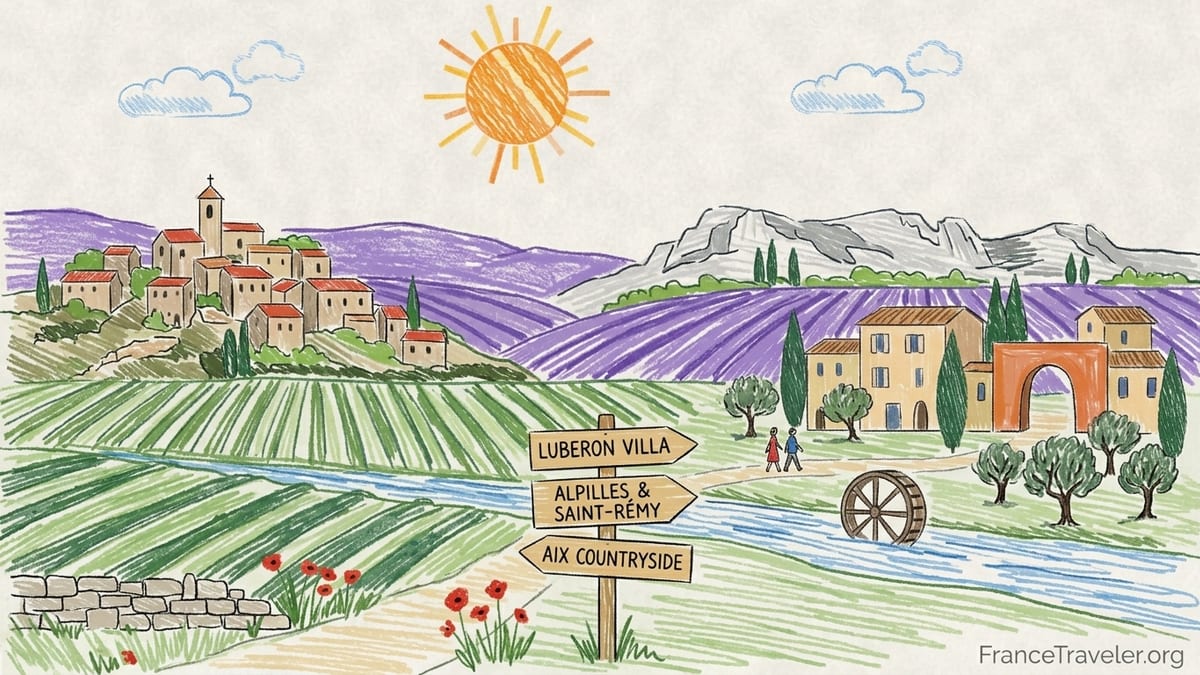
Luberon vs Alpilles vs Aix Countryside vs L’Isle-sur-la-Sorgue
Most villa searches in inland Provence quickly converge on four hubs: the hill villages of the Luberon, the Alpilles around Saint-Rémy-de-Provence, the countryside outside Aix-en-Provence, and the riverside town of L’Isle-sur-la-Sorgue. They all deliver stone farmhouses, cypress trees and poolside lunches, but the feel of each area is quite different and matters a lot for families.
The Luberon is the classic picture of rural Provence, with perched villages such as Gordes, Bonnieux, Ménerbes, Lacoste and Goult scattered across a protected regional park. Many villas here are freestanding stone mas with vineyards or lavender fields, reached by small lanes. You come for big views, quiet nights and day trips to different villages, which means you will almost certainly have a rental car and accept that bakeries and restaurants are usually a short drive away.
The Alpilles are lower limestone hills west of Avignon, with Saint-Rémy-de-Provence as the main base and smaller villages like Eygalières and Maussane-les-Alpilles nearby. The landscape keeps its Provençal charm but is less remote than the Luberon. Saint-Rémy in particular has a lively center of shops and restaurants and an unusual number of villas hidden just a few minutes’ walk or drive from town, some with pools in surprisingly central locations.
The Aix countryside spreads out in a ring around the city of Aix-en-Provence. Here you find larger estates and family houses in quiet lanes, often 10 to 20 minutes’ drive from the historic center. It suits travelers who want the space and calm of a villa but still enjoy day trips into a mid-size city with museums, shopping and dining. L’Isle-sur-la-Sorgue, by contrast, is a compact canal town on the edge of the Luberon. It is popular for antiques markets and has grown into a villa hub, with a mix of in-town houses with pools tucked behind walls and modern homes just outside the center that still allow a short walk or quick drive into town.
Luberon Villas: Space, Views and Car-Dependent Freedom
Luberon villas are the template many travelers have in mind: soft stone houses with shutters, terraced gardens and long views over a valley of vines or lavender. A typical example is a four-bedroom house near Goult or Bonnieux with a private pool and air-conditioned bedrooms, set among olive trees or forest rather than neighboring houses. It is common for these homes to sleep eight or more guests between main bedrooms and extra children’s rooms.
The trade-off for this beauty is that you will rely heavily on a car. In many Luberon rentals, the nearest bakery or café is a five to ten minute drive and the region’s famous villages can be twenty to forty minutes apart along winding country roads. For families, that works well if you treat the villa as your base and plan one main outing each day, returning to swim and cook dinner at home. It is less ideal if teenagers want to wander into town on their own or you prefer not to drive after dinner.
Comfort levels vary, but modernized Luberon properties at family-friendly price points usually offer air conditioning at least in bedrooms, shaded terraces and a proper kitchen with large fridge, oven and outdoor grill. Heated pools are common in shoulder seasons such as May, early June and late September, but in high summer a regular unheated pool is usually enough. Large seven-bedroom houses near villages like Gordes can host several families together with en suite bathrooms and a big open-plan living space, which becomes valuable compared with booking multiple hotel suites.
Prices in the Luberon vary widely. A simple three-bedroom mas with pool outside the busiest weeks might start from a mid four-figure weekly amount in euros, while a substantial estate sleeping ten or more people near headline villages can run well into five figures for peak July and August. Cleaning is often included once per week, with extra housekeeping at additional daily or hourly cost.
Alpilles & Saint-Rémy: Walkable Charm and Family-Friendly Bases
The Alpilles region has become one of Provence’s most popular family villa areas because it blends countryside calm with easier access to services. Saint-Rémy-de-Provence in particular offers something rare in rural France: houses with gardens and pools that are still walkable into a genuinely lively small town. You can find a four or five bedroom villa with a pool that sits just a few minutes from cafés, bakeries and restaurants, which is ideal for multi-generational groups or families with older children who want some independence.
Beyond Saint-Rémy, villages like Eygalières, Maussane-les-Alpilles and Paradou have their own mix of stone houses and more modern constructions with private pools, usually within a short drive or bike ride of the village center. The landscape here is gentler than the higher Luberon hills, with olive groves, vineyards and rocky outcrops. Hiking and cycling opportunities are excellent, so families who want to combine pool time with activities often gravitate here.
Most Alpilles villas aimed at international travelers now offer air conditioning at least in bedrooms, private parking, Wi-Fi and fenced gardens. Pools can be surprising in size, even within town limits, which makes this area particularly appealing in July and August. Weekly markets, festivals and day trips to Arles, Avignon and Les Baux-de-Provence are easy to arrange, and drive times are generally shorter than in the Luberon for equivalent excursions.
In cost terms, central and walkable properties around Saint-Rémy typically command a premium, particularly in high summer and during local festival weeks. Air-conditioned four and five bedroom houses with private pools and short walks into town are priced accordingly. However, once you compare the weekly rate to what three or four hotel rooms would cost in the same season, the villa often ends up more economical for families sharing the space.
Aix Countryside and L’Isle-sur-la-Sorgue: Town Access Without Sacrificing Space
If you want access to a larger town or small city but still prefer a villa, the areas around Aix-en-Provence and L’Isle-sur-la-Sorgue are worth a close look. Around Aix, many countryside estates sit behind gates along small departmental roads, some with views to Montagne Sainte-Victoire and others hidden among vineyards and orchards. You will almost always need a car, but drive times into the city center for dinner or shopping can be kept to around 15 to 25 minutes from many properties.
A typical Aix countryside rental for a family might be a four or five bedroom stone or stucco house with a pool, shaded terraces and a modern kitchen. Some properties form part of small hamlets or shared domains, which can be useful for families traveling together who prefer separate houses within walking distance. Air conditioning is common but not absolutely universal, so summer travelers should check whether all bedrooms are cooled.
L’Isle-sur-la-Sorgue provides a slightly different proposition. Here, villas and houses cluster on quiet residential streets and along the Sorgue River, with stone walls or gardens creating privacy. For families, the appeal is the ability to walk into town for morning pastries, markets or dinner, yet return to a garden and pool that feel detached from the crowds. Some rentals are modern architect-designed houses in wooded plots just outside town, with air conditioning and large pools suited to long lazy days.
Both Aix and L’Isle-sur-la-Sorgue work especially well for groups that value eating out, markets and easy logistics as much as rural seclusion. Road and rail access is convenient, with TGV stations within reasonable driving distance. For many travelers, these areas strike a comfortable balance: enough countryside to feel private, but not so isolated that every errand turns into a long drive.
Key Villa Features: Pools, Air-Conditioning and Layout for Groups
For family and group stays, a few features determine how comfortable your villa week will be. The first is the pool. In Provence’s inland summer heat, often climbing well above 30 degrees Celsius in July and August, a proper, full-size pool matters more than a small plunge pool. Many family-focused villas now include shallow steps or a beach area that works for smaller children, a safety cover or alarm, and shaded seating nearby so adults can supervise comfortably.
Heating is most important from May to mid June and again from late September into October. Many Luberon and Alpilles properties offer pool heating at extra cost, commonly charged per week. In high summer, heating is less critical and some owners even disable it to keep water temperatures comfortable. When comparing listings, it is worth checking whether heating is included or optional, and what the cost implications are for your travel dates.
Air conditioning is the second crucial feature for comfort, particularly at night. Traditional stone houses stay cool in shoulder seasons, but July and August nights can be warm even in thick-walled mas. Listings in Provence often specify whether air conditioning is in all bedrooms, in the main living areas or only in certain suites. For groups sharing the cost, it is usually worth prioritizing fully air-conditioned sleeping spaces so no one ends up in an overheated room.
Layout matters as much as headline bedroom count. Multi-generational groups often appreciate a ground-floor bedroom for grandparents, separate children’s rooms and enough bathrooms to avoid queues before dinner. Open-plan kitchens that flow onto terraces make it easy to prepare meals while supervising pool time. For larger groups, annexes, guest houses or independent suites allow early risers, small children or late-night adults not to disturb everyone else.
Car Necessity, Village Walkability and Hidden Extra Costs
One of the biggest practical questions for a Provence villa stay is whether you can walk into a village or will rely entirely on a car. In the Luberon, many of the most scenic properties sit outside town limits to guarantee views and privacy. While some houses are within a 15 to 20 minute walk of a village like Goult or Bonnieux, those walks often involve hills, unlit lanes and no pavements, so they are less suitable for small children or nighttime returns from dinner.
By contrast, parts of Saint-Rémy-de-Provence, L’Isle-sur-la-Sorgue and a few Luberon villages offer something closer to in-town living: villas within a five to ten minute flat walk of bakeries, cafés and markets, yet hidden behind gates with small gardens and pools. These properties are ideal for families who would like older children or teenagers to have some independence, and for groups that prefer not to drive every evening. In Aix countryside, true walkability is rarer; most stays assume you will drive into town.
Car rental is therefore close to essential for most villa holidays in this region, particularly if you plan to explore more than one or two nearby villages. It allows you to reach hilltop towns, weekly markets, Roman sites and vineyards with flexible timing, which is important since public transport in the countryside is limited. When budgeting, consider the cost of at least one or two rental cars plus fuel and tolls, as well as parking in popular tourist towns.
Beyond the nightly or weekly rate, villa costs usually include a set of extras that are easy to overlook on first glance. Many rentals add a final cleaning fee, either fixed or scaled with the number of guests, and may charge extra for mid-stay housekeeping. Linen and towel changes can be included once a week, with extra changes available for an additional charge. Local tourist tax is calculated per adult per night and varies by commune and property classification, generally adding a modest but noticeable amount over a two-week stay for a large group.
Minimum Stays, Booking Patterns and When Villas Beat Hotels
In Provence, most villas operate on a weekly rhythm, particularly in high season. Saturday-to-Saturday bookings dominate July and August, with some owners relaxing to shorter minimum stays or flexible arrival days in May, June, September and October. For families planning around school holidays, it pays to check these patterns early. A ten-night stay can be harder to arrange in the strictest summer weeks, whereas a fourteen-night stay often aligns neatly with owner expectations.
Cleaning and staff arrangements usually follow this weekly structure. Many villas include a set number of housekeeping hours per week, ranging from light cleaning of common areas and bathrooms to more thorough mid-stay services. For groups used to daily hotel housekeeping, this can feel like an adjustment, although additional cleaning can often be arranged in advance at an hourly rate. Some higher-end properties in the Luberon and Alpilles offer near-hotel levels of service, with live-in caretakers, breakfast preparation or on-call concierges, but these naturally come at higher weekly rates.
The question of when a villa becomes better value than several hotel rooms depends on group size and expectations. For a family of four booking one hotel room, a villa will rarely be cheaper. Once you reach six to eight travelers needing three or more hotel rooms, the economics shift. A four-bedroom villa with a pool shared between two families can cost less per night than three or four mid-range hotel rooms in the same region, especially when you factor in the ability to self-cater breakfasts and some dinners rather than eating out for every meal.
For large groups of ten or more, the math often tilts decisively in favor of a villa, particularly in the Luberon and Alpilles where hotel rooms with equivalent privacy and outdoor space simply do not exist at the same price point. Moreover, the qualitative benefits multiply: shared living spaces, kitchens, gardens and private pools create a home base where children can rest and play while adults socialize. The trade-offs are that you will handle more of your own logistics and accept less frequent housekeeping than in a full-service hotel.
The Takeaway
Choosing a villa in Provence rather than a hotel is less about luxury versus simplicity and more about matching your group’s rhythms to the right landscape. The Luberon offers big views, freestanding stone houses and a feeling of escape, best suited to travelers happy to drive for every outing. The Alpilles and Saint-Rémy mix rural scenery with genuinely walkable town life, allowing teenagers and adults to peel off for their own café runs or evening strolls. Aix’s countryside estates and L’Isle-sur-la-Sorgue’s riverside houses provide a bridge between town and country, appealing to groups who want both quiet gardens and easy access to markets, museums and restaurants.
For families and groups, the most important decisions come down to a few practical questions. Prioritize a proper pool and clear information on air conditioning, especially in July and August. Decide how walkable you need your base to be, and be realistic about car use in the countryside. Budget for cleaning fees, tourist taxes and potential pool heating, not just the headline weekly rate. Finally, compare the total villa cost to what you would pay for three, four or more hotel rooms in high season. In many cases, you will find that a well-chosen villa delivers more space, flexibility and privacy at a similar or lower overall cost, especially once you factor in the value of cooking for yourselves and sharing long, lazy evenings under the trees.
FAQ
Q1. Is a car essential for a villa holiday in Provence?
For most areas, yes. In the Luberon and around Aix, a car is practically essential for shopping, markets and sightseeing. In Saint-Rémy and L’Isle-sur-la-Sorgue you can base yourselves within walking distance of town, but a car still makes day trips much easier.
Q2. Which area is best for families who want to walk into a village?
Saint-Rémy-de-Provence and L’Isle-sur-la-Sorgue offer the best combination of villas and walkability, with houses that are just a few minutes from bakeries, cafés and markets while still having private gardens and pools.
Q3. How many bedrooms should we look for when traveling as two families?
Two families typically do well with at least four bedrooms. That allows each set of parents a bedroom and separate rooms for children, or the option to use one room as a quiet nursery or office if needed.
Q4. How important is air conditioning in a Provence villa?
In peak summer, air conditioning in all bedrooms is highly desirable, especially for children and older relatives. In shoulder seasons some travelers are comfortable with just a few cooled rooms, but July and August nights can be warm.
Q5. Do most villas in Provence have private pools?
In the main villa regions, private pools are standard for family-size houses. Exceptions tend to be smaller in-town houses or apartments. Always check pool size, depth and whether there is a safety alarm or cover if you are traveling with young children.
Q6. What extra fees should we expect beyond the rental price?
Common extras include final cleaning, optional mid-stay housekeeping, pool heating in cooler months, and local tourist tax charged per adult per night. Some owners also request a refundable damage deposit.
Q7. What is the usual minimum stay for villas in Provence?
In July and August, a seven-night minimum stay with Saturday arrivals is standard. Outside peak season, many owners accept shorter stays or flexible arrival days, especially in May, June, September and October.
Q8. When does a villa become better value than hotel rooms?
Once you need three or more hotel rooms, a four-bedroom villa with a pool often becomes similar in overall cost, while providing far more space. For groups of eight or more, villas usually offer better value and privacy.
Q9. Is the Luberon or Alpilles better for a first-time visit?
The Alpilles around Saint-Rémy suit first-time visitors who like a lively town base with easier logistics. The Luberon is perfect if you prioritize views, quiet and hopping between picture-postcard villages, and do not mind more driving.
Q10. How far in advance should we book a family villa in Provence?
For school holiday weeks and popular months like July, it is wise to book 9 to 12 months ahead, especially if you need specific features such as walkability to a village, a heated pool or a large number of bedrooms.