

Few wine regions feel as instantly romantic as Provence and the Southern Rhône. Vineyards tumble down stony slopes, medieval villages crown hilltops and the air smells faintly of wild thyme. Yet when you actually try to book a wine tour, you are met with more than a hundred experiences across multiple platforms, from quick tastings to full-day private circuits. This guide cuts through the noise, comparing Châteauneuf-du-Pape and Southern Rhône tours from Avignon with Côtes de Provence and Sainte-Victoire itineraries from Aix-en-Provence and Marseille, so you can match the right experience to your time, budget and wine interests.
Understanding the Wine Map: Châteauneuf-du-Pape vs Sainte-Victoire
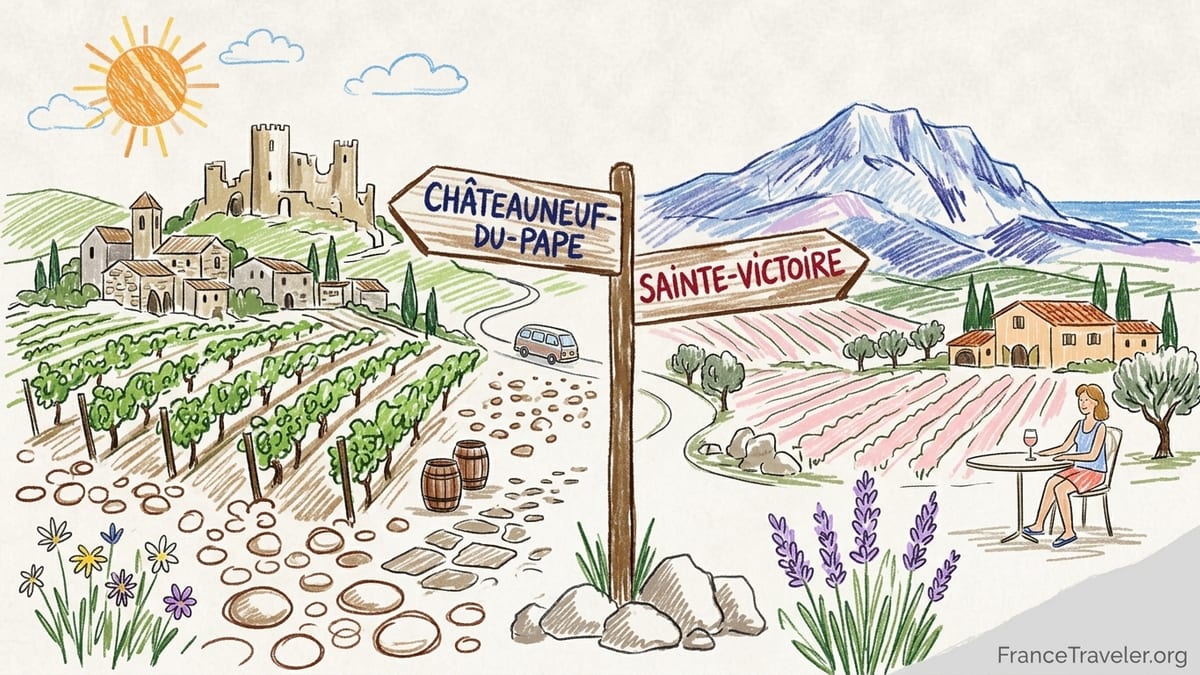
For trip planning, it helps to think of Provence and the Southern Rhône as two overlapping but distinct playgrounds. Châteauneuf-du-Pape, along with nearby appellations such as Gigondas and Vacqueyras, belongs to the Southern Rhône. These are mostly powerful reds grown on galet-rolled vineyards north of Avignon. Côtes de Provence and Sainte-Victoire sit further southeast, between Aix-en-Provence and the Mediterranean, and are best known for pale rosé and increasingly serious reds and whites. The styles are different enough that many travelers choose to dedicate at least a day to each area rather than trying to cram both into a single outing.
In practice, that means using Avignon as the natural base for Châteauneuf-du-Pape and wider Southern Rhône tours, and using Aix-en-Provence or Marseille for Sainte-Victoire and broader Côtes de Provence excursions. From Avignon, you can reach the village of Châteauneuf-du-Pape in about 30 to 40 minutes by road. From Aix, the first Sainte-Victoire vineyards east of town are roughly 20 to 30 minutes away, with estates such as Château Henri Bonnaud and Château des Trois Sautets lying along the wine road toward the iconic Montagne Sainte-Victoire.
Both regions now support a dense ecosystem of small-group and private tours, and marketplaces commonly display well over one hundred Provence wine experiences at any given time. The most visible offers tend to cluster around two hubs: Châteauneuf-du-Pape departures from Avignon, and Sainte-Victoire or mixed Côtes de Provence routes from Aix and, to a lesser extent, Marseille. Understanding how these hubs differ in driving distances, wine styles and price ranges will shape the kind of day you end up having.
Half-Day vs Full-Day Tours: How Much Time Do You Really Need?
Half-day tours are popular with travelers who only have one or two nights in Avignon or Aix and want to combine wine with city sightseeing. A typical half-day Châteauneuf-du-Pape itinerary from Avignon runs around four to five hours and includes visits to two estates, with tastings of several reds and often a white at each stop. A similar half-day Sainte-Victoire tour from Aix usually features two wineries focused on Côtes de Provence and Sainte-Victoire rosé, plus short photo stops near the mountain made famous by Cézanne. These outings leave your morning or evening free for the Palais des Papes in Avignon or the Cours Mirabeau in Aix.
Full-day tours, usually between eight and ten hours, offer a different kind of experience. Southern Rhône itineraries often combine Châteauneuf-du-Pape with one or two neighboring appellations such as Gigondas or Vacqueyras, or mix wine with short cultural stops in villages like Séguret or Uzès. From Aix or Marseille, full-day Sainte-Victoire routes can extend deeper into the Côtes de Provence hinterland, stopping at three or four estates and sometimes including a winery lunch or a picnic among the vines. The extra hours give you more breathing room between tastings and make it easier to travel a little farther off the main highway.
In terms of value, first-time visitors who genuinely enjoy wine usually find that a full-day program offers better cost per tasting and a less rushed rhythm. Half-days can feel compressed once you factor in hotel pickups, vineyard transfers and time spent in each cellar. That said, if you are traveling in high summer with children or non-wine-drinkers, a half-day often strikes the right balance between wine discovery and overall holiday relaxation. Think of half-days as a flavorful introduction and full-days as a deeper immersion.
How Many Estates and Tastings to Expect
Most small-group half-day tours in both Châteauneuf-du-Pape and Sainte-Victoire include two estates and at least one structured tasting at each stop. In Châteauneuf-du-Pape, that could mean a visit to a family-run domaine in the village, followed by a more polished cellar with panoramic views over the Rhône plains. At each estate, you usually sample several wines side by side, which might cover different cuvées, vintages or blends within the AOC. In Sainte-Victoire and broader Côtes de Provence, tastings are often built around comparing rosé, red and white expressions of the same terroir, highlighting how the limestone soils near the mountain differ from the warmer sites toward the Var interior.
Full-day tours typically expand the program to three or sometimes four estates. From Avignon, a classic route might start in Châteauneuf-du-Pape, continue to Vacqueyras for a contrasting Grenache blend and finish in Gigondas, where vineyards climb the Dentelles de Montmirail. From Aix or Marseille, a full day could feature a premium Sainte-Victoire estate in the morning, a more rustic Côtes de Provence property for lunch and a final tasting at a design-forward winery like a contemporary art estate north of Aix. The number of individual wines tasted can easily reach a dozen or more, so pacing and hydration become important.
Travelers who are particularly passionate about wine sometimes worry that group tours will not provide enough depth or access. In reality, many Southern Rhône and Provence estates are accustomed to hosting visitors as part of mixed small groups and still offer informative cellar walks, barrel-room visits and time to ask questions. If there are specific estates you have in mind, such as a particular Châteauneuf-du-Pape producer whose bottles you collect at home or a Sainte-Victoire domaine you read about in a wine magazine, a private tour remains the most reliable way to secure appointments there.
Lunch, Food Pairings and How Tours Handle Meals
One of the biggest practical differences between tours is how they handle lunch. Many small-group half-day outings from Avignon and Aix do not include a meal and return you to town either just before or after the traditional French lunch window. A common scenario for a morning Châteauneuf-du-Pape tour is a mid-day drop-off back in Avignon, at which point guides often suggest brasseries near the Place de l’Horloge or under the plane trees close to the Palais des Papes. In Aix, afternoon half-day tours to Sainte-Victoire usually depart after lunch, letting you enjoy a relaxed meal in the old town before heading out to the vineyards.
Full-day experiences are more likely to build food into the itinerary, but the format varies. Some Provence wine operators design routes around a fixed-menu lunch at a countryside inn or at a winery restaurant, where dishes such as lamb with Provençal herbs or grilled vegetables with olive tapenade are paired with local wines. Others give you free time in a village like Lourmarin or Cassis to choose your own lunch spot, which works well for travelers with dietary restrictions or picky eaters in the group. There are also tours, particularly from Aix, that arrange picnics using market produce assembled that morning.
If you care strongly about the food component, read the tour description carefully and, if needed, email to confirm what is and is not included. Some full-day private tours from Marseille and Aix include a more upscale restaurant stop but leave the actual bill for you to settle directly with the establishment, which can be a pleasant way to keep flexibility while still benefiting from the guide’s connections and reservations. In all cases, it is sensible to carry a light snack in case lunch happens later than you are used to back home.
Designated Driver Value: Why a Guided Tour Often Makes Sense
There is a romantic appeal to renting a car and drifting through vineyards at your own pace, but French drink-driving laws are strict and enforcement is taken seriously. For travelers based in Avignon, Aix or Marseille, hiring a local driver-guide or joining a small-group tour effectively builds a designated driver into your day. This lets everyone in your party taste freely within reasonable limits and removes the stress of navigating unfamiliar rural roads, parking in tiny stone villages and timing appointments in a region where lunch closures are common.
The financial value becomes clearer when you break down the costs. By the time you have rented a car, added fuel, parking and full insurance and potentially booked individual tastings at three or four estates, the gap between self-drive and a small-group tour can narrow considerably. Private tours are more expensive per day, but they also function as a concierge service, handling reservations and using local knowledge to avoid closed gates or fully booked cellars. While your actual price will depend on the season, group size and exact itinerary, many travelers describe the incremental cost over self-drive as worth it for the peace of mind alone, especially if they are unfamiliar with French roads.
There is also a safety dimension. On rural roads around Châteauneuf-du-Pape or up toward Sainte-Victoire, lighting can be limited after dark, and weather can change quickly in shoulder seasons. Having a professional driver who knows the area and is not tasting reduces the risk of accidents and avoids the possibility of an expensive legal issue that could overshadow your trip. For groups celebrating birthdays, honeymoons or anniversaries, this designated-driver aspect is often the deciding factor when choosing between piecing together tastings independently and buying a curated tour.
Private vs Small-Group Tours: Which Suits You?
Small-group tours are the backbone of the Provence wine experience marketplace. Departing from Avignon, it is common to find minivan tours limited to eight people that visit two or three estates in Châteauneuf-du-Pape and sometimes another Southern Rhône appellation. From Aix-en-Provence, operators run similar minibus circuits into Sainte-Victoire and the wider Côtes de Provence, often marketed as relaxed, convivial introductions where you might meet fellow travelers from around the world. These tours usually follow a fixed route and schedule, and their prices are attractive for couples or solo travelers.
Private tours, by contrast, are typically priced per vehicle rather than per person and appeal most to families, groups of friends and serious wine enthusiasts. A private driver-guide can adapt the day to your pace, include a mix of blockbuster estates and smaller family domaines and adjust on the fly if you discover a preference for, say, Mourvèdre-heavy Côtes de Provence reds or the more structured styles of certain Châteauneuf-du-Pape producers. From Marseille, private tours are particularly popular because they can incorporate port pickups for cruise passengers and adjust timing to ship schedules.
In terms of on-the-ground experience, the biggest difference is not just space in the vehicle but also control over the narrative. On a private Southern Rhône day out of Avignon, you might spend a full hour walking vineyard parcels, discussing soil types and grape varieties with the winemaker. On a small-group tour, that same estate visit might be more concise to keep everyone on schedule. Neither format is inherently better; it is a question of your priorities. If you care most about tasting in a social environment at a comfortable price, small-group tours are ideal. If you want specific estates, in-depth explanations and flexibility around lunch and photo stops, private touring is usually the better fit.
Choosing Your Base: Avignon, Aix or Marseille?
When comparing Châteauneuf-du-Pape and Southern Rhône tours with Sainte-Victoire and Côtes de Provence experiences, your choice of base makes a practical difference. Avignon is the undisputed hub for Châteauneuf-du-Pape excursions. Many tours pick up from central hotels or near the train station, and driving times to the first vineyards are short, which means less time in transit and more time in the cellars. Staying in Avignon also gives you easy access to the wider Rhône corridor if you later decide to explore places like Orange or the Roman theater in Vaison-la-Romaine.
Aix-en-Provence is the natural base for Sainte-Victoire and nearby Côtes de Provence appellations. The famous mountain rises just east of town, and routes such as the Cézanne road thread through landscapes that appear on countless postcard views. Wine tours from Aix often highlight this artistic and natural heritage, with guides pointing out viewpoints that recall Cézanne’s paintings while you sip pale rosé under oak trees. Because many producers cluster within a relatively tight radius, driving distances are modest, and you can usually visit two or three estates without spending hours in the van.
Marseille adds a different dimension. As a major port and city, it offers a broad range of accommodations and dining options, and several operators run wine days from Marseille into both the Sainte-Victoire area and deeper into Côtes de Provence. For cruise passengers, private tours from the cruise terminal are particularly common, with itineraries that balance vineyard time with quick stops in seaside towns or at Cassis for a view of the calanques. The trade-off is longer driving times compared with starting in Aix or Avignon. If wine is your main focus and you have flexibility, staying in Avignon for Southern Rhône and Aix for Provence generally results in more efficient days.
Real-World Itineraries and What They Feel Like
To make these differences more concrete, imagine a typical small-group half-day from Avignon to Châteauneuf-du-Pape. You are picked up mid-morning in a minivan with six other travelers and driven north across the Rhône. After about half an hour, you reach your first estate, where a guide walks you through the cellar, explains how the famous round stones retain heat and then pours a flight of reds, sometimes including a special cuvée from older vines. A short drive later, you stop at a second domaine, perhaps with a hilltop view of the castle ruins, taste another series of wines and then head back to Avignon by mid-afternoon, with time for a café or a stroll along the city walls.
Now compare that to a full-day Sainte-Victoire and Côtes de Provence circuit from Aix. You depart around 9 a.m., head east along the base of Montagne Sainte-Victoire and reach your first winery within half an hour, where you taste rosé and white wines that reflect the limestone foothills. Late morning might bring a second estate with a more contemporary cellar, followed by a leisurely lunch at a countryside inn or in a village square. In the afternoon, your driver takes you deeper into the Côtes de Provence to a third winery, perhaps in a more wooded landscape, before returning you to Aix around 6 p.m. The day feels more like a gentle loop through diverse Provence scenery, with wine as the thread that ties it together.
For travelers with limited time, one common strategy is to spend two or three nights in Avignon, taking a half- or full-day Châteauneuf-du-Pape and Southern Rhône tour, then move to Aix for another few nights with a Sainte-Victoire or wider Provence wine excursion. This dividing line mirrors the way locals often think of their wine regions and makes logistics smoother, since you are not backtracking long distances for each tasting day. It also lets you experience two very different town atmospheres: the papal grandeur of Avignon and the café culture of Aix-en-Provence.
The Takeaway
Planning a wine tour in Provence and the Southern Rhône can feel overwhelming when you first encounter dozens of tour names and glowing reviews, but a few clear choices simplify the decision. Châteauneuf-du-Pape and neighboring Southern Rhône appellations pair best with an Avignon base, where half-day tours deliver focused tastings and full days widen the lens to include villages and additional AOCs. Sainte-Victoire and the broader Côtes de Provence shine brightest from an Aix-en-Provence base, with Marseille as an alternative for those who prefer a larger city or arrive by cruise ship.
Half-day tours suit travelers who want a taste of wine country alongside other sightseeing, while full-day circuits provide deeper immersion and better pacing between estates. The number of wineries you visit, whether lunch is included and whether you opt for a private driver or a small group will all shape the rhythm and cost of your day more than any individual tasting fee. Above all, building in a designated driver through a tour or private guide keeps the experience relaxed and safe, allowing you to enjoy the wines and the landscapes that make Provence such a lasting travel memory.
FAQ
Q1. Is Avignon or Aix-en-Provence better as a base for wine tours?
Avignon is generally better for Châteauneuf-du-Pape and Southern Rhône tours because driving times to the main appellations are short. Aix-en-Provence works best for Sainte-Victoire and nearby Côtes de Provence wineries, where routes radiate directly from the edge of town into the foothills of the mountain.
Q2. Can I visit both Châteauneuf-du-Pape and Sainte-Victoire in one day?
It is technically possible but not advisable. The regions sit in different directions and combining them makes for a long day with more time in the van than in the vineyards. Most travelers are happier dedicating one day to Southern Rhône wines from Avignon and a separate day to Sainte-Victoire or Côtes de Provence from Aix or Marseille.
Q3. Are half-day wine tours worth it, or should I book a full day?
Half-day tours are worthwhile if you have limited time or want to balance wine tasting with city sightseeing. Full days, however, usually feel more relaxed, allow visits to three or more estates and give better value per tasting. If wine is a highlight of your trip, a full-day itinerary is usually the more satisfying choice.
Q4. Do most tours include lunch in the price?
Many half-day tours do not include lunch and schedule departures around the French lunch hours instead. Full-day tours are more likely to feature a lunch stop, but the meal may be at your own expense even if the reservation is arranged by the guide. Always check the description and, if it matters to you, confirm in advance whether food is included.
Q5. How many wineries will I visit on a typical tour?
Small-group half-day tours usually visit two wineries, while full-day programs often include three and occasionally four estates, depending on driving distances and whether a longer lunch or village stop is planned. Private tours can sometimes adjust this up or down to match your pace and interest level.
Q6. Is it realistic to drive myself and skip tours altogether?
Driving yourself is possible, but you will need to plan around strict drink-driving laws, rural roads and limited parking at some estates. For many visitors, hiring a guide or joining a small-group tour offers better value once you factor in car rental, fuel, tastings and the peace of mind of having a designated driver.
Q7. Should I choose a private tour or a small-group experience?
Private tours suit travelers who want control over the itinerary, specific estates and a flexible pace. They are especially attractive for families, groups of friends and serious wine enthusiasts. Small-group tours work well for couples and solo travelers seeking a social environment and a lower per-person price, even if the route is more fixed.
Q8. Are tours from Marseille very different from those from Aix-en-Provence?
Tours from Marseille often involve slightly longer driving times to reach the same Sainte-Victoire and Côtes de Provence estates that Aix-based tours use, but they appeal to travelers who prefer staying in a large port city or who arrive by cruise ship. The core experiences in the vineyards are similar, although Marseille itineraries may incorporate brief coastal or village stops.
Q9. Do I need to be an expert in wine to enjoy these tours?
No expertise is required. Most tours are designed for curious beginners as well as enthusiasts. Guides explain local grapes and appellations in accessible language, and tastings are structured so you can discover what you like without any pressure to buy more than you want to take home.
Q10. How far in advance should I book a Provence wine tour?
In peak months such as June through September, it is wise to book popular Châteauneuf-du-Pape and Sainte-Victoire tours several weeks in advance, especially for weekends or private experiences. Outside high season, you will often find availability closer to your travel dates, but reserving early still gives you the best choice of itineraries and departure times.