


Planning a Provence lavender tour in 2026 is all about timing and choosing the right route. With fields around Valensole, the Luberon, Sault and Sénanque Abbey all blooming on slightly different calendars, the difference between a life‑changing violet landscape and a patchy, half‑harvested plateau can be a matter of just a week or two. This guide focuses on practical, bookable options from Aix-en-Provence, Avignon and Marseille, and explains how to choose between Valensole, Luberon and Sault tours, including popular combinations with Moustiers-Sainte-Marie and the Verdon Gorge.
Understanding Provence Lavender Bloom in 2026
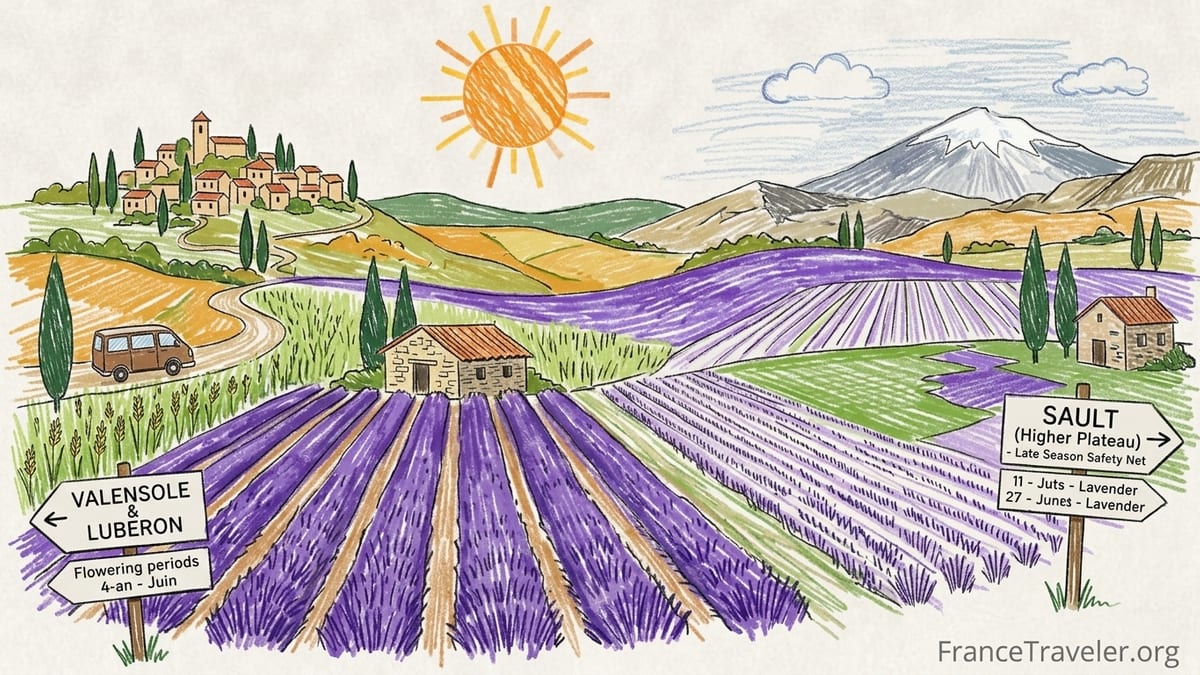
The 2026 lavender season in Provence is forecast to run slightly earlier than the old “mid June to late July” rule of thumb. Local tourism offices and regional guides report that Valensole’s lavandin fields started flowering around 10 June 2026, ahead of average, with a projected peak from roughly late June to about 15 July. Higher, cooler plateaus around Sault and the Plateau d’Albion are expected to peak later, broadly in the 10 to 25 July window, while some fields near Sault are deliberately left unharvested until mid August for the traditional lavender festivities. For travelers who only have one day to spend, this staggered calendar is good news, because it creates a rolling wave of purple across the region.
At a simple level, the lower, warmer Valensole Plateau tends to bloom and be harvested first, followed by mid‑altitude Luberon fields and, last of all, the higher Sault area and Albion Plateau. In a typical 2026 scenario, late June to the first half of July is ideal for Valensole, while Luberon fields around Roussillon and Gordes often look best from around the last week of June into mid July. Sault and its surroundings then carry the season into late July, and a handful of fields remain colorful into early August. This matters if you are booking a fixed date tour from Aix, Avignon or Marseille, since your departure city will largely determine which plateau you can realistically reach on a day trip.
It is also important to distinguish between lavandin, the hybrid grown in many commercial Valensole fields, and fine lavender, which dominates in higher zones near Sault. Lavandin usually blooms slightly earlier and more uniformly, which is why so many photographic tours focus on Valensole in late June and early July. Fine lavender around Sault offers a more traditional, sometimes patchier landscape but often retains its color longer into high summer. Many travelers choose to hedge against climate variability by booking Valensole for late June or very early July and switching attention to Sault or Luberon if they arrive later in the month.
If you are planning a once‑in‑a‑lifetime trip specifically for the purple fields, the safest single date range for 2026 based on current regional forecasts is roughly 25 June to 15 July. Within that window, you can expect strong bloom on Valensole, good color in much of the Luberon, and the start of full flowering around Sault. Outside that range, lavender may still be visible but you must be more strategic about which plateau you choose and realistic about the risk of early harvests or heat‑shortened seasons.
Valensole Plateau Tours: Peak Bloom & Verdon Extensions
The Valensole Plateau is the classic Provence lavender postcard: huge geometric fields, deep violet rows running to the horizon, and iconic stone cabanons dotted between swathes of purple and wheat. In 2026, many tour operators from Aix-en-Provence, Avignon and Marseille are again structuring full‑day itineraries that combine Valensole with Moustiers-Sainte-Marie and viewpoints over the Verdon Gorge. This combination reflects clear traveler demand for a high‑impact day that mixes lavender photography with a characterful hill village and a dramatic canyon landscape.
From Aix-en-Provence, small‑group minibus tours to Valensole typically cost in the region of 110 to 150 euros per person for an 8 to 10 hour day, with departures timed to catch soft morning light in the fields and a leisurely lunch stop in Moustiers. A common route runs Aix to the Valensole plateau via Manosque, stopping at two or three large fields near Valensole village, then on to Moustiers-Sainte-Marie for lunch and free time, and finally to a viewpoint above Lac de Sainte‑Croix or the Verdon Gorge before returning to Aix in early evening. Some operators include a stop at a farm distillery or producer shop where you can buy essential oils, soap and honey made from local lavender.
From Marseille, driving distances are longer, so many agencies emphasize longer full‑day outings, often around 11 to 12 hours. Prices can run a little higher, often between 130 and 170 euros per person for a small‑group tour that reaches Valensole, Moustiers and at least one Verdon overlook. The extra drive time makes it important to check how many photo stops are included in the plateau itself; if your aim is photography, prioritize tours that guarantee several field stops over those that only cross Valensole on the way to the Verdon. Avignon‑based tours to Valensole are less common than Luberon or Sault departures, but a few premium operators do offer long‑day lavender and Verdon excursions for around 150 to 190 euros per person, sometimes in very small groups of 8 travelers or fewer.
For travelers who want the most flexibility, private day trips to Valensole from Aix, Avignon or Marseille are widely available at price points starting around 550 to 750 euros per vehicle for up to 6 or 8 passengers, increasing with vehicle size and language options. A private tour allows you to adjust the schedule to the light and weather, detour to quieter fields away from the classic bus stops, or linger longer in Moustiers or by the lake. That flexibility can be critical if you are visiting at the edges of the season and need to hunt for remaining unharvested fields, or if you want to photograph at sunrise or sunset when group tours are usually back in town.
Luberon & Sénanque Abbey: Avignon and Marseille Departures
The Luberon offers a different lavender experience to Valensole. Rather than endless flat plateaus, you get smaller, more intimate fields set around hilltop villages such as Gordes and Roussillon, backed by ochre cliffs and stone farmhouses. Many tours from Avignon and Marseille use lavender as one highlight among several, pairing short stops at fields with visits to villages, markets and the famous Sénanque Abbey, a 12th‑century Cistercian monastery framed by neat rows of lavender in front of its stone facade.
From Avignon, a typical small‑group Luberon and lavender tour costs about 90 to 130 euros per person for 8 to 9 hours. It may include morning in L’Isle‑sur‑la‑Sorgue or Fontaine-de-Vaucluse, a midday visit to Gordes, and an afternoon stop at Sénanque Abbey for photos from the roadside viewpoint above the monastery. In high season, some itineraries add a visit to the lavender museum near Coustellet to explain cultivation and distillation. Actual time in lavender fields is often an hour or two in total, spread across a couple of locations, so these tours suit travelers who want an all‑round taste of Provence rather than a single‑minded photography mission.
Marseille‑based Luberon excursions are less focused on lavender but still exist, generally at around 120 to 150 euros per person in small groups. They spend longer on the highway reaching the region and sometimes only include one or two lavender field photo stops near Gordes or Roussillon, depending on bloom conditions. A private driver‑guide from either Marseille or Avignon can design a more targeted route, stopping at less busy fields off the main tourist circuit, but prices then climb towards 600 to 900 euros for a full‑day tailored itinerary for a family or small group of friends.
If your dream image of Provence centers on the lavender in front of Sénanque Abbey, timing is critical. In early June 2026 the abbey fields may still be green, while by the second half of July harvest can begin, stripping rows and reducing the impact of the classic postcard view. Regional patterns in recent years suggest that the best odds for a fully purple foreground at Sénanque run between roughly the last week of June and about mid July. Because access to the abbey grounds is controlled and photography within the lavender rows themselves is restricted, it is wise to manage expectations and choose a tour whose description is honest about viewing conditions and vantage points.
Sault Plateau: Late Season Safety Net from Avignon and Aix
The Sault area, northeast of the Luberon and at a higher altitude, is often described by local tourism boards as Provence’s “late lavender” plateau. Fields around Sault, Ferrassières and the Plateau d’Albion typically bloom later and hold their color longer than those on Valensole. In practice, that means that if you have fixed travel dates in the second half of July, Sault often becomes your safest bet for seeing large expanses of lavender that have not yet been harvested. Some fields here are also kept in bloom deliberately until the mid‑August lavender celebrations in Sault village, though by that stage color and density can be variable.
From Avignon, several operators offer dedicated Sault lavender day trips in 2026 that cost roughly 100 to 140 euros per person in small groups. These tours might route via scenic villages such as Saint‑Saturnin‑lès‑Apt or through the Gorges de la Nesque, then spend time on the Sault plateau visiting multiple fields, sometimes including a farm visit or a viewpoint towards Mont Ventoux. Total driving time is slightly longer than to the Luberon, but still manageable in a 9 to 10 hour day. From Aix-en-Provence, Sault is reachable on day trips, although not all providers offer this route; when they do, prices and durations are usually comparable with Avignon‑based options.
Because Sault sits higher, evenings can be fresher and summer storms more likely than on Valensole, which can actually be an advantage in very hot summers by extending bloom and preventing excessively early harvest. Travelers who have already visited Valensole or the Luberon sometimes choose Sault specifically for a quieter, more rural feel and to avoid crowds at the most photographed spots. Fields here are spread across a broader landscape, so your guide’s local knowledge makes a bigger difference to how much you see in a single day.
Private Sault tours from Avignon or Aix, priced in the 600 to 900 euro range per vehicle depending on company and inclusions, allow for flexible timing and custom stops such as walks between adjacent fields, longer photography sessions at sunrise or sunset, or detours to viewpoints near Mont Ventoux. For travelers arriving at the end of July or very start of August, this flexibility can be vital. In some years, Valensole may already be largely harvested by that point, while Sault still offers decent color, making a last‑minute itinerary switch from a Valensole‑focused plan to a Sault‑centered day a sensible strategy.
Small‑Group vs Private Tours: Which Is Best for You
Lavender tours from Aix, Avignon and Marseille fall broadly into two categories: small‑group minibus tours, often capped at 8 passengers, and fully private excursions where you and your travelling companions have the vehicle and guide to yourselves. Choosing between them is partly a budget decision and partly about how much control you want over timing, locations and pacing. Both options can deliver a rewarding experience if matched correctly to your priorities and your dates within the 2026 season.
Small‑group tours are usually the most economical way to see the fields without renting a car. Prices from Aix and Avignon commonly sit between 90 and 140 euros per person for a standard full day, with shorter half‑day options available in some cases for Luberon or Sénanque routes. The main advantages are simplicity and social atmosphere: you book online, meet at a central point, and follow a tried‑and‑tested route that hits several classic viewpoints. On peak days during late June and early July, popular operators often fill their departures in advance, which can create a lively, international mix of travelers in each minibus.
Private tours come into their own if your main goal is photography, if you have limited mobility, if you are traveling as a family group, or if your dates fall close to the edges of bloom where flexibility is crucial. Per‑vehicle pricing can feel steep, but once split between 4 to 6 travelers a private guide from Aix or Avignon to Valensole or Sault may end up only moderately more expensive than joining a high‑end small group. More importantly, a private driver can leave before sunrise, stay on the plateau through golden hour, or detour to follow weather and bloom reports that change from week to week. That responsiveness is difficult for scheduled group tours that must keep to fixed departure and return times.
Whichever format you choose, it is wise to look beyond the marketing photos in 2026 and read recent traveler feedback describing how many field stops were actually made, how crowded they were, and how guides handled any signs of early harvest or heat‑damaged bloom. Ask operators directly whether they adjust routes dynamically during the season. A company that is willing to substitute Sault for Valensole at the last minute when fields around Valensole have been cut, or to add extra Luberon stops when Sénanque is past its prime, is likely to deliver a better experience than one that rigidly follows a printed itinerary.
Choosing Your Base: Aix, Avignon or Marseille
Your departure city shapes what kind of lavender day trip makes the most sense. Aix-en-Provence is the most convenient base for Valensole and the Verdon, sitting closest to the plateau and offering the largest range of dedicated lavender and Moustiers‑Sainte‑Marie combinations. If your heart is set on the big open fields and the classic Provence postcard, staying in or near Aix, even for a single night, increases your choice of operators and your chances of catching a departure with optimal timings in late June or early July 2026.
Avignon is better positioned for mixed itineraries that pair lavender with Luberon villages, Sénanque Abbey and wine routes in the Rhône Valley. Many visitors who are already planning to explore historic Avignon and the nearby Pont du Gard choose to add a one‑day Luberon and lavender loop from here. If you book in the first half of July, you can still reach Valensole on a long‑day tour, but in practice most Avignon‑based travelers opt for the closer Luberon and Sault plateaus, which reduce time in the van and allow more stops.
Marseille has fewer purely lavender‑focused departures, but it works as a base for travelers who want to combine city life and the Mediterranean coast with a single inland day trip. From Marseille, you can reach Valensole and the Verdon on a long excursion or focus on Luberon villages and a couple of fields closer to the coast. Because journey times are longer and motorway traffic around the city can be heavy in July, it is particularly important to scrutinize tour descriptions from Marseille to ensure that you will not spend most of your day in transit.
In all three cities, peak bloom days in late June and early July 2026 are likely to sell out for the most popular guided tours. Booking several weeks ahead is prudent if your dates are fixed, but if your schedule is flexible, consider mid‑week departures which are often less crowded both on the plateau and in villages like Moustiers or Gordes. Travelers who are comfortable driving in rural France can also rent a car and use local tourism office maps to design independent routes, but for many visitors the convenience, commentary and parking expertise of a professional guide are well worth the tour cost.
Managing Risk: Booking Around an Unpredictable Season
Even with 2026 forecasts, lavender bloom is never guaranteed on a precise date. A warm spring can bring the flowers on a week early, while unusually cool, wet weather can delay them. Harvest timing is influenced by essential oil content and farmer schedules, so some fields may be cut while neighboring plots remain in full bloom. When you commit to a fixed‑date tour from Aix, Avignon or Marseille, you are effectively gambling on a small window of seasonal perfection. Understanding and managing that risk is essential, especially for travelers flying from outside Europe.
The first lever is to choose your travel dates carefully. If lavender is your top priority, aim for at least three full days in Provence between roughly 25 June and 15 July 2026 and book your key tour toward the start of that window. That way, if an unexpected heatwave threatens to accelerate harvest, you have time to adjust your booking or add an extra outing to Sault or the Luberon while fields are still colorful. If you can only travel in the second half of July, recognize that Valensole may already be partly or largely harvested and focus instead on Sault plateau itineraries, where later bloom and intentionally preserved fields hold the season longer.
The second lever is to choose adaptable tour providers. When comparing Valensole and Luberon products, look for language in the description that mentions flexible routing based on bloom conditions, or that explicitly lists alternative plateaus such as Sault. Consider contacting companies directly before booking to ask how they handled early harvests in recent years. An operator who answers candidly that they shifted several departures from Valensole to Sault or Luberon in response to changing conditions is likely to take similar care in 2026.
Finally, it is important to calibrate your expectations. Even outside perfect peak, a well‑designed tour can still be rewarding. In late June you might see some green rows among those in flower, but enjoy quieter fields and milder temperatures. In late July near Sault, colors may be softer and more silvery than electric purple, but the plateau is less crowded and the landscape feels more agricultural and authentic. Booking outside the absolute peak flowering period carries a real risk of more limited bloom, but it can also deliver a more relaxed experience that many travelers actually prefer once on the ground.
The Takeaway
For 2026, the essence of a successful Provence lavender trip is to match the right plateau to the right week and the right style of tour. Valensole, with its cinematic rows and popular combinations with Moustiers-Sainte-Marie and the Verdon Gorge, is at its best roughly from late June to around mid July, and is most easily accessed from Aix-en-Provence and, with a longer drive, from Marseille. The Luberon and Sénanque Abbey deliver a more varied cultural day out from Avignon or Marseille, with lavender as one highlight among villages, abbeys and markets. Sault offers a valuable late‑season safety net, especially from Avignon and Aix, keeping the dream of violet fields alive into late July.
Small‑group tours keep costs straightforward and routes simple, while private tours offer flexibility that can be crucial during edge‑of‑season visits or for serious photographers. Whichever option you choose, booking within the late June to mid July core window, checking how adaptable the itinerary is to real‑time conditions, and being honest with yourself about your priorities will help transform a fragile seasonal spectacle into a memorable, well‑timed journey. With a bit of planning, the 2026 Provence lavender season can deliver exactly the scenes that first inspired you to seek out these fields of purple in the south of France.
FAQ
Q1. When is the best time in 2026 to book a Valensole lavender tour?
The safest window for strong bloom on the Valensole Plateau in 2026 is expected to be roughly from 25 June to about 15 July, with a probable absolute peak in the first half of July.
Q2. If I visit in late July 2026, should I choose Valensole or Sault?
By the second half of July, Valensole may already be partly harvested, so Sault is usually the better choice for seeing large areas of lavender still in flower, thanks to its higher altitude and later season.
Q3. Which city is best as a base for lavender tours: Aix, Avignon or Marseille?
Aix-en-Provence is ideal for Valensole and Verdon combinations, Avignon is best for Luberon, Sénanque and Sault routes, and Marseille works if you want to combine a coastal stay with a single long inland day trip.
Q4. How much do small‑group lavender tours typically cost?
In 2026, small‑group full‑day tours from Aix, Avignon or Marseille generally range from about 90 to 150 euros per person, depending on route length, inclusions and group size.
Q5. Are private lavender tours worth the extra cost?
Private tours, often priced from around 550 to 900 euros per vehicle, are worth considering if you prioritize photography, are traveling as a family or group of friends, or are visiting at the edge of the season when itinerary flexibility matters most.
Q6. Can I see both lavender and the Verdon Gorge in a single day?
Yes. Many tours from Aix and Marseille combine Valensole fields with a visit to Moustiers-Sainte-Marie and one or two viewpoints over the Verdon Gorge, but expect a long day with several hours of driving.
Q7. Is Sénanque Abbey a good primary lavender destination?
Sénanque Abbey offers an iconic view of lavender in front of a historic monastery, but the fields are relatively small and access is controlled, so it is best seen as part of a wider Luberon itinerary rather than as your only lavender experience.
Q8. What are the risks of booking outside peak flowering weeks?
Outside the late June to mid July core window you may encounter green or already harvested fields, patchy color and shorter blooming periods, especially on Valensole, though higher plateaus like Sault can still offer good displays later.
Q9. Should I rent a car instead of booking a tour?
Renting a car gives you maximum independence but requires confidence with rural driving and navigation. Guided tours simplify logistics, manage parking and route‑finding, and often include local insights and producer visits that independent travelers might miss.
Q10. How far in advance should I book a 2026 Provence lavender tour?
For travel between 25 June and 15 July 2026, it is sensible to book popular small‑group tours several weeks in advance, especially for weekend departures, while private tours and late July Sault itineraries also benefit from early reservation due to limited availability.