


Two trips, one corner of France. On one side, Provence and its Luberon villages, lavender fields and vineyard roads. On the other, the French Riviera, where Nice, Cannes and a string of Mediterranean resorts run along a coastal train line. Both sit in the same region, Provence Alpes Côte d’Azur, but the experience on the ground could not feel more different. Choosing between them is less about which is objectively better and more about which trip fits the way you like to travel.
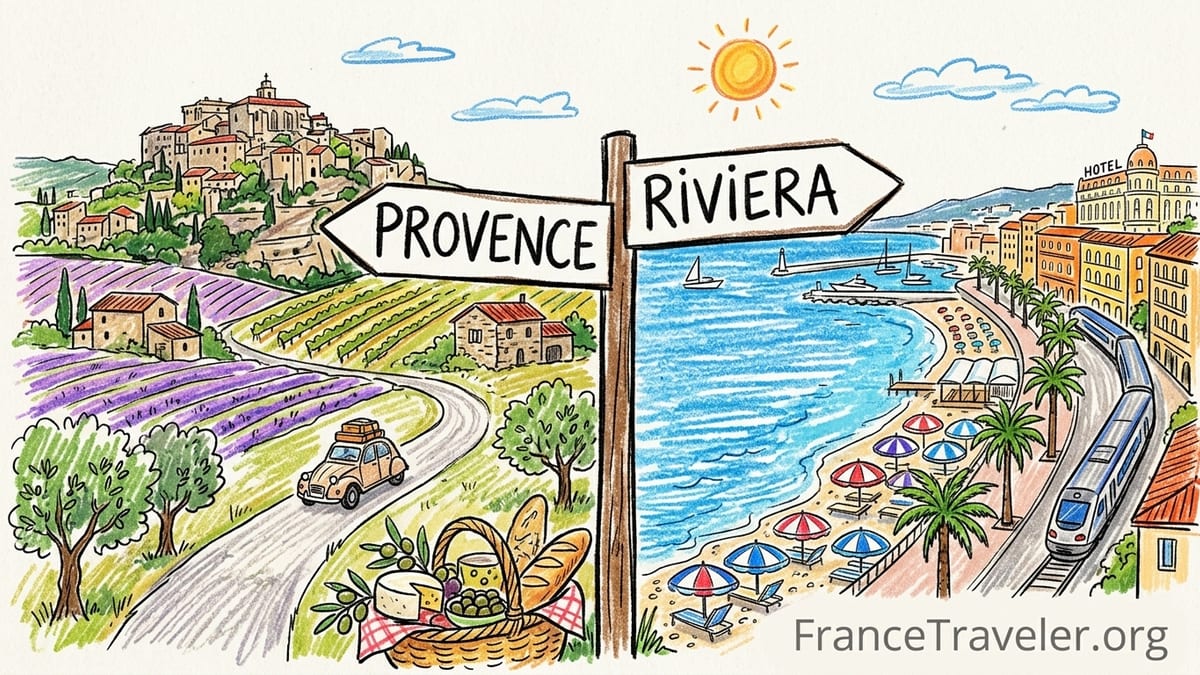
Provence vs French Riviera at a Glance
Think of inland Provence, especially the Luberon, as slow-travel countryside: stone villages such as Gordes, Roussillon and Ménerbes perched above patchworks of vineyards and orchards, weekly markets that fill entire squares, and small hotels converted from farmhouses. It is a place for long lunches under plane trees, visits to wineries around Bonnieux or Châteauneuf du Pape, and looping road trips that zigzag between medieval streets and lavender plateaus like Valensole in early summer.
The French Riviera, by contrast, is coastal, concentrated and connected. Nice, Cannes, Antibes, Monaco and smaller towns like Villefranche sur Mer sit along a busy rail corridor with frequent regional trains. From a single base in Nice you can be in Cannes in roughly 30 to 40 minutes, in Monaco in around 25 minutes, and at beaches or coastal promenades within a few minutes’ walk of many hotels. Resort life, nightlife, beach clubs and people watching shape the rhythm of the trip far more than vineyards and village markets.
Both areas share Mediterranean light, good food and a strong sense of French art de vivre, but the tone differs. Provence skews to birdsong mornings, wine tastings and shuttered village facades that change little from year to year. The Riviera skews to clinking glasses on rooftop bars, long rows of parasols on pebbly or sandy strands, and seasonal events from the Cannes Film Festival to the Monaco Grand Prix that shift prices and crowds noticeably.
Practically, that means different planning styles. Provence is easier with a car and some advance booking around key market days and lavender season. The Riviera can be almost improvisational: you land in Nice, check into a hotel within tram reach of the station, and decide over breakfast whether today feels like Antibes, Cannes, Menton or simply staying put on the Promenade des Anglais.
Costs, Hotels and When Your Budget Hurts
In broad terms the French Riviera is more expensive at the same comfort level, especially in peak summer. In central Nice in July or August, a fairly ordinary three star hotel can easily fall in the range of about 180 to 250 euros per night for a double, while a seafront four star with at least a partial sea view often hovers around or above 300 euros. Cannes, especially during major congresses or the film festival in May, and smaller luxury pockets such as Saint Tropez or Cap Ferrat push higher still, with many comfortable rooms starting above 300 to 400 euros in those peak windows.
In the Luberon and wider Provence, averages drop outside a handful of ultra luxury estates. You can still spend heavily on a Relais & Châteaux style property with manicured gardens and a spa, but it is noticeably easier to find characterful guesthouses and small hotels between roughly 120 and 200 euros in high season, especially if you stay a short drive outside headline villages. A family friendly farmhouse hotel outside L’Isle sur la Sorgue or near Saint Rémy de Provence can feel both more spacious and better value than a comparable budget on the Riviera seafront.
Daily costs follow the same pattern. A simple two course dinner at a seafront restaurant in Nice or Cannes might hover 30 to 50 percent higher than a similar meal a few streets back from the water, and higher again than a countryside bistro in inland Provence. Beach clubs illustrate the difference sharply: renting a lounger with umbrella at a popular private beach in Cannes or Saint Tropez in August can run from around 40 euros into three figures for the most in demand clubs, whereas a village pool, river swim near Fontaine de Vaucluse or public lake beach in Provence often costs little or nothing beyond parking.
The catch is that Provence’s better value often assumes you have a car and are willing to stay just outside the most photogenic villages. If you insist on a pool, parking and a front row view in famously pretty spots such as Gordes or Bonnieux, prices climb nearer Riviera levels in June and July. Shoulder seasons, roughly May to early June and September into early October, tend to soften prices in both areas, but you feel the discount more noticeably inland.
Transport, Car Dependence and Ease of Getting Around
One of the biggest practical differences between these trips is how you move once you arrive. The Riviera is built around its rail and bus spine. Nice is a true transport hub with a major airport at one end of town and a central station feeding regional TER trains along the coast. Those trains link Nice with Antibes, Cannes, Menton and Monaco in a matter of minutes to about an hour, running frequently enough during the day that many travelers simply turn up, check the next departure on the board and go.
Because the Riviera’s major towns are compact and walkable along the waterfront, you can comfortably plan a week based entirely in Nice without renting a car. The city’s own tram system connects the airport to the center, and local buses cover hilltop villages such as Eze or Saint Paul de Vence. For many visitors, that freedom from driving, parking and navigating mountain hairpins is a strong point in the Riviera column.
In inland Provence, public transport exists but rarely lines up neatly with the way most travelers want to hop between villages, vineyards and countryside viewpoints. TGV trains bring you quickly to Avignon, Aix en Provence or Marseille from Paris and other major cities, but once you are there, the prettiest Luberon settlements lie on minor roads. Distances are not huge, but routes are twisting and timetables sparse. To wake up in Gordes, catch sunrise over the valley, spend the day between lavender fields around Sault and wineries near Bonnieux, then detour via the ochre cliffs of Roussillon, you realistically want your own wheels.
A compromise some travelers choose is a partial self-drive: pick up a car in Avignon or Aix for four or five days of Provence, then drop it and take the train across to Nice for several days of car free Riviera time. A direct or lightly connecting train between the Avignon area and Nice typically takes a little over four hours, and the journey doubles as a landscape shift from farmland and low hills to rocky coastline without the stress of highway driving.
Beaches, Scenery and Signature Experiences
The archetypal Provence image is not coastal at all, even though part of the region technically touches the sea. It is a low stone farmhouse beside rows of lavender in late June, or pale green vineyards climbing a gentle slope with a hill village above. Driving the Luberon’s small roads between Oppède le Vieux, Lacoste and Bonnieux gives you constant views of orchards, cypress lined lanes and pale cliffs. Morning markets in towns like Apt or Lourmarin fill streets with cheese stalls, olive tapenades, honey, seasonal fruit and stacks of linen, often followed by a simple lunch on a shady terrace and an afternoon wine tasting.
On the Riviera, the view is almost always blue. Nice’s Promenade des Anglais curves around a broad pebble beach backed by Belle Époque facades and palm trees. Cannes mixes a glamorous Croisette lined with luxury hotels and designer boutiques with soft sandy beaches, some public and some tied to private clubs. Smaller spots like Villefranche sur Mer, Beaulieu or Théoule sur Mer sit in coves where hills meet the water, with pastel facades ending almost directly at the sea. Beach clubs set out neat rows of parasols, waiters shuttle past with iced rosé, and the soundtrack is a blend of waves and conversation rather than tractors in a vineyard.
If swimming is central to your trip, the Riviera is the clear winner. Even in shoulder seasons, sheltered bays around Antibes or Menton can still feel swimmable when inland Provence evenings have cooled. However, you give up some of the pastoral calm and sense of discovery that comes with wandering into a weekly market in Saint Rémy or stumbling on a road side stand selling goat cheese in the Luberon. Many travelers who have done both say the Riviera often feels like a scenic stage set with lots of other visitors on it, whereas Provence, once you step back from the biggest names, still offers quieter corners.
For photography and day to day atmosphere, both regions deliver in different ways. A golden hour walk through the alleyways of Roussillon, with its ochre walls glowing against a blue sky, can feel every bit as cinematic as sunset on Nice’s promenade. But the Riviera’s combination of sea reflections, boat filled harbors and hilltop viewpoints like Eze’s exotic garden makes it easier to stack multiple postcard scenes into a single day without ever turning the ignition key.
Nightlife, Dining and General Vibe
If late nights and bar hopping are part of your ideal holiday, the Riviera is better suited. Nice has a dense cluster of wine bars, cocktail spots and late opening restaurants in and around the Old Town and the port. Cannes, particularly during festivals and summer, runs on a late schedule with beach bars, clubs around the harbor and hotel lounges that stay busy well past midnight. Monaco adds casino glamour and rooftop lounges, though at prices that surprise many first time visitors.
In inland Provence, evenings tend to be quieter and earlier. Most village restaurants in the Luberon or around Avignon do a strong trade at dinner but wind down not long after. You are more likely to find live music on a village square during a summer festival or a local wine fair than a string of open-to-all cocktail bars. For many couples or families this is precisely the appeal: dinner under fairy lights, a stroll back through narrow streets, then silence broken only by cicadas and church bells.
Dining styles reflect the landscapes around them. On the Riviera, seafood and Italian influences dominate: plates of fried fish in Menton, socca and niçoise specialties in Nice, and flashy sushi or Mediterranean fusion along the Croisette aimed squarely at international visitors. Inland, menus lean heavily on lamb, goat cheese, seasonal vegetables, truffle dishes in winter and spring, and hearty stews or grilled meats served with local wines. A simple set lunch at a bistro in a market town, priced in the low twenties for a starter and main, often feels like one of the best value meals of a Provence trip.
The overall vibe is harder to quantify but easy to feel. The Riviera hums, even in its quieter corners. You are aware of cruise ships, day trippers, luxury shopping, beach reservations and the social calendar. Provence breathes more slowly. You schedule around market days and perhaps one or two marquee sights such as the Roman theater in Orange or the Palais des Papes in Avignon, but otherwise a lot of the pleasure comes from unscripted detours between fields, villages and viewpoints.
Families vs Couples: Who Thrives Where
For couples, both Provence and the Riviera can be memorably romantic, but in different registers. Provence leans intimate: a converted stone farmhouse outside Gordes with only a handful of rooms, lavender around the pool, and evenings spent with a bottle from a nearby winery feels made for slow mornings and long conversations. Towns like Aix en Provence or Uzès combine graceful architecture with enough cafes and small shops to fill gentle days without ever rushing.
On the Riviera, romance is more extroverted. A sea view balcony at a hotel along Nice’s promenade, dinner at a harbor side restaurant in Villefranche, or a splurge night in a glamorous Cannes property feels wrapped in lights and people watching. For some, that buzz is exactly what makes a trip special. Others find it harder to truly unwind in high season when beaches, trains and restaurant terraces are busy from late morning onward.
For families, priorities shift to logistics and activities. Provence works especially well for families who are comfortable renting a car, want space and do not mind that evenings will be quiet. A self catering villa or countryside hotel with a pool becomes the base, with day trips to markets, short hikes, river swims and the occasional fortified town. Children can run around more freely in rural settings, and parents are less stressed about crowded stations or busy seafront roads.
The Riviera suits families who prefer to avoid driving and want beach days on tap. A hotel or apartment within easy walking distance of the sea in Nice or Antibes makes life simple: breakfast, a few hours on the beach, a nap, then an evening stroll for ice cream. The coastal trains make kid friendly day trips straightforward, although platforms and summertime crowds require more vigilance. Budget can also pinch more quickly for families on the Riviera, as beach clubs, seafront cafes and attraction tickets add up faster than a picnic beside a Provençal river.
Trip Planning, Seasons and Combining Both
Season timings nudge the choice as much as preference. Lavender in Provence usually peaks from late June into early July depending on altitude and weather. Vineyards are lush by early summer and the heat builds steadily through August. Visiting in May, June or September often gives a sweet spot of warm days, cooler evenings and lighter crowds. By contrast, the Riviera’s sea swimming season stretches a little later into autumn, and many travelers deliberately time Riviera stays for shoulder months like May, late September or October to balance water temperatures with calmer streets and softer hotel rates.
In the depths of winter, both areas quieten, but cities like Nice and Aix en Provence retain enough life, markets and culture to support a long weekend, while small Luberon villages fall very sleepy between New Year and early spring. If you are locked into peak school holidays in late July or early August, expect both regions to be busy and hot, with more traffic on Provence roads and more competition for Riviera beach space and mid range hotel rooms.
Combining both in a single trip is not only possible, it is in many ways the ideal South of France itinerary if you have at least ten to twelve days. A common pattern is to fly into Marseille or Paris, take the TGV to Avignon or Aix, spend four to five nights exploring the Luberon and surrounding countryside by car, then drop the vehicle and take a direct or lightly connecting train to Nice for another four to five nights of Riviera life. This sequence gives you countryside calm first, then ends with the easier, car free logistics of the coast.
Alternatively, if your primary arrival airport is Nice, you can reverse the order: start with a few easy days on the coast to recover from the flight, then pick up a car at Nice or Cannes and drive inland toward Aix and the Luberon. The driving itself can be part of the experience if you build in a night around the Var or the Verdon Gorge, though toll roads and summer traffic mean many travelers now prefer to let the train handle the longer link and keep the car strictly for countryside exploration.
The Takeaway
Choosing between Provence and the French Riviera is really choosing between two neighboring but distinct styles of holiday. If your dream South of France trip involves lavender fields, vineyard tastings, hilltop villages and long quiet evenings under plane trees, then anchor yourself in Provence, particularly the Luberon and surroundings. Accept that you will almost certainly need a car, but in return you get space, better average value and a slower rhythm that many people remember as the highlight of their time in France.
If, instead, you picture Mediterranean bays, coastal train rides, beach clubs, promenades, rooftop bars and the ease of moving without a car, then the Riviera is the better fit. Nice, Cannes and their neighbors along the curve of the Côte d’Azur deliver sea views on demand, dense dining and nightlife, and a social, urban energy that countryside villages simply do not try to match. You will pay more for the convenience and glamour, especially at the height of summer, but the payoff is a trip that feels simple to organize and rich in daily variety.
For many travelers, the most satisfying answer is not either or but both. Start in Provence for five or six days of hill towns, markets and vineyard roads, then let the train carry you to Nice for another five or six days of sea air and coastal exploring before you fly home. In roughly two weeks you experience two different South of France worlds without ever leaving the same broad region, and you no longer have to decide whether you are more of a lavender field person or a beach club person. You are allowed to be both.
FAQ
Q1. Is Provence or the French Riviera cheaper for a one week trip?
In general, inland Provence is slightly cheaper, especially for mid range hotels and everyday meals, while the Riviera commands a premium for seafront locations and resort amenities.
Q2. Do I need to rent a car in Provence or on the French Riviera?
In Provence, particularly the Luberon and rural areas, a car is strongly recommended to reach villages, vineyards and viewpoints, while on the Riviera most visitors rely on trains, trams and buses instead.
Q3. When is the best time to see lavender in Provence?
Lavender fields around the Luberon and Valensole typically look their best from late June through early to mid July, though exact timing varies with weather and altitude each year.
Q4. Are the beaches better in Nice, Cannes and the Riviera than in Provence?
Yes, for classic sea swimming and beach days, the Riviera clearly wins, with long pebble and sand beaches, beach clubs and sheltered coves, while inland Provence focuses more on rivers, lakes and pools.
Q5. Which is better for a honeymoon, Provence or the French Riviera?
Provence is ideal if you want seclusion, countryside charm and long quiet evenings, whereas the Riviera suits couples who enjoy a livelier scene with seafront strolls, cocktail bars and people watching.
Q6. Is it easy to combine Provence and the French Riviera in one itinerary?
Yes, many travelers spend four or five nights around Avignon or the Luberon, then take a direct or lightly connecting train to Nice for another four or five nights on the coast.
Q7. Which destination works better for families with young children?
Families who like space, pools and driving often prefer Provence, while those who want car free beach days and easy train based excursions find Nice or Antibes on the Riviera more convenient.
Q8. How many days do I need in Provence versus the French Riviera?
A comfortable first trip might give at least four to five full days to each area, but if you must choose one, aim for a minimum of five full days either in Provence or based in Nice on the Riviera.
Q9. Is the French Riviera overcrowded in summer compared to Provence?
Both regions are busy in July and August, but the Riviera’s trains, beaches and promenades feel more intensely crowded, while Provence’s congestion shows more in traffic and parking in popular villages.
Q10. If I have to pick just one, which is better for a first time South of France trip?
If you prefer beaches, nightlife and simple logistics, choose the French Riviera, but if you are drawn to villages, vineyards and slower days, Provence is likely to feel more rewarding.