


Choosing where to sleep in Provence has more impact on your trip than almost any other decision. Pick the right base and you glide between lavender fields, markets and wine villages with easy drives and relaxed evenings. Pick the wrong one and you spend your days in traffic or searching for parking instead of sipping rosé under plane trees. This guide compares the main bases used by independent travelers in 2026 – Aix-en-Provence, Avignon, Saint-Rémy-de-Provence, Luberon villages, Arles and countryside estates – to help you choose one or two strategic hubs rather than changing hotels every night.
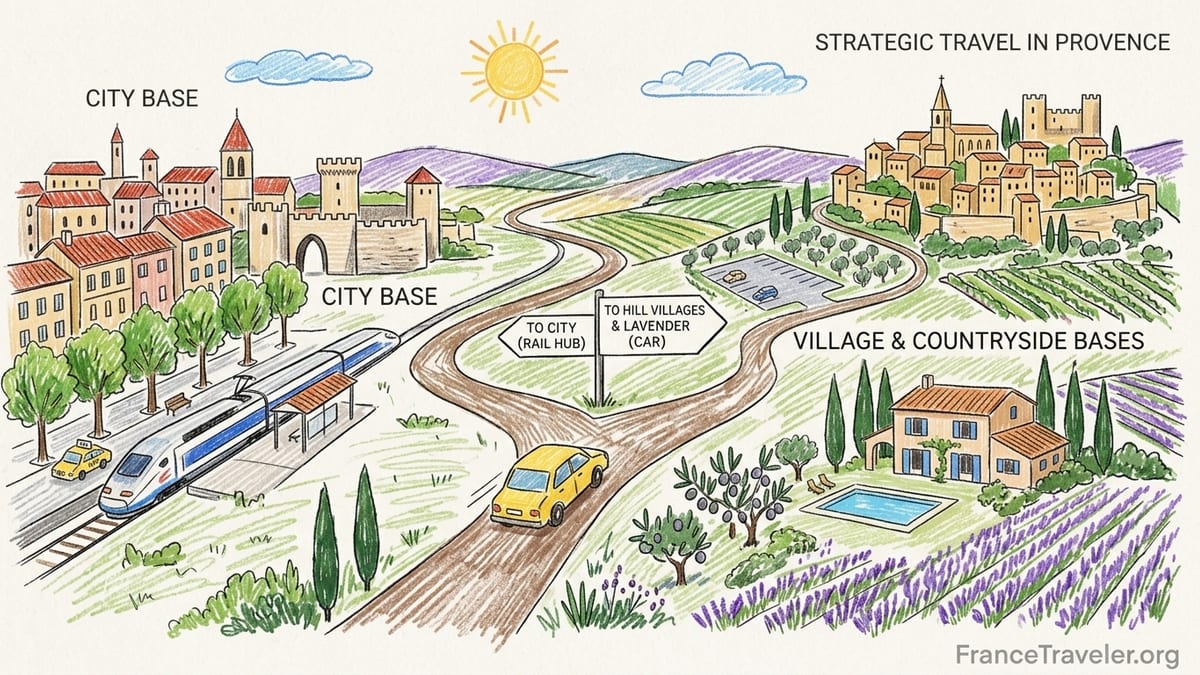
How to Think About Bases in Provence
Provence looks compact on the map, but travel times can surprise first timers. A day that strings together Gordes, Roussillon, Sénanque Abbey and a vineyard tasting can easily involve over two hours of driving, even though everything is within roughly 30 to 40 kilometers. That is why experienced visitors usually pick one or two hubs and fan out on day trips, rather than moving hotels every night. The right base is not just pretty. It needs parking that does not turn into a daily headache, restaurant options you will still be happy with on night four, and realistic access to the places on your wish list.
Another key factor is whether you want a city feel with trains, museums and nightlife, or a village or countryside stay where stars, cicadas and a pool replace cocktail bars. Staying in Aix or Avignon feels very different from sleeping in hilltop Gordes or a farmhouse outside Saint-Rémy. In the cities you might skip a car for a few days and ride high speed trains; in the countryside you will rely on a rental car from day one. This article walks through each major option, using concrete examples of hotels, parking realities and sample day trips so you can match your base to your travel style.
Aix-en-Provence: Lively City, Limited Lavender
Aix-en-Provence is often described as a small-scale Paris with a Mediterranean accent. Its compact old town is packed with cafes and restaurants around Cours Mirabeau and the surrounding streets, which makes it a strong base for travelers who want a buzzy evening scene. You will find everything from simple brasseries with lunch formulas around 18 to 25 euros to chef driven bistros where a three course dinner runs 50 to 70 euros per person. Boutique hotels and apartments cluster in the pedestrian core; in 2026 it is common to see midrange doubles in central Aix from roughly 160 to 260 euros per night in shoulder season, with higher prices in June and September.
Logistically, Aix works best if you value train access and urban comfort more than being in the heart of the postcard landscapes. The city sits on a major rail and bus corridor, with frequent buses to Marseille Provence Airport and onward trains to Avignon and the Côte d’Azur. You can arrive by TGV to Aix-en-Provence TGV station and connect to the city center in about 15 minutes by shuttle, then rent a car for selected days rather than your entire stay. Once in town, much of central Aix is pedestrian and several underground car parks ring the old quarter, charging by the hour or offering day rates that are reasonable by big city standards, though you do still pay to park most days.
From Aix you can day trip to the Luberon villages, but it is a compromise. A drive to Gordes usually takes around 1 hour 15 minutes in light traffic. That means a triangle day of Gordes, Roussillon and Bonnieux is entirely doable, but you will drive 2.5 to 3 hours in the day. The lavender plateaus of Valensole are closer to 1.5 hours. Wine country such as Cassis and Bandol, or the Sainte-Victoire mountain hikes, are easier excursions from Aix, making the city a good choice if your Provence vision mixes urban café culture, coastal days and a single “Luberon loop” rather than several days among villages and fields.
Avignon: Rail Hub and Gateway to Wine
Avignon is the best all round base for travelers who care about train access. The city has two important stations: Avignon Centre by the ramparts and Avignon TGV on the high speed line used by trains from Paris, Lyon and other major French cities. High speed services from Paris can take as little as around 2 hours 40 minutes, which makes Avignon an easy entry point for North American and UK travelers flying into Paris and continuing by rail. A short local train or taxi connects Avignon TGV to the walled city, so you can be checked into a hotel inside the ramparts without ever renting a car.
Within the walls, Avignon has a dense stock of hotels, guesthouses and apartments, from simple two star properties near the station to upscale boutique hotels in 17th century mansions around the Palais des Papes. In mid season you might find decent doubles from approximately 130 to 220 euros, with historic properties and pools commanding more. The restaurant scene is broad and reliable, with everything from casual bistros on Rue des Teinturiers to refined dining closer to the palace. Evening life is livelier than in small villages, especially on festival weekends, and you can easily walk off dinner along the Rhône or through the squares without worrying about driving.
Avignon really shines as a base for wine and culture day trips. Châteauneuf du Pape, one of southern France’s most famous appellations, lies only about 20 minutes by car. Many visitors book a half day tour that includes tastings at two or three domaines so they can leave the driving to a guide. The Luberon villages are around an hour away, while the lavender plateau of Sault is often just over 1.5 hours by car. Without a car, you can still reach Arles, Nîmes or even Marseille on direct regional trains, making Avignon an excellent choice for travelers who are hesitant to drive every day but still want to see more than one city.
Parking inside the ramparts requires some planning. Several car parks sit along the inner ring road, including large lots near the city gates and underground garages closer to the center. Expect to pay daily rates but gain the convenience of leaving the car and exploring on foot. If you plan to combine several train based days with two or three days of driving, a smart approach is to book a hotel near Avignon Centre station, arrive by train, then rent a car only for the segment when you will explore the Luberon, Alpilles and lavender.
Saint-Rémy-de-Provence: Classic Village Base for the Alpilles
Saint-Rémy-de-Provence is perhaps the archetypal Provence base: a medium sized village with plane shaded squares, fountains, art galleries and restaurants wrapped inside circular boulevards. It sits in the Alpilles, a low limestone range south of Avignon and east of Arles, and offers an almost perfect compromise between atmosphere and practicality. Because it is a true working town rather than a set piece hill village, you have supermarkets, pharmacies and markets along with bistros and boutiques.
For many visitors, Saint-Rémy offers enough choice that you can stay a full week without repeating everything. You will find characterful three star hotels from around 150 to 250 euros in mid season, plus a handful of four star options and numerous chambres d’hôtes just outside town that add pools and gardens. Dinner can range from a simple steak frites at a brasserie for roughly 20 to 25 euros to higher end menus at more polished restaurants. The weekly market spills across the center, so many self catering guests shop for cheeses, tapenades and produce to enjoy back at their apartments.
Day tripping from Saint-Rémy is exceptionally efficient. Les Baux de Provence and its quarry light show are roughly 20 minutes away. Arles and the Camargue can be reached in 35 to 60 minutes depending on traffic, while Avignon and its papal palace are about 30 to 40 minutes to the north. The western Luberon villages like Gordes and Ménerbes are commonly reached in around an hour, so a loop combining Saint-Rémy, the Luberon and a lavender stop in the Pays de Sault is realistic over several days. You will, however, rely heavily on a rental car, because public transport through the Alpilles remains patchy and slow.
Parking in Saint-Rémy is generally easier than in Aix or Avignon, but it still demands some thought in high season. The town offers a mix of free and paid car parks arranged in zones with different tariffs, and on busy market mornings spaces near the center can fill quickly. Many hotels and guesthouses on the outer ring include private parking, which removes daily stress. Compared with sleeping in tiny hilltop villages like Gordes, Saint-Rémy gives you both the postcard shutters and a more practical base of operations, which is why it has become a favorite among travelers who want to settle in and explore in spokes.
Luberon Villages: Immersed in the Postcard
The Luberon is where many visitors locate the mental image of Provence: stone villages perched on hillsides, vineyards and cherry orchards, and the pale massifs of the Petit and Grand Luberon ridges. The so called golden triangle of Gordes, Roussillon and Bonnieux draws most first timers. Gordes is the most photographed, with stone houses cascading down from a clifftop, while Roussillon is famous for its ochre cliffs and red and orange facades. Bonnieux sits on a steep slope facing the valley, larger and more lived in than the other two, with bakeries, cafes and a cluster of good restaurants that make it one of the best village bases for eating out.
Staying in a Luberon village puts you inside the scenery, not looking at it from a distance. A couple waking up in Gordes might walk out before 8 am, when the tour buses have not yet arrived, and have the cobbled lanes almost to themselves. In Roussillon, the atmosphere changes completely after day trippers leave around early evening, leaving a quiet core of residents and overnight guests. Accommodation ranges from small inns around 130 to 200 euros in shoulder season to luxury hotels like Bastide de Gordes or five star estates near Bonnieux, where high season suites can sit well above 500 euros per night. Many visitors also rent gîtes or villas on the edges of villages or in the surrounding countryside for a week at a time.
From a practical standpoint, Luberon villages require a car and comfort with narrow, winding roads. Public transport is minimal, and taxi options are limited outside of market towns such as Apt or L’Isle sur la Sorgue. Parking in tiny centers like Gordes often means using paid lots below the village and walking up, especially between June and September. In Roussillon and Bonnieux, small lots close to the core fill by late morning, so guests who head out early for day trips rarely struggle, but those arriving near midday may spend time circling or parking on the outskirts.
For day trips, the Luberon is ideal if your focus is on villages and modest driving distances. From Bonnieux or Gordes, most neighboring villages are within 20 to 30 minutes, and you can easily spend three or four days visiting places such as Ménerbes, Lacoste, Oppède-le-Vieux, Lourmarin and L’Isle sur la Sorgue without repeating routes. Lavender fields near the Abbey of Sénanque lie just a few minutes’ drive from Gordes, although the timing of peak bloom varies year by year and is usually around late June to mid July. Longer excursions to Avignon, Saint-Rémy or Arles are still possible but will turn into full day outings rather than short hops.
Arles and the Camargue Edge
Arles occupies a different corner of Provence’s personality. It is a Roman city on the Rhône, with an amphitheater, forum remnants and narrow medieval streets layered over ancient foundations. The atmosphere feels a touch more rugged than Avignon or Aix, with a strong local character and easy access to the wide open landscapes of the Camargue to the south, where marshes and salt flats host flamingos and white horses.
As a base, Arles works well for travelers who prioritize Roman history, photography and day trips to the Camargue. Hotels and guesthouses range from simple two star properties close to the historic core to converted mansions and design hotels. Prices in mid season can be slightly lower than Aix or Avignon for similar quality, with many comfortable options between 120 and 220 euros per night. The restaurant scene has improved in recent years, with wine bars, contemporary bistros and more traditional Provençal addresses scattered through the old town, particularly around the amphitheater and main squares.
Driving into central Arles requires attention to parking rules, because certain streets are restricted and posts limit vehicle access. The city operates a mix of surface lots and underground garages, including options along the boulevards near the old town, with typical day rates that are manageable but still encourage leaving the car parked while you explore on foot. Some hotels on the edges of the center include private parking, which is worth paying for if you are traveling with a rental car and luggage. Once parked, most sights inside the walls are reachable on foot within 10 to 15 minutes.
From Arles, you can day trip to Saintes-Maries-de-la-Mer on the Camargue coast in roughly 45 minutes, Nîmes in around 35 minutes to see another major Roman arena, and Saint-Rémy-de-Provence or Les Baux in roughly 35 to 45 minutes. The downside is that you are farther from lavender country and the Luberon. Expect 1.5 hours or more each way to Gordes or the plateau around Sault. For visitors whose Provence dreams are more about van Gogh sites, wild horses and wide skies than hill villages, Arles is an excellent anchor. For a first timer keen on both villages and lavender, pairing three nights in Arles with four in Saint-Rémy or the Luberon can work better than committing your full stay to the river city.
Countryside Estates and Farm Stays
Beyond the cities and villages lies a third model that has become increasingly popular: staying on a countryside estate or farmhouse, often with a pool, gardens and perhaps a small vineyard or olive grove. These properties ring Saint-Rémy, dot the plains between L’Isle sur la Sorgue and the Luberon, and stretch through the hills east of Aix. They may be run as small hotels with breakfast, as chambre d’hôtes with a shared table d’hôtes dinner a few nights per week, or as self catering villas rented by the week.
The appeal is obvious. After a day among crowded streets in Gordes or the Roman arena in Arles, you return to a quiet terrace and watch the light fade over cypress trees with a glass of rosé. Families value the space and pools, while couples appreciate the sense of retreat. Rates cover a wide range. In shoulder seasons you might find a simple farmhouse B&B room from around 140 to 200 euros per night, while high end estates with spa facilities and fine dining can rival luxury city hotels at well above 400 euros per night in summer.
The tradeoff is dependence on a car and the need to plan dinners. Some estates have their own restaurant or host occasional table d’hôtes evenings, but many do not serve dinner every night. A realistic routine is to spend days on the road, stop in a village for an early dinner, then drive back before dark. In rural areas there is almost no public transport and very limited taxi service, especially after 22:00. This model suits travelers who are comfortable driving and do not mind being 10 to 25 minutes from the nearest restaurant or market.
For day trips, countryside bases can actually be more efficient than famous villages if you choose wisely. A property in the lowlands near Goult or between Saint-Rémy and Avignon can place you within roughly 40 minutes of several major clusters: the Luberon villages, Avignon and its TGV station, Arles and the Camargue, and even some of the Dentelles de Montmirail wine villages. When you compare this with staying in a hill village where every excursion starts with a winding descent, you can see why many repeat visitors prefer a farmhouse at a crossroads over a postcard view from their window.
Aix & Avignon vs Gordes & Saint-Rémy: Different Kinds of Trips
At this point the tradeoffs between city bases and village or countryside bases become clearer. Staying in Aix or Avignon is fundamentally an urban experience with strong transport links, while sleeping in Gordes, Bonnieux or a mas near Saint-Rémy is about immersion in the landscapes and slower rhythms of rural Provence. Both models work, but they deliver different trips.
If you choose Aix or Avignon as your only base, you can arrive and depart entirely by train, walk to dozens of restaurants each night, and pick up a car only for specific days. A couple spending five nights in Avignon might do one day trip by train to Arles, one guided wine tour to Châteauneuf du Pape, and two self driven days to the Luberon and Alpilles, returning each evening to a hotel steps from the ramparts. Lavender fields will be at the edge of your day trip radius but still reachable, especially in early July when seasonal shuttles and tours sometimes run to Sault or Valréas.
By contrast, a week based in Saint-Rémy or a Luberon village assumes you will have a car all or most days. You will drive on small roads, navigate village parking and perhaps avoid late nights because you prefer not to drive after dark. In exchange, you wake up inside the countryside scenes you came to see. A family renting a villa outside Ménerbes, for example, might spend mornings by the pool, then head out to one village and one market each day, rotating between L’Isle sur la Sorgue, Lourmarin and Bonnieux, and visiting nearby lavender fields at Sénanque at sunrise to avoid crowds.
This is why many travelers combine one city base with one village or countryside base. Arrive in Avignon, stay car free for two nights to adjust to jet lag and visit the Palais des Papes, then rent a car and move to Saint-Rémy or the Luberon for four or five nights. Alternatively, start in Aix for urban flavor and coastal day trips, then switch to a farmhouse near Bonnieux for the lavender and wine country portion. The key is to minimize hotel changes while still allowing your environment and daily rhythm to shift once during the trip.
How to Choose Your One or Two Strategic Bases
When deciding where to stay, begin with your must do experiences and your tolerance for driving and parking. If your dream list includes lavender fields in bloom, hill villages, market towns, Camargue horses and Roman ruins, you will not see everything from a single base without some long days. In that case, planning two hubs, such as Avignon plus the Luberon, or Saint-Rémy plus Arles, is more realistic. On the other hand, if you have four or five nights and mainly want to experience village life, it can be more relaxing to plant yourselves in Saint-Rémy or a Luberon village and accept that some sights, like the Camargue or Cassis, will wait for another trip.
Also consider your arrival and departure points. Travelers flying into Paris and leaving by train might favor Avignon, which sits directly on the high speed line. Those arriving via Marseille Provence Airport might lean toward Aix, which lies less than an hour away by shuttle and offers easier access to the Côte d’Azur for the tail end of a trip. If your flights are into and out of Nice, an L shaped route that begins with a car free stay on the coast, then loops into the Luberon or Alpilles from Aix, can minimize backtracking.
Budget and season matter as well. In July and August, hotel and rental rates across Provence peak and village parking becomes more challenging. In these months, a countryside estate with guaranteed on site parking and a pool can be worth the extra cost, especially for families. In shoulder seasons such as May, June, September and early October, cities and villages are more balanced, and you may find attractive shoulder season offers in higher end hotels in Aix, Avignon or Arles that narrow the gap with rural properties.
A practical approach for many first time visitors is to book one urban base and one rural base, each for at least three nights. For example, spend three nights in Avignon without a car, using trains and guided tours to see the city and nearby wine towns, then rent a car and spend four nights in Saint-Rémy or the Luberon. That gives you enough time to settle into each place, reduces the stress of packing and unpacking, and lets you experience both the cultural, rail connected side of Provence and the quieter, village based side without turning the trip into a constant relocation.
The Takeaway
There is no single “best” place to stay in Provence, only the best base for your particular trip. Aix-en-Provence and Avignon excel as lively, well connected cities with good hotels and restaurants, ideal if you want to rely partly on trains and enjoy urban evenings. Saint-Rémy-de-Provence and the Luberon villages trade some convenience for immersion in the landscapes and rhythms that many people imagine when they picture Provence. Arles and countryside estates add distinct flavors again, whether you are drawn to Roman ruins and the Camargue or to long afternoons by a farmhouse pool.
If you remember one guiding principle, let it be this: choose one or two bases that minimize daily stress and maximize the experiences that matter most to you. Factor in your arrival city, driving comfort, interest in trains, and appetite for restaurant choice versus rural quiet. In many cases, a blend works best, such as pairing Avignon with Saint-Rémy or Aix with a Luberon village. With a thoughtful base strategy, Provence becomes less about logistics and more about the simple pleasures that brought you here in the first place.
FAQ
Q1. Is it better to stay in one base in Provence or split between two?
For most trips of a week or more, splitting between two bases works best, often one city such as Avignon or Aix and one village or countryside base like Saint-Rémy or the Luberon. That balance limits packing and unpacking while still letting you experience both urban culture and rural landscapes.
Q2. Do I need a car if I stay in Avignon or Aix-en-Provence?
You can spend several days in Avignon or Aix without a car, using trains and guided tours for nearby sights. However, to reach hill villages, lavender fields and many vineyards, renting a car for at least a few days is very helpful, especially if you want flexibility with timing and photography stops.
Q3. Which base is best if lavender fields are my top priority?
If lavender is your main goal and you are visiting around late June to mid July, a base in the Luberon, such as Gordes or Bonnieux, or a countryside estate between the Luberon and Sault area, shortens drives to fields near Sénanque Abbey and the higher plateaus. Avignon and Aix can still work but require longer outings.
Q4. How does parking compare between cities and villages in Provence?
Cities like Avignon, Aix and Arles have structured car parks with clear day rates but often limited free street parking. Villages such as Gordes and Roussillon rely on small surface lots that fill quickly in high season. Medium sized bases like Saint-Rémy or L’Isle sur la Sorgue usually offer a mix of free and paid lots and are often easier day to day.
Q5. Is Saint-Rémy-de-Provence too small for a full week?
For travelers who enjoy a slower pace, Saint-Rémy is large enough for a week, with multiple restaurants, a good market and easy day trips to Les Baux, Arles, the Camargue, Avignon and the western Luberon. If you prefer more nightlife, you may want to combine it with a few nights in Avignon or Aix.
Q6. Which base works best for wine tasting without driving too much?
Avignon is ideal for access to Châteauneuf du Pape and other Rhône appellations, especially if you book organized tours. A base in the Luberon or near Bonnieux also puts you close to smaller appellations and estates, but you will rely more on a car or private driver since organized tours are less frequent than around Avignon.
Q7. Are countryside estates suitable for travelers without a car?
In most cases no. Countryside estates and farm stays almost always require a car, as they sit several kilometers from villages and offer limited or no public transport. Taxis, if available, can be expensive and scarce at night, so rural bases are best for guests comfortable driving.
Q8. How early should I book hotels in Provence for summer 2026?
For stays in July and August, especially in popular villages like Gordes, Roussillon or Saint-Rémy, booking four to six months ahead is wise. City hotels in Avignon and Aix also fill early on festival dates and during peak lavender season, so booking as soon as your dates are fixed gives you more choice.
Q9. Is Arles a good substitute for Avignon as a base?
Arles can substitute for Avignon if your priorities are Roman history, photography and visiting the Camargue. It is slightly farther from the Luberon and many lavender areas, so you will have longer drives for hill villages, but it offers a strong sense of place and generally solid value in hotels and restaurants.
Q10. What is a good simple itinerary for a first trip focused on Provence villages?
A straightforward plan is to fly into Marseille or take the train to Avignon, spend two nights in Avignon or Aix without a car, then rent a car and spend five nights in Saint-Rémy or a Luberon village. From that rural base you can visit Gordes, Roussillon, Bonnieux, local markets, nearby lavender fields in season, and return to the same hotel or villa each night.